
Cost to Move a Boiler to Another Room: 2026 Price Guide
What if the physical distance between your kitchen and the new utility room isn’t what actually determines your final bill? Many homeowners assume a relocation is a simple swap, yet the real cost to move a boiler to another room is often hidden behind floorboards and within wall cavities. It’s natural to feel anxious about potential mess or whether your preferred spot even meets strict Gas Safe regulations. You need a solution that prioritizes transparency and removes the guesswork from your home improvement plans.
We’re here to simplify this complex task and provide you with total peace of mind. This 2026 guide breaks down the essential technical requirements and real-world expenses involved in relocating your unit, including pipework adjustments and flue extensions. You’ll gain a clear understanding of how to budget for your project and learn how to verify if your new location is viable before any work begins. We’ll also show you how to secure a trusted local engineer who values efficiency and safety, ensuring your renovation stays on track without any structural surprises.
Key Takeaways
- Establish a realistic budget by comparing simple relocations with complex infrastructure upgrades.
- Identify how pipework distance and flue positioning directly impact the total cost to move a boiler to another room.
- Avoid the “double labour” trap by evaluating your current boiler’s age and warranty before committing to a move.
- Discover the technical pros and cons of reclaiming kitchen space by moving your boiler to a loft, garage, or utility room.
- Secure peace of mind with transparent quoting and local Gas Safe expertise that eliminates hidden structural surprises.
Average Cost to Move a Boiler to Another Room in 2026
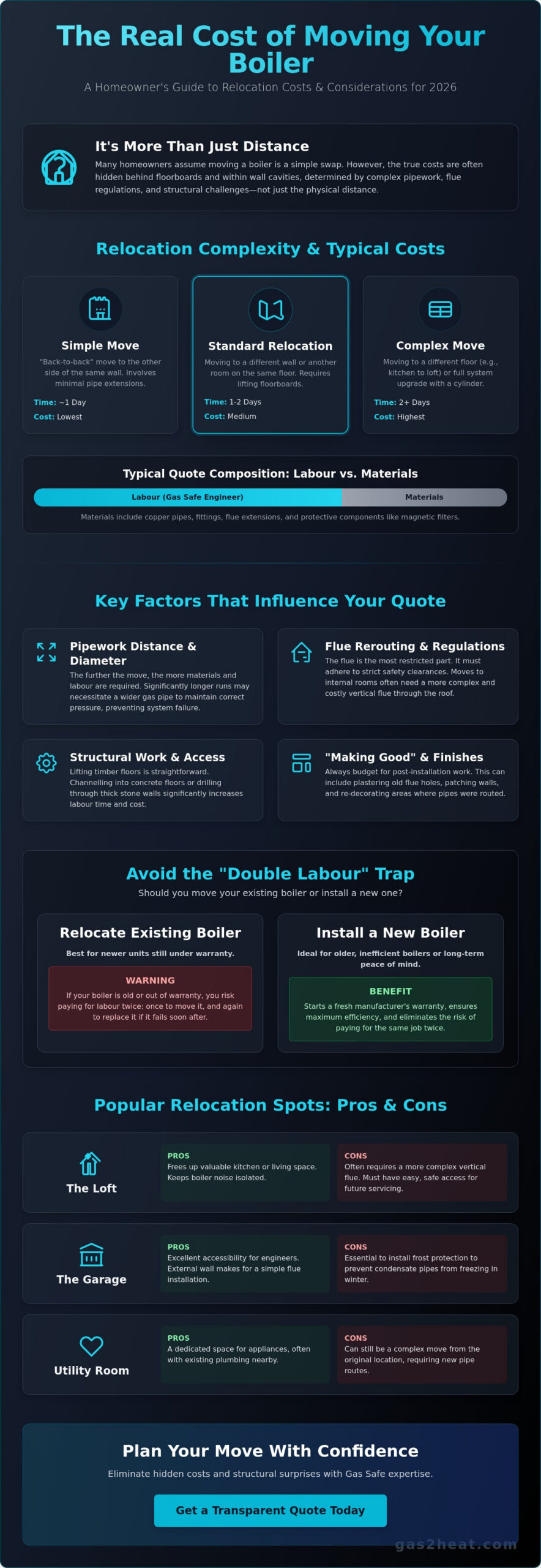
Relocating your heating system is rarely a “plug and play” task. The total cost to move a boiler to another room depends heavily on the complexity of the pipework and the distance from the original site. A simple “back-to-back” move, where the unit shifts to the opposite side of the same wall, requires minimal material. In contrast, a “cross-house” relocation involves lifting floorboards and routing new gas and water lines through the structural fabric of your home. Most standard relocation projects take between one and two days to complete. This timeline depends on how easily your engineer can access the necessary joists and wall cavities.
Typical Price Breakdown by Project Type
Project complexity is the primary driver of your final quote. Moving an existing combi unit to an adjacent wall represents the most straightforward scenario. This usually involves basic pipe extensions and a new flue hole. Relocating a boiler to a different floor, such as moving it from a kitchen up to a loft, increases the logistical challenge significantly. You must account for the vertical run of pipework and the potential need for specialized access to reach the external flue exit. If your project involves a full system upgrade with a cylinder relocation, expect a more intensive timeline as the engineer reconfigures the entire hot water distribution network.
Labour vs. Material Costs
Your quote is divided into two main categories: professional expertise and physical components. Gas Safe registered engineers in SW Scotland typically provide quotes based on the estimated hours required for safe decommissioning and re-installation. High-quality materials are non-negotiable for a reliable system. Standard kits include heavy-duty copper piping, specialized fittings, and flue extensions that must meet current safety standards. Modern condensing boiler systems are highly sensitive to debris, so we recommend including a magnetic filter and scale reducer in your plan. These components protect your heat exchanger from sludge buildup, potentially saving you from expensive repairs later. While these additions increase the initial material spend, they are essential for maintaining your manufacturer’s warranty and long-term efficiency.
Key Factors That Influence Your Relocation Quote
The total cost to move a boiler to another room is rarely a flat fee. It’s dictated by what we call the “path of least resistance.” Every meter of distance between the old and new location requires more than just extra copper. If you move the unit significantly further from the gas meter, your engineer might need to upgrade the entire gas pipe diameter to maintain the correct pressure. This technical necessity ensures your system operates safely and efficiently under full load. Ignoring pipe sizing can lead to hardware failure or safety shut-offs, so it’s a critical part of any professional quote.
Local architecture in SW Scotland brings its own set of challenges. In Moffat and Dumfries, many traditional homes feature thick stone walls that require heavy-duty core drilling. This process takes significantly longer than drilling through modern brick or breeze block. You should also consider lead times for local experts. During the colder months in Dumfries and Galloway, Gas Safe engineers are often in high demand. We recommend planning your move at least three to four weeks in advance to secure your preferred dates and avoid the rush.
Flue Rerouting and External Access
Your flue is the most restricted part of the installation. It must follow strict safety clearances from windows, doors, and neighbouring property boundaries. While a standard horizontal flue is the most cost-effective option, moving a boiler to an internal room or basement often necessitates a vertical flue kit. These kits exit through the roof and require specialized flashing to remain watertight. Every relocation must adhere to Building Regulations approval standards. These rules exist to prevent carbon monoxide from re-entering your home or bothering your neighbours.
Lifting Floors and “Making Good”
What lies beneath your feet changes everything. Timber floorboards are relatively simple to lift and replace, allowing for fast pipe routing. Concrete floors, however, are a different story. If pipes cannot be run through walls or ceilings, we may need to channel into the concrete or run pipes surface-mounted in trunking. This adds labour time and affects the aesthetic finish. You should also budget for “making good” once the work is done. While we take every precaution to be tidy, you might need a plasterer to patch old flue holes or a decorator to touch up paintwork. If you want to identify the most efficient route before you start, a professional boiler servicing visit can provide a clear view of your current pipework layout.
Relocating an Existing Boiler vs. Installing a New Unit
Deciding whether to relocate your current unit or start fresh is a pivotal financial choice. While the initial cost to move a boiler to another room might seem lower than a full replacement, you must consider the long-term value. If your boiler is over ten years old, it’s likely approaching the end of its reliable lifespan. Moving an aging appliance risks a “double labour” scenario. You pay for the relocation now, only to pay again for a new installation when the old unit inevitably fails a year or two later. It’s often more transparent and cost-effective to invest in a modern system during the renovation process.
Energy efficiency is the other major factor in this decision. Modern 2026 heating technology has advanced significantly. While older models might operate at 60% or 70% efficiency, new condensing units frequently exceed 90%. This reduction in monthly bills helps offset the cost of replacing a boiler over time. You aren’t just paying for a move; you’re investing in a more sustainable and reliable home heating network.
When Moving Your Old Boiler Makes Sense
Start with the age of your unit. A boiler under five years old usually justifies the move. If it still carries a manufacturer’s warranty, you’re protected against mechanical failure. However, you should check if the move voids that warranty. Some manufacturers require specific commissioning by a Gas Safe engineer after a relocation to keep the cover active. For budget-restricted projects where the current unit is already a high-efficiency model, moving it to a more convenient spot makes sense. This is especially true if the move is a short distance and allows for the reuse of existing pipework runs.
The Benefits of a Fresh Start
Opting for a new boiler installation alongside your move offers several strategic advantages. Engineers can design the new pipework layout specifically for the new unit. This often reduces the total labour hours compared to retrofitting an old boiler into a new space. You also gain access to extended 10 to 12 year warranties that provide total peace of mind for the next decade. When you combine the relocation and installation into one project, you eliminate the need for future disruption. You’ll have a brand new, highly efficient system in your ideal location with a single, clear service visit.
Popular Locations: Moving Your Boiler to a Loft, Garage, or Utility Room
Choosing the right destination for your unit is about balancing lifestyle benefits with technical reality. Most homeowners start this journey to reclaim valuable kitchen cupboard space. While this move transforms your kitchen layout, it introduces specific environmental factors that influence the total cost to move a boiler to another room. You must weigh the silence of a garage installation against the potential heat loss from longer pipe runs. Every choice affects your overall heating efficiency, so planning for insulation is vital. Noise is another major consideration. If you move a boiler to a wall shared with a bedroom, the late-night hum of the pump might become a nuisance you didn’t anticipate.
Loft Relocations: The Space-Saving Favourite
Moving a boiler to the loft is the ultimate way to hide your heating system. This location is popular in modern Dumfries developments, but it requires specific structural preparation. You can’t simply hang a boiler in an empty attic. Safety regulations require a stable environment, which usually involves:
- Secure Boarding: A solid walkway from the loft hatch to the boiler.
- Fixed Lighting: Permanent illumination for safe maintenance.
- Ladders: A safe, fixed method of access for engineers.
You also need a dedicated discharge pipe for condensation. Since gravity is on your side, this is usually straightforward, but you must ensure it won’t freeze in the winter. In taller properties, be aware that moving the boiler to the highest point can occasionally impact water pressure in downstairs taps. We recommend a pressure test before you commit to this location.
Garage and Utility Room Moves
Garages and utility rooms are excellent choices for keeping mechanical noise away from living areas. However, Scottish winters in Moffat and the surrounding rural areas demand extra precautions. If your garage isn’t thermally insulated, your pipework needs high-quality frost protection and thick lagging. Without this, you risk burst pipes during a cold snap. Rerouting the main gas supply to an outbuilding also adds to the labour time, as it often involves trenching or running high-level external pipes. On the plus side, these locations offer the easiest access for your annual boiler service. An engineer can work quickly in a spacious utility room without disrupting your daily kitchen routine. If you’re ready to reclaim your kitchen space, contact us for a transparent quote today.
Planning Your Boiler Relocation with Gas2Heat.com Ltd
Navigating the technical hurdles of a heating project requires more than just general trade skills. Local expertise in Moffat and Dumfries is essential for ensuring your system meets regional gas safety standards and handles the unique Scottish climate. We understand the structural nuances of local properties, from traditional stone cottages to modern developments. This specialized knowledge allows us to anticipate challenges before they become expensive problems. Our goal is to remove the stress of home maintenance through a process built on transparency and technical precision.
Disruption to your daily routine is a common concern during any renovation. We prioritize a clean, organized workspace to ensure your home remains functional throughout the project. Our team focuses on rapid fulfillment, meaning we work efficiently to restore your heating and hot water as quickly as possible. By choosing a local expert, you gain the reliability of a professional who values honesty and straightforward communication. We provide clear answers about the final cost to move a boiler to another room, ensuring you can plan your budget with total confidence.
The Gas2Heat.com Ltd Approach to Relocation
Every successful move starts with a detailed site survey. We don’t guess; we map out the most efficient pipe route to minimize structural impact. Our Gas Safe registered engineers verify that your chosen location complies with all current building regulations, from flue clearances to ventilation. If you’re looking to maximize your home’s comfort during the move, we can seamlessly manage an underfloor heating installation at the same time. This integrated approach ensures your entire heating network is optimized for performance and longevity from day one.
Get Your Fixed-Price Quote Today
Securing an accurate estimate shouldn’t be a slow or complicated process. We’ve streamlined our logistics to respect your time. You can start by providing photos of your current boiler, the proposed new location, and the external wall for the flue. This allows us to offer a rapid remote estimate and identify any immediate technical requirements. On the day of the move, our engineers arrive fully equipped to handle the decommissioning and re-installation with minimal fuss. We handle the paperwork, the safety certifications, and the final testing, leaving you with a perfectly positioned system. Don’t leave your home’s comfort to chance. Contact Gas2Heat.com Ltd for a bespoke relocation quote and take the first step toward a more efficient home today.
Secure Your Ideal Home Layout Today
Relocating your boiler is a strategic investment in your home’s functionality and comfort. You now understand how infrastructure pathing and specific room requirements influence the final project scope. Whether you’re reclaiming kitchen space or moving to a loft, prioritizing Gas Safe compliance ensures long-term safety and system performance. If your project is part of a larger home transformation, Bowkirk Kitchens & Bedrooms offers bespoke design services and flexible payment options to help you complete your vision. Getting a clear handle on the cost to move a boiler to another room allows you to plan your renovation without the fear of hidden structural expenses or unexpected delays.
Gas2Heat.com Ltd has been serving Moffat, Dumfries, and the wider SW Scotland area since 2017. Our approach focuses on transparent, benefit-first pricing that removes the guesswork from trade services. Our Gas Safe Registered Engineers provide the technical precision needed for a seamless transition. Request a fixed-price boiler relocation quote from Gas2Heat.com Ltd to secure your project dates. Transforming your living space is much simpler when you have a dependable, modern expert by your side. We look forward to helping you build a more efficient and organized home.
Frequently Asked Questions
How long does it typically take to move a boiler to another room?
Most boiler relocation projects take between one and two days to complete. A straightforward move to an adjacent wall might be finished in a single day, while a relocation involving different floors requires more time for floorboard lifting and pipe routing. We prioritize a brisk, purposeful pace to ensure your heating and hot water are restored as quickly as possible.
Do I need a building warrant to move my boiler in Scotland?
You typically don’t need a building warrant for a standard boiler relocation in Scotland, provided the work is carried out by a Gas Safe registered engineer. The installation must strictly comply with current Building Regulations regarding flue positioning and safety. We handle the necessary safety certifications and notifications to ensure your home remains fully compliant with all legal standards.
Will moving my boiler affect my water pressure?
Moving your boiler can impact water pressure if the new location is significantly higher than the original site, such as a loft relocation. This is particularly relevant in taller properties where the vertical lift might slightly reduce flow to downstairs taps. We perform a comprehensive pressure test during our site survey to ensure your chosen location won’t compromise your system’s daily performance.
Can I move a boiler myself if I am competent at DIY?
No, you cannot legally move a gas boiler yourself under any circumstances. In the UK, all work on gas appliances must be performed by a Gas Safe registered engineer by law. Attempting this as a DIY project is extremely dangerous and will immediately void your home insurance and any existing manufacturer warranty. Professional installation is the only way to ensure your family’s safety.
What is the cheapest place to move a boiler to?
The most cost-effective location is usually the opposite side of the current wall. This “back-to-back” move minimizes the need for extensive new pipework and structural alterations. Keeping the unit close to existing gas and water lines is the best way to reduce the overall cost to move a boiler to another room while still achieving your desired layout.
Is it better to move a combi boiler or a system boiler?
Moving a combi boiler is generally simpler because it doesn’t require a separate hot water cylinder or header tanks. System boilers involve more complex pipework networks to connect the unit to the storage tank. If you have a system boiler, you must decide whether to move the cylinder as well, which significantly increases the labour hours and material requirements for the project.
Does moving a boiler add value to my home?
Relocating a boiler often adds value by optimizing your home’s layout and reclaiming premium space in kitchens or utility areas. Modern buyers value “hidden” utilities that allow for open-plan living or additional storage. Combining a move with a new, energy-efficient installation further enhances your property’s appeal and can improve your overall Energy Performance Certificate rating.
What happens to the old holes in the wall after a boiler move?
Old flue holes and pipe exits must be professionally sealed to maintain your home’s weatherproofing and thermal insulation. We ensure all external holes are filled with matching brickwork or appropriate mortar. Internally, you should budget for minor plastering or decorative touch-ups to finish the space once the old unit and its associated pipework are removed.
