

Landlord Responsibilities for Boiler Breakdown in Scotland: 2026 Legal Guide
In Scotland, the phrase “reasonable time” for a boiler repair effectively means 24 hours when your tenant is left without heat or hot water. If you miss this window during a cold snap, you aren’t just dealing with a frustrated tenant; you’re risking a costly visit to the Housing and Property Chamber. Understanding landlord responsibilities for boiler breakdown Scotland is no longer just about basic maintenance. It’s about protecting your investment from Rent Relief Orders and legal tribunals in an increasingly regulated market.
It’s stressful to manage property standards when Scottish housing laws feel like a moving target, especially with the 2026 updates to the Repairing Standard and the commencement of Awaab’s Law. You want to provide a safe home without getting lost in technical jargon or struggling to find a reliable Gas Safe engineer in rural areas like Moffat. This guide will help you master these regulations so you can stay compliant and keep your tenants warm throughout the year.
You’ll learn about the specific temperature requirements for every room, the new five year validity rules for EPCs, and exactly how to secure a local expert for your Gas Safety Certificate or emergency repairs. We’ve simplified the legal landscape to give you total peace of mind and a clear path to compliance.
Key Takeaways
- Define the Repairing Standard under the Housing (Scotland) Act 2006 to ensure your property remains legally fit for habitation.
- Understand your landlord responsibilities for boiler breakdown Scotland, including why a total loss of heat is treated as an emergency requiring a 24-hour response.
- Learn the specific “Cold Home” standards that mandate fixed heating capable of maintaining 21°C in main living areas.
- Discover why the landlord is almost always responsible for repair costs and how to document your compliance to avoid Rent Relief Orders.
- Secure reliable local Gas Safe engineers for your CP12 and repairs to navigate the unique challenges of rural areas like Moffat and the Borders.
The Repairing Standard: Scottish Landlord Boiler Obligations
The Housing (Scotland) Act 2006 sets a clear benchmark for every rental property through the Repairing Standard. If you’re a landlord, this isn’t just a suggestion; it’s a legal obligation to ensure your property is fit for habitation. Central to these landlord responsibilities for boiler breakdown Scotland is the requirement to maintain all “fixtures and fittings for the supply of water, gas, electricity, and for space heating.” Because the boiler provides both heat and hot water, it’s considered a core fixture that must be kept in a state of good repair throughout the tenancy.
Your property must also be “wind and watertight” to meet the standard. While this often refers to the roof and windows, a failed heating system in the middle of a Scottish winter quickly leads to dampness and internal environmental issues. If you fail to meet these duties, tenants have the right to take the matter to the First-tier Tribunal for Scotland (Housing and Property Chamber). This body has the power to issue Repairing Standard Enforcement Orders, which can result in significant rent reductions or even criminal prosecution if the repairs aren’t completed as directed.
In addition to tribunal-enforced rent reductions, landlords must consider the risk of health-related legal claims. If a tenant’s wellbeing is compromised by a lack of heating, they may choose to learn more about their right to pursue a personal injury claim in Scotland.
Key Legislation: From 2006 to the 2024 Updates
Statutory guidance updated in March 2024 has significantly tightened the rules surrounding gas and heat supply. It’s no longer enough for a boiler to simply turn on. It must be in “proper working order,” meaning it operates efficiently and safely according to the manufacturer’s intent. This standard is deeply rooted in the evolution of Housing in Scotland and the Tolerable Standard, which defines the absolute minimum conditions for any home to be occupied. If your heating system cannot maintain specific temperatures or poses a safety risk, you’re likely in breach of both pieces of legislation.
The Landlord Gas Safety Record (CP12)
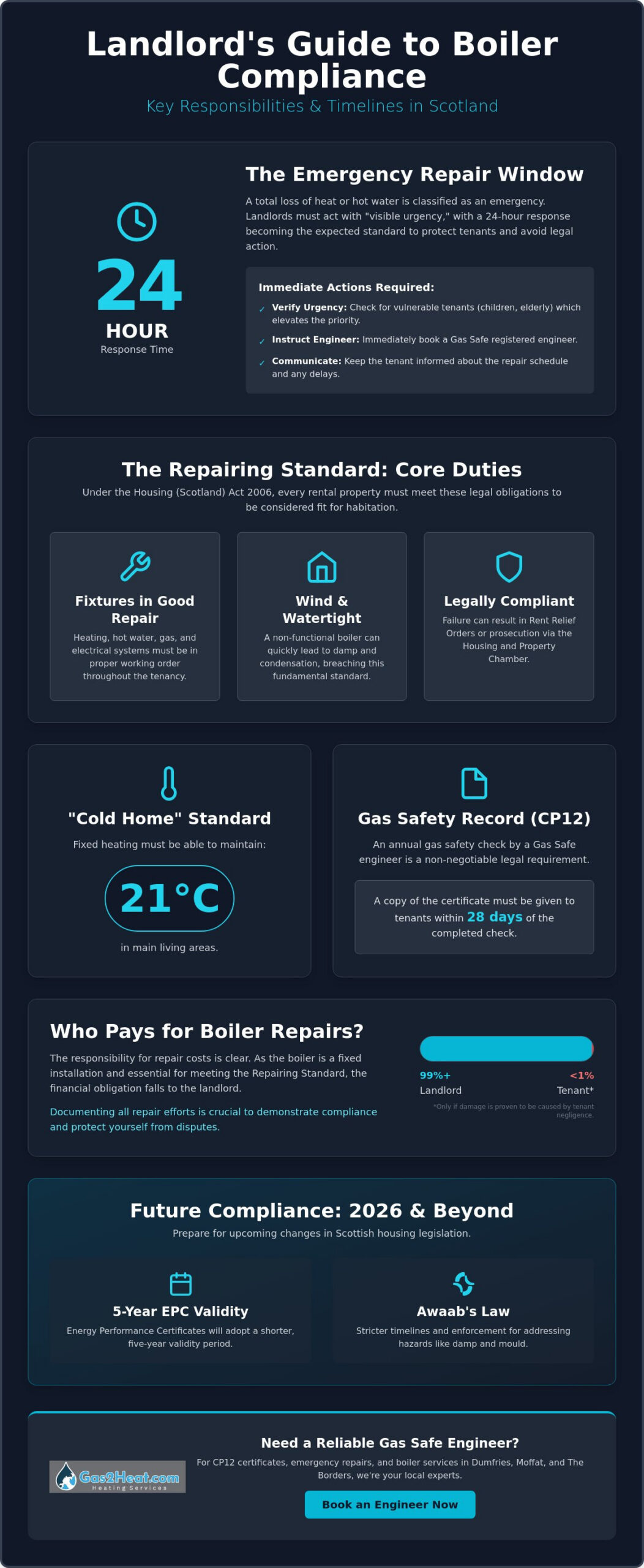
An annual gas safety check is your primary line of defense against legal disputes and safety failures. This inspection ensures all gas appliances are safe for continued use and identifies potential issues before they become emergencies. Once the check is finished, you must provide a copy of the Landlord Gas Safety Certificate to your existing tenants within 28 days. New tenants must receive a copy before they sign the lease. Keeping this paper trail updated is essential for fulfilling your landlord responsibilities for boiler breakdown Scotland and proving you’ve taken every reasonable step to protect your tenants.
The 24-Hour Rule: How Quickly Must You Fix a Boiler Breakdown?
In the grip of a Scottish winter, “reasonable time” shrinks significantly. While the law doesn’t explicitly state a 24-hour limit for every scenario, the industry standard and tenant expectations align around this window for emergencies. Total loss of heating or hot water is always classified as an emergency. It impacts the health and safety of your tenants directly. To remain compliant with The Repairing Standard: Scottish Government Guidance, you must act with visible urgency. Navigating landlord responsibilities for boiler breakdown Scotland requires a balance of speed and documentation.
Sometimes a fix isn’t instant. If a specific fan or circuit board is on backorder, you must still demonstrate proactive effort. Communicate clearly with your tenant. Provide alternatives. Your legal defense rests on your response speed and the steps you took to mitigate discomfort, not just the final resolution date. If you’re currently facing a system failure, you can book an emergency repair to get your property back to standard quickly.
Immediate Actions When a Tenant Reports a Breakdown
Follow these steps to manage landlord responsibilities for boiler breakdown Scotland effectively:
- Verify the emergency status: Ask if there are children, elderly residents, or vulnerable individuals in the property. This changes the legal definition of urgency.
- Instruct a Gas Safe registered engineer immediately: Don’t wait for the next business day. Promptly scheduling an inspection shows you’re fulfilling your duty of care.
- Provide temporary heating: If the repair will take longer than 24 hours, offer electric heaters to maintain safe temperatures. This keeps the property habitable while you wait for parts.
- Keep a written log: Document every phone call, email, and engineer visit. This is your evidence if a tribunal claim arises later.
When “Reasonable Time” Becomes a Legal Issue
The First-tier Tribunal for Scotland understands that rural locations in South West Scotland pose logistical challenges. However, they expect landlords to have a plan. Being in a remote area like Moffat isn’t an excuse for a week-long delay without a temporary solution. There is a clear difference between the timeline for a minor leak and a full system replacement. A replacement might take several days to organize, but you must provide interim heating to stay within the law. One of the best ways to avoid these high-pressure situations is to maintain a professional boiler service history. A well-maintained unit is far less likely to fail when the temperature drops.
EPC Ratings and the “Cold Home” Standard in 2026
In 2026, the Scottish rental landscape is shifting toward much stricter energy performance. While there’s currently no mandatory minimum EPC rating for private rentals, the Heat in Buildings Bill introduced in November 2025 has set a clear path forward. Landlords must prepare for a minimum standard of EPC Band C for new tenancies starting in April 2028. This isn’t just about paperwork. It’s a fundamental part of landlord responsibilities for boiler breakdown Scotland because an inefficient system makes it nearly impossible to meet the legal “Cold Home” requirements during a freeze.
A property is legally considered a “Cold Home” if the heating system cannot maintain a temperature of 21°C in at least one room and 18°C elsewhere when the outside temperature is -1°C. If your boiler is old or undersized, it might struggle to reach these targets. In these cases, even if the boiler is “working,” you could still be in breach of the Repairing Standard. Relying on thick jumpers and draft excluders won’t protect you from a tribunal if the fixed heating system isn’t up to the task.
Energy Efficiency as a Legal Requirement
The Scottish Government is using Energy Performance Certificates to ensure properties remain habitable and affordable to heat. A critical change arrives on October 31, 2026, when all new Scottish EPCs will have their validity reduced to five years. If you own an older property with an F or G rating, a boiler breakdown is a high-risk legal event. It often triggers an inspection that reveals wider efficiency failures. You can get ahead of these regulations by improving heating efficiency now, rather than waiting for a winter emergency to force your hand.
The Cost of Occupancy Test
Compliance isn’t just about the temperature on the thermostat; it’s about whether the tenant can afford to get it there. An inefficient, 20-year-old boiler might technically be capable of hitting 21°C, but if it costs the tenant an unreasonable amount in gas bills to do so, you may be violating “reasonable cost” occupancy rules. Old boilers are a liability because they fail the cost of occupancy test more often than modern, condensing models. The “Cold Home” standard is defined as a property’s inability to maintain a minimum internal temperature of 18°C when the external temperature drops to -1°C. Fulfilling your landlord responsibilities for boiler breakdown Scotland means providing a system that is both effective and economically viable for your residents.
Landlord vs. Tenant: Who Pays for Boiler Repairs?
Financial responsibility for a heating failure is a common point of friction. Under the Repairing Standard, your landlord responsibilities for boiler breakdown Scotland include a “non-delegable duty” to keep the system in good repair. This means you cannot pass the bill to your tenant for parts that have failed due to age or regular wear and tear. Even if your tenancy agreement contains a clause suggesting the tenant is responsible for maintenance, the law overrides this. You pay for the repair. It’s your asset and your legal obligation.
Tenants do have a role to play. They must report faults immediately to prevent further damage. If a tenant notices a drop in pressure or a strange noise and says nothing for weeks, they are failing their side of the agreement. However, proving that a tenant caused a breakdown is notoriously difficult. While you might feel frustrated if a tenant bleeds a radiator incorrectly and causes a pressure drop, the cost of a simple engineer visit is usually cheaper than a tribunal dispute. If your system has failed, book a professional boiler repair now to ensure the job is done safely and legally.
The Myth of Tenant Maintenance
You cannot contract out of your legal duties. Any lease clause that asks a tenant to pay for an annual service or a Landlord Gas Safety Certificate is legally void in Scotland. Safety is paramount. Allowing a tenant to attempt “DIY repairs” or hiring an uncertified handyman to save money is a massive risk. Every gas-related repair must be carried out by a Gas Safe registered engineer. If you allow an unregistered person to work on the boiler, you’re not just breaking the law; you’re potentially voiding your insurance and endangering lives.
Access Rights for Emergency Repairs
Gaining entry to the property can sometimes be a hurdle. For routine inspections or non-emergency repairs, the Private Residential Tenancy rules in Scotland require you to provide at least 48 hours’ notice. However, a total loss of heating in winter or a suspected gas leak constitutes a genuine emergency. In these cases, you have the right to enter the property immediately to prevent property damage or ensure safety. If a tenant repeatedly refuses access for essential safety checks, like your annual CP12, you must document these refusals. This evidence is vital if you need to apply to the First-tier Tribunal for an order to gain entry. Understanding these landlord responsibilities for boiler breakdown Scotland helps you act decisively when every hour counts.
Navigating Boiler Compliance in Dumfries, Moffat, and the Borders
Managing rental properties in South West Scotland requires more than just a legal checklist. It needs local expertise and boots on the ground. When you’re fulfilling landlord responsibilities for boiler breakdown Scotland, national call centres often fail to navigate the logistical challenges of the Borders. A local engineer understands the specific environmental factors of our region, from fluctuating water pressure in Moffat to the unique grid issues found in rural Dumfriesshire. Choosing a regional expert ensures your property remains compliant without the delays associated with out-of-town contractors.
Proactive planning is the only way to avoid the stress of a mid-winter emergency. In rural areas, a breakdown isn’t just an inconvenience; it’s a significant risk to your property’s habitability. Regular maintenance prevents small faults from becoming total system failures. If your current heating system is aging and becoming a financial liability, you can request a quote for a new boiler installation. This long-term investment helps you meet the upcoming 2028 EPC standards while providing your tenants with a reliable, efficient home.
Local Support for Moffat and Dumfries Landlords
Speed is everything when a tenant is without heat. Gas2Heat.com Ltd provides rapid response times for emergency boiler repairs throughout the Scottish Borders. We don’t just fix the immediate problem. We use our local knowledge to identify why the failure happened, whether it’s related to local water quality or specific infrastructure issues in SW Scotland. This insight helps you make informed decisions about your property portfolio and prevents recurring issues that could lead to tribunal disputes.
The Gas2Heat.com Ltd Landlord Safety Checklist
Compliance shouldn’t be complicated. We’ve streamlined our services to ensure you meet every aspect of your landlord responsibilities for boiler breakdown Scotland with a single point of contact. Our comprehensive safety checks protect your investment and your tenants. Our process includes:
- Annual Gas Safety Check (CP12): Completed by local Gas Safe registered experts who understand Scottish legislative nuances.
- Carbon Monoxide Alarm Verification: We test and verify the placement of detectors in every room with a carbon-fuelled appliance.
- System Health Checks: We identify potential wear and tear early to prevent expensive mid-winter breakdowns.
- Digital Record Keeping: Receive your certificates instantly to ensure you meet the 28-day tenant notification rule.
Don’t leave your property’s safety to chance. Secure your legal standing and protect your tenants with a team that knows the Dumfries and Galloway region inside out. Ensure your rental is compliant; book your Landlord Gas Safety Check with Gas2Heat.com Ltd today.
Secure Your Property and Stay Compliant
As a Moffat-based local family business, we understand the unique logistics of managing rentals in South West Scotland. Our Gas Safe Registered Engineers are specialists in Scottish Landlord Compliance, providing the rapid response and technical accuracy you need to stay ahead of regulatory shifts. Whether you need an annual certificate or an urgent system restoration, our team is ready to assist. Book an Emergency Boiler Repair or Gas Safety Check in South West Scotland and gain total peace of mind for your rental portfolio. We look forward to helping you keep your properties safe, warm, and fully compliant.
Frequently Asked Questions
Is a landlord responsible for a boiler breakdown in Scotland?
Yes, the landlord is legally responsible for all boiler repairs and maintenance. Under the Housing (Scotland) Act 2006, you must ensure the property meets the Repairing Standard, which includes keeping the supply of gas and space heating in proper working order. This is a non-delegable duty. You cannot pass these costs to the tenant through the lease agreement or contract out of your safety obligations.
How long does a landlord have to fix a boiler in Scotland?
You should aim to restore heating and hot water within 24 hours of a reported breakdown. While the law uses the term “reasonable time,” a total loss of these essential services is classified as an emergency. Fulfilling landlord responsibilities for boiler breakdown Scotland requires immediate action. If a permanent fix takes longer due to part availability, you must provide temporary electric heaters to keep the property habitable.
Can a tenant claim compensation for a broken boiler in Scotland?
Tenants can apply to the First-tier Tribunal for Scotland (Housing and Property Chamber) if repairs are delayed. The Tribunal has the power to issue a Rent Relief Order, which can reduce the rent by up to 90% until the boiler is fixed. In some cases, tenants may also be awarded compensation for extra electricity costs used for portable heaters or for the loss of enjoyment of the property.
What is the minimum temperature a landlord must provide in Scotland?
The heating system must be capable of maintaining 21°C in at least one room and 18°C in all other rooms when the outside temperature is -1°C. This is a specific requirement of the Repairing Standard. If your boiler is working but cannot reach these levels due to its age or inefficiency, you’re still in breach of your legal duties as a landlord.
Do I need a new gas safety certificate every year in Scotland?
Yes, you must arrange a Landlord Gas Safety Check (CP12) every 12 months. This is a strict legal requirement for any rental property with gas appliances. You must provide a copy of this record to your tenants within 28 days of the check. Failing to maintain an up-to-date certificate is a criminal offence and will prevent you from legally serving an eviction notice if needed.
Can I be fined for a broken boiler in a Scottish rental property?
You won’t typically face an immediate “fine” like a parking ticket, but the financial consequences are severe. If you ignore a Repairing Standard Enforcement Order, you can be charged with a criminal offence, leading to significant fines. Additionally, Rent Relief Orders can cost you thousands in lost income. Managing landlord responsibilities for boiler breakdown Scotland professionally is always the most cost-effective approach to property management.
What if my tenant refuses access for a boiler repair?
Document every attempt to gain access in writing. While you usually need to give 48 hours’ notice, you can enter the property without consent in a genuine emergency, such as a gas leak or a burst pipe. If the tenant continues to block a non-emergency repair or safety check, you should apply to the First-tier Tribunal. They can grant an order that legally allows you access to the property.
Does the Repairing Standard apply to all types of Scottish tenancies?
The Repairing Standard applies to almost all private residential tenancies in Scotland. This includes traditional leases, the modern Private Residential Tenancy (PRT), and most agricultural tenancies. It ensures that every tenant has a basic right to a safe, warm, and dry home. If you’re unsure if your specific arrangement is covered, it’s safer to assume the standard applies and maintain your boiler accordingly.
