
Setting Up Hive Thermostat for Efficiency: The 2026 Homeowner’s Guide
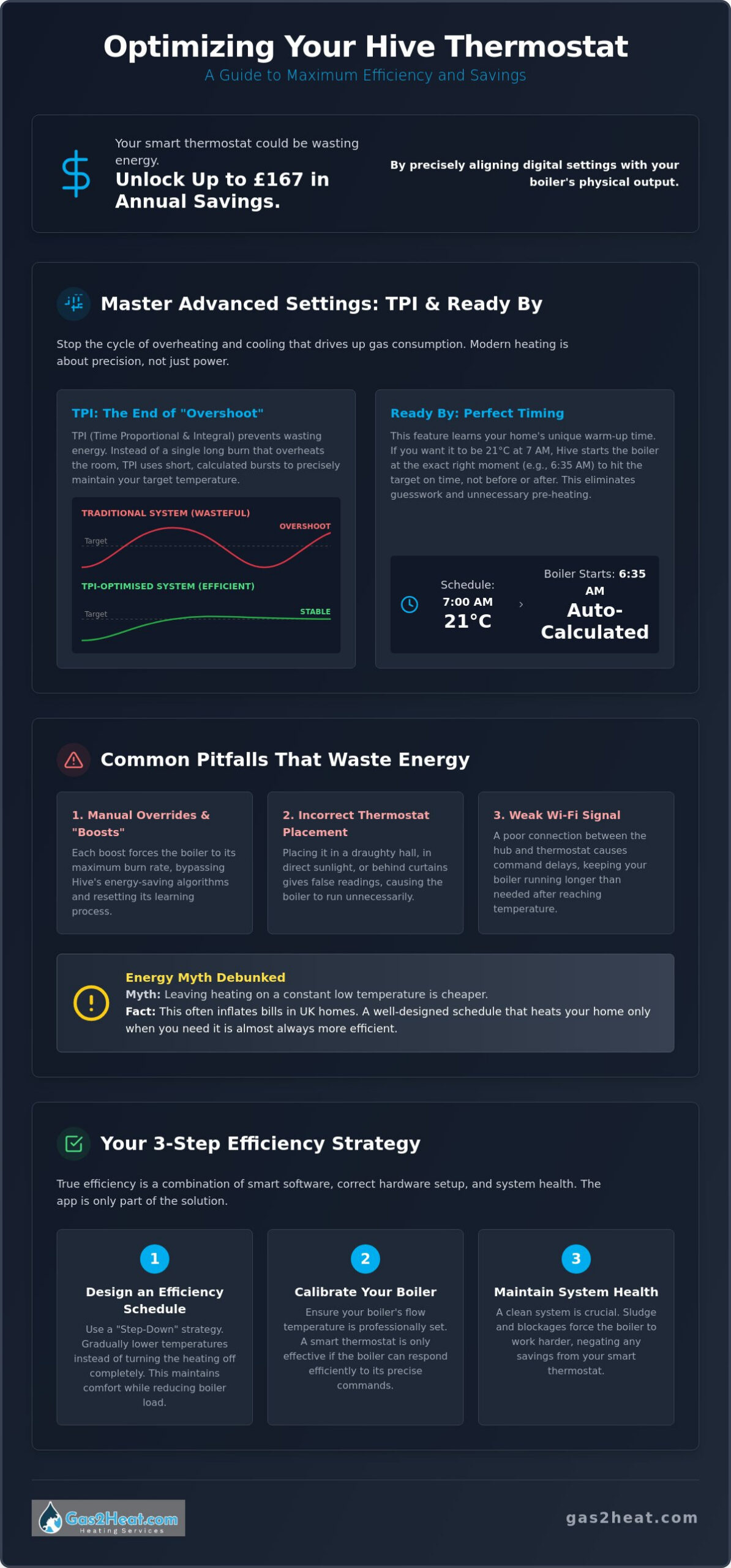
Your Hive thermostat is likely the smartest piece of tech in your home, but it could still be costing you hundreds of pounds in wasted energy every year. Many homeowners find that despite having the latest v15.3 app, their rooms are cold when they need them or their bills remain stubbornly high. Setting up Hive thermostat for efficiency requires more than just a basic schedule; it demands a precise alignment between your digital settings and your boiler’s physical output.
We understand the frustration of smart tech that feels anything but intelligent when you’re staring at a confusing TPI setting or a cold radiator. You deserve a home that’s warm exactly when you want it without the financial sting. This guide promises to clear the confusion by showing you the exact configurations and “Ready By” strategies used to unlock up to £167.12 in annual savings.
We will walk you through the essential 2026 updates, including how to calibrate your system for the latest Boiler Plus flow temperature standards. You’ll gain the confidence to manage your heating like a professional, ensuring your system is fully optimised for both comfort and cost.
Key Takeaways
- Master the “Ready By” and TPI settings to ensure your home reaches the perfect temperature without wasting energy on overshoot.
- Implement the “Step-Down” strategy to transition temperatures gradually, maintaining comfort while reducing the load on your boiler.
- Learn why leaving your heating on a constant low temperature is a myth that often inflates energy bills in UK homes.
- Discover why setting up Hive thermostat for efficiency is only effective when paired with professional boiler calibration and a clean system.
- Optimise your scheduling specifically for the SW Scotland climate to balance warmth with significant monthly savings.
Understanding the Hive Efficiency Ecosystem
Efficiency is not just about turning your heating on from your phone while you are at the supermarket. True smart heating is about data-driven heat management. It is the difference between simple remote access and deep system optimisation. When you look at what a smart thermostat is in a modern context, it becomes clear that the device acts as a manager rather than a simple switch. It doesn’t just toggle power; it calculates the most cost-effective way to reach your desired comfort level.
For homeowners in SW Scotland and Cumbria, this distinction is vital. Our local climate in places like Dumfries and Moffat is famously unpredictable. One hour brings a biting wind off the Solway Firth, and the next brings mild, damp air. Hive is effective here because it can react to these rapid shifts. Setting up Hive thermostat for efficiency means allowing the system to use its internal logic to decide how hard your boiler needs to work to combat the external temperature.
The Hive Hub acts as the central brain of this operation. It creates a bridge between your home Wi-Fi and the physical components of your heating system. While “control” allows you to flick a switch from your desk, “optimisation” ensures you use the least amount of gas possible to achieve the same level of warmth. It focuses on the “how” of heating, not just the “when.”
The Components of an Efficient System
Your system relies on a constant dialogue between the thermostat and the receiver. The thermostat measures the air, but the receiver tells the boiler to fire. If your internet connection is unstable, you lose the real-time data that drives efficiency. Placement is the most common error we see in local homes. If you place your thermostat in a draughty hallway or behind thick curtains, the sensor will provide false readings. This causes the boiler to run for longer than necessary, wasting fuel to heat a room that is already warm. Always aim for a neutral internal wall away from direct sunlight and heat sources.
The “Set and Forget” Misconception
Manual overrides are often the biggest drain on your bank account. Every time you “boost” the heating, you force the boiler to work at its maximum burn rate. This bypasses the energy-saving algorithms Hive uses to maintain steady temperatures. Setting up Hive thermostat for efficiency requires patience. The Hive algorithm needs several days to learn your home’s thermal profile. It calculates exactly how long your specific insulation takes to retain heat. Constant manual changes reset this learning process. Additionally, ensure your signal strength is high. A weak connection between the hub and thermostat leads to command latency. This delay can keep your boiler running for several minutes after the target temperature is reached, leading to unnecessary gas consumption.
Mastering Advanced Settings: TPI and Ready By
Most homeowners treat their thermostat like a light switch. They think it is either on or off. While old-fashioned dial thermostats worked this way, setting up Hive thermostat for efficiency requires a shift in mindset. Modern heating is about precision and modulation. When your system is correctly configured, it stops acting like a blunt instrument and starts acting like a fine-tuned engine. This is essential for modern condensing boilers, which are designed to run at lower temperatures to remain in their most efficient state.
The goal is to ensure your hardware and software work in harmony to deliver energy savings that reflect the latest 2026 standards. By mastering two specific features—TPI and Ready By—you can stop the cycle of overheating and cooling that drives up gas consumption. If you are unsure if your boiler is physically capable of these smart commands, a professional smart thermostat installation can ensure your hardware is fully compatible.
How TPI Prevents Energy Waste
TPI stands for Time Proportional and Integral. It is the secret weapon against “overshoot.” In a traditional system, if you set the temperature to 21°C, the boiler runs until the air hits that mark and then shuts off. However, your radiators are still full of scorching water. This residual heat continues to warm the room, often pushing the temperature to 23°C or higher. You have effectively paid for two degrees of heat that you didn’t actually want.
TPI solves this by learning how fast your home warms up. As the room temperature approaches your target, TPI begins to fire the boiler in shorter, calculated bursts rather than one long burn. TPI is a digital pulse-width modulation for home heating. This keeps the temperature on a steady line rather than a jagged peak, saving significant amounts of gas. This is particularly important under the 2026 Boiler Plus updates, which mandate a default low-temperature factory setting of 60°C for new combination boilers.
Optimising “Ready By” for Your Routine
The “Ready By” feature is the opposite of a traditional timer. Instead of telling the boiler when to start, you tell Hive when you want the house to be warm. If you want your kitchen at 19°C by 7:00 AM, Hive calculates the start time for you. On a mild Dumfries morning, it might start at 6:40 AM. On a freezing Scottish winter morning, it might start at 6:10 AM.
This prevents energy waste by ensuring the boiler never runs a minute longer than necessary. A common mistake is setting the target time too early “just in case.” Trust the algorithm. It uses historical data from your specific home to determine the exact thermal response of your walls and insulation. By setting up Hive thermostat for efficiency using Ready By, you avoid the habit of “boosting” the heat manually, which is one of the least efficient ways to run a modern heating system.
Designing the Perfect Efficiency Schedule for Scottish Winters
Winters in SW Scotland and Cumbria present a unique challenge. The biting dampness of the Solway Firth and the sharp frosts in the Moffat hills mean your heating works harder than in the south. A generic schedule often fails here. Setting up Hive thermostat for efficiency in this climate requires a “Step-Down” strategy. Instead of a hard shut-off at bedtime, which allows the fabric of older stone buildings to become cold and damp, you should lower the temperature gradually. This prevents the boiler from having to work at maximum capacity to recover the lost heat the next morning.
Every degree matters. Industry data suggests that dropping your thermostat by just 1 degree can lead to a 10% saving on your annual energy bill. For a typical family home, this is a significant financial return for a five-second adjustment in the app. Aim for active hours at 18 to 20°C and sleep hours at 15 to 16°C. This maintenance temperature is high enough to prevent condensation in your walls but low enough to stop the meter from spinning unnecessarily.
The 5-Step Scheduling Framework
Efficiency is built on consistency. Use this framework to build your 2026 schedule:
- Step 1: Identify Anchor Times. These are the non-negotiable periods when the house must be warm, such as 7:00 AM for the school run.
- Step 2: Set Maintenance Temps. Never let your home drop below 15°C. This protects against damp and ensures the boiler stays in its high-efficiency condensing mode when it does fire up.
- Step 3: Use the “Copy Day” Feature. Don’t overcomplicate things. Use the copy function for your standard work week to ensure you don’t have stray “on” periods during the day.
- Step 4: Calibrate for the Weekend. If you spend Saturdays at the coast or visiting Dumfries, create a separate profile that reflects your reduced presence at home.
- Step 5: Activate Holiday Mode. If you are away for more than 24 hours, use this feature. It suspends your schedule but keeps the frost protection active.
Leveraging Geofencing and Hive Actions
Geofencing is a game-changer for homes in Moffat and surrounding rural areas. It uses your phone’s GPS to detect when you’ve left the house. If you forget to turn the heating off, Hive sends a notification or does it for you. This prevents you from heating an empty house while you are at work or shopping.
While you are out, having the same peace of mind for your vehicle is essential; Safe & Sound Mobile provides nationwide installation of advanced vehicle security and audio systems, ensuring your car is as well-protected as your smart home.
You can also set up “Actions” within the app. If you have Hive door sensors, you can create an action that turns the heating off if the front door is left open for more than two minutes. Finally, always ensure the “Shield” feature is active. This is Hive’s built-in frost protection. It automatically fires the boiler if the internal temperature drops below 7°C, protecting your pipes during a severe Dumfries frost without you having to lift a finger. Setting up Hive thermostat for efficiency isn’t just about the app; it’s about these automated layers of protection.
Common Pitfalls That Waste Energy in Local Homes
You might have heard that keeping your heating on at a constant 18°C all day is the cheapest way to run a home. In the UK, this is almost always a myth. Unless your property is built to modern “Passive House” standards with extreme insulation, your home is constantly losing heat through the walls and roof. Keeping the heating on all day simply means you are paying to replace that lost heat for 24 hours straight. Setting up Hive thermostat for efficiency means using schedules to heat only when necessary. If your house is empty, your boiler should be off.
Traditional Scottish properties present a unique hurdle: thick stone walls. These structural features are excellent for character but terrible for wireless signals. Hive components communicate using a protocol called Zigbee. In a large or old-fashioned home, these signals can struggle to penetrate granite or sandstone. This leads to “offline” devices and erratic heating cycles. If your thermostat loses connection, it may fail to send the “off” command to your boiler, leading to hours of wasted gas. Placing your Hive Hub in a central, open location is the first step to preventing this digital lag.
The Battle of Thermostat vs. Radiator Valves
A common error when setting up Hive thermostat for efficiency is ignoring the manual Thermostatic Radiator Valves (TRVs) already on your radiators. If your Hive thermostat is set to 20°C but the manual TRV in that same room is set to “2,” the radiator will shut off before the room reaches the Hive’s target. Your boiler will continue to fire, trying in vain to heat a room that has been physically throttled.
To fix this, ensure the TRV in the room with your wall thermostat is set to “Max” or “5.” This allows the Hive to be the sole commander of that space. For the ultimate level of control, upgrading to Hive Radiator Valves allows you to set different temperatures for every room. This prevents you from heating the guest bedroom to 21°C just because you want the lounge to be warm. If your radiators are slow to react even after adjusting the valves, it may be time to book a professional boiler servicing to clear out system sludge and restore flow.
Physical Barriers to Digital Efficiency
Digital efficiency is often undermined by physical neglect. If your thermostat is hidden behind a sofa or caught in a draught from an old sash window in Annan, it will give the hub false data. A thermostat trapped behind a curtain will think the room is 25°C because of the trapped heat, while you sit shivering in the middle of the lounge.
Battery maintenance is another overlooked factor. When batteries in the thermostat or TRVs run low, they don’t just stop working. They often become sluggish, delaying commands to the boiler. We see many homeowners using cheap, zinc-carbon batteries to save a few pence. These batteries leak and provide inconsistent voltage. Always use high-quality alkaline batteries to ensure your Hive system can execute its efficiency algorithms without interruption. A small investment in the right batteries can save you pounds on your monthly gas bill.
Beyond the App: Boiler Health and Professional Calibration
A smart thermostat is a powerful tool, but it is not a magician. Even the most advanced software cannot compensate for mechanical failure or a poorly maintained heating system. Think of your Hive system as a highly intelligent brain. If that brain is attached to a “broken body”, such as a sludgy or unserviced boiler, the results will always be disappointing. Setting up Hive thermostat for efficiency is a two-part process. You must configure the digital settings, but you must also ensure the physical hardware is capable of executing those commands.
There is a direct link between improving heating efficiency and the quality of your smart controls. A boiler struggling with internal debris or worn-out parts will use more gas to reach the same temperature, regardless of what the app says. Regular boiler servicing ensures that when Hive tells the boiler to fire in a short, efficient burst, the boiler responds instantly. Without this calibration, you are simply putting a high-tech remote on a low-efficiency machine.
Why Professional Installation Matters
Many homeowners attempt a DIY install, but they often miss the critical technical nuances that drive ROI. A Gas Safe engineer ensures the receiver is correctly wired for TPI or OpenTherm. These protocols allow the thermostat to talk to the boiler in a more sophisticated language than just “on” or “off.” We also verify signal strength across your entire property. Large Dumfries and Galloway floorplans often have “dead zones” where the hub and thermostat lose touch. A professional setup identifies these gaps early, ensuring your setting up Hive thermostat for efficiency journey isn’t cut short by connectivity drops. We provide custom calibration based on your specific boiler model, ensuring the two devices work as a single, cohesive unit.
Annual Maintenance: The Final Efficiency Piece
Smart technology works significantly faster when the water in your pipes is clean. Techniques like power flushing remove the magnetic sludge that slows down heat transfer. When your radiators are clear, they warm up quicker. This allows the Hive “Ready By” feature to be even more accurate, as it doesn’t have to fight against system blockages.
The return on investment for combining smart tech with a healthy heating system is clear. You get lower bills, a longer boiler lifespan, and a home that stays warmer for longer. Ready to optimise? Book a professional Hive calibration with Gas2Heat.com Ltd and ensure your system is truly ready for the winter ahead.
Secure Your Long-Term Energy Savings
Achieving maximum performance from your smart tech requires more than just a well-designed app schedule. It involves synchronising your digital commands with the physical reality of your boiler and the local climate. By mastering TPI settings and avoiding common placement errors, you move beyond basic control into true system optimisation. Setting up Hive thermostat for efficiency is the first step toward a warmer, more cost-effective home.
The most successful systems are those calibrated by experts who understand the unique demands of Dumfries and Moffat properties. As a local Moffat-based family business, Gas2Heat.com Ltd combines regional expertise with professional certifications to ensure your smart home integration actually delivers. Our Gas Safe Registered Engineers are specialists in smart home installation, focusing on the technical alignment that DIY setups often miss. Optimise your home heating with Gas2Heat.com Ltd today and enjoy the peace of mind that comes from a perfectly tuned system. You deserve a home that works for you, not against your bank account.
Frequently Asked Questions
Does Hive TPI actually save money on gas?
Yes, TPI saves money by reducing the frequency of high-intensity boiler burns. Instead of one long, expensive cycle that causes your room to overshoot the target, TPI uses short pulses of heat to maintain a steady line. This precision prevents you from paying for heat you don’t actually need, which is a core part of setting up Hive thermostat for efficiency in any modern home.
What is the most efficient temperature to set Hive at night?
The most efficient night setting for a typical UK home is between 15°C and 16°C. While some believe turning the heating off entirely is better, a maintenance temperature prevents the fabric of your home from cooling down too much. This makes it significantly easier and cheaper for your boiler to bring the house back up to comfort levels in the morning without overworking.
How does Hive Geofencing work to save energy?
Geofencing uses your phone’s GPS location to create a virtual boundary around your property. When you cross this boundary, Hive detects you’ve left and sends an alert to turn the heating off or lower the temperature. This prevents energy waste if you have a change of plans or forget to adjust your schedule before leaving for work in Dumfries or Moffat.
Why is my Hive thermostat not reaching the target temperature?
If your Hive isn’t hitting the target, the issue is often physical rather than digital. Check that your radiator valves aren’t throttled and that the thermostat isn’t in a draughty spot. If these are fine, the culprit is likely system sludge or a poorly calibrated boiler link. Professional servicing can resolve these flow issues to ensure your smart commands are actually executed.
Can Hive control my underfloor heating efficiently?
Hive can control underfloor heating, but it requires a specific installation path to manage the slower thermal response of floor loops. Unlike radiators, underfloor systems take longer to warm up and cool down. A specialist can ensure your Hive is configured to account for this lag, providing a seamless and efficient experience that avoids the energy spikes common with manual floor controls.
Should I leave Hive on “Schedule” or “Manual” for best results?
You should always use “Schedule” mode for the best results. Manual mode encourages “boosting,” which forces the boiler to run at its least efficient maximum rate. A well-designed schedule uses the Hive algorithm to predict heat loss, ensuring you only use gas when it’s absolutely necessary to maintain your desired comfort levels throughout the day.
How often should I change the batteries in my Hive thermostat?
You should change your Hive thermostat batteries every 12 to 18 months. Low battery voltage causes communication delays between the thermostat and the boiler receiver, which can lead to inefficient firing cycles. Always use high-quality alkaline batteries rather than rechargeable ones to ensure the signal remains strong through thick traditional Scottish walls.
Does Hive work with older boilers in SW Scotland?
Hive is compatible with the vast majority of older gas boilers found in SW Scotland. While older models might not support advanced modulation like OpenTherm, the Hive receiver can still manage the on/off cycles much more accurately than an old dial thermostat. Setting up Hive thermostat for efficiency on an older boiler is one of the fastest ways to modernise an aging heating system.
