
No Hot Water from Boiler in Moffat? Why Low Pressure is Often the Culprit
Imagine waking up on a crisp morning in the Southern Uplands only to find your shower running ice-cold. It is a stressful and immediate problem when there is no hot water from boiler Moffat units, especially when you are worried about expensive emergency call-out fees or confusing technical error codes. You aren’t alone in this frustration. Many homeowners assume a lack of heat means a total system failure, but the reality is often a simple mechanical adjustment that you can identify quickly.
We understand that a cold house during a harsh winter creates immediate anxiety for your family’s comfort and safety. This guide will help you diagnose low boiler pressure, troubleshoot the root cause of your hot water loss, and safely repressurise your system today. We will walk you through the vital difference between a minor top-up and a professional repair. You will learn how to stay compliant with the 2026 Gas Safe regulation updates regarding DIY maintenance limits while restoring your heating and peace of mind immediately. By the end of this article, you will know exactly if your boiler is broken or if it just needs a straightforward pressure boost.
Key Takeaways
- Learn to identify if low pressure is the reason there is no hot water from boiler Moffat units by checking if your gauge falls below the 1.0 bar “Goldilocks Zone.”
- Understand the common causes of pressure drops, including how local seasonal shifts in Dumfries & Galloway can impact your heating system’s performance.
- Master the safe, step-by-step method for using a filling loop to repressurise your boiler and restore your hot water immediately.
- Discover why frequent manual top-ups are a warning sign of underlying leaks that could lead to internal sludge and expensive system damage.
- Gain peace of mind by knowing exactly when a simple DIY fix is enough and when professional Gas Safe expertise is required for your safety.
How to Tell if Low Pressure is Killing Your Hot Water
Finding there is no hot water from boiler Moffat systems is often a sign of a safety lockout rather than a mechanical breakdown. Your boiler operates as a sealed unit, maintaining a specific balance of water and air to move heat around your home. To understand the mechanics, it helps to start with the basics of What is a boiler? and how it uses pressure to function. When the water level drops, the pressure falls, and the system shuts down to prevent internal damage.
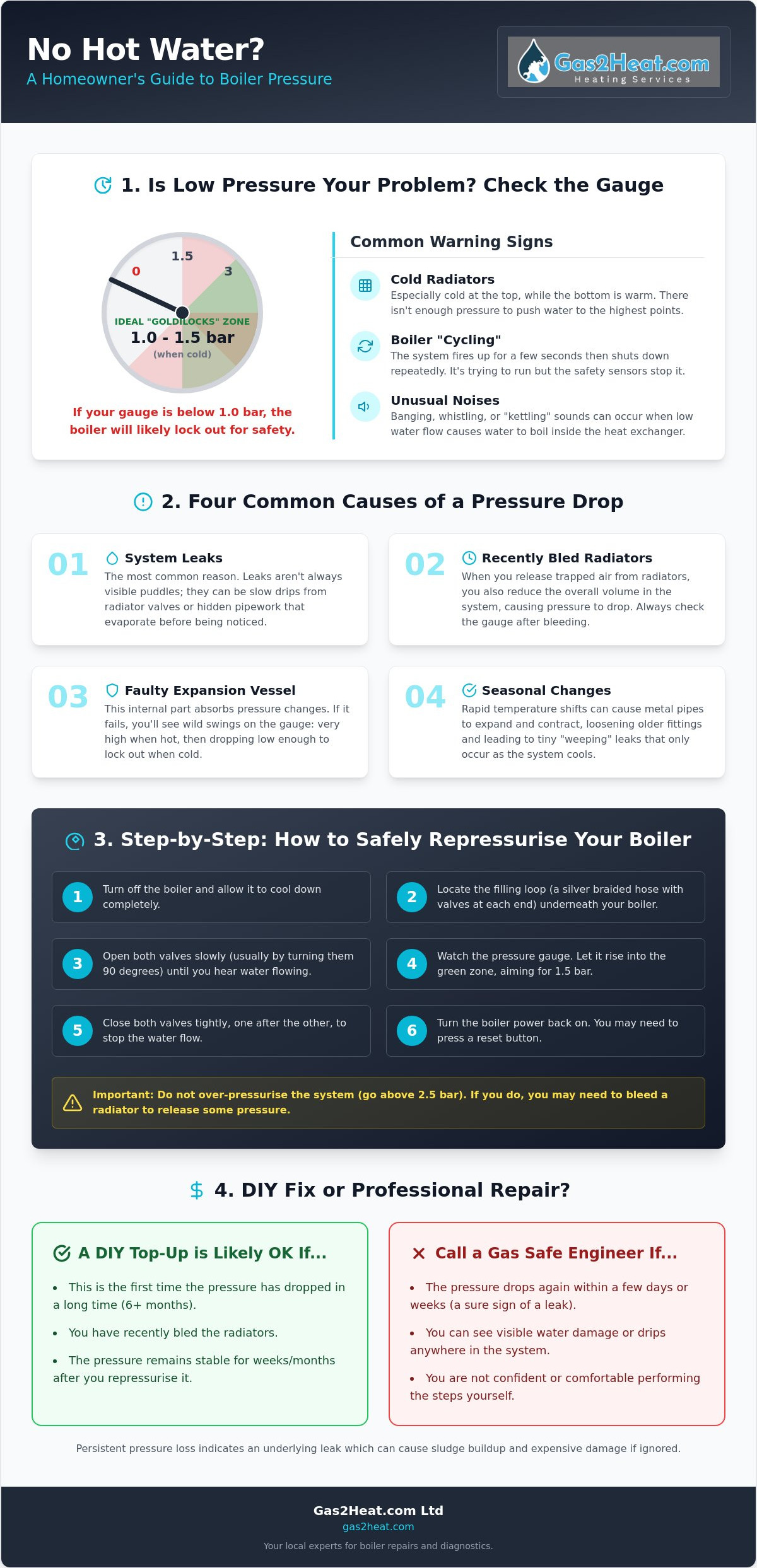
In 2026, the standard “Goldilocks Zone” for a cold boiler is between 1.0 and 1.5 bar. This range ensures there is enough force to push water to your furthest radiators and through the heat exchanger for your taps. If your gauge sits below 1.0, the internal sensors will likely trigger a lockout. This is a protective measure. It stops the burner from firing when there isn’t enough water to absorb the heat, which prevents the metal components from melting or cracking.
Reading Your Pressure Gauge: Analogue vs. Digital
You can usually find your pressure gauge on the front or underside of the boiler casing. Older models feature a hydraulic needle gauge. On these dials, the needle should point to the green section. If it’s in the red zone near zero, your system needs more water. Conversely, a needle pointing toward 3 bar indicates over-pressurisation, which is its own set of problems.
Modern boilers in Moffat often use digital LCD displays instead of physical needles. These screens might not show a bar reading at all times. Instead, they display specific error codes like F22 or E119 when the pressure drops too low. A common confusion for homeowners using smart thermostats is that these apps don’t always report the specific pressure fault. You might see a generic “Heating Offline” message on your phone, but the real answer is waiting on the boiler’s own display panel. Always check the physical unit before assuming your thermostat is broken.
Symptoms of a Low-Pressure Lockout
Before your boiler shuts down completely, you might notice subtle warning signs. Radiators often fail to heat up at the top first, or they might stay stone cold while the boiler appears to be “running.” This happens because there isn’t enough pressure to overcome gravity and push water into the higher parts of the system.
You might also experience “cycling,” where the boiler fires up for a few seconds and then shuts off rapidly. This is often accompanied by strange banging or whistling noises, known as kettling. These sounds occur because small amounts of water are essentially boiling into steam inside the heat exchanger due to low flow. If you hear these noises or find your hot water is intermittent, check your pressure immediately to avoid a total lockout during a cold Moffat night.
4 Common Culprits Behind a Pressure Drop in Moffat
Pressure loss is rarely a normal part of your heating system’s operation. If your gauge keeps falling, it almost always indicates that water is escaping somewhere. This loss of volume is a primary reason you might find no hot water from boiler Moffat units during the colder months. While some people believe they should top up their boiler every few weeks, a healthy, sealed system should ideally hold its pressure for an entire year between services.
The Southern Upland climate plays a significant role in system stability. Rapid temperature shifts during a Moffat winter cause the metal pipes and joints in your home to expand and contract. This physical movement can loosen older fittings, leading to “weeping” joints that only leak when the system is cooling down. Additionally, many homeowners forget that bleeding radiators removes air and reduces the overall pressure. You must always check your gauge and top up the water level immediately after venting any air from your radiators.
Owners of mobile homes or caravans in the area face similar challenges with seasonal temperature shifts affecting water systems; for specialized maintenance of these leisure systems, leisurevan.co.uk provides comprehensive mobile servicing to keep your vehicle winter-ready.
A steady bar level also depends on your expansion vessel. This internal component contains an air cushion that absorbs the increased volume of water as it heats up. If this cushion perishes or loses its charge, the pressure will spike rapidly when the heating is on and then plumet when it cools, often resulting in a total system lockout. If you notice these wild swings, it is time to book a professional boiler repair to prevent further damage.
System Leaks: The Most Common Culprit
Leaks are not always obvious puddles on the floor. Many occur behind radiator valves or within floor-level pipework where the water evaporates before it can stain the carpet. You should also check the Pressure Relief Valve (PRV) discharge pipe, which usually pokes through your external wall. If this pipe is dripping, it means the valve is either faulty or reacting to a pressure spike. Even a tiny pinhole leak can drop your system from 1.5 bar to zero over a 24-hour period.
Component Failure: Expansion Vessels and Valves
Internal component failure is a frequent issue in older Moffat properties. A faulty pressure sensor can give false low readings, causing the boiler to shut down even if the water level is technically fine. Furthermore, the internal diaphragms in expansion vessels can fail over time. When this happens, the system has no way to handle the expanding hot water, forcing the safety valve to open and dump water out of the system.
Weather Factors: Frozen Condensate Pipes
Moffat’s freezing winters present a unique challenge: the frozen condensate pipe. When the external waste pipe freezes, the boiler cannot discharge the liquid produced during the combustion process. This backup often triggers an error code that mimics low-pressure symptoms, leading to a complete lockout. If you suspect this is the case, follow our specific guide on fixing a frozen boiler condensate pipe in Moffat. Staying compliant with the Gas Safety Regulations is vital, so always ensure external pipework is properly insulated to avoid these recurring 2026 winter issues.
Step-by-Step: How to Repressurise Your Boiler Safely
If you’ve confirmed your gauge is in the red, repressurising is the fastest way to fix the issue of no hot water from boiler Moffat units. It’s a task most homeowners can handle safely if they follow a logical sequence. Before you touch any valves, turn the boiler power off at the fused spur. The system must be stone cold. Handling a hot system is dangerous and can lead to inaccurate pressure readings, as water expands when heated. Following official Gas Safe Register boiler guidance ensures you maintain your system without compromising safety or your warranty.
Look for the filling loop first. It’s usually a silver, flexible braided hose located directly underneath the boiler casing. This hose connects your main cold water supply to the central heating circuit. Many modern setups have this permanently attached, but some older systems require you to screw it on manually at both ends. Ensure the connections are finger-tight to avoid a mess on your floor. If the hose is missing, check nearby cupboards or the top of the boiler casing where it might have been stored by a previous engineer.
Use the “Double Valve” technique to introduce water. Most loops have two small black lever valves or slotted taps. You need to open both to allow water to flow. Open the first one fully, then slowly turn the second. You’ll hear a distinct hissing sound as water enters the system. Watch the gauge closely. You want to reach exactly 1.5 bar. Do not exceed this. Over-pressurising can stress your pipework and trigger the pressure relief valve, which often leads to persistent drips or a repeat of the lockout later.
Instructions for External Filling Loops
Attach the filling loop securely if it isn’t already a permanent fixture. Once the connections are tight, open the valves slowly and listen for the water flow. Keep your eyes fixed on the pressure gauge throughout the process. As soon as the needle hits the 1.5 bar mark, close both valves firmly. It’s best to do this in small bursts to avoid overshooting the target. Once finished, remember to disconnect the loop if it’s the removable type to comply with local water regulations.
What if You Have an Internal Filling Key?
Certain boiler designs, particularly some older units, feature an internal plastic filling key instead of a silver hose. To use this, you must insert the key into the dedicated port on the underside of the boiler. Turn the key to the ‘locked’ position, then move the adjacent white lever to start the water flow. Be extremely gentle. These plastic keys can snap if forced. If the key is stuck or starts leaking during the process, stop immediately and seek professional help from a qualified engineer such as those at Gas2Heat.com Ltd. A broken internal key can lead to a permanent leak that you won’t be able to stop by simply turning a tap.
Persistent Pressure Loss: Why the ‘Quick Fix’ Might Be Hiding a Leak
While following the steps in the previous section might restore your system, a one-time fix shouldn’t become a weekly routine. If you find there is no hot water from boiler Moffat units every few days, you aren’t just managing a quirk. You are likely masking a significant leak or a failing internal component. As a rule of thumb, a well-maintained system should only require a pressure top-up once a year, usually during its annual service. Anything more frequent is a sign that your system is no longer sealed.
Constantly adding fresh water to your boiler is technically damaging. Every time you open that filling loop, you introduce oxygenated water into the sealed circuit. This oxygen reacts with the internal metal components, leading to rust and the buildup of black iron oxide sludge. Over time, this sludge blocks the heat exchanger and causes your radiators to develop cold spots. If you’re topping up frequently, it’s time to book expert boiler servicing in Moffat to flush the system and find the source of the pressure loss.
There is also the risk of over-pressurising. If you accidentally fill the system to 3.0 bar, you reach the limit of the safety relief valve. This can cause the valve to discharge water externally to protect the boiler. Once these valves open, they often fail to seal correctly again, leading to a permanent, slow drip that keeps your pressure low. Homeowners are legally permitted to use the filling loop, but any work involving the removal of the boiler casing or the gas supply must be handled by a Gas Safe registered engineer to comply with 2026 safety standards.
Identifying Chronic Pressure Loss
Keep a log of how often you reach for the filling loop. If the pressure drops specifically when the heating goes off and the water cools, your expansion vessel has likely lost its internal air charge. This is a common fault in Moffat homes that requires professional recalibration rather than more water. Ignoring this leads to unnecessary stress on every joint and valve in your house. If you are unsure, a professional diagnostic can save you from a much larger repair bill later.
The Risks of Ignoring the Root Cause
A system that runs on low pressure forces the central heating pump to work harder. This often leads to premature motor failure and a total loss of circulation. The long-term cost of ‘fresh water’ corrosion is far higher than a simple repair, as it eats away at the internal lining of your radiators. Eventually, the internal damage becomes so extensive that a repair is no longer cost-effective. When the internal components are heavily corroded, you should consider a new boiler installation in Dumfries or Moffat to ensure efficiency and safety for the future.
If your boiler pressure won’t stay stable, don’t keep topping it up and hoping for the best. Contact Gas2Heat.com Ltd today for a transparent diagnostic and reliable boiler repair that solves the problem for good.
Local Boiler Repairs and Diagnostic Support in Moffat
When DIY attempts don’t solve the problem of no hot water from boiler Moffat residents need a specialist who understands the local terrain. Gas2Heat.com Ltd is a family-owned business based in the heart of Moffat. We provide rapid response boiler repairs across Dumfries, Lockerbie, and the wider Southern Uplands. Every engineer on our team is Gas Safe registered, ensuring your repair is handled with technical authority and total compliance with 2026 safety standards.
Our diagnostic process is built on transparency. We don’t just guess; we use professional pressure testing and leak detection equipment to find exactly where your system is failing. This approach removes the uncertainty of trade services, providing you with a clear solution and straightforward pricing. By identifying whether the fault is a simple valve replacement or a more complex expansion vessel issue, Gas2Heat.com Ltd ensures you only pay for the work required to restore your peace of mind.
Why Choose a Local Gas Safe Engineer?
Local knowledge is a significant advantage when dealing with the specific plumbing infrastructure in Dumfries & Galloway. Our team is familiar with the impact of local water hardness on internal boiler components and how our regional climate affects external pipework. Choosing a Moffat-based firm like Gas2Heat.com Ltd means faster response times in Annan, Lochmaben, or Thornhill during the winter months. We are part of the community, mirroring the fast-paced nature of the service with a personal, dependable touch.
Preventing Future Issues with Annual Servicing
A total system lockout is often preventable with a proactive maintenance schedule. An annual service allows our engineers to check the charge of your expansion vessel and the integrity of your safety valves before they lead to a breakdown. This is also the ideal time to discuss improving heating efficiency to keep your 2026 energy costs manageable. Secure your home for the upcoming 2026/2027 season by booking a comprehensive check that keeps your pressure stable and your water hot.
Secure Your Heating System for the Moffat Winter
Maintaining stable boiler pressure is the most effective way to prevent an unexpected cold house. While a manual top-up often solves the immediate problem of no hot water from boiler Moffat systems, remember that chronic pressure loss indicates a deeper mechanical fault. Addressing these issues now saves you from the stress of a total system failure during a harsh Southern Upland freeze. You have the tools to monitor your gauge and the knowledge to identify when a professional intervention is necessary for your safety.
The team at Gas2Heat.com Ltd is dedicated to providing the technical authority and approachable service you deserve. As a local Moffat-based family business, we understand the unique demands placed on heating systems in Dumfries and Galloway. Our Gas Safe Registered Engineers specialize in rapid response boiler repairs, focusing on efficiency and honesty. We take the stress out of boiler maintenance through straightforward promises and professional results that prioritize your convenience.
Book a Professional Boiler Check in Moffat & Dumfries today to secure your home’s comfort. Let Gas2Heat.com Ltd provide the peace of mind you need for the season ahead.
Frequently Asked Questions
Is it dangerous to have low boiler pressure?
Low boiler pressure is not dangerous in terms of an explosion or fire risk. Modern systems include a safety pressure switch that automatically shuts the unit down if the water level drops too far. This protective lockout prevents the internal components from overheating. While it isn’t a safety hazard for your property, it will cause a total loss of heating and result in no hot water from boiler Moffat units during cold weather.
Can I leave my boiler on with low pressure if I still have some hot water?
You should repressurise your system as soon as you notice the gauge is in the red. Running a boiler with insufficient water puts unnecessary strain on the central heating pump and the heat exchanger. This extra work can lead to premature mechanical failure. Even if you have intermittent heat now, the system will eventually trigger a permanent lockout that requires a full reset to clear.
How much does it cost to fix a boiler that is constantly losing pressure?
The total cost depends on whether the issue is a simple component failure or a hidden leak. Replacing a faulty pressure relief valve or a standard filling loop is typically a quick and affordable repair. If the problem lies with a perished expansion vessel or a leak beneath your floorboards, the price will reflect the additional labour and parts required. A professional diagnostic visit is the only way to secure an accurate quote for your specific setup.
Why does my boiler pressure go up significantly when the heating is turned on?
It is normal for pressure to rise slightly as water expands when heated. However, if your gauge jumps from 1.0 bar to over 3.0 bar, your expansion vessel has likely failed. This internal component should absorb the extra volume. When it fails, the pressure spikes rapidly and often forces the safety valve to leak. This is a technical fault that requires a Gas Safe engineer to recalibrate or replace the vessel.
How often should I realistically have to repressurise my boiler?
A healthy, sealed heating system should only need repressurising once a year. This is usually handled by an engineer during your annual service. If you find yourself reaching for the filling loop every few weeks or months, you have a leak or a component fault. Constantly adding fresh water introduces oxygen and minerals that cause internal rust and sludge, so you should seek a professional repair if the pressure drops frequently.
What should I do if I accidentally put too much pressure in my boiler?
You can easily lower the pressure by bleeding one of your radiators. Use a radiator key to release water into a small container while someone else watches the boiler gauge. Once the needle returns to the 1.5 bar mark, close the radiator valve firmly. This is a safer and more controlled method than waiting for the boiler to discharge the excess water through its external safety pipe.
Will low pressure affect both my hot water and my radiators at the same time?
Low pressure usually causes a total system shutdown that affects both your heating and your hot water taps. Because the boiler cannot detect enough water to safely fire the burner, it stops all operations. In some cases, you might notice your upstairs radiators staying cold while the hot water still works briefly, but a full lockout is almost always inevitable if the pressure continues to fall.
Do I need a general plumber or a Gas Safe engineer for low pressure issues?
You must hire a Gas Safe registered engineer for any work that involves the boiler itself. While a general plumber can repair a leaking radiator valve or a visible pipe, they are not legally permitted to open the boiler casing or work on internal components like the expansion vessel. Using a qualified gas expert ensures your repair is safe, legal, and compliant with your manufacturer’s warranty standards.
