
Boilers vs Heat Pumps in South West Scotland: The 2026 Homeowner’s Guide
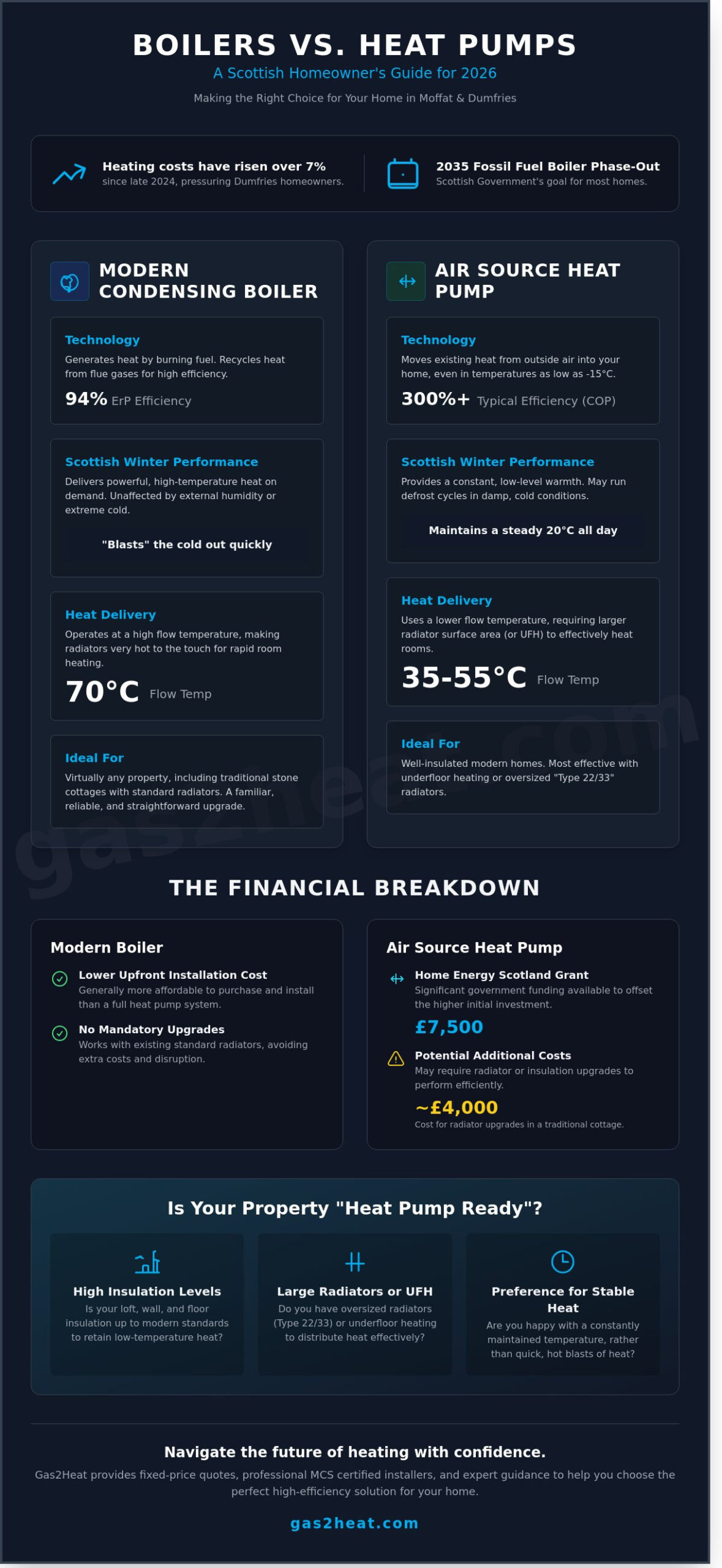
What if the most expensive mistake you make this year is following generic energy advice that doesn’t account for a freezing winter in Moffat? It’s a common worry. Most homeowners in Dumfries are feeling the pressure of heating costs that have risen by over 7% since late 2024. You want a warm home, but the debate over boilers vs heat pumps scotland often leaves you more confused than when you started. It’s difficult to weigh up the £7,500 Home Energy Scotland grant against the potential £4,000 cost of upgrading every radiator in a traditional Borders cottage.
This guide provides the clarity you need to make an informed investment for 2026. You’ll learn the honest truth about which system delivers 15 years of reliability and the lowest possible monthly bills for your specific property type. We’ll break down the latest regulations and grant schemes so you can secure a high-efficiency, fixed-price solution with total confidence.
Key Takeaways
- Understand how modern heating systems perform during a Scottish winter, ensuring your home in Moffat or Dumfries stays warm even when temperatures drop below zero.
- Identify if your property is “heat pump ready” by evaluating the specific insulation requirements for traditional stone cottages versus modern builds.
- Navigate the financial landscape of boilers vs heat pumps scotland, including a deep dive into Home Energy Scotland grants that can help offset upfront costs.
- Explore the benefits of a hybrid heating solution to achieve the perfect balance between high-temperature performance and long-term energy efficiency.
The State of Home Heating in Scotland: Why the Boiler vs Heat Pump Debate Matters in 2026
By 2026, the conversation around home heating has shifted from simple repairs to long-term property strategy. The Scottish Government’s Heat in Buildings Strategy sets a clear path toward net zero by 2045. This plan includes a 2035 deadline to phase out fossil fuel boilers in most domestic properties. For homeowners in South West Scotland, the choice between boilers vs heat pumps scotland is now a financial and environmental priority. Choosing the right system requires understanding the fundamental difference between combustion-based heating and heat transfer technology.
South West Scotland’s unique climate demands a tailored approach. Coastal winds and high humidity in areas like Moffat mean that heating systems must be resilient. While a gas boiler generates heat by burning fuel, a heat pump moves existing heat from the outside air into your home. This distinction impacts everything from your monthly energy bills to your home’s EPC rating. At Gas2Heat, we provide fixed price quotes and professional guidance to ensure your transition is seamless, regardless of which technology you choose for your property.
What is a Modern Condensing Boiler?
Modern condensing boilers in 2026 are remarkably efficient. Current ErP-rated models achieve 94% efficiency or higher. They work by capturing heat that would otherwise escape through the flue, recycling it back into the system. This technology provides a familiar, reliable way to heat homes in Moffat and surrounding areas. When paired with smart thermostats, these boilers can reduce fuel consumption significantly. They offer a straightforward solution for those seeking a hassle-free upgrade with professional Gas Safe registered engineers and the convenience of next day installation.
What is an Air Source Heat Pump (ASHP)?
An Air Source Heat Pump functions like a fridge in reverse. It extracts heat from the outside air, even when temperatures drop as low as -15°C. Learning how heat pumps work helps homeowners understand why they are the cornerstone of Net Zero Scotland. For a successful transition, using MCS certified installers is essential to ensure the system is sized correctly for the local climate. These systems represent the future of boilers vs heat pumps scotland, providing a low-carbon alternative that reduces long-term reliance on the gas grid while offering significant environmental benefits.
Performance in the Scottish Winter: How Boilers and Heat Pumps Compare
When the temperature drops to -5°C in Dumfries, your priority is a warm home. The central debate regarding boilers vs heat pumps scotland often focuses on whether renewable tech can handle a genuine Galloway winter. A gas boiler is the traditional gold standard for a reason. It delivers high-temperature bursts of heat on demand. This provides a sense of security when you come in from the cold. Heat pumps operate on a different logic. They provide a constant, low-temperature flow rather than rapid spikes. This keeps your home at a steady 20°C all day, but it won’t “blast” the cold out of a room in ten minutes.
Humidity and coastal air in South West Scotland also play a role. Air source heat pumps (ASHPs) must occasionally run a defrost cycle to clear ice from their heat exchangers. This is a standard 5 to 10-minute process. In damp, misty conditions common in the Solway Firth, these cycles happen more frequently. While modern units are designed for this, a boiler ignores external humidity entirely. If you value instant, high-intensity warmth, a high-efficiency boiler remains the most predictable choice for local weather patterns.
The Temperature Flow Challenge
Boilers typically operate with a 70°C flow temperature. This makes your radiators hot to the touch and heats rooms quickly. Heat pumps usually run between 35°C and 55°C to maintain efficiency. Because the water is cooler, you need more surface area to transfer that heat into the room. This often means upgrading to larger Type 22 or Type 33 radiators. Underfloor heating is the most effective partner for a heat pump. It turns your entire floor into a giant, low-temperature radiator. Without these upgrades, a heat pump may struggle to keep an uninsulated stone cottage warm during a freeze. You can check your eligibility for system upgrades through Scottish Government grants and loans which currently support many local decarbonisation projects.
Reliability and Maintenance in SW Scotland
A high-quality, ERP rated boiler has an expected lifespan of 12 to 15 years. In contrast, a well-maintained ASHP can last 20 years. However, local infrastructure is a key factor for homeowners in Moffat or Lockerbie. There are over 130,000 Gas Safe registered engineers in the UK, making parts and repairs easy to source locally. Specialist heat pump technicians are currently less common in rural Dumfries and Galloway. If your system fails on a Sunday in January, a boiler is often easier to fix quickly. In Scotland, SCOP represents the average amount of heat energy a pump produces for every unit of electricity it consumes across an entire heating season. While heat pumps are technically efficient, the simplicity of a fixed price boiler installation offers many homeowners immediate peace of mind and lower upfront complexity.
Is Your Property “Heat Pump Ready”? Suitability for Moffat and Dumfries Homes
Determining the winner in the debate of boilers vs heat pumps scotland depends entirely on your property’s “thermal envelope.” We advocate for a “fabric first” approach. This means you must prioritise insulation and draught-proofing before considering a change in heat source. A heat pump typically operates at lower flow temperatures, often around 45°C, compared to the 70°C delivered by a traditional gas boiler. If your home leaks heat through the roof or walls, a heat pump will struggle to keep you warm during a cold South West Scotland winter.
Preparation often involves more than just insulation. You must consider the physical infrastructure of your heating system. Many Dumfries homes currently using combi boilers have removed their hot water cylinders to save space. To install a heat pump, you will need to find room for a large unvented cylinder, often requiring a footprint of 600mm by 600mm in a cupboard or utility room. Additionally, your existing pipework may be too narrow. Heat pumps require a higher flow rate, which often necessitates upgrading 15mm copper pipes to 22mm or 28mm alternatives to prevent system noise and inefficiency.
The Traditional Stone Property Perspective
Moffat is home to hundreds of 19th-century stone cottages. These buildings feature solid walls that lose heat significantly faster than modern cavities. For these properties, an EPC rating of E or F is common. Unless you invest £10,000 or more in internal wall insulation, a high-efficiency boiler is usually the most pragmatic choice. It provides the high-temperature burst needed to overcome the heat loss of 600mm thick stone. We find that for uninsulated stone builds, gas remains the most reliable way to guarantee a fixed price for comfort.
Modern Developments and New Builds
Properties built in Dumfries after 2010 are the primary candidates for a transition. These homes were constructed to modern building standards with high levels of floor and loft insulation. If your home has an EPC rating of B or C, a heat pump is a logical, future-proof investment. Integrating the unit with solar PV panels can offset electricity costs by as much as 40% during the brighter months. Always check with Dumfries and Galloway Council regarding planning permission if you live in a conservation area, as the external fan unit must meet specific noise and placement criteria.
- Check your EPC: Ratings below D usually require significant fabric upgrades first.
- Assess your radiators: You may need “oversized” Type 22 or Type 33 radiators to work with lower temperatures.
- Space requirements: Ensure you have a 1.5-metre clearance for the external unit and space for an internal cylinder.
For many homeowners in the Scottish Borders, the decision comes down to immediate practicality. While we offer next day installation for high-efficiency boilers to restore heat quickly, a heat pump transition is a longer-term project. If your current system is failing and your home isn’t “heat pump ready” today, a modern A-rated boiler provides an instant, cost-effective solution for the next 12 to 15 years. Working with a trusted local heating engineer in the Scottish Borders ensures you get an honest assessment of your options without hidden costs or unnecessary upselling.
The Financial Breakdown: Installation Costs, Scottish Grants, and Monthly Bills
Choosing between boilers vs heat pumps scotland involves balancing immediate cash flow against long-term energy security. A high-efficiency gas boiler installation typically costs between £2,500 and £4,000. In contrast, an air source heat pump system in South West Scotland currently averages between £10,000 and £15,000. While the upfront gap is wide, the Scottish government provides significant financial buffers to bridge it. We provide a fixed price quote for every installation, ensuring you avoid the “hidden extras” that often plague complex home upgrades.
Navigating Scottish Government Funding
The Home Energy Scotland (HES) scheme remains the most robust support system in the UK. Homeowners can currently access a grant of £7,500 towards a heat pump. If you live in a designated rural area, such as Moffat or parts of the Rhins of Galloway, this grant increases to £9,000. You can also apply for an interest-free loan to cover the remaining balance or to fund supplementary improvements like larger radiators. To qualify, you must use an MCS-certified installer. Our Gas Safe registered engineers work alongside these standards to ensure your system is both compliant and eligible for every penny of available funding.
Running Costs in 2026
Electricity prices in 2026 are roughly 3.5 times higher than gas per unit. This ratio determines your monthly outgoings. A heat pump only becomes cheaper to run than a gas boiler when it reaches a “Tipping Point” efficiency. Specifically, your system needs a Seasonal Coefficient of Performance (SCOP) of 3.2 or higher to beat gas on price. If your home is poorly insulated, a boiler often remains the more economical choice for daily heating. You can reduce boiler bills by 10% simply by integrating a smart thermostat that uses load compensation to prevent energy spikes.
Consider a typical three-bedroom household in Moffat over a 10-year period. After applying the £9,000 rural grant, the net installation cost for a heat pump drops to roughly £6,000. When you factor in annual servicing and fuel prices, the 10-year Total Cost of Ownership (TCO) for a heat pump is approximately £14,800. A high-efficiency gas boiler over the same period costs roughly £13,200. The gap has closed significantly since 2022, making the transition to “clean heat” a matter of a few hundred pounds per year rather than thousands.
Ready to see your specific savings? Get a fixed price quote today and find the right heating solution for your home.
Choosing Your Path: How Gas2Heat Helps You Navigate the Future of Heating
Deciding between boilers vs heat pumps scotland doesn’t have to be an all or nothing choice. Many homeowners in 2026 find that a hybrid system offers the most resilience for our specific climate. This setup uses a high-efficiency boiler to handle the coldest winter nights while an air source heat pump provides low-carbon warmth during milder months. It’s a practical way to reduce emissions without risking a cold home when the temperature drops below zero in the Southern Uplands. At Gas2Heat, we specialise in identifying which configuration saves you the most on your annual energy bills.
We provide a fixed price quote for every installation. You won’t find hidden costs or surprise add-ons here. Our process is built on transparency and speed. We often provide next day installation for urgent boiler replacements, ensuring your family stays warm without a long wait. Every engineer we send is Gas Safe registered and trained in the latest ERP rated technology.
Why Local Knowledge Matters
National call centres don’t understand the specific challenges of South West Scotland. We know that water pressure in parts of Moffat can vary significantly, sometimes dropping below 1.0 bar in older stone properties. Our team lives and works here. We understand the local grid capacity limitations that might affect a heat pump’s performance in rural areas. If you aren’t ready for a full renewable transition, we provide expert boiler installation in Dumfries to keep your home running efficiently. You get a local expert who knows the Borders, not a random contractor from a hundred miles away.
Your 2026 Heating Roadmap
Preparing your home for the future requires a logical sequence. It’s about making the right choice for your specific property type and budget. Follow these three steps to secure a warmer home:
- Step 1: Improve the fabric. Focus on insulation first. Ensure your loft has at least 270mm of mineral wool and seal draughts around old timber frames to prevent heat from escaping.
- Step 2: Get a professional heat loss calculation. We don’t guess. We measure every room to ensure your new system, whether it’s a boiler or a heat pump, is sized perfectly for your needs.
- Step 3: Decide on your technology. We’ll help you weigh up the benefits of a 94% efficient condensing boiler against the long-term carbon savings of a renewable transition.
The best way to start is by booking a comprehensive home heating survey. We’ll assess your radiators, pipework, and insulation levels to give you an honest recommendation. Whether you want the immediate reliability of a new boiler or the future-proof benefits of a heat pump, Gas2Heat delivers a hassle-free experience from start to finish.
Future-Proof Your South West Scotland Home Today
Deciding on boilers vs heat pumps scotland shouldn’t feel like a gamble. With Scottish government grants providing up to £7,500 toward installation in 2026, the financial barrier to upgrading your home has never been lower. Success depends on your property’s unique profile; a well-insulated Moffat home might see 300% efficiency from a heat pump, while others may still require the high-temperature output of a modern gas boiler. Getting this right can cut your carbon footprint by over 2 tonnes every year.
Our Moffat-based team of Gas Safe Registered Engineers brings technical expertise in both traditional gas boilers and modern underfloor heating. We remove the guesswork with transparent fixed pricing and a commitment to honest, local service. You won’t find hidden costs or confusing jargon here; just reliable solutions tailored to the Dumfries and Galloway climate. We’re here to ensure your home remains a sanctuary, regardless of how cold the winter gets.
Book your free home heating survey with Gas2Heat today to secure your fixed price quote. Our experts are ready to help you make the smartest investment for your home’s future.
Frequently Asked Questions
Are gas boilers being banned in Scotland in 2026?
No, you can still install a replacement gas boiler in an existing home in 2026. The Scottish Government’s New Build Heat Standard, which began in April 2024, only prohibits direct emission heating like gas boilers in new-build properties. For the 600,000 plus existing homes in Scotland currently using gas, there’s no legislation forcing you to remove a working boiler by 2026.
How much is the Scottish heat pump grant in 2026?
You can currently access a grant of £7,500 towards a heat pump installation through the Home Energy Scotland scheme. If you live in a designated rural area, this amount increases to £9,000 to account for higher logistical costs. This funding is a flat-rate grant rather than a loan, which significantly lowers the initial investment when comparing boilers vs heat pumps scotland prices.
Will a heat pump work with my existing radiators in my Dumfries home?
Most heat pumps require larger radiator surface areas because they operate at lower flow temperatures than traditional gas boilers. In a typical Dumfries sandstone villa or terrace, we often find that 40% of existing radiators need upgrading to high-output models. Our engineers perform a room-by-room heat loss calculation to ensure your home stays at a steady 21°C even during a cold Galloway winter.
How long does it take to install a heat pump compared to a boiler?
A standard boiler replacement takes 1 day, whereas a full heat pump installation typically requires 3 to 5 days of on-site work. We offer next day installation for boilers to get your hot water back immediately. Heat pumps take longer because we have to install the outdoor unit, a new hot water cylinder, and often upgrade internal pipework to 28mm to handle the different flow rates.
Is a heat pump noisier than a standard gas boiler?
Modern air source heat pumps produce roughly 45 to 55 decibels of sound, which is similar to the hum of a domestic dishwasher. While they’re slightly louder than a high-efficiency gas boiler, which usually operates at 40 decibels, the sound is mostly wind noise from the fan. We ensure the unit sits on anti-vibration mounts to prevent any noise from entering your living spaces.
What happens to heat pump efficiency when it snows in the Scottish Borders?
Your heat pump will continue to provide warmth even when it snows and temperatures drop to -15°C in the Scottish Borders. Efficiency does decrease in freezing weather; the Coefficient of Performance might drop from 4.0 in autumn to 2.5 during a cold snap. The system’s automatic defrost cycle prevents ice build-up on the coils, ensuring your home remains at its set temperature throughout the winter.
Do I need a water tank for a heat pump if I currently have a combi boiler?
Yes, you’ll need to install a hot water cylinder if you’re switching from a combi boiler to a heat pump. Heat pumps don’t provide instant hot water like a combi; instead, they heat a tank of water gradually. We typically install a 200-litre to 300-litre unvented cylinder in a cupboard or loft space. This ensures you have a fixed price solution for high-pressure hot water at every tap.
Can Gas2Heat service both boilers and heat pump systems?
Gas2Heat provides expert servicing for both high-efficiency gas boilers and modern heat pump systems across the South West. Our Gas Safe registered engineers in Moffat handle boiler repairs, while our MCS-accredited technicians look after heat pump maintenance. We offer transparent, fixed price servicing to keep your manufacturer warranty valid and ensure your system runs at peak efficiency year after year.
