
Hive vs Nest for UK Homes: Compare Upgrade Costs and Savings
The easier upgrade isn’t automatically the better thermostat. For Hive vs Nest in UK homes, neither is universally easier to install: compatibility depends on your boiler and wiring. Professional installation is recommended, particularly in older properties or where boiler types vary.
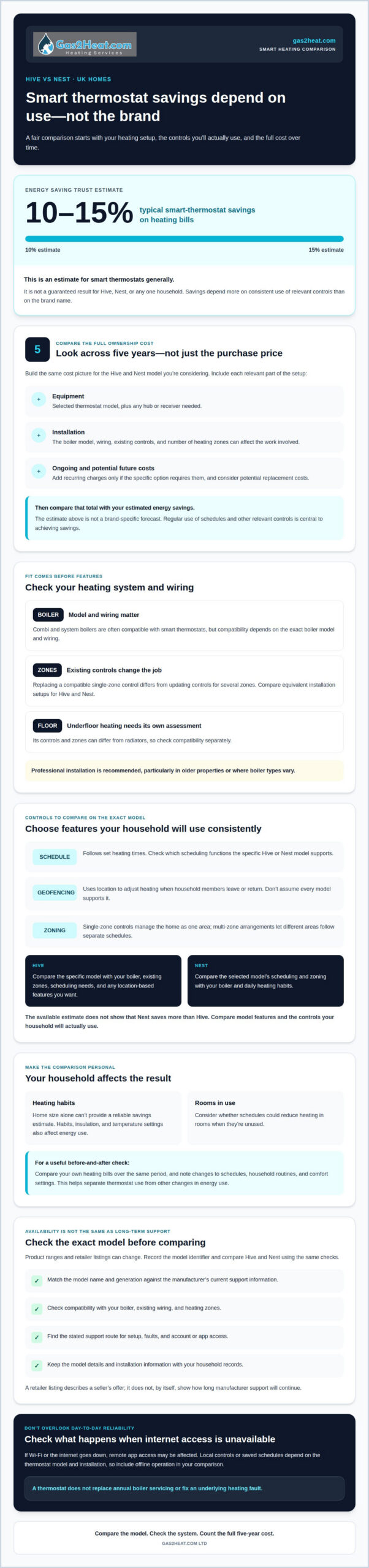
It’s understandable to focus on the upfront switch, but the way you use a smart thermostat matters too. The Energy Saving Trust estimates typical smart-thermostat savings of 10-15% on heating bills, while the savings depend more on consistent use of the features than on which brand you choose.
This comparison will help you weigh Hive and Nest on installation, compatibility, heating efficiency and potential bill savings. It also looks at five-year costs and long-term support, so you can see which option fits your home and what an upgrade involves before deciding.
Key Takeaways
- Compare the full five-year outlay, not just the thermostat’s purchase price; installation and how you use the controls affect the value over time.
- Check how each option handles your heating setup and the features you’ll actually use before choosing between them.
- Look beyond the initial upgrade: product availability and ongoing support can influence how practical each system is for your household.
- If a thermostat upgrade is part of a wider heating change, professional boiler installation can help ensure the system and controls work together.
Heating efficiency and potential bill savings
A Hive vs Nest comparison for UK homes should start with how your household heats each room. Combi and system boilers are often compatible with smart thermostats, but the boiler model and wiring matter. Underfloor heating needs a separate compatibility assessment because its controls and zones can differ from radiators.
The Energy Saving Trust estimates typical smart-thermostat savings of 10-15% on heating bills. This is an estimate for smart thermostats generally, not a guaranteed result for either brand or any one household.
Hive heating controls
The heating savings from Hive depend on how consistently people use its controls, not just the brand. Compare the specific model with your boiler and existing zones. For schedules or location-based adjustments such as geofencing, check which features that model supports rather than assuming every Hive system works the same way.
Nest heating controls
Assess Nest against your boiler and daily heating habits. The Energy Saving Trust estimate doesn’t show that Nest saves more than Hive. Compare the selected models’ scheduling and zoning, then consider which controls your household will use consistently. That practical comparison is more useful than choosing by brand alone.
Home size alone can’t provide a reliable savings estimate. A larger home may have more rooms to heat, but energy use also depends on habits, insulation and temperature settings. Start with your own heating bills, then consider whether schedules could reduce heating in rooms when they’re unused.
Single-zone controls manage the home as one area; multi-zone arrangements let different areas follow separate schedules. Geofencing uses location to adjust heating when household members leave or return, while a schedule follows set times. When comparing Hive vs Nest for UK homes, check which functions each specific model supports before relying on them.
If Wi-Fi or the internet goes down, remote app access may be affected. Local controls or saved schedules depend on the thermostat model and installation, so include offline operation in your comparison. Neither thermostat replaces annual boiler servicing or fixes an underlying heating fault.
Five-year costs and savings
Compare the full ownership cost over five years, not just the thermostat purchase price. For Hive and Nest, list the chosen model, any hub or receiver needed, installation and potential replacement costs. Include recurring charges only if the specific option requires them. This creates a like-for-like comparison without assuming either brand has the lower overall cost.
Use a simple worksheet. Record the equipment and installation costs, then add any ongoing charges across five years. Next, compare that total with your estimated energy savings. The Energy Saving Trust estimates typical smart-thermostat savings of 10-15% on heating bills, but that figure isn’t a brand-specific forecast. Regularly using schedules and other relevant controls is central to achieving savings.
Your central heating setup can affect installation costs. Boiler model, wiring, existing controls and the number of heating zones can all change what the job involves. Replacing a compatible single-zone control, for example, differs from updating controls for several zones. Compare the same type of installation for Hive and Nest, rather than treating hardware as the complete cost.
Smart-home integration is another comparison point, not an automatic saving. List the functions you already use, such as Google Assistant, and compare them with the features supported by each model. Include only integrations you’ll actually use. A heating feature that goes unused won’t add practical value to your five-year calculation.
Finally, compare your own heating bills before and after changing how you control heating. Keep the same comparison period and note changes to schedules, household routines and comfort settings. That helps separate the effect of thermostat use from other changes in energy use. If your plans include a new floor-heating system, consider how underfloor heating installation fits the wider project and its controls.
Product availability and long-term support
For Hive and Nest, compare the exact thermostat models, not just the brand names. Product ranges and retailer listings can change, so note the model identifier before comparing compatibility, support information and replacement options. An Amazon listing, for example, describes a seller’s offer; it doesn’t by itself show how long manufacturer support will continue.
Before buying, use this practical checklist:
- Match the model name and generation against the manufacturer’s current support information.
- Check whether the thermostat is compatible with your boiler, existing wiring and heating zones.
- Find the stated support route for setup, faults and account or app access.
- Keep the model details and installation information with your household records.
These steps help distinguish immediate availability from long-term usefulness. A thermostat may be on sale, but your decision also depends on whether its controls suit your system and whether clear support information is available for that exact model. Compare Hive and Nest using the same questions, rather than assuming one brand’s support will always last longer.
Consider what could change in your household. If your routine shifts, you may need to adjust schedules or temperature settings. If you move, the next property may have different wiring or heating zones. Keeping the model details makes it easier to understand which controls you have and whether they’ll work with a new setup.
Also consider how much learning each interface involves. A household that wants straightforward scheduled heating may prefer different controls from one that regularly changes settings through a smart-home app. Try the steps for setting a schedule, changing the temperature and reducing heating when it’s unnecessary. Those everyday tasks matter more than a long feature list.
For either Hive or Nest, treat availability, compatibility and support as separate checks. A model being available today doesn’t establish how long it will be supported. Clear product identification and manufacturer guidance give you a more useful basis for comparing long-term ownership than a retailer listing alone.
Which UK heating systems are compatible with Hive and Nest?
Hive and Nest work with existing gas, combi and system boilers in most cases. Compatibility depends on the specific boiler model and wiring, so identify both before choosing a thermostat.
Use this practical check before purchase:
- Find the boiler make and model on its information label or paperwork.
- Note whether the system is combi, system or another heating arrangement.
- Record the existing thermostat and controller setup, including wiring details.
- Compare those details with the requirements for the exact Hive or Nest model.
These checks matter because two homes with gas boilers can still have different controls. A wired wall thermostat and separate programmer, for example, may connect differently from a simpler setup. Professional installation is recommended, particularly in older UK properties or where boiler types vary.
Consider underfloor heating alongside the boiler. Its zone controls may differ from radiator heating, so don’t assume a thermostat designed for one setup will control the other in the same way. Match the thermostat to the full arrangement, including existing underfloor controls, before planning an upgrade.
In England, Boiler Plus, part of Building Regulations Part L, requires most new combi boiler installations to include a compatible smart control or time-and-temperature zone control. This rule concerns most new combi boiler installations, not every thermostat replacement. For an upgrade, the practical step remains matching the control to the boiler and wiring.
Hive and Nest can both suit common UK boiler arrangements, but the right choice depends on the model and system configuration. If the installation includes underfloor zones, a new boiler or unfamiliar wiring, assess how all the controls will work together before buying. This helps avoid choosing a thermostat that doesn’t fit the planned setup.
Arrange a heating-controls assessment to plan a compatible thermostat setup for your boiler or underfloor heating.
Neither Hive nor Nest is universally better: compatibility depends on the boiler model, wiring and existing controls. In older properties, have the full heating setup assessed before choosing. This comparison does not cover renter-specific considerations.
Gas2Heat.com: Boiler Installation
Gas2Heat.com Ltd can help when a thermostat decision is part of a wider boiler upgrade. If your current boiler needs replacing, Boiler Installation is the relevant next step; Boiler Servicing and Boiler Repairs address maintenance or faults instead. The team serves homeowners across Moffat, Dumfries, Lockerbie, Annan, Lochmaben, Thornhill, Gretna and Castle Douglas.
Identify whether you need a boiler replacement, servicing or repairs before discussing the work. Contact Gas2Heat.com Ltd to talk through your heating requirements.
Make your next heating upgrade a considered one
Choose controls that fit the way you want to manage your home, then decide what the heating system itself needs. Before arranging work, note whether your priority is a boiler replacement, routine upkeep or a fault. That gives your conversation with Gas2Heat.com Ltd a clear starting point and keeps the next step focused on your household.
For Hive vs Nest for UK homes, practical advice based on your setup can help you decide how to proceed. Gas2Heat.com Ltd offers Boiler Installation, Boiler Servicing and Boiler Repairs for different stages of a home heating system’s life.
Discuss your heating upgrade with Gas2Heat.com Ltd. A clear plan can help you move forward with confidence.
Frequently Asked Questions
How Easy Is It to Upgrade?
Upgrading is usually more straightforward when you identify your boiler and existing controls first. For Hive and Nest in UK homes, installation still depends on the boiler model, wiring and control setup. An older property with unfamiliar wiring, for example, may need a professional assessment before fitting. Note the boiler’s make and model, then compare the thermostat’s requirements with the existing arrangement.
Can Hive or Nest control hot water, multiple heating zones, and smart radiator valves?
Support for hot water, multiple zones and smart radiator valves depends on the exact Hive or Nest model and your heating arrangement. Don’t assume these functions from the brand name alone. A home with a separate hot-water cylinder, for example, has a different setup to consider from a combi boiler. Before choosing, compare the model’s compatibility requirements with your controls, wiring and zone layout.
Which is better for UK renters, homeowners, and homes with older boilers?
In any home, check the thermostat’s compatibility with the specific boiler model and wiring. Professional installation is recommended, particularly in older properties or where boiler types vary. This comparison does not cover renter-specific considerations.
What smart heating features and app controls do Hive and Nest offer?
Compare the exact models for scheduling, zoning and location-based adjustments such as geofencing, as feature support can vary. Remote app access may be affected by an internet outage, while local controls and saved schedules depend on the model and installation.

Leave a Reply
You must be logged in to post a comment.