
Vaillant F75 Fault Code: What It Means and Why It Appears
F75 is a symptom, not a diagnosis. On many modern heating units, it means the system didn’t detect the expected pressure change when its pump started. A Vaillant F75 fault code fix depends on the cause, which may include a pressure sensor problem, a pump fault or restricted water circulation.
The code can be unsettling, especially if your heating or hot water stops working. You may also notice the fault returns after a reset, or that the system’s pressure appears normal despite the warning. This guide explains what F75 means, the symptoms to look for and how a faulty or blocked pressure sensor may be involved. It also covers what a reset can and can’t tell you, and when the problem needs professional diagnosis rather than more troubleshooting. Understanding the signs can help you make sense of the fault and what should happen next.
Key Takeaways
- F75 points to a pressure-change problem at startup, not a single confirmed fault. The pump, pressure sensor and water circulation can all be involved.
- A normal pressure reading doesn’t rule out a blocked or faulty sensor. Debris, including after radiator work, may affect the sensor and filter assembly.
- Note whether the fault returns after a reset and whether heating or hot water is interrupted. A recurring code needs diagnosis rather than repeated resets.
- Boiler servicing can help identify pressure and circulation issues early. Internal boiler repairs should be handled by an appropriately qualified Gas Safe Register engineer.
Faulty or blocked pressure sensors
On Vaillant ecoTEC boilers, F75 can appear when the pump starts. The boiler then fails to detect the expected pressure change. A pressure sensor reports water pressure to the boiler’s controls. If faulty, F75 may persist despite a normal gauge reading.
A blocked sensor can disrupt the pressure signal. Debris may enter a Vaillant boiler after a radiator is removed and refitted, obstructing the water pressure sensor or its filter assembly. The boiler may then fail to register a pressure change, even when the system pressure appears adequate. A pressure reading alone cannot confirm that the sensor is clear.
Sludge creates another possible circulation problem. As water moves through radiators and pipework, accumulated debris can restrict its flow. That restriction may affect how the pump circulates water at startup. F75 can then relate to circulation, rather than low pressure alone. A heating system that was not power flushed correctly, or lacks a protective filter, may also contribute.
Stuck valves can limit water movement through part of the system. For example, a valve that does not open properly may leave circulation restricted when the pump runs. This is different from proving the pressure sensor has failed. The pump, sensor, filter and wider heating circuit can produce similar F75 symptoms, so the code needs diagnosis.
An appropriately qualified Gas Safe Register engineer can inspect the sensor and pump. If the sensor assembly is blocked, cleaning the water-block where it sits may be needed. The engineer may also replace a faulty sensor. If F75 remains after sensor replacement, a power flush or pump replacement may be considered.
Don’t open the boiler casing or attempt internal sensor repairs yourself. Internal boiler components require suitable professional attention. Tell the engineer if F75 started after radiator work, or returns with normal pressure. Those details help focus checks on debris, sludge, the sensor, pump and circulation restrictions.
What does the Vaillant F75 fault code mean?
On many Vaillant ecoTEC boilers, F75 means the boiler didn’t detect the expected pressure change when its pump started. The pump should move water through the heating circuit, creating a change the boiler can recognise. If that signal is absent, the boiler displays the fault. F75 describes what the control system detected, not the confirmed cause.
A single appearance after a pressure drop or airlock may clear after a reset. If the code quickly returns after pressure is corrected and air is dealt with, further resetting won’t address the underlying issue. The pump, pressure sensor and system circulation may need diagnosis. Keep a note of when F75 appears and whether the heating or hot water is affected.
To reduce the risk of recurring problems, arrange annual boiler servicing. A service can help identify pressure or circulation issues early. A magnetic system filter can collect debris in the heating circuit, while corrosion inhibitor helps limit corrosion-related contamination. These measures support cleaner system water, but they won’t repair an existing fault.
When does a Vaillant F75 fault require a Gas Safe registered engineer? If F75 returns quickly after a reset, or pressure correction doesn’t resolve it, arrange professional diagnosis. Internal boiler checks and repairs should be handled by an appropriately qualified Gas Safe Register engineer.
Is a Vaillant F75 fault covered by warranty or a service plan? Coverage depends on the written terms, including whether they cover the failed component and its cause. Exclusions and maintenance conditions can also affect whether a repair is included.
Repeatedly topping up pressure is not a lasting prevention method. It can point to an underlying leak, pressure relief valve discharge or expansion vessel issue. Record how often pressure falls, rather than repeatedly adding water without investigation. A recurring F75 fault needs its cause addressed, whether that involves the boiler or wider heating circuit. Service records can also help show when symptoms began and what checks have already taken place.
What the Vaillant F75 fault code means
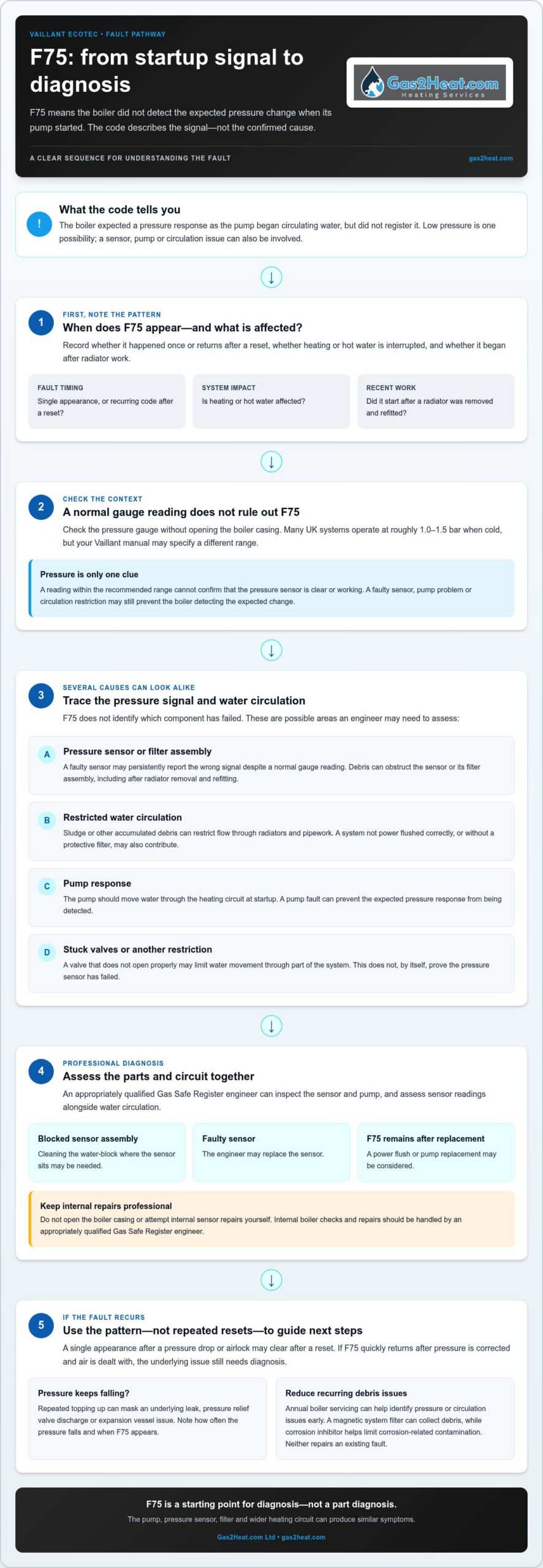
On Vaillant ecoTEC, ecoTEC plus and ecoTEC pro boilers, F75 identifies a failed startup pressure check. The boiler expects a pressure response when its pump starts circulating water. F75 means that response wasn’t detected. It doesn’t identify the failed component. Low system pressure is one possible reason, but not the only one.
Check the pressure gauge without opening the boiler casing. Many UK systems operate at roughly 1.0-1.5 bar when cold. Your Vaillant boiler manual may specify a different range. A reading within the recommended range doesn’t rule out F75. A faulty sensor, pump problem or circulation restriction can prevent the boiler detecting the expected change.
The timing can help explain what happened. If F75 appears once after a pressure drop or airlock, a reset may clear it. If it returns quickly after pressure is corrected and air is dealt with, the underlying issue remains. Repeated resets won’t identify whether the pump, sensor or circulation needs attention. The right Vaillant F75 fault code fix starts with identifying that underlying cause.
Pressure that keeps falling also needs attention. Repeatedly topping up the system can mask a leak, pressure relief valve discharge or expansion vessel issue. Note when the gauge drops and whether F75 appears at the same time. That pattern gives useful context for diagnosis.
For example, a normal cold pressure reading with recurring F75 points away from simple low pressure. It still doesn’t prove the sensor has failed. A qualified engineer can assess the pump’s response, sensor readings and water circulation together. Those checks distinguish a pressure problem from a fault in the boiler’s detection or heating circuit. A reliable Vaillant F75 fault code fix depends on interpreting those checks together, not replacing a part based on the code alone.
F75 fault symptoms
The clearest sign is F75 displayed on a Vaillant boiler. The code may appear as the boiler starts, when its pump begins circulating water. You might find the heating or hot water stops working, or the boiler repeatedly locks out. Note which service is affected and whether the code appears before either starts.
Check the boiler’s pressure gauge and record its reading. Many UK systems operate at roughly 1.0-1.5 bar when cold, though the Vaillant manual may give another range. A low reading can accompany F75, but normal pressure does not rule it out. The boiler may still fail to detect the expected pressure change.
Other useful observations include:
- Whether F75 appears once or returns after a reset.
- Whether heating, hot water or both are interrupted.
- Whether the pressure reading changes between checks.
- Whether the pump makes an unusual sound during startup.
A Vaillant boiler pump may make a low rumbling sound for a few seconds, about every 20 seconds, when the boiler calls for heat. Record when you hear it and whether F75 appears at the same time. A sound alone cannot identify the fault, but its timing gives an engineer useful context.
Look for patterns, not a diagnosis. For example, F75 after radiator work differs from a code that appears alongside repeated pressure loss. Note recent changes, including radiator removal or refitting, and any regular need to top up the system. Frequent pressure loss can accompany a leak, pressure relief valve discharge or expansion vessel issue.
Write down the displayed code, gauge reading and affected service before arranging diagnosis. If F75 returns quickly, avoid repeatedly resetting the boiler. These symptoms help distinguish an isolated interruption from a recurring fault needing attention.
Gas2Heat.com: Boiler Installation
Gas2Heat.com Ltd provides boiler repairs when a recurring F75 fault needs professional diagnosis. A repair can address a fault affecting the boiler or its circulation, while servicing can help identify pressure and circulation problems early. If repair is no longer the right option, boiler installation may suit a replacement instead. The appropriate next step depends on the fault and the boiler’s condition.
Share the F75 code, pressure readings and symptoms you’ve noticed. Details such as repeated pressure loss or a fault returning after reset can help explain the issue. For routine maintenance, ask about boiler servicing; for a persistent fault, discuss boiler repairs.
Contact Gas2Heat.com Ltd to discuss your boiler repair or visit gas2heat.com.
Take the next step with confidence
A recurring boiler fault calls for a considered decision, not repeated resets. Keep a clear record of what happens and explain the problem when arranging help. This gives the conversation a practical starting point and helps focus attention on a lasting solution.
The right Vaillant F75 fault code fix depends on the boiler’s condition and the diagnosis. If repair or replacement is being considered, weigh the fault against the boiler’s wider performance and reliability. A clear assessment can help you decide what makes sense for your home.
For support with the next step, get in touch with Gas2Heat.com Ltd. You can discuss the issue and move forward with a clearer plan for your heating.
Frequently Asked Questions
Can I reset my Vaillant boiler if it shows F75?
Yes, you can try resetting it once if F75 appears after a pressure drop or airlock. Use the boiler’s lockout button, marked with a cross-flame symbol, then call for heat by turning on the heating or running a hot-water tap. If the code returns, don’t keep resetting it. Note when it reappears and arrange diagnosis.
How can you avoid F75 happening again?
Reduce the risk by keeping the heating system clean and maintaining the boiler. Annual servicing can help identify pressure or circulation concerns. A magnetic system filter collects debris, while corrosion inhibitor helps limit corrosion in the water. Tell the engineer if radiators or pipework have been altered. System condition and correct flushing also matter.
How much does it cost to repair an F75 error?
Repair costs depend on the cause and work required. A pressure sensor fault, pump problem and circulation restriction each involve different checks and components. The diagnosis, parts needed and repair work all affect the quote. When requesting one, describe the boiler model, displayed code and symptoms.
What causes the Vaillant F75 error code?
F75 can result from a faulty pressure sensor, a pump malfunction or restricted water circulation. Low system pressure may also be involved, while a hidden leak can cause pressure to fall. Debris after radiator work may obstruct the sensor assembly. The code alone doesn’t identify which cause applies, so diagnosis needs to consider the boiler and heating circuit.
Which Vaillant models show F75?
Vaillant ecoTEC, ecoTEC plus and ecoTEC pro boilers are among the models commonly associated with F75. To identify yours, check the model information on the boiler or its documentation. The model helps an engineer understand which boiler they’re assessing, but the code still doesn’t pinpoint a failed part. Share the model alongside the displayed fault.
Will topping up the pressure fix F75?
Topping up may help if the system pressure is low, but it won’t fix a faulty sensor, pump problem or circulation restriction. The guidance for this fault advises bringing pressure to 1.5 bar. Follow your Vaillant manual, as the recommended range can differ. If pressure keeps dropping or F75 returns, repeated top-ups won’t resolve the underlying cause.

Leave a Reply
You must be logged in to post a comment.