

Boiler Losing Pressure Constantly? Causes and 2026 Fixes
Topping up your filling loop every morning isn’t just a minor chore; it’s a clear signal that your heating system is struggling. If you find your boiler losing pressure constantly, you’re likely dealing with cold radiators, tepid showers, and the growing fear of a major repair bill. It’s stressful to wonder if a hidden leak is slowly damaging your floorboards while your energy bills climb.
We understand that you want a reliable, safe home without the guesswork. You deserve a heating system that works when you need it most. This guide explains the technical reasons behind pressure drops and helps you decide between a simple DIY top-up and a professional intervention. We’ll cover everything from the standard 1.0 to 1.5 bar cold pressure requirements to the impact of the Renters’ Rights Act 2025 on system maintenance. You’ll learn how to secure a permanent fix, ensure your system is safe, and ultimately lower your monthly costs through a healthy, efficient boiler.
Key Takeaways
- Aim for the 1.0 to 1.5 bar “sweet spot” when your system is cold to ensure peak efficiency and consistent hot water.
- Identify hidden leaks at radiator valves using the simple paper towel test if your boiler losing pressure constantly.
- Check your external discharge pipe for active dripping to spot potential issues with the expansion vessel or pressure relief valve.
- Follow a logical troubleshooting checklist to determine if you need a quick DIY top-up or a professional boiler repair.
- Prioritize safety by ensuring any internal diagnosis or repair is performed by a Gas Safe registered engineer.
Understanding Boiler Pressure: What is Normal in 2026?
Your boiler relies on a precise balance of water and air to circulate heat through your home. For most modern combi and system boilers, the “sweet spot” is between 1.0 and 1.5 bar. You should always check this measurement when the system is cold. If you notice your boiler losing pressure constantly, it’s a sign that this internal balance is being disrupted, either by a leak or a mechanical fault.
It’s natural for the needle to move slightly during the day. When your heating is active, water expands as it warms up. This expansion is safely managed by Expansion Vessels, which act as a pressurized cushion for the system. You might see the pressure rise toward 2.0 bar while the radiators are hot. However, if the gauge drops to 0 bar, your unit will trigger a safety shutdown. This prevents the boiler from firing without enough water, which could cause expensive internal damage.
How to read your boiler’s pressure gauge
Most UK homes use reliable brands like Worcester Bosch, Vaillant, or Baxi. These units feature either a physical dial or a digital display. On a physical dial, look for the green zone. This indicates the safe operating range. If the needle enters the red zone, the pressure is either too low or dangerously high. Digital displays are even more direct. They often flash specific error codes when things go wrong. A Vaillant might show “F22,” while a Baxi often displays “E119.” These codes mean the system has detected low water pressure and stopped running to protect itself.
The ‘Filling Loop’ basics
To restore pressure, you’ll need to find the filling loop. This is usually a flexible, silver braided hose located directly beneath the boiler. It connects your cold water mains to the heating circuit. While it’s a helpful tool for a quick fix, you shouldn’t have to use it more than once a year. If you find yourself reaching for the valves every few weeks because your boiler losing pressure constantly, you’re masking a deeper issue. Be careful not to over-pressurise the system. Going above 2.5 bar puts stress on your pipework and can cause the pressure relief valve to leak, leading to further complications.
Persistent External Leaks: The #1 Cause of Pressure Loss
If your boiler losing pressure constantly, the culprit is often a small, persistent leak somewhere in your central heating circuit. Even a pinhole-sized exit point can drop the system pressure by 0.5 bar over a few days. Because the water in your pipes is hot, these tiny drips often evaporate the moment they hit the air. This leaves no obvious puddle, making the source incredibly difficult to spot with a quick glance.
Try the “paper towel test” to find these elusive leaks. Wrap a dry piece of kitchen roll around each radiator valve and secure it with a rubber band. Leave the heating on for a few hours, then check for damp spots. This simple diagnostic tool reveals slow “weeps” that usually vanish before they reach the floor. It’s a highly effective way to confirm if a minor seal failure is causing your daily pressure drop.
In SW Scotland, our local climate plays a significant role in system health. Harsh winters and freezing temperatures can cause external pipes, such as the condensate line, to freeze and expand. While a total blockage usually leads to a boiler lockout, the repeated thermal stress of freezing and thawing can weaken external joints. This leads to recurring pressure loss as the system struggles to maintain its integrity against the elements.
Checking your radiators and valves
Inspect the nuts on your Thermostatic Radiator Valves (TRVs) first. These connections can loosen over time due to natural vibration or thermal movement. Look closely for “rust scabs” or green copper oxidation, known as verdigris, around the joints. These are definitive signs of a slow-motion leak. Also, consider if you have recently bled your radiators. Removing trapped air creates more space in the system, which naturally causes the pressure gauge to drop. Always top up the system slightly after bleeding to maintain the correct balance.
Identifying hidden plumbing leaks
Sometimes the issue isn’t visible on your radiators. Hidden pipework under floorboards or inside walls can develop leaks that only manifest when the heating is active. This happens because pipes expand when they get hot, which can widen tiny cracks or loose fittings. If you notice damp patches on skirting boards or see staining on ceilings, you need a reliable plumbing and heating service immediately. Dealing with pressurized systems carries inherent risks, and following official safety guidance for Professional Help in SW Scotland ensures your home remains safe. If your boiler losing pressure constantly and no external leaks are found, a professional engineer can perform a targeted Boiler Repair to locate and seal the fault.
Internal Faults: Expansion Vessels and Pressure Relief Valves
If you’ve checked every radiator and found no damp spots, the issue likely sits inside the boiler casing itself. When a boiler losing pressure constantly without an external leak, the internal expansion vessel is the primary suspect. This component is a small tank containing a rubber bladder and a cushion of compressed air. Its job is to absorb the extra volume created when water heats up and expands. Without this cushion, the physical pressure inside your pipes has nowhere to go.
Professional engineers use the “Schrader Valve” test to diagnose this fault. They check the air valve on the vessel, much like a tyre valve on a car. If water escapes during this test, the internal bladder has perished, and the vessel is “logged” with water. This means it can no longer manage the system’s expansion, leading to rapid pressure spikes and subsequent drops. It’s a technical failure that requires specialized tools and Gas Safe expertise to resolve safely.
The Pressure Relief Valve (PRV) acts as the system’s ultimate safety “blow off.” If the internal pressure exceeds 3.0 bar, the PRV opens to discharge water and prevent the boiler from over-pressurising. You can verify this by performing a “copper pipe” check. Locate the small copper pipe that pokes through the external wall directly behind your boiler. If this pipe is dripping or shows signs of water staining on the brickwork, your PRV is active. This is a clear signal that your system’s internal balance is broken.
The failed Expansion Vessel cycle
A failed expansion vessel creates a very specific pattern of behavior. You’ll notice the pressure gauge rises rapidly toward the red zone as soon as the heating turns on. Once the system cools down, the needle often drops back to zero. While it’s tempting to keep using the filling loop, topping up a failed vessel actually makes the problem worse. Each time you add fresh water, you’re reducing the remaining air space and introducing more minerals that can cause internal corrosion. Depending on the severity, an engineer may be able to re-pressurise the vessel with a manual pump, but a perished bladder will always require a full replacement.
The dripping Pressure Relief Valve (PRV)
A dripping PRV is frequently a secondary symptom of expansion vessel failure. Once the PRV has been forced to open to vent excess pressure, it often struggles to reseal properly. Tiny bits of dirt or system grit can get trapped in the valve’s seating, preventing a watertight closure. Even after the expansion vessel is fixed, the PRV might continue to weep, leading to a boiler losing pressure constantly. In these cases, replacing the PRV is the only way to ensure the system remains sealed and efficient. Regular Boiler Servicing is the best way to catch these issues before they lead to a total system shutdown.
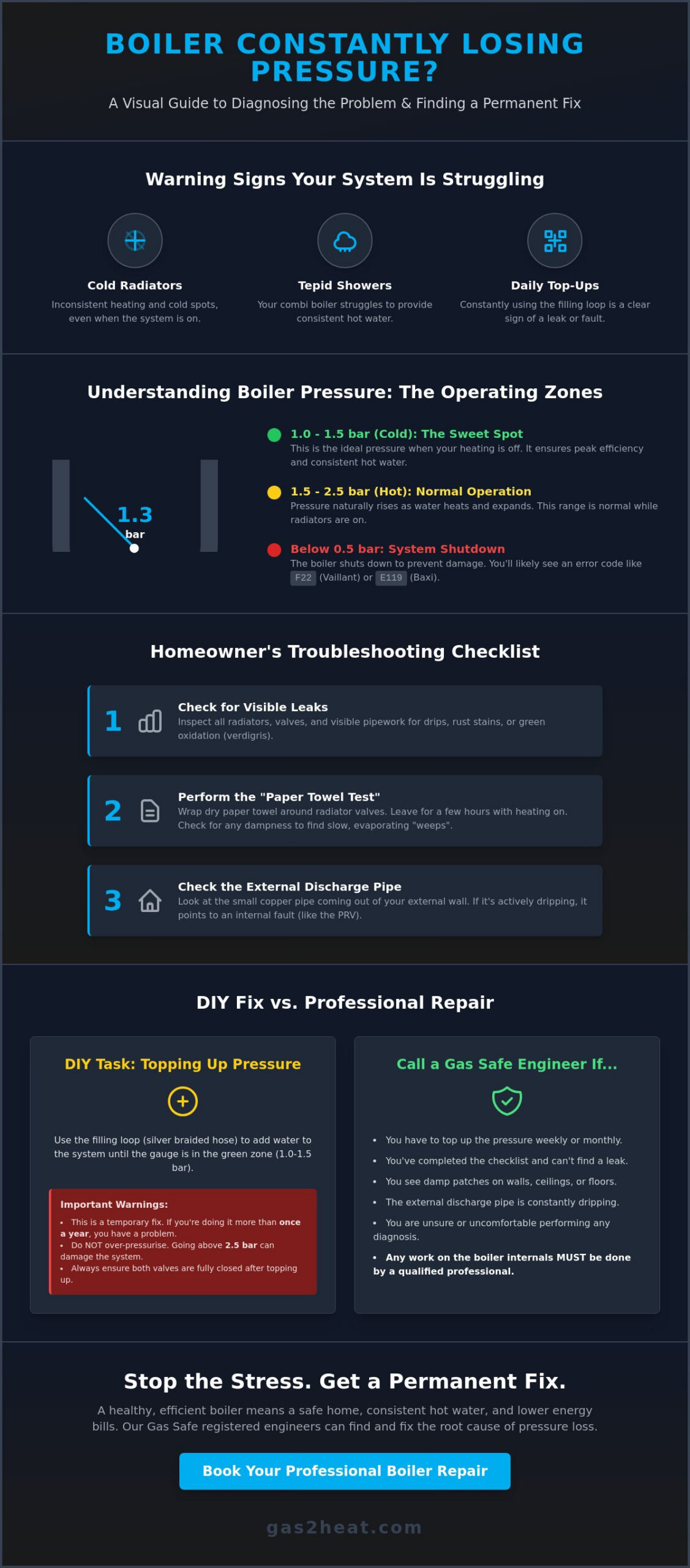
The Homeowner’s Troubleshooting Checklist
Before calling an engineer, follow this systematic checklist to understand exactly how your system is behaving. If you find your boiler losing pressure constantly, gathering specific data helps a professional diagnose the root cause faster. Start with a methodical visual inspection of every visible radiator valve and pipe joint in your home. Look for the white, chalky residue of dried leaks or the green tint of copper oxidation. Next, head outside to check the copper discharge pipe for any active dripping. It’s also vital to ensure all radiator bleed valves are fully tightened; a slightly loose valve can slowly vent system pressure without you noticing.
Monitor your pressure gauge during a full heating cycle. Watch how high the needle climbs when the radiators are hot and how far it falls when they’re stone cold. Documenting this rate of loss, such as a drop of 0.5 bar every 24 hours, provides invaluable data. This information helps determine if the issue is a slow-weeping leak or a more significant internal failure. If you’ve completed these steps and the pressure continues to plummet, it’s time to contact a specialist for a professional boiler repair.
- Step 1: Inspect all visible joints and valves for moisture or “rust scabs.”
- Step 2: Check the external PRV discharge pipe for signs of water.
- Step 3: Verify that all radiator bleed valves are securely closed.
- Step 4: Watch the gauge move from a cold start to a fully heated state.
- Step 5: Record how much pressure is lost over a specific period.
When to try a DIY top-up
If the pressure has dropped below 1.0 bar, you can usually restore it yourself using the filling loop. This is the silver braided hose located beneath your boiler. Open the small valves slowly until you hear the distinct “rush” of water entering the system. Watch the needle carefully and stop once it hits the 1.5 bar mark. Ensure both valves are fully closed afterward to prevent over-pressurising. If you have to do this more than once every few months, the system has a fault that a simple top-up won’t fix.
The role of Power Flushing in system health
A boiler losing pressure constantly isn’t always caused by a hole in a pipe. Over time, black iron oxide sludge builds up inside your radiators and heat exchanger. This debris creates internal blockages that lead to localized overheating and massive pressure fluctuations. These spikes put immense strain on your expansion vessel and can eventually cause it to fail. Investing in power flushing removes this sludge, clears the blockages, and restores smooth circulation. This process protects your internal components and ensures your system maintains a stable, healthy pressure year-round.
Professional Help in SW Scotland: When to Call Gas2Heat.com Ltd
Attempting to fix internal boiler components yourself isn’t just difficult; it’s illegal. UK law requires a Gas Safe registered engineer to handle any task that involves opening the boiler casing. If your boiler losing pressure constantly and the troubleshooting steps haven’t solved it, the fault likely involves gas-carrying parts or complex internal seals. The team at Gas2Heat.com Ltd provides the technical authority needed to handle these repairs safely, giving you total peace of mind and protecting your home from the risks of improper maintenance.
We focus on removing the uncertainty that often comes with trade services. Gas2Heat.com Ltd engineers arrive with the right diagnostic tools to find the exact cause of your pressure loss. We don’t believe in temporary patches. Whether it’s a perished expansion vessel bladder or a faulty heat exchanger, we provide a permanent solution. We prioritize financial transparency, providing clear explanations of the work required before we begin. Investing in an expert boiler service is the most efficient way to catch these small issues before they turn into expensive emergency call-outs. This proactive approach keeps your system running at peak performance.
Our regional expertise in Moffat and Dumfries
We understand the specific challenges of homes in South West Scotland. From traditional stone properties in Moffat to modern developments in Dumfries, we know the typical heating system layouts and common failure points. Our local presence allows for a rapid response across the region. You won’t have to wait days for a specialist to arrive. Gas2Heat.com Ltd engineers are fully certified and carry a wide range of common parts. This regional focus means we can often resolve issues in a single visit, respecting your schedule and restoring your home’s comfort without delay.
Preventing future pressure issues
A healthy system requires more than just reactive repairs. We recommend annual servicing to keep your manufacturer’s warranty valid and your energy bills low. During a service, we check the charge in your expansion vessel and ensure the PRV is clear of debris. We also advise on installing magnetic system filters. These devices catch metallic sludge before it can damage your pump or cause your boiler losing pressure constantly. By removing these particles, you reduce the internal wear on your boiler and radiators. Taking these proactive steps ensures your home stays warm and your system stays reliable for years to come.
Don’t let a minor pressure drop turn into a major flood or a cold house. Secure your home’s comfort with a team that values your time and transparency. Book your boiler repair or service with Gas2Heat.com Ltd today.
Restore Your Home’s Comfort and System Efficiency
Dealing with a boiler losing pressure constantly is more than a daily annoyance. It’s a clear signal that your heating system needs professional attention to prevent long-term damage and rising energy costs. You now know how to distinguish between a simple radiator weep and a more complex expansion vessel failure. By following our troubleshooting checklist, you’ve taken the first step toward a permanent solution.
Don’t let a minor technical fault turn into a cold house or an expensive emergency. Our Gas Safe Registered Engineers have been serving Moffat, Dumfries, and the wider SW Scotland region since 2017. We prioritize transparent, benefit-first pricing to ensure you receive expert service without hidden complications. Whether you need a targeted repair or a comprehensive service, we’re here to help. Our team is ready to restore your system’s reliability.
Get your boiler pressure fixed by our Moffat experts today and enjoy the peace of mind that comes with a healthy, reliable heating system. You’re just one step away from a warm, worry-free home.
Frequently Asked Questions
Is it safe to use a boiler that is constantly losing pressure?
Yes, it’s generally safe to run your boiler when the pressure is low, but the unit will eventually lock out once it hits 0 bar. This safety feature prevents the system from firing without enough water. While it isn’t immediately dangerous, a boiler losing pressure constantly is working harder than necessary. This leads to higher energy bills and uneven heating throughout your home. You should address the cause quickly to avoid a total system failure.
How often should I have to top up my boiler pressure?
You should only need to top up your system once or twice a year. Modern sealed systems are designed to retain water indefinitely. If you find your boiler losing pressure constantly and require the filling loop every few weeks, you have a leak or a failing component. Frequent topping up introduces fresh, oxygenated water into your pipes. This accelerates internal corrosion and can lead to expensive sludge buildup over time.
Why does my boiler pressure go up when the heating is on but drop when it’s off?
Pressure naturally rises as water heats and expands, but a massive jump usually indicates a failed expansion vessel. Your gauge should stay within a 0.5 bar range during a cycle. If it spikes from 1.0 bar to 3.0 bar and then drops back to zero, the air cushion in your expansion vessel has likely perished. This forces the safety valve to vent water, causing the subsequent drop when the system cools down.
Can a faulty heat exchanger cause pressure loss?
Yes, a cracked or perforated heat exchanger can cause significant pressure loss. This is an internal fault where water leaks from the heating circuit into the combustion chamber or the condensate trap. Because the leak is internal, you won’t see any puddles on your floor. An engineer can confirm this by checking the condensate pipe for excessive water flow while the boiler isn’t firing, as this indicates an internal breach.
How much does it cost to fix a boiler losing pressure in the UK?
Will bleeding my radiators lower the boiler pressure?
Bleeding your radiators will definitely lower the system pressure. When you release trapped air, you’re removing volume from a sealed circuit, which causes the needle on your gauge to drop. It’s standard practice to check your boiler gauge immediately after bleeding all your radiators. You’ll likely need to use the filling loop to bring the pressure back up to the recommended 1.0 to 1.5 bar range for optimal performance.
What should I do if I over-pressurise my boiler by accident?
If you accidentally over-pressurise the system, the most effective solution is to bleed a radiator. Simply open a bleed valve and allow water to drain into a container until the gauge returns to the green zone. You don’t need to call an engineer for this. However, if the pressure stays high even after bleeding, your filling loop valves might be passing water and require a professional repair to ensure the system remains sealed.
Could my underfloor heating be the cause of my pressure loss?
Yes, your underfloor heating system is a common source of persistent pressure drops. These systems contain hundreds of meters of pipework and multiple joints at the manifold. Even a tiny weep at a manifold connection can cause the boiler to lose pressure over time. Because these pipes are often buried under screed or flooring, identifying the exact location of a leak requires specialized thermal imaging or pressure testing by a professional engineer.
