

7 Signs Your Boiler is Inefficient: The Homeowner’s Guide to Lowering Bills in 2026
With the energy price cap set at £1,663 for typical households this year, a struggling heating system is more than just a nuisance; it’s a direct drain on your finances. Spotting the signs your boiler is inefficient before a total breakdown occurs is the most effective way to protect your budget and your comfort. We know how frustrating it is to watch your monthly gas bills spike while your living room remains stubbornly chilly. It’s stressful to hear clunking sounds from the utility cupboard and wonder if a costly emergency is looming.
This guide will show you how to identify the hidden red flags of an inefficient boiler and explain how to restore your home’s warmth while slashing unnecessary energy waste. You’ll learn how to interpret strange noises, understand why some rooms take forever to heat up, and get clear advice on whether a professional power flush or a modern upgrade is your best path forward. We’ll provide the transparency you need to make an informed decision for a warmer, more reliable home this winter.
Key Takeaways
- Learn to spot the primary signs your boiler is inefficient, including unexplained gas bill spikes and radiators that take too long to warm up.
- Understand how magnetite and limescale build-up create internal blockages that force your system to work harder and cost you more.
- Decode energy ratings and the impact of the “10-year rule” to determine if your current unit is still providing value for money.
- Discover why professional power flushing and annual servicing are essential maintenance steps to restore system efficiency and reliability.
- Gain clear guidance on whether to invest in repairs or a modern installation to ensure a warm, cost-effective home during harsh SW Scotland winters.
7 Warning Signs Your Boiler Is Losing Efficiency (and Costing You Money)
Identifying an underperforming heating system early prevents the stress of a mid-winter breakdown. While some issues are obvious, others are subtle. Understanding boiler efficiency fundamentals helps you spot when your system is working harder than it should. Keep an eye on these seven primary indicators to protect your home and your budget.
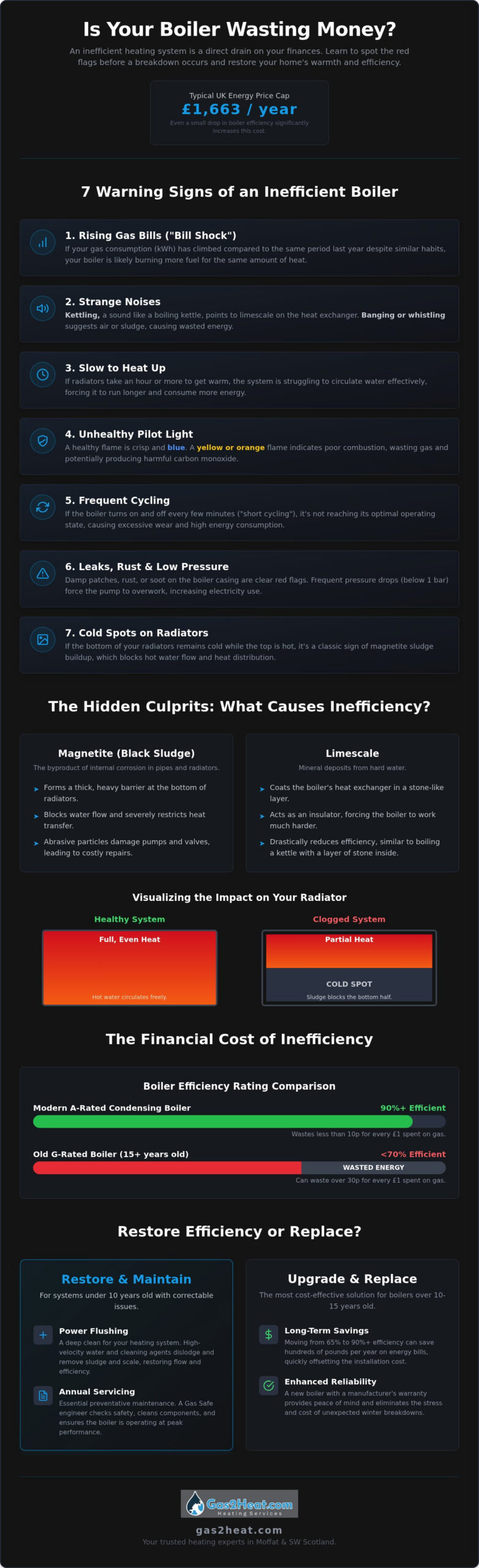
The first sign is often “Bill Shock.” Compare your gas consumption in kWh on your current statement to the same period last year. If your usage has climbed despite similar weather and habits, your boiler is likely burning more gas to produce less heat. With the 2026 energy price cap at £1,663 for typical households, even a small drop in efficiency adds up quickly.
Listen for strange noises. Kettling sounds like a boiling kettle and usually indicates limescale build-up on the heat exchanger. Banging or whistling suggests air pockets or internal sludge. These sounds aren’t just annoying; they represent energy wasted on friction and heat resistance. You should also monitor how long it takes for your home to get comfortable. If your radiators take an hour to warm up, the system is struggling to circulate water effectively. Finally, check the pilot light. A healthy flame is crisp and blue. A yellow or orange flame indicates poor combustion and is one of the most serious signs your boiler is inefficient.
Temperature Fluctuations and Cold Spots
If your boiler turns on and off every few minutes, it’s likely “short cycling.” This prevents the unit from reaching its most efficient operating state and puts immense strain on internal components. You might also notice cold spots at the bottom of your radiators. This is a classic symptom of magnetite sludge, which blocks the flow of hot water. A failing internal pump can also cause these fluctuations, forcing the boiler to run for longer cycles to hit the thermostat target. These issues drive up energy consumption while leaving your rooms feeling draughty.
Visual Red Flags on the Unit
Inspect the area around your boiler casing for damp patches or rust. Even small leaks cause pressure drops that force the system to work harder. Look for soot marks or dark staining on the exterior. These marks are clear signs your boiler is inefficient because they suggest the gas isn’t burning cleanly. Check your pressure gauge regularly. If it frequently falls below 1 bar, your system is losing water. This lack of pressure makes the pump work overtime, leading to higher electricity bills and potential component failure. Addressing these visual cues early can save you from a complete system replacement.
Why Do Boilers Become Inefficient? The Role of Sludge and Scale
Many homeowners assume the boiler unit is the only factor in their heating costs. In reality, the water circulating through your pipes and radiators determines how much fuel you burn. One of the most common signs your boiler is inefficient is actually a symptom of what’s happening inside your system’s hidden network. When water quality degrades, your boiler must work twice as hard to achieve the same temperature, leading to higher bills and unnecessary wear.
Two primary culprits cause this decline: magnetite and limescale. Magnetite, often called “black sludge,” is a byproduct of internal corrosion. As water reacts with the steel inside your radiators, tiny rust particles break off and settle. Limescale acts similarly in hard water areas, coating the heat exchanger in a layer of calcium. This component is the heart of your system. When it’s insulated by scale or sludge, heat transfer is severely restricted. It’s like trying to boil a kettle with a layer of stone at the bottom; you’ll use far more energy to get the job done.
The Science of Heating Sludge
Heating sludge isn’t just harmless dirt. It’s a heavy, metallic substance that settles in the lowest points of your system, usually the bottom of your radiators. This creates a thick barrier that prevents hot water from warming the entire surface of the radiator. Because the room stays cold, your thermostat keeps the boiler running for longer cycles. Beyond wasting gas, these abrasive particles act like liquid sandpaper. They travel into the boiler and damage expensive internal components like the pump and diverter valve. This leads to a cycle of declining performance and frequent, costly repairs.
The Power Flushing Solution
Power flushing is the most effective way to clear these blockages and restore your system to its original performance. This process involves using a specialized machine to circulate high-velocity water and cleaning chemicals through your pipes. It dislodges the magnetite and flushes it out of your home for good. If you’re looking for more ways to protect your budget, read our guide on improving heating efficiency for 2026. After a flush, we often recommend installing a magnetic system filter. This device captures new debris before it can reach the boiler, ensuring your system remains clean. If your radiators have cold spots, a professional power flushing service can often resolve the issue without the need for a full replacement.
Calculating the Cost of Inefficiency: Energy Ratings and Age
Financial transparency is the foundation of a smart home maintenance strategy. While previous sections explored physical blockages, the raw data of your boiler’s age and rating provides the most objective signs your boiler is inefficient. In 2026, with the energy price cap for typical households at £1,663, every percentage point of wasted fuel carries a heavy price tag. If your unit was installed over a decade ago, it likely lacks the condensing technology required to keep modern bills manageable.
The gap between old and new technology is often as wide as 20%. Non-condensing boilers, common before the mid-2000s, allow significant heat to escape through the flue pipe. Modern condensing models capture this heat and recycle it back into the system. With gas prices currently at 7.33p per kWh, a boiler operating at 70% efficiency means you are effectively throwing away 30p of every pound spent on heating. Over a single Scottish winter, these losses can total hundreds of pounds in wasted energy.
Understanding Modern Efficiency Standards
Modern units are measured by the ErP (Energy-related Products) directive, which replaced the older SEDBUK system. An A-rated boiler must deliver at least 92% efficiency. This high performance is often achieved through modulating burners. Unlike older “on or off” burners, modulating versions adjust the flame size to match the exact heat demand of your home. This prevents the wasteful fuel spikes associated with constant restarting. As 2026 regulations continue to focus on reducing household carbon footprints, maintaining these high standards is no longer optional for those looking to lower their bills.
The Hidden Cost of ‘Zombie’ Boilers
A “zombie” boiler is a unit that still functions safely but has become too expensive to run. It might not break down every week, but its internal components have degraded to the point where it consumes excessive gas to reach a basic temperature. You can check your specific model’s efficiency rating by searching the PCDB (Product Characteristics Database) online with your model number. Age is the primary driver of this decline; research suggests that after 10 years, even well-maintained boilers begin to see a drop in heat exchange effectiveness. This decline often coincides with an increase in repair frequency, where the cost of replacement parts starts to rival the price of a new, high-efficiency installation.
Maintenance vs. Replacement: When to Call a Gas Safe Engineer
Deciding whether to patch up an old unit or invest in a new one is a common dilemma for homeowners. If you’ve identified the signs your boiler is inefficient, your first step should always be a “Service First” approach. A professional inspection often reveals that your system doesn’t need a full replacement, but rather a targeted tune-up to restore its original performance. Regular expert boiler servicing is the most cost-effective way to extend the lifespan of your unit and keep your 2026 energy bills as low as possible.
There is, however, a tipping point where maintenance is no longer viable. If your repair bills over the last 12 months are mounting, or if a single repair costs more than half the price of a new installation, it’s time to upgrade. Modern boilers provide a level of reliability that older “zombie” units simply can’t match. To bridge the gap between these two options, many homeowners are turning to smart technology. Smart thermostats aren’t just for convenience; they act as a real-time health monitor for your entire heating system.
What Happens During an Efficiency Service?
A standard safety check is not the same as an efficiency service. During an efficiency-focused visit, a Gas Safe engineer will deep-clean the burner and heat exchanger to ensure optimal combustion. We also analyse the “delta T,” which is the temperature difference between the water leaving the boiler and the water returning to it. If this gap is too wide, it’s one of the clearest signs your boiler is inefficient. By checking gas pressure and flue gases, we can ensure that every penny you spend on fuel is being converted into heat rather than escaping through the chimney.
The Benefits of Smart Controls
Modern smart controls use load compensation technology to prevent energy waste. Instead of simply turning the boiler on and off, these systems tell the boiler exactly how much heat is needed to maintain a steady temperature. This prevents the “over-shooting” that wastes gas in traditional systems. For homes in Moffat and the surrounding areas, integrating these controls with existing systems provides a powerful way to combat harsh winters. You can spot efficiency drops immediately through your smartphone app, allowing you to call for a repair before a minor issue becomes a total breakdown. To ensure your system is running at peak performance, schedule your professional boiler servicing today with our local team.
Restoring Your Home’s Heating Efficiency in Moffat & SW Scotland
Living in the Scottish Borders and Dumfries and Galloway presents unique challenges for home heating. Our region’s harsh winters mean your system runs longer and harder than those in warmer climates. Recognising the signs your boiler is inefficient is the first step toward securing a warm, reliable home. For residents in these areas, local expertise isn’t just a preference; it’s a necessity. A technician from outside the area may not understand the specific demands placed on systems in our rural landscape. If your unit is struggling, exploring a professional boiler installation in Dumfries can provide the modern efficiency needed to withstand the local climate.
Gas2Heat.com Ltd understands the specific needs of SW Scotland homeowners and landlords. We focus on removing the uncertainty of trade services through transparent communication and reliable results. Whether you’re managing a single property in Moffat or a portfolio in Dumfries, maintaining peak efficiency is the most effective way to protect your investment. Our team of Gas Safe Registered engineers is specifically trained to handle the diverse heating configurations found throughout the region, from modern townhouses to traditional rural cottages.
Local Solutions for Local Homes
Rural areas like Lockerbie and Annan often rely on LPG or oil boilers rather than the standard gas grid. These systems have their own specific maintenance requirements and efficiency quirks. Regional water quality also plays a significant role in system health. In parts of the Scottish Borders, mineral content can lead to faster scaling in your heat exchanger, which is one of the primary signs your boiler is inefficient. Securing a local engineer for a rapid efficiency audit ensures these regional factors are taken into account. We check for the specific wear patterns common in SW Scotland homes, providing a more accurate assessment than a generic national service.
Next Steps for a Warmer Home
The focus on preventative maintenance and understanding specific wear patterns is essential for any high-value asset; for instance, you can learn more about how the family-run team at Angus MacKinnon applies similar expertise to ensure vehicle reliability.
This emphasis on regional knowledge is shared by other quality providers across the country; for instance, if you are located in the East of Scotland, you can visit Dundee Plumbing & Heating for specialized local assistance with boiler installations and maintenance.
Booking a performance assessment in Moffat or Dumfries is a straightforward process designed to respect your time. As a local, family-run heating specialist, we prioritise honesty over high-pressure sales. We’ll give you a clear breakdown of your system’s current health and provide actionable advice on whether to repair or replace. This professional transparency ensures you aren’t spending money on “zombie” boilers that will only fail again when the temperature drops. To secure your home’s comfort and start lowering your energy waste, request an efficiency check from Gas2Heat today and experience the benefit of regional expertise.
Secure Your Home’s Comfort and Efficiency
Addressing heating issues early is the most effective way to lower your household bills. If you’ve noticed unexplained gas usage spikes or noisy radiators, these are clear signs your boiler is inefficient. We’ve explored how internal sludge and outdated energy ratings directly impact your comfort and your wallet. Taking action now prevents a costly emergency when the SW Scotland winter truly takes hold.
Reliability starts with expert care. Our Gas Safe Registered engineers provide the technical authority needed to restore your system’s peak performance. As local Moffat and Dumfries specialists, we combine regional knowledge with transparent pricing and reliable service to remove the stress from your home maintenance. We focus on straightforward solutions that provide immediate results for your property.
Don’t let energy waste drain your household budget. Book a Boiler Efficiency Service with Gas2Heat today to ensure your home remains warm and cost-effective throughout 2026. You deserve a heating system that works as hard as you do. Secure your peace of mind and your home’s warmth with a single professional visit.
Frequently Asked Questions
Is it normal for my boiler to make a loud banging noise?
Loud banging is never a normal part of boiler operation. It usually points to a process called “kettling,” where limescale or sludge restricts water flow in the heat exchanger. This causes the water to overheat and turn into steam bubbles that pop loudly. These sounds are common signs your boiler is inefficient and struggling to transfer heat. Ignoring these noises can lead to permanent damage and significantly higher running costs.
How much can I save by upgrading to a high-efficiency condensing boiler?
Upgrading can bridge an efficiency gap of up to 20% or more. Older non-condensing models often operate at around 70% efficiency, meaning 30p of every pound spent is wasted. Modern A-rated condensing boilers deliver at least 92% efficiency by recycling heat that would otherwise escape through the flue. While we cannot promise exact savings figures for every home, the reduction in gas consumption is substantial for typical households in 2026.
Why are some of my radiators hot at the top but cold at the bottom?
Cold spots at the bottom of a radiator usually indicate a build-up of magnetite sludge. This heavy, black iron oxide settles at the base and prevents hot water from circulating through the entire radiator surface. Your boiler then has to run for longer to reach your thermostat’s target temperature. This is a classic symptom of system-wide neglect. A professional power flush is the most effective way to remove this debris and restore efficiency.
Does a boiler service actually make the system more efficient?
A professional service directly improves efficiency by ensuring the combustion process is clean and calibrated. Engineers clean the burner and heat exchanger, which are the core components responsible for transferring heat. Removing even a thin layer of soot or debris allows the boiler to burn less gas to achieve the same result. Regular servicing also identifies minor signs your boiler is inefficient before they develop into expensive, mid-winter breakdowns or total failures.
What is the most efficient temperature to set my boiler at?
For modern condensing boilers, setting your flow temperature to approximately 60°C to 65°C is often the most efficient choice. This allows the boiler to operate in “condensing mode” more frequently, which captures waste heat from the flue gases. If the temperature is set too high, the boiler won’t condense properly and your efficiency will drop. Experimenting with lower flow temperatures can lead to noticeable reductions in gas consumption without sacrificing your comfort.
How do I know if my boiler is G-rated or A-rated?
You can identify your boiler’s rating by checking the model number on the Product Characteristics Database (PCDB) online. Most boilers installed after 2005 are at least B-rated, while those from the last decade should be A-rated. If your unit is over 15 years old, it’s likely a G-rated model with an efficiency of 70% or less. Look for the ErP sticker on the casing of newer models for a quick visual confirmation.
Can a smart thermostat really lower my heating bills?
Smart thermostats lower bills by using load compensation to prevent the boiler from “over-shooting” your desired temperature. Instead of simple on-off cycles, they tell the boiler to modulate its flame based on real-time demand. These devices also provide data that helps you spot efficiency drops early. By ensuring your heating is only active when needed, you reduce total gas consumption. They are particularly effective when integrated with modern, high-efficiency boiler installations.
What happens if I ignore signs of boiler inefficiency?
Ignoring inefficiency leads to a cycle of rising costs and eventual system failure. Your monthly gas bills will continue to climb as the boiler works harder to compensate for internal blockages or worn components. This extra strain often results in a total breakdown during the coldest months when the system is under the most pressure. These common signs your boiler is inefficient are warnings that your system is becoming unsafe and overly expensive to operate.
