
Carbon Monoxide Detector Requirements Scotland: The 2026 Homeowner and Landlord Guide
Your property could be failing its next safety inspection even if you installed new alarms just a few years ago. Since the legislation change on February 1, 2022, understanding the precise carbon monoxide detector requirements Scotland mandates has become a critical priority for every homeowner and landlord. The law is clear: any room with a carbon-fuelled appliance, like a boiler or fire, must have a compliant alarm. It’s no longer just a recommendation; it’s a legal necessity that affects your insurance and your safety.
We understand that technical standards like EN 50291-1 can feel confusing, especially when you’re trying to figure out if your CO alarms need to be interlinked like your smoke detectors. It’s stressful to face a Landlord Gas Safety check when you aren’t 100 percent sure about mounting distances or battery types. This guide provides the peace of mind you need by breaking down the 2026 regulations into simple, actionable steps. You’ll get clear instructions for both DIY and professional installations, ensuring your home stays fully compliant and your family remains safe.
Key Takeaways
- Confirm your property meets the latest 2026 legal standards by understanding the core differences between the Tolerable and Repairing Standards.
- Identify exactly which rooms require protection by applying the “Combustion Rule” to your boilers, wood burners, and even hidden flues.
- Ensure your hardware is compliant with the carbon monoxide detector requirements Scotland enforces, including the mandatory BS EN 50291 technical standard.
- Avoid common installation errors by following the strict 300mm ceiling rule and specific wall-mounting heights for maximum sensor accuracy.
- Simplify your safety checks by integrating CO alarm verification into your next professional Landlord Gas Safety Certificate.
Current Carbon Monoxide Regulations in Scotland (2026 Update)
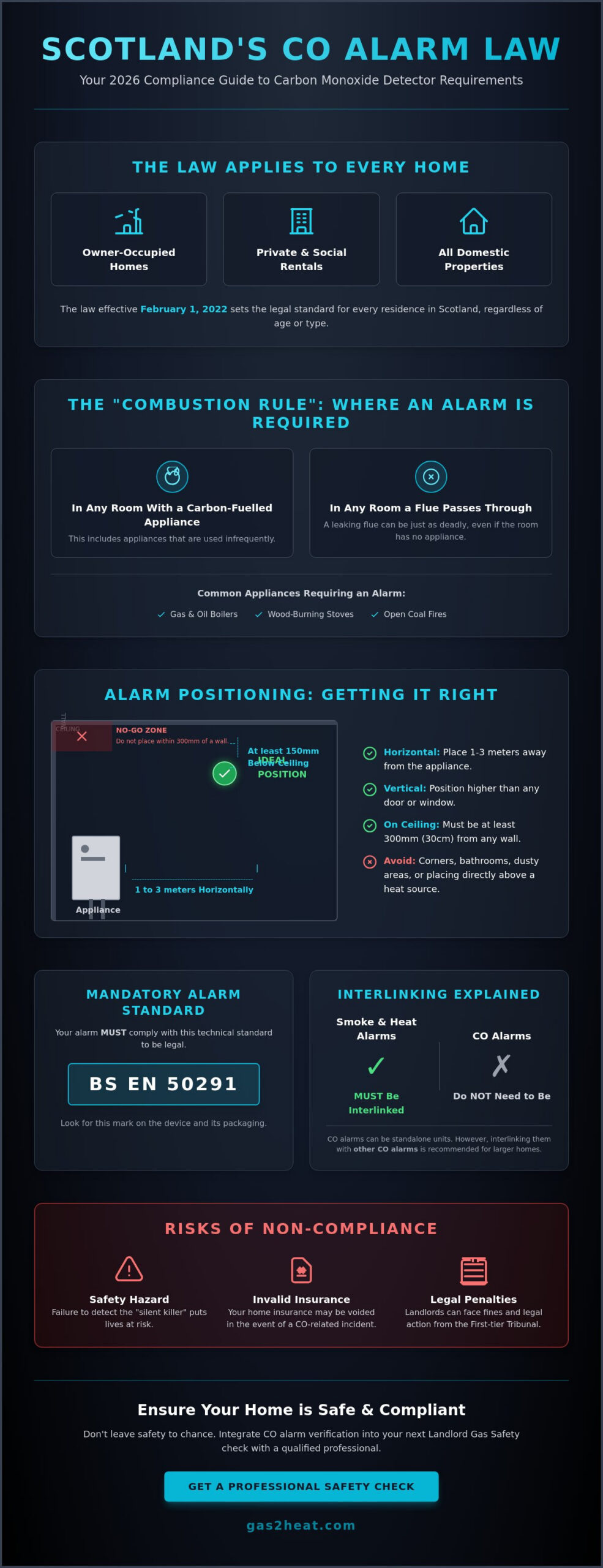
The legislation that came into force on February 1, 2022, set a new benchmark for home safety across the country. This law remains the gold standard in 2026. It ensures that every resident in Scotland has the same level of protection from the “silent killer.” Unlike previous years where rules varied by housing type, the current carbon monoxide detector requirements Scotland enforces apply to every single domestic property. This includes owner-occupied homes, private rentals, and social housing alike.
Compliance isn’t just a safety box-ticking exercise. It’s a legal obligation with real-world consequences. If your property doesn’t meet these standards, you face significant risks beyond just safety. Your home insurance could be invalidated in the event of a claim; leaving you financially vulnerable. For landlords, non-compliance can lead to penalties from the First-tier Tribunal or even legal liability. Understanding Carbon Monoxide Detector Technology helps you see why these sensors are vital. They detect an odorless, colorless gas that you simply cannot sense without professional equipment.
The Scottish Tolerable Standard Explained
The Tolerable Standard is the basic legal requirement for a house to be considered fit for habitation in Scotland. To meet this, your home must have a satisfactory system for detecting and giving warning of hazardous carbon monoxide concentrations. This requirement is triggered by any “fixed combustion appliance.” This includes your gas boiler, wood-burning stove, or open coal fire. Even if the appliance is rarely used, the law requires a functional alarm to be present. For landlords, these rules fall under the Repairing Standard. This means you must ensure the property is safe at the start of a tenancy and throughout its duration. Whether you live in a modern flat or a traditional cottage, the age of the building doesn’t exempt you from these carbon monoxide detector requirements Scotland has established.
Interlinking: What You Need to Know
There is often confusion about whether carbon monoxide alarms need to be interlinked with your smoke and heat alarms. The simple answer is no. While your fire safety system must be interlinked so they all sound at once, CO alarms can operate as standalone units. They don’t have to “talk” to your smoke detectors to be legal. However, for larger properties in areas like Moffat or Dumfries, choosing interlinked CO alarms is a smart move. If a boiler in a remote utility room leaks, an interlinked system will alert you in the bedroom immediately. You can identify your current setup by checking for a wireless pairing button or a hardwired connection between units. Integrated systems offer the highest level of peace of mind for families and tenants alike.
Which Rooms and Appliances Require a CO Alarm?
Identifying the risk zones in your property is the first step toward full legal compliance. The central principle is the “Combustion Rule.” This means any space housing an appliance that burns carbon-based fuel requires a detector. Under the carbon monoxide detector requirements Scotland enforces, this covers gas boilers, oil-fired boilers, wood-burning stoves, and open coal fires. It’s a comprehensive approach to safety that leaves no room for guesswork. You can find the full details of these mandates in the Scottish Government Fire Alarm Law, which outlines the necessity for protection in every high-risk room.
Don’t overlook the path of your exhaust gases. If a boiler flue travels through a bedroom or a cupboard in a hallway, that specific area must have its own CO alarm. This is a common point of failure during safety inspections. In many multi-storey homes across Dumfries and Galloway, flues are routed through upper floors to reach the roof. Each room the flue passes through becomes a mandatory zone for detection. Even if there’s no appliance in that room, a leaking flue can be just as deadly. Ensuring these spaces are monitored is vital for protecting your family while they sleep.
Fixed Combustion Appliances vs. Portable Heaters
Your central heating boiler is the most common trigger for a CO alarm. Whether it’s tucked away in a kitchen cupboard or located in a utility room, it needs a sensor nearby. Wood-burning stoves and biomass heaters are also high-risk categories that require permanent detection. Gas fires in your main living areas must have their own alarms too. While portable gas heaters aren’t technically “fixed” appliances, they still produce combustion gases. We strongly suggest keeping a detector in any room where they’re used for extended periods. It’s a simple step that provides an extra layer of security for your household.
The Gas Cooker and Hob Exception
One of the most frequent questions we receive is about kitchen appliances. In Scotland, gas hobs and ovens are currently exempt from the mandatory CO alarm rule. The logic behind this is based on usage patterns; cooking is typically a short-term, supervised activity compared to a boiler running constantly. While it isn’t a legal requirement, many residents still choose to install one for total peace of mind. If you have a high-output range cooker, Gas2Heat.com Ltd still recommends adding a detector to your safety checklist. If you’re currently organizing a boiler installation, our team can help you position your alarms correctly from day one to ensure you meet all carbon monoxide detector requirements Scotland demands.
Technical Standards: BS EN 50291 and Alarm Specs
Compliance starts with the hardware you choose. To meet the carbon monoxide detector requirements Scotland mandates, every alarm must carry the BS EN 50291 mark. This isn’t just a label; it’s a guarantee that the device has passed rigorous testing for sensitivity and durability. You’ll find these specifics detailed in the Scottish government fire safety laws. Using substandard or uncertified hardware can leave you legally exposed and physically unsafe. Ensure the packaging or the device itself clearly displays this British Standard number before you begin the installation process.
The 2026 standards prioritize long-term reliability through the “sealed for life” rule. Gone are the days of swapping out 9V or AA batteries every year. Modern compliant alarms must feature a sealed, tamper-proof lithium battery designed to last for the duration of the sensor’s life, which is typically 10 years. If your current detector has a battery door that opens easily, it likely doesn’t meet the current legal criteria for new installations or replacements. This shift reduces the risk of alarms being disabled by tenants or failing due to forgotten battery changes.
Battery-Powered Alarms (Type B)
Type B units are standalone, battery-powered devices. They’re often the go-to choice for retrofitting because they don’t require new cabling through your walls or ceilings. For rental properties in the Borders, these alarms must include tamper-proof features to prevent the battery from being removed. We recommend choosing units with a 10-year lifespan to minimize maintenance visits. While replaceable AA batteries were common in the past, they’re now insufficient for meeting the strict legal compliance required for modern Scottish homes.
Mains-Powered Alarms (Type A)
Type A units are hard-wired directly into your home’s electrical circuit. They’re incredibly reliable because they don’t rely solely on a battery, though they must still have a battery backup for power cuts. Crucially, these cannot be “plug-in” types that use a standard wall socket. They must be permanently wired by a professional. These units are also required to have a sensor failure warning device. This ensures that if the internal electrochemical sensor fails before the power does, you’ll be alerted immediately to the malfunction.
Every compliant alarm must also feature an end-of-life warning signal. Carbon monoxide sensors use an electrochemical process that eventually wears out. Once the sensor reaches its limit, the device will emit a distinct alert, usually a specific beep or a flashing light. This tells you the unit is no longer capable of protecting you and must be replaced immediately. Ignoring this signal is a major safety risk and a breach of your legal duties as a homeowner or landlord. Checking these signals during a regular boiler servicing appointment is a great way to stay ahead of equipment failure.
Professional Installation and Positioning Rules
Precision is everything when it comes to life-saving equipment. Even the most expensive sensor is useless if it’s placed in a “dead air” zone where carbon monoxide cannot reach it. To comply with the carbon monoxide detector requirements Scotland mandates, you must follow specific distance rules. These measurements ensure that the alarm triggers at the earliest possible moment; giving you and your family the time needed to evacuate safely. Don’t leave your safety to guesswork when a few centimeters can make all the difference.
If you’re mounting your alarm on the ceiling, the 300mm rule is your primary guide. You must place the detector at least 300mm away from any wall or light fitting. This prevents the unit from being caught in stagnant air pockets that naturally form in corners. For those choosing to wall-mount their devices, the positioning is equally strict. The alarm should be at least 150mm below the ceiling but positioned higher than any door or window in the room. This ensures the sensor is in the path of rising warm air which often carries the gas.
Horizontal distance from the appliance is the third critical factor. You should install the alarm between one and three metres away from the boiler, fire, or stove. Placing it closer than one metre can lead to nuisance alarms caused by tiny, harmless amounts of gas released during startup. Placing it further than three metres risks a delayed response. If you’re unsure about the layout of your utility room or kitchen, it’s best to book a professional boiler servicing appointment to have a qualified engineer verify your alarm placement.
Ceiling vs. Wall Mounting
Ceiling mounting is generally preferred for central boiler rooms or large kitchens as it provides 360-degree detection. However, in living rooms with open fires or wood burners, wall mounting is often more practical. It allows the alarm to sit at a height where it can quickly catch gases drifting from the hearth. Always prioritize the manufacturer’s specific instructions, but remember that the carbon monoxide detector requirements Scotland enforces are the absolute legal minimums you must meet for insurance and safety compliance.
Avoiding Nuisance Alarms
False alarms are more than just an annoyance; they often lead to people disabling their safety devices. To prevent this, never place a detector directly above a heat source like a radiator or the boiler itself. Keep sensors away from damp areas, such as directly next to a sink, and at least two metres away from extractor fans. Finally, test the volume from your bedrooms. If a boiler in the kitchen triggers an alarm, you must be able to hear it through closed doors to ensure everyone wakes up in an emergency.
Gas Safety and Compliance with Gas2Heat.com Ltd
Managing the various carbon monoxide detector requirements Scotland demands doesn’t have to be a solo effort. Gas2Heat.com Ltd specializes in making safety simple by integrating full alarm audits into our standard service visits. For property owners in Moffat and Dumfries, we ensure that every sensor is compliant with 2026 standards during our routine work. This proactive approach eliminates the stress of managing multiple maintenance schedules while ensuring your home or rental property remains a safe environment for everyone inside. We focus on removing the uncertainty typically associated with trade services through clear promises and straightforward results.
An annual boiler service is the perfect opportunity to upgrade your detection hardware. While our Gas Safe registered engineers inspect your appliance, they also verify the age, positioning, and battery life of your CO alarms. If your current setup is outdated or fails to meet the “sealed for life” battery rule, we can install compliant units on the spot. This saves you the time and expense of booking separate tradespeople. It also guarantees that your protection is as modern as your heating system; providing a reliable layer of security for your household.
Landlord Compliance Packages
Streamline your legal duties with our comprehensive landlord safety bundles. We combine the mandatory Landlord Gas Safety Certificates with smoke, heat, and CO alarm testing in a single, efficient visit. This ensures your property fully adheres to the Repairing Standard without hassle. After the check, you’ll receive a digital certificate for your records. This makes it easy to prove compliance to local authorities or letting agents across SW Scotland. Our tech-enabled approach to scheduling means you get your documentation quickly and without complications.
Homeowner Peace of Mind
Safety and performance go hand in hand. Our local engineers provide expert advice on improving heating efficiency while ensuring your home meets all safety regulations. We understand the specific needs of Borders homes, from traditional stone cottages to modern builds. Our pricing is transparent and our process is straightforward. You get a reliable service that respects your time and prioritizes your family’s protection. We avoid the coldness of large corporations by maintaining a professional yet approachable feel; focusing deeply on your convenience and safety.
Our commitment to Scottish safety standards is absolute. Every engineer at Gas2Heat.com Ltd is Gas Safe registered; meaning they’re legally qualified to work on your gas appliances and advise on CO safety. We don’t just install hardware; we provide a professional assessment of your entire combustion setup. This includes checking flues and ventilation points that often go overlooked in DIY installs. By choosing a professional service, you ensure that your carbon monoxide detector requirements Scotland compliance is verified by an expert who understands the life-saving importance of these regulations. This creates a sense of momentum and ease in securing your home’s future.
In Dumfries and Galloway, the regional climate and housing stock present unique challenges. Our engineers are familiar with the specific boiler models and flue configurations common in this area. This local knowledge allows us to spot potential issues before they become hazards. We focus on rapid fulfillment and clear communication, so you’re never left wondering about the status of your safety checks. From the moment you book until the final certificate is issued, Gas2Heat.com Ltd provides a streamlined, honest service that removes the complexity from home maintenance.
Secure Your Home with Professional Compliance
Meeting the carbon monoxide detector requirements Scotland mandates is about more than just avoiding legal penalties; it’s about protecting your household from a silent, invisible threat. You now have the knowledge to identify which rooms require sensors based on the “Combustion Rule” and why choosing hardware that meets the BS EN 50291 standard is essential. Remember that precise positioning, such as following the 300mm ceiling rule, ensures your equipment works exactly when you need it most. These small technical details are what stand between a failed inspection and total peace of mind.
As family-owned SW Scotland specialists, Gas2Heat.com Ltd is here to help you navigate these regulations with total confidence. Our Gas Safe Registered Engineers provide expert installation and verification during every routine visit. We back our work with a transparent pricing guarantee; ensuring you get professional service without any hidden costs or unexpected complications. Don’t leave your property’s safety to chance when expert help is just a click away. Book Your Gas Safety Check with Gas2Heat.com Ltd Today to ensure your property remains legal and your family stays safe. Taking these simple steps today provides lasting security for your home’s future.
Frequently Asked Questions
Do I need to interlink my carbon monoxide alarms in Scotland?
No, you don’t need to interlink your carbon monoxide alarms with your fire safety system. While Scottish law mandates that smoke and heat alarms must be interlinked so they all sound simultaneously, CO detectors can remain standalone units. Many homeowners choose to interlink them for extra safety in larger properties, but it isn’t a legal necessity for compliance under the current 2026 regulations.
What is the specific British Standard for CO detectors in 2026?
Every alarm must comply with British Standard BS EN 50291-1. This specific certification guarantees that the sensor is capable of detecting hazardous gas levels accurately over a long period. When checking your devices, look for this standard number printed on the casing or the packaging. Using uncertified hardware will result in a failure during a professional safety check and could invalidate your home insurance.
Does a gas hob require a carbon monoxide detector under Scottish law?
Gas hobs and ovens are currently exempt from the mandatory detection rules in Scotland. The legislation focuses on fixed combustion appliances like central heating boilers, gas fires, and wood burners which run for longer periods. However, we still recommend installing a detector in kitchens with high-output gas ranges for total peace of mind. It’s a low-cost way to ensure your cooking area remains as safe as the rest of your home.
How often should I test my carbon monoxide alarm?
You should test your carbon monoxide alarms at least once every month. Use the dedicated test button to ensure the audible siren is loud enough to be heard in bedrooms and that the internal sensor is functioning. If you have a sealed-battery unit, check the “replace by” date on the side of the casing. Regular testing is the only way to guarantee the device will perform during a real emergency.
Can I use a plug-in carbon monoxide detector in a rental property?
No, plug-in detectors that use a standard wall socket are not permitted for meeting the carbon monoxide detector requirements Scotland enforces for rentals. These units are too easily unplugged or moved by tenants; leaving the property unprotected. You must install either a hard-wired alarm or a unit with a tamper-proof, sealed lithium battery that lasts for the full 10-year life of the sensor.
What should I do if my CO alarm starts beeping intermittently?
First, determine if the beep is a warning or an emergency alarm. An intermittent chirp every minute usually signals that the battery is low or the sensor has reached its end-of-life and needs replacement. If the alarm sounds continuously, you must evacuate the property immediately and call the National Gas Emergency Service. Never ignore any beeping from your CO detector; it’s designed to be your final line of defense.
Where is the best place to install a CO detector in a room with a boiler?
The optimal position is on the ceiling or a wall between 1 and 3 metres from the boiler. If you choose a ceiling mount, ensure the unit is at least 300mm away from any wall to prevent it from being stuck in dead air where the gas might not reach the sensor. For wall mounts, place the device higher than any door or window but at least 150mm below the ceiling.
Are landlords responsible for the cost of CO detectors in Scotland?
Yes, landlords are entirely responsible for the cost of providing and maintaining these devices. Under the Repairing Standard, it’s your legal duty to ensure the property is safe for tenants at all times. This includes the initial purchase of compliant hardware and any necessary replacements when sensors expire. Failing to meet these carbon monoxide detector requirements Scotland mandates can lead to significant legal penalties and issues with your landlord registration.
