
The Ultimate Boiler Fault Finding Guide: Diagnosing Heating Issues in 2026
Last Tuesday, a homeowner in Moffat woke up to a freezing house and a cryptic error code flashing on their boiler screen. It’s a stressful situation that often leads to frantic searches through dusty manuals or worrying about the potential cost of a call-out. Most people feel overwhelmed by these technical glitches during a cold Scottish winter. You’re not alone in wanting a quick, clear answer without the confusion.
This boiler fault finding guide helps you decode those signals, identify simple fixes you can handle safely, and recognize exactly when it’s time to bring in a Gas Safe professional. We’ll walk through the logical sequence of boiler operation to help you regain control of your home’s comfort and peace of mind. Whether you are in Dumfries or the surrounding valleys, understanding your system is the first step toward a warm home. Our expert-led approach focuses on transparency and efficiency, ensuring you have the facts needed to make an informed decision about your heating repairs.
Key Takeaways
- Understand the boiler’s start-up sequence to identify exactly where the heating process is interrupted.
- Learn how to fix common issues like low system pressure and thermostat signal drops safely and quickly.
- Use this boiler fault finding guide to decode digital error codes and understand the severity of any lockout.
- Recognize the legal and safety boundaries that dictate when you must contact a Gas Safe registered engineer.
- Discover how professional diagnostics and proactive servicing prevent recurring faults and extend your boiler’s lifespan.
Understanding Boiler Faults and Digital Error Codes
A boiler fault is rarely a random event. It’s a calculated safety or performance interruption triggered by the system’s internal logic. When a component fails to meet specific parameters, the boiler enters a “lockout” state to prevent internal damage or hazardous conditions. To grasp why this happens, it helps to understand What is a Boiler? and how it functions as a pressurized, fuel-burning appliance. This boiler fault finding guide helps you interpret these signals before you spend money on unnecessary call-outs.
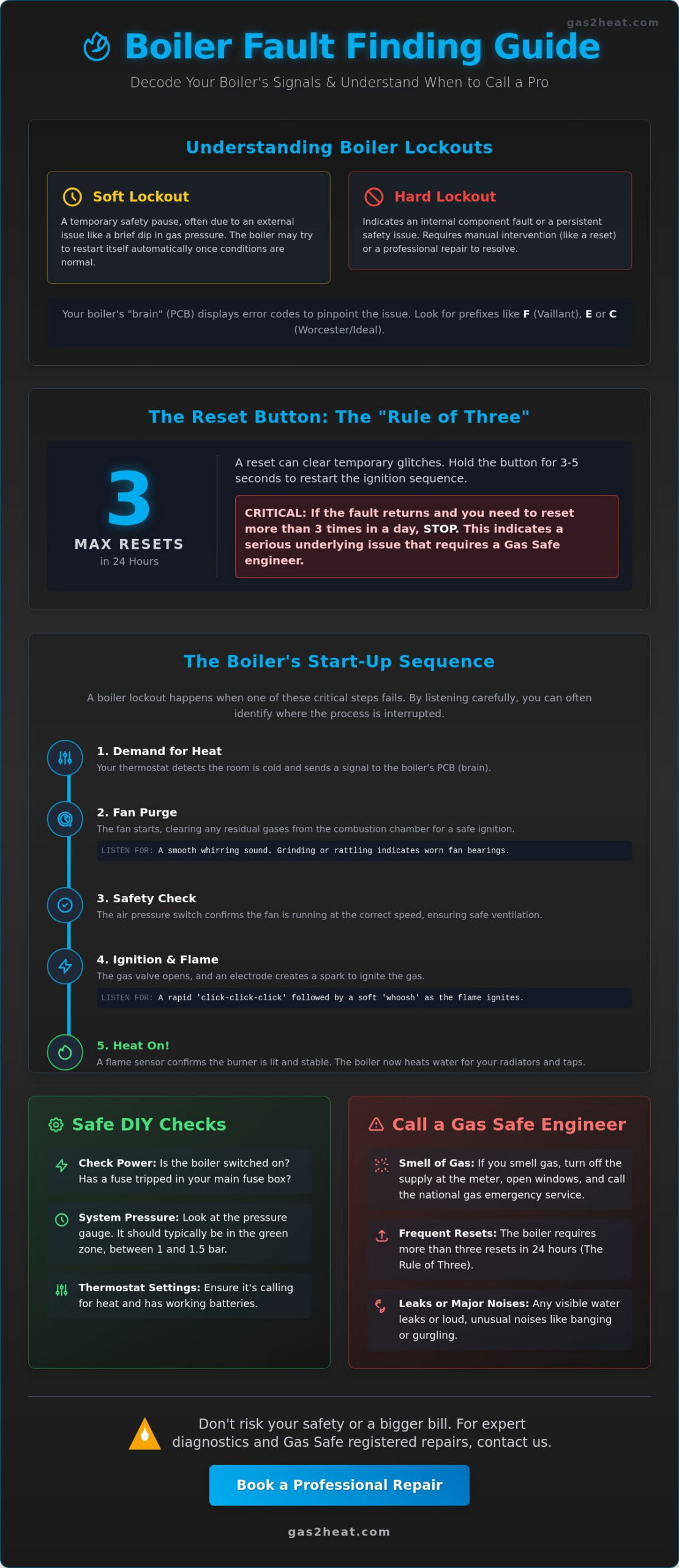
The Printed Circuit Board (PCB) serves as the “brain” of your heating system. It monitors every sensor, from the water pressure switch to the flame-sensing electrode. If any part of the start-up sequence fails, the PCB halts the process and generates an error code. These codes, such as E119 or F28, act as diagnostic shorthand. They allow engineers to pinpoint the exact location of the failure without stripping the entire unit. Understanding these codes helps you determine if you’re facing a “soft” lockout, which might resolve itself, or a “hard” lockout that demands manual intervention. A soft lockout often clears once conditions return to normal, while a hard lockout requires a manual reset or repair.
Decoding Common Manufacturer Symbols
Modern displays use symbols and lights to communicate status. A flashing red light usually indicates a critical fault that has stopped the boiler entirely. Static codes are often less urgent but still require attention. Major brands use specific prefixes that help identify the source of the trouble. Vaillant typically uses “F” (Fault) codes, while Ideal and Worcester Bosch often utilize “E” or “C” prefixes. Always keep your physical user manual in a pocket or shelf near the boiler unit. While digital resources are helpful, the manufacturer’s original documentation is the final authority on brand-specific quirks. This boiler fault finding guide is a supplement to, not a replacement for, those technical specifics.
The Role of the Reset Button
Resetting your boiler is a simple process, but it shouldn’t be your default solution for every problem. Most units require you to hold the reset button for three to five seconds. This clears the PCB’s current error memory and attempts a fresh start-up sequence. It’s effective for clearing temporary glitches caused by external factors like a brief dip in gas pressure. However, you must follow the “Rule of Three.” If your boiler requires more than three resets in a 24-hour period, stop. A boiler that needs constant resetting is a safety hazard. It indicates a deeper mechanical issue that could lead to dangerous gas build-ups or total component failure if ignored.
The Sequence of Operation: How Your Boiler Should Work
Think of your boiler as a relay race. Each component must finish its task before handing the baton to the next. If the runner stops, the race ends. This boiler fault finding guide focuses on the sequence of operation because it’s the most reliable way to diagnose a lockout. By listening to the sounds your unit makes, you can often identify the failing part before an engineer even arrives at your door. It removes the guesswork and helps you communicate clearly with a technician.
A healthy start-up follows a strict logic: Demand, Fan, Air Pressure Check, Spark, and finally, Flame. When your boiler “stalls,” it’s because one of these steps failed to verify. For example, if you hear the fan whirring but never hear a click, the system is stuck waiting for air pressure confirmation. This systematic approach is a core part of any professional Boiler Maintenance Schedule, ensuring every safety check is met before gas enters the chamber.
Stage 1: The Demand and Fan Start
Everything starts with a signal from your thermostat. Once the “demand” for heat is received, the PCB activates the fan. You should hear a distinct whirring sound. The fan’s job is vital; it clears out any residual flue gases to ensure a clean, safe environment for ignition. If you hear silence, the fan might be seized or the PCB isn’t sending the signal. A loud grinding or vibrating noise often points to worn bearings. Identifying these sounds early can save you from a total system failure during a cold Scottish winter. If you notice these symptoms, it’s a good time to consider boiler servicing to prevent a full breakdown.
Stage 2: Ignition and Flame Sensing
Once the fan reaches the correct speed, the air pressure switch closes. This tells the boiler it’s safe to introduce fuel. You’ll hear a rapid “click-click-click” followed by a muffled “whoosh” as the gas ignites. This is the moment the gas valve opens and the electrodes produce a spark. If you hear the clicking but no flame follows, you likely have a gas supply issue or a dirty electrode. The boiler then uses a flame sensor to confirm heat is present. If this sensor, or thermocouple, is covered in carbon soot, it won’t detect the flame and will shut the system down for safety. Narrowing the fault down to this specific stage helps determine if the issue is a simple cleaning job or a more complex component failure.
Common Boiler Faults You Can Safely Check Yourself
Many heating interruptions don’t require a toolbag or a technical degree to resolve. While the sequence of operation discussed earlier helps you understand internal logic, several external factors frequently cause a system lockout. This boiler fault finding guide focuses on the checks you can perform safely without opening the boiler casing. Identifying these simple issues first can save you time and the cost of a professional call-out.
- Thermostat and Programmer: Check the display on your wall controller. If it’s blank, replace the batteries immediately. Wireless thermostats can also lose their signal connection; try moving the unit closer to the boiler to see if the link restores.
- Radiator Air Pockets: If your boiler is running but the radiators are cold at the top, you likely have trapped air. Use a radiator key to bleed them. This simple maintenance task often resolves “noisy boiler” complaints and improves efficiency.
- Gas Supply: Verify that other gas appliances, like a hob or gas fire, are working. If they aren’t, the issue is with your gas meter or supply line rather than the boiler itself.
How to Re-pressurise Your Boiler
Low system pressure is the most frequent cause of boiler lockouts in Moffat homes. Locate the pressure gauge on the front of your boiler or underneath the unit. For most modern systems, the needle should sit between 1 and 1.5 bar when the heating is cold. If the needle is below 1 bar, your boiler will likely shut down to protect the heat exchanger. To fix this, locate the filling loop, which is usually a flexible silver hose with two small valves. Open both valves slowly; you will hear water entering the system. Watch the gauge carefully and close the valves once the needle reaches 1.5 bar. Ensure the valves are fully closed to prevent over-pressurising the system. If the pressure drops again within a few days, you may have a slow leak that requires professional attention.
Thawing a Frozen Condensate Pipe
During a Dumfries & Galloway cold snap, your boiler might shut down and display a “condensate fault” code. This happens when the external plastic pipe that carries waste water away freezes solid. Locate the white plastic pipe on your external wall. If it’s blocked with ice, the boiler cannot drain and will stop working. You can resolve this by pouring warm water, never boiling water, over the frozen section of the pipe. Alternatively, use a hot water bottle or a heat wrap to gently thaw the blockage. Once the ice melts, reset your boiler to restore heating. To prevent this from happening again, consider fitting weather-proof foam insulation to the external pipework.
When a Fault Requires a Gas Safe Registered Engineer
Safety is the absolute priority. While previous sections of this boiler fault finding guide covered external checks, the legal boundary stops at the boiler casing. You must never unscrew the front panel yourself. Inside, you’re dealing with live electricity, pressurized water, and combustible gas. Opening the unit without a Gas Safe qualification is illegal and dangerous. It can also void your home insurance or manufacturer warranty. This guide helps you identify the problem, but a professional must execute the fix.
Immediate action is required if you smell gas, often described as a “rotten egg” scent. Turn off the gas supply at the meter, open all windows, and leave the property. Don’t flip any light switches or use electrical appliances, as a single spark could trigger an explosion. Similarly, if you notice a small drip inside the unit, don’t ignore it. Even a minor internal water leak can ruin the PCB (Printed Circuit Board). A small leak can quickly turn a simple seal replacement into a costly electronic repair if water hits the circuitry.
The Dangers of DIY Gas Work
Carbon monoxide is a colorless, odorless gas that can kill without warning. Faulty combustion or a poorly fitted flue can lead to CO poisoning, which is why professional servicing is non-negotiable. UK legislation requires anyone performing gas work to be on the Gas Safe Register. This protects you from incompetent work that could lead to fires or leaks. Always check an engineer’s ID card before they start. It should show their photo, a valid expiry date, and the specific types of gas work they are qualified to handle. You can verify these details on the official register to ensure your home remains safe.
Complex Component Failures
Some faults are purely mechanical and require specialized tools. If your boiler runs but your radiators stay cold, the diverter valve has likely seized. This part directs hot water to either your taps or your heating system. Another common sign of trouble is “kettling,” a loud whistling or banging sound. This usually indicates a blockage in the heat exchanger caused by limescale or sludge. In these cases, power flushing is often the most effective solution to restore flow and efficiency. Components like fans and gas valves also require professional multimeters to test for electrical continuity. If these parts fail, they must be replaced by a qualified technician to ensure the system remains sealed and safe.
If your boiler is showing a hard lockout or making unusual noises, book a professional boiler repair today to get your heating back online quickly and safely.
Professional Boiler Repairs and Long-Term Solutions in SW Scotland
Following the steps in this boiler fault finding guide gives you a significant advantage when your heating fails. You now understand the difference between a simple pressure drop and a complex component failure. While DIY checks are helpful, most internal faults require the precision and legal authority of a professional. For homeowners also looking into future-proof energy options, Jelvis provides expert insights into how renewable technologies can work alongside traditional heating. At Gas2Heat.com Ltd, we combine advanced diagnostic technology with deep local expertise to resolve lockouts quickly. We prioritize your comfort and safety, ensuring your home in Moffat or Dumfries returns to temperature without delay.
Most boiler breakdowns are entirely preventable. Regular annual boiler servicing is the most effective way to catch minor issues before they become expensive repairs. Our engineers perform a comprehensive check of your system’s “brain” and mechanical parts, cleaning the burner and testing safety devices. This proactive approach keeps your energy bills low and ensures your manufacturer warranty remains valid. It’s a small investment that provides long-term peace of mind and prevents the stress of a sudden winter breakdown.
Every boiler eventually reaches a point where repairs are no longer the most cost-effective path. If your unit is over 12 years old and requires frequent parts, you’ve likely reached the “tipping point.” We provide honest, transparent advice on whether a repair or a new boiler installation is your best option. Modern A-rated systems offer up to 94% efficiency, which means they often pay for themselves through reduced gas consumption. We help you calculate these savings so you can make an informed decision for your property.
Why Choose Gas2Heat.com Ltd for Your Repair?
Our team lives and works in the Borders, giving us a unique understanding of the local conditions that affect your heating. We offer a streamlined, tech-enabled service that respects your time and removes the uncertainty often associated with trade services.
- Local Expertise: We understand the specific water and climate challenges in Moffat, Dumfries, and the surrounding valleys.
- Gas Safe Certified: Our fully registered team follows the highest safety standards for every diagnostic and repair task.
- Benefit-First Approach: We aim to fix your existing boiler whenever it’s safe and sensible, protecting your bank balance.
- Transparent Pricing: You’ll receive clear information and straightforward promises with no hidden complications.
Booking Your Diagnostic Visit
Restore your heating quickly by providing our team with your boiler’s model name and the specific error code you’ve identified. This information allows our engineers to arrive at your home in Lockerbie or Annan with the likely spare parts already in the van. We focus on rapid fulfillment and high-quality workmanship to get your hot water running again. Our process is designed for your convenience, from the initial call to the final safety check. Contact Gas2Heat.com Ltd today for expert boiler repairs in SW Scotland and experience a modern, reliable approach to home maintenance.
Secure Reliable Heating for Your Home
Understanding your system’s sequence of operation turns a stressful breakdown into a manageable situation. You’ve learned how to identify low pressure and frozen pipes safely while recognizing the critical moment to call for professional help. This boiler fault finding guide ensures you never have to guess about the safety or efficiency of your heating. By identifying faults early, you protect your boiler’s components and your household’s peace of mind.
Gas2Heat.com Ltd is a local Moffat-based family business dedicated to keeping South West Scotland warm. Our Gas Safe Registered Engineers provide expert diagnostics with transparent pricing guarantees. We remove the uncertainty of trade services through clear communication and rapid response times. Don’t let a cryptic error code leave you in the cold during a harsh winter.
Book a Professional Boiler Diagnostic in South West Scotland with Gas2Heat.com Ltd
Take the first step toward a warmer, more efficient home today. Our team is ready to provide the honest, expert support you deserve.
Frequently Asked Questions
Is it safe to reset my boiler if it shows an error code?
It is generally safe to reset your boiler once or twice to see if a minor glitch clears. However, if the error code returns immediately or requires constant resetting, you should stop. Repeatedly resetting a faulty system can bypass safety protocols and lead to more serious component damage. If the lockout persists, consult a professional to identify the underlying issue.
Why does my boiler pressure keep dropping every few days?
Persistent pressure loss usually indicates a slow leak in your pipework or a failing expansion vessel. Even a tiny drip from a radiator valve can cause the system to lose pressure over several days. If you have topped up the pressure using this boiler fault finding guide and it still drops, an engineer needs to inspect the internal seals and pressure relief valve.
Can I change a boiler part myself if I buy it online?
No, it is illegal and dangerous for an unqualified person to replace internal boiler components. Any work that requires removing the boiler casing must be performed by a Gas Safe registered engineer. Attempting a DIY repair voids your warranty and can lead to carbon monoxide leaks or fires. Always prioritize your safety and legal compliance by hiring a certified professional.
How much does a typical boiler fault diagnosis cost in Dumfries?
Diagnostic costs in South West Scotland vary depending on the complexity of the issue and the time required for testing. Most professional firms provide a transparent fee structure for the initial investigation. It is best to request a clear estimate that covers the engineer’s expertise and diagnostic tools before the visit begins to ensure there are no surprises.
What should I do if I smell gas near my boiler?
Evacuate the property immediately and turn off the gas supply at the meter if it is safe to do so. Do not use any electrical switches, lighters, or phones inside the building, as these can trigger an explosion. Once outside, call the National Gas Emergency Service and a Gas Safe professional to locate and repair the leak safely.
Why is my boiler making a loud banging or whistling noise?
Loud banging or whistling, often called “kettling,” is typically caused by a buildup of limescale or sludge in the heat exchanger. This debris restricts water flow, causing the water to overheat and turn into steam. A professional power flush is often required to clear the system and restore quiet, efficient operation to your heating system.
How long does a boiler repair usually take?
Most common boiler repairs are completed within one to three hours if the engineer has the necessary parts on their van. More complex issues, such as replacing a heat exchanger or PCB, may take longer or require a follow-up visit. Providing your boiler model and error code in advance helps our team prepare and speeds up the repair process significantly.
