

7 Signs Your Radiators Need Flushing: The 2026 Homeowner’s Guide to Heating Efficiency
Did you know that 28% of UK homeowners now report “repair anxiety,” fearing that an unexpected boiler failure will disrupt both their finances and their comfort? If you’re noticing cold spots in your home, a central heating power flush Dumfries specialists provide is often the most effective way to stop internal corrosion from damaging your system. It is a common issue in our local stone-built properties, where older pipework often struggles to keep up with the demands of modern high-efficiency boilers.
You’ve likely felt the frustration of turning up the thermostat only to find your radiators remain cold at the bottom while your gas bills continue to climb. It is stressful to pay more for a home that doesn’t actually feel warm. In this 2026 guide, Gas2Heat.com Ltd will help you identify the seven critical warning signs of system sludge and explain exactly how the powerflushing process works. You will learn how to clear out blockages to restore your home’s warmth, lower your monthly energy costs, and protect your boiler investment for years to come.
Key Takeaways
- Identify the seven critical warning signs of system sludge, including radiators that remain cold at the bottom or take significantly longer to heat up.
- Understand the science behind magnetite and how this black iron oxide creates blockages that force your boiler to work harder and more expensively.
- Compare maintenance methods and learn why a professional central heating power flush Dumfries experts provide is superior to messy manual radiator cleaning.
- Discover the professional flushing process, including how thermal imaging and high-velocity pumps restore your system without the need for radiator removal.
- Learn how to lower your monthly gas bills and protect your long-term boiler investment by restoring your heating system to its peak efficiency.
How to Tell If Your Radiators Need Flushing: 7 Warning Signs
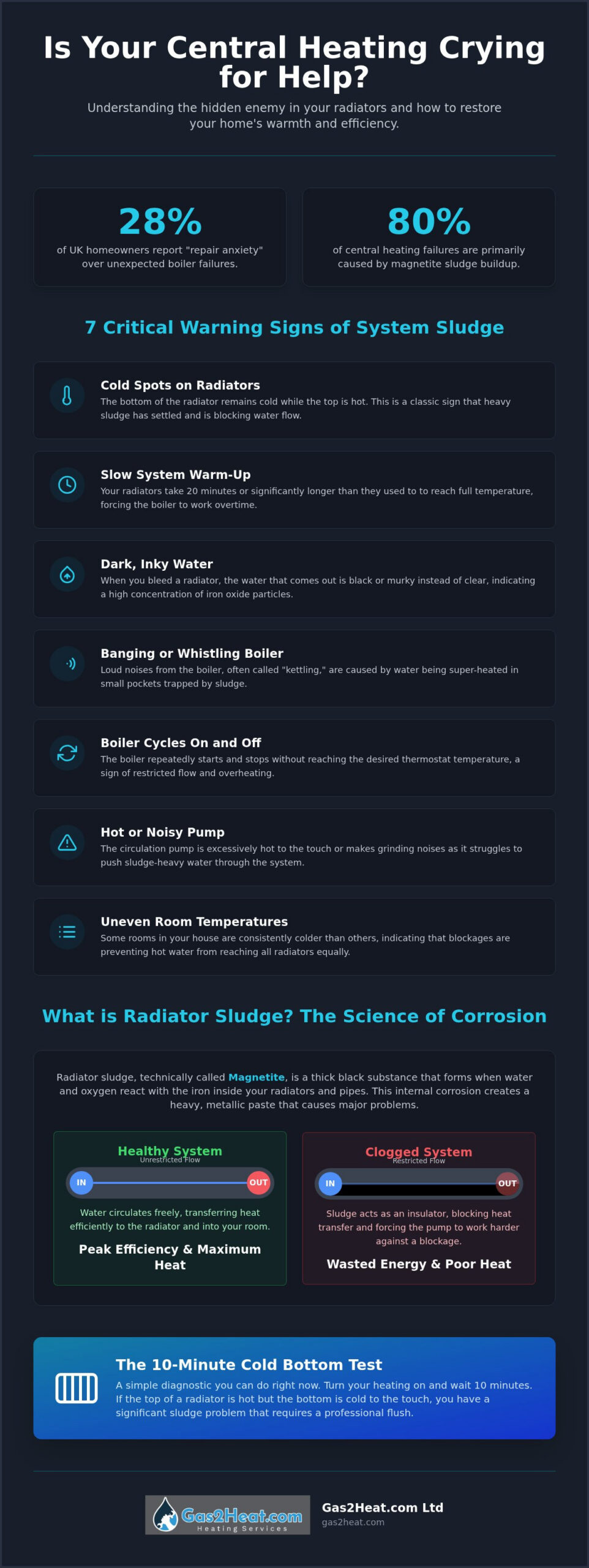
Your central heating system is the heart of your home comfort. In South West Scotland, where stone-built properties often retain the damp, a reliable boiler isn’t just a luxury; it’s a necessity. Over time, water-based heating systems naturally develop internal corrosion. This creates a thick, black sludge that settles in your pipework and radiators. Recognizing the early warning signs can save you from a costly emergency breakdown and help you maintain peak efficiency.
If you suspect your system is underperforming, look for these seven red flags:
- Cold spots: The bottom of your radiator feels significantly colder than the top.
- Slow warm-up: Radiators take 20 minutes or more to reach full temperature.
- Discoloured water: Bleeding the radiators releases dark, inky liquid instead of clear water.
- Kettling sounds: Your boiler makes banging or whistling noises similar to a tea kettle.
- Frequent restarts: The boiler cycles on and off repeatedly without reaching the set temperature.
- Pump failure: Your circulation pump feels excessively hot or makes grinding noises.
- Uneven heat: Some rooms stay chilly while others are boiling hot, suggesting a flow imbalance.
Addressing these issues early with a professional central heating power flush Dumfries specialists recommend prevents permanent damage to your heat exchanger. It’s the most effective way to clear the system and restore the heat you’re paying for.
The Cold Bottom Test: A Simple Diagnostic
You can perform a basic health check on your system in minutes. Turn your heating on and wait ten minutes. Carefully run your hand across the radiator panel, starting at the top and moving toward the floor. If the top is hot but the bottom is stone cold, you have a sludge problem. Unlike air pockets, which cause cold spots at the top and require simple bleeding, cold bottoms indicate heavy magnetite deposits. This sludge is too heavy for the water to push, effectively turning the bottom of your radiator into a dead zone that wastes energy and money.
Boiler Noises and Pump Stress
What is Radiator Sludge? The Science of System Corrosion
Magnetite is the technical name for the thick, black substance commonly known as radiator sludge. It is a chemical byproduct that forms when the iron components in your radiators and pipework react with the water circulating through them. Even in a closed system, tiny amounts of oxygen inevitably enter through microscopic gaps in joints or during routine maintenance. This oxygen triggers an oxidation process. Over several years, this reaction creates a heavy, metallic debris that settles at the lowest points of your heating circuit.
This sludge acts as a highly effective insulator, which is the last thing you want inside a radiator. Instead of the heat transferring from the water to the metal panel and into your room, it gets trapped behind a layer of mud. Your boiler has to run longer and hotter to compensate for this thermal barrier. Modern high-efficiency boilers are particularly vulnerable. While older units had wide internal channels, 2026-standard condensing boilers use compact heat exchangers with narrow waterways. A small amount of debris that an old boiler might have ignored can completely block a modern unit, leading to an expensive repair bill.
The technical complexity of modern systems underscores the importance of professional engineering; for example, firms like Ingenieurbüro Lohse specialize in TGA planning and building physics to ensure that heating and energy systems are designed for maximum efficiency and durability.
The Chemical Reaction Inside Your Pipes
Internal corrosion is a silent process. It starts with microscopic metal flakes stripping away from the inside of your radiators. These particles are magnetic, which causes them to clump together into the dense, abrasive paste we call sludge. Industry data suggests that magnetite is the primary cause of up to 80% of central heating system failures. Beyond just blocking flow, these abrasive particles can physically wear down the internal seals of your boiler and seize up the moving parts of your circulation pump. Scheduling a central heating power flush Dumfries homeowners trust is the most reliable way to stop this chemical chain reaction before it causes permanent damage.
Why Dumfries and SW Scotland Homes Are At Risk
Regional factors play a significant role in how quickly your system degrades. Many properties in Dumfries and the surrounding Galloway area are traditional stone-built homes with older, wider-diameter pipework. These systems often contain a larger volume of water and more surface area for corrosion to occur. Local water characteristics can also influence the rate of mineral buildup. If you live in an older property, you might find more information in our guide on Improving Heating Efficiency in Dumfries & Moffat. Combining regional expertise with The Professional Powerflushing Process ensures your specific system requirements are met. If you’re worried about your system’s health, booking a professional system health check with Gas2Heat.com Ltd is a proactive way to secure your home’s warmth.
Powerflushing vs. Chemical Flushing: Choosing the Right Method
Choosing the right cleaning method depends on your system’s age and the severity of the symptoms described earlier. Not every radiator requires the same level of intervention. While there are several ways to clear debris, they vary significantly in effectiveness, mess, and long-term value. Understanding these differences helps you make an informed decision that protects your home without overstretching your budget.
A manual flush is an old-school approach. It involves physically removing each radiator from the wall and flushing it through with a garden hose in the garden. It is incredibly messy and time-consuming. More importantly, it only cleans the radiator itself. The sludge sitting in your pipework remains untouched. Once you reconnect everything, that leftover debris simply flows back into your clean radiators and settles again. It is rarely the right choice for modern systems.
Chemical circulating is a lighter alternative often used for maintenance. An engineer adds a cleaning agent to the system and lets it circulate for several days during normal use. It is effective for very minor buildup but lacks the force to shift heavy magnetite deposits. If your radiators have significant cold spots, chemicals alone won’t be enough. A professional central heating power flush Dumfries homeowners choose for maximum results is the most thorough option. It uses a high-velocity pumping station to clean the entire circuit in one visit.
The Powerflush Advantage
The primary advantage of a powerflush is the sheer volume of water flow. Professional machines move water at speeds up to 20 times faster than a standard boiler pump. This creates a scouring action that dislodges stubborn blockages chemicals cannot reach. Specialized equipment also features an instantaneous reverse flow function. By rapidly switching the direction of the water, the engineer creates turbulence that breaks up compacted sludge. For safety and performance, this process must be carried out by Gas Safe registered engineers who understand the pressure tolerances of your specific boiler model. It is a controlled, high-efficiency process that restores your system without the need for radiator removal.
When a Chemical Flush is Sufficient
A chemical flush is often sufficient for newer systems or as a preventative measure during Expert Boiler Servicing in Moffat. If your system is less than five years old and you aren’t experiencing cold spots, a chemical treatment can keep things running smoothly. Once the cleaning is complete, adding a high-quality inhibitor is essential. This chemical creates a protective film on the internal metal surfaces, slowing down the oxidation process and preventing new sludge from forming. Making the right choice now prevents the need for more expensive repairs later.
The Professional Powerflushing Process: What to Expect
Transparency is key to our service. When you book a central heating power flush Dumfries homeowners trust, you aren’t just getting a system drain. You’re getting a technical restoration. We start with a thermal imaging inspection. This allows us to see exactly where the sludge has settled without taking anything apart. It provides you with clear visual proof of the problem and a baseline to measure the final results. You will see the cold spots disappear in real-time as we work.
We connect our specialized pumping station to your system, usually through the circulation pump or a radiator tail. We isolate the boiler during the initial high-velocity flush to ensure no loosened debris enters the delicate heat exchanger. This protects your boiler investment while we focus on the pipework and radiators. Our modern, tech-enabled approach ensures the entire process is contained and mess-free.
Step-by-Step Breakdown
Once the machine is connected, we follow a rigorous cleaning protocol. We don’t just hope the sludge moves; we force it out. The process involves several critical stages:
- Chemical injection: We add professional-grade cleaning agents to break down hardened magnetite.
- Individual flushing: We close all radiators except one, directing the full force of the pump into a single panel at a time.
- Agitation: We use a specialized tool to vibrate the radiator panel, dislodging baked-on sludge that chemicals alone can’t reach.
- Magnetic filtration: Our machine uses industrial-strength magnets to trap the iron oxide as it circulates, preventing it from re-entering your system.
We continue this cycle until the water runs crystal clear. We perform a turbidity test to verify the water quality. Finally, we neutralize the system and add a high-quality corrosion inhibitor to provide long-term protection.
Preparation and Timeframes
A thorough central heating power flush Dumfries engineers perform for a standard three-bedroom home usually takes between five and eight hours. Larger properties or severely neglected systems may require a full day. You don’t need to do much to prepare. We just need clear access to all radiators and your boiler. If you have furniture blocking a radiator, moving it slightly before we arrive helps us stay on schedule.
Never attempt this as a DIY project. Professional machines operate at high velocities and use specific chemical balances. Without the right training, you risk blowing internal seals or causing leaks. Our Gas Safe registered experts ensure the process is safe, efficient, and guaranteed. If you’re ready to restore your home’s warmth, you can book your power flush online today to secure your preferred date.
Restore Your Comfort with Gas2Heat.com Ltd Power Flushing
Choosing a local specialist for your central heating power flush Dumfries service ensures you receive care from engineers who understand the unique challenges of South West Scotland’s housing stock. Since 2017, Gas2Heat.com Ltd has focused on removing the uncertainty of trade services through technical authority and transparent pricing. We provide clear, fixed-price quotes for your property. You won’t have to worry about hidden costs or unexpected additions to your bill. Our Gas Safe registered engineers prioritize your home’s efficiency and your peace of mind.
A clean system is a cheap system. Recent 2026 data indicates that 29% of UK homeowners cite rising energy bills as their primary household obstacle. A professional power flush directly addresses this pressure by restoring thermal transfer. You’ll notice the difference immediately. Your rooms will warm up faster, your boiler will run more quietly, and you’ll protect your long-term investment. Many major boiler brands now require proof of a professional system flush to honor their warranty terms. By removing the abrasive magnetite that causes 80% of system failures, we ensure your boiler operates at the peak performance levels intended by the manufacturer.
Our Service Area: From Moffat to Dumfries
Our team covers the entire Dumfries and Galloway region. We provide rapid, reliable service to homes in Lockerbie, Annan, Gretna, and Castle Douglas. Using a local business offers a level of accountability and regional expertise that national giants simply cannot match. We know the local water conditions and the specific pipework configurations common in our stone-built properties. If you’re considering a more significant upgrade, our guide to Boiler Installation in Dumfries & Moffat explains how a clean system forms the foundation of any high-efficiency heating setup.
Booking Your System Health Check
You don’t have to guess about the health of your heating. If you aren’t sure if your radiators need a full flush, book a diagnostic visit. We use thermal imaging to show you exactly where sludge is restricting flow. It’s a straightforward way to see if you need a central heating power flush Dumfries experts recommend for aging systems. We also strongly advise this service during a new boiler installation. This prevents old debris from contaminating your brand-new heat exchanger. Book your radiator health check today with Gas2Heat.com Ltd to secure your home’s warmth and lower your monthly gas bills.
Secure Your Home’s Warmth and Efficiency Today
Restoring your heating system doesn’t have to be a stressful or complicated task. By identifying the early warning signs of radiator sludge and choosing a professional central heating power flush Dumfries homeowners trust, you can eliminate cold spots and protect your boiler from long-term damage. This maintenance is about more than just cleaning; it’s about securing lower energy bills and ensuring your system operates at peak performance throughout the winter months.
As a local Moffat-based family business, Gas2Heat.com Ltd is committed to providing straightforward solutions with no hidden complications. Our Gas Safe Registered Engineers use technical expertise to simplify your maintenance, offering transparent pricing that removes the uncertainty often associated with trade services. We focus on delivering rapid results so you can get back to enjoying a comfortable, reliable home.
Don’t wait for a total system failure to address your heating efficiency. Request a Professional Powerflush Quote from Gas2Heat.com Ltd today to restore your comfort. We are ready to help you achieve a warmer, more efficient home with the reliability you deserve.
Frequently Asked Questions
How much does a powerflush cost in SW Scotland?
The total cost depends on the size of your property and the number of radiators in your system. While larger homes with more complex pipework require more time and chemicals, a professional assessment ensures you receive a fixed-price quote based on your specific needs. Investing in this maintenance now prevents the much higher costs associated with emergency boiler repairs or a complete system replacement.
Can a powerflush cause leaks in old radiators?
A powerflush does not create leaks, but it can occasionally reveal them. If your radiators are severely corroded, the internal sludge might be the only thing “plugging” a microscopic pinhole. Our engineers perform a thorough system inspection before starting to identify any high-risk areas. If a radiator is too thin to survive the process, we will advise you on the best course of action before we begin.
How often should I have my central heating system flushed?
Most modern systems benefit from a deep clean every five to ten years. This timeframe varies depending on the quality of the initial installation and whether you have kept up with annual servicing. If you notice the symptoms of sludge buildup, such as cold spots or noisy operation, it’s best to act immediately rather than waiting for a specific milestone. Regular maintenance keeps your system running at peak efficiency.
Will a powerflush make my house warmer?
Yes, you will notice a significant improvement in your home’s temperature almost immediately. By removing the insulating layer of magnetite from inside your radiators, the hot water can once again heat the entire metal panel. This restores the full heat output of your system. You’ll find that your rooms reach your desired temperature much faster, allowing you to turn your thermostat down and save on energy costs.
Is powerflushing messy for my carpets and furniture?
No, a professional central heating power flush Dumfries homeowners book is designed to be a clean and self-contained process. We connect our specialized pumping station directly to your system using secure, reinforced hoses. There is no need to remove radiators from the walls or carry them through your house. We take every precaution to protect your flooring and furniture, ensuring your home remains exactly as we found it.
Do I need a powerflush before installing a new boiler?
Yes, performing a flush is a critical step when upgrading your heating system. Most boiler manufacturers explicitly state that their warranty is only valid if the system is cleaned before the new unit is installed. This prevents old, abrasive sludge from entering and damaging the delicate heat exchanger of your new boiler. It ensures your new investment is protected from day one and operates at its maximum rated efficiency.
Can I DIY a powerflush with a rented machine?
It is not recommended to attempt this yourself. Professional powerflushing requires specific technical knowledge to balance the chemicals and manage the flow rates without damaging internal seals. Rented machines are often less powerful and don’t include the magnetic filtration or thermal imaging tools used by experts. Our Gas Safe registered engineers ensure the process is safe, effective, and fully guaranteed, saving you from potential system damage.
How do I know if my radiator needs bleeding or a flush?
The location of the cold spot is the most reliable indicator. If the top of the radiator is cold, there is likely trapped air that can be removed by bleeding. If the bottom or the center of the radiator remains cold while the pipes are hot, this indicates a heavy buildup of sludge. A flush is required to clear these solid deposits. You can use the simple “cold bottom test” to diagnose the health of your system in minutes.
