
Fixing a Frozen Boiler Condensate Pipe in Moffat: A 2026 Emergency Guide
Imagine waking up to a freezing house in the Southern Uplands, only to find your boiler has locked out and is flashing a confusing error code. It’s a stressful situation that leaves many homeowners fearing a massive repair bill just to get the hot water running again. In many cases, the culprit is a frozen boiler condensate pipe Moffat residents frequently encounter during a harsh cold snap. You don’t need to be a heating engineer to handle this common winter glitch yourself.
We know how frustrating it is to lose your heating when the temperature drops. That’s why we have created this emergency guide to help you take control of your home comfort. You will learn how to identify the blockage, safely thaw the pipe using simple household items, and get your boiler restarted in minutes. We also cover professional preventative measures, such as permanent pipe re-routing and modern insulation standards, to ensure your home stays warm and your heating system remains reliable all season long.
Key Takeaways
- Identify the problem quickly by checking for ice build-up on the small plastic waste pipe located outside your property.
- Restore your heating safely by using the warm water method to clear a frozen boiler condensate pipe Moffat winters often cause.
- Save money on emergency call-out fees by following our simple DIY thawing steps before booking a repair.
- Prevent recurring issues by upgrading to 32mm external piping and installing weather-proof “Class O” foam insulation.
- Recognize when to contact a Gas Safe engineer if error codes persist or the blockage is located inside the boiler unit.
Identifying a Frozen Boiler Condensate Pipe in Your Moffat Home
If your heating has cut out during a biting Moffat cold snap, the first place to look isn’t inside the boiler, but outside your house. Most high-efficiency boilers produce a small amount of waste water during the heating process. Understanding what a condensing boiler does helps explain why this pipe exists. This liquid, known as condensate, travels through a plastic pipe to an external drain. Because this pipe is often exposed to the harsh Southern Uplands elements, it’s highly susceptible to freezing. When a frozen boiler condensate pipe Moffat homeowners encounter occurs, the water backs up into the boiler, triggering a safety shutdown to prevent internal damage.
You can usually spot the problem by looking for specific visual and audible clues. First, check the external exit point of the pipe. You might see a “beard” of ice hanging from the end or a solid block of ice visible inside the opening. If the ice isn’t obvious from the outside, listen to the boiler unit itself. A distinct gurgling or bubbling sound, similar to someone blowing through a straw into a drink, often indicates that water is struggling to pass through an icy blockage. Eventually, the system will “lock out” and refuse to ignite, leaving you with cold radiators and no hot water.
Common Error Codes to Look For
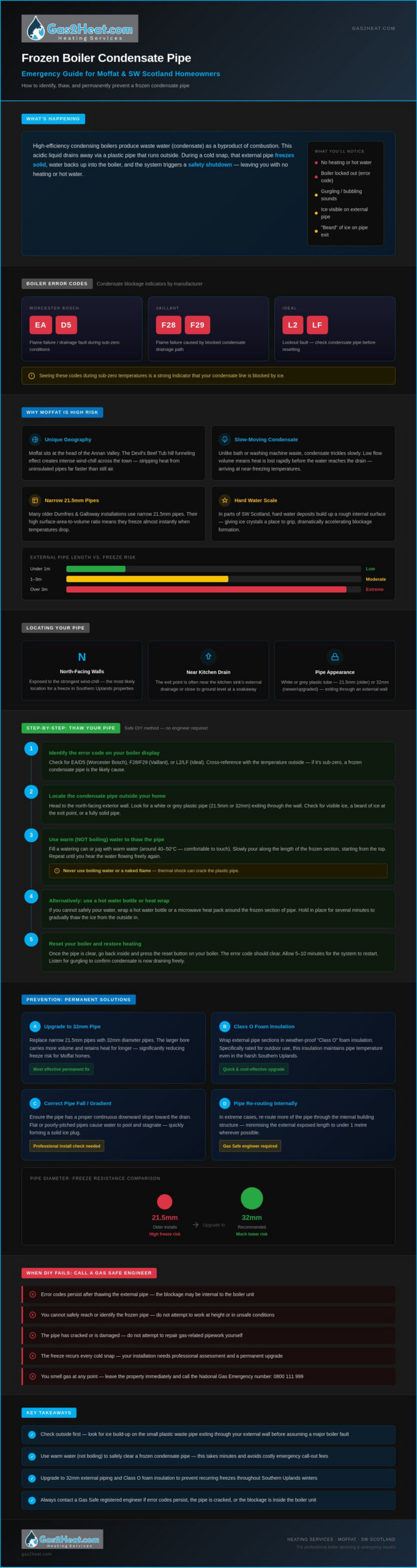
Your boiler’s digital display is a vital diagnostic tool. Different manufacturers use specific codes to signal a drainage issue. Worcester Bosch systems typically show EA or D5. Vaillant boilers often display F28 or F29, which signifies a flame failure caused by the blocked pipe. If you have an Ideal boiler, look for L2 or LF. Seeing these codes during sub-zero temperatures is a strong indicator that your condensate line is blocked by ice.
Locating Your Pipe in a Typical Moffat Property
In most Moffat homes, the condensate pipe is a 21.5mm or 32mm plastic tube, usually white or grey. It exits through an external wall and runs toward a drain or a soakaway. Start your search on the North-facing side of your property. These walls are exposed to the strongest wind-chill in the Southern Uplands, making them the most likely spot for a freeze. You’ll often find the exit point near your kitchen sink’s external drainage or near ground level where the pipe enters a dedicated soakaway.
Why Condensate Pipes Freeze During SW Scotland Winters
Moffat isn’t just cold during the winter; it’s damp and windy. This combination creates a perfect storm for a frozen boiler condensate pipe Moffat homeowners often have to battle. Unlike high-flow waste from a bath or washing machine, boiler condensate moves in a slow, steady trickle. This low volume means the water loses heat rapidly as it travels outside. By the time it reaches the end of the pipe, it’s often already near freezing temperatures.
Many older installations in Dumfries & Galloway use narrow 21.5mm pipes. These thin tubes have a high surface-area-to-volume ratio, which makes them freeze almost instantly when the mercury drops. If the pipe lacks a proper downward slope, water pools in the line instead of draining. This stagnant water quickly becomes a solid ice plug. Pipes extending more than 3 meters externally are at extreme risk. The longer the exposure to the elements, the higher the chance of a total blockage occurring.
The Science of Condensation
Modern condensing boilers reclaim heat that would otherwise be lost through the flue. Condensate is a natural byproduct of high-efficiency gas combustion. This water is slightly acidic and must be drained away constantly for the heat exchanger to function. If the drainage path is blocked by ice, the system cannot operate safely. This leads to the frustrating lockouts and gurgling noises mentioned earlier in this guide.
The Wind-Chill Factor in Moffat
Moffat sits in a unique geographic position at the head of the Annan Valley. The funneling effect of the hills near the Devil’s Beef Tub creates intense wind-chill across the town. This moving air strips heat away from uninsulated external pipes far faster than still air. Even at -1°C, a strong gust can freeze a pipe that might have stayed clear in a more sheltered location. In some parts of SW Scotland, hard water scale also builds up inside these pipes. This rough surface gives ice crystals a place to grip, which accelerates the formation of a blockage.
Proper insulation is your first line of defense against these local conditions. If you suspect your pipe was installed with an incorrect diameter or lacks the necessary fall, a professional boiler servicing can identify these risks before the next freeze. Upgrading to a 32mm pipe is often the most effective permanent fix for homes in the Southern Uplands.
Step-by-Step Guide: How to Safely Thaw Your Frozen Pipe
Safety is your priority. Before you attempt any repairs, ensure you have a stable footing on the icy ground surrounding your property. Moffat winters often leave paths and driveways treacherous, and pouring water outside in sub-zero temperatures creates an immediate slip hazard. Spread some grit or salt on the area where you will be working to prevent the water from turning into a fresh sheet of ice. Successfully thawing a frozen boiler condensate pipe Moffat homeowners encounter is often a 15-minute job if you follow the correct sequence.
You don’t need expensive tools for this task. Most blockages can be cleared using items you already have in your kitchen. The goal is to apply gentle, consistent heat to the frozen section until the ice plug melts and allows the condensate to flow freely again. Once the blockage clears, you will often hear a satisfying trickle or see water finally exiting the pipe into the drain.
The Warm Water Technique
This is the most effective method for pipes that are easily accessible. Fill a watering can or a large jug with warm water. Aim for a temperature similar to a hot cup of tea, roughly 60°C. Never use boiling water directly from the kettle. Extreme heat can cause the plastic pipe to become brittle or even crack, leading to a much more expensive repair. Follow these steps for the best results:
- Identify the frozen section, typically found at elbows, bends, or the very end of the pipe run.
- Start pouring the water slowly at the highest point of the external pipe.
- Work your way down the length of the pipe, focusing extra time on joints where ice naturally collects.
- Continue until you hear the boiler’s internal gurgling stop or see water flowing from the outlet.
Using Heat Pads or Hot Water Bottles
If your pipe is in a hard-to-reach spot or you’re worried about creating ice on the ground, use a more localized heat source. Wrap a hot water bottle or a microwaveable heat pad around the suspected frozen section. Use a heavy towel or an old scarf to secure the heat source against the plastic and help retain the warmth. This method takes longer than pouring water but is much cleaner and safer in very tight spaces. Under no circumstances should you ever use a blowtorch, heat gun, or any naked flame on the pipe. Plastic melts quickly, and the risk of fire or permanent damage to your heating system is too high.
Once you have cleared the ice, go back inside to your boiler. The error code won’t always disappear on its own. You will likely need to hold the reset button for a few seconds to tell the system the path is clear. If the boiler fires up and stays on, you have successfully completed the repair. If the system locks out again immediately, there may be a secondary blockage further up the line that requires professional boiler repairs to resolve safely.
Preventing Future Freezes: Permanent Solutions for Borders Homeowners
Thawing your pipe is a necessary emergency measure, but it won’t stop the problem from returning during the next cold snap. To ensure long-term reliability, you should consider more permanent modifications to your system. A frozen boiler condensate pipe Moffat homeowners experience is usually the result of an installation that isn’t robust enough for the Southern Uplands. Upgrading your external pipework from the standard 21.5mm to a 32mm diameter is one of the most effective changes you can make. The larger diameter reduces the surface-area-to-volume ratio of the water, making it significantly harder for a solid ice plug to form.
Internal routing is the gold standard for freeze prevention. By moving the condensate pipe so it connects to an internal waste system, such as a kitchen or bathroom drain, you remove the pipe from the cold entirely. If internal routing isn’t possible, trace heating provides a high-tech alternative. This involves installing an electric heating wire along the pipe that automatically switches on when temperatures drop. It guarantees the water stays above freezing point, regardless of the wind-chill coming off the hills.
Insulation Best Practices
Standard foam “pool noodle” insulation often fails during a harsh Moffat winter. It’s frequently too thin and absorbs moisture, which actually accelerates freezing. For real protection, use weather-proof Armaflex or “Class O” nitrile rubber foam. These materials are closed-cell, meaning they don’t soak up water. You should also ensure the insulation has a UV-resistant coating. Without it, the sun will eventually cause the foam to crack and degrade, leaving your pipe exposed once again. You can find more tips on improving heating efficiency to help prepare your home for the months ahead.
For those interested in the technical standards of high-performance insulation and protective materials, you can discover BIS Group to see how industrial-grade coating and lining solutions are used to protect critical infrastructure from the elements.
System Health and Efficiency
A well-maintained boiler is less likely to suffer from drainage issues. Over time, debris can build up in the condensate trap or the pipe itself. This rough internal surface gives ice crystals a place to snag and grow, speeding up the blockage process. Scheduling expert boiler servicing is the best way to catch these risks early. During an annual service, a Gas Safe engineer includes a thorough check of the condensate discharge to ensure the fall is correct and the pipe is clear. If your pipework needs a permanent upgrade, our team can provide professional boiler repairs to secure your system against future freezes.
When DIY Thawing Fails: Emergency Boiler Repairs in Moffat
Sometimes, even the best DIY efforts aren’t enough to beat a harsh Scottish winter. If you’ve spent time applying warm water but the error code remains on your screen, the blockage might be deeper than the external pipe run. A frozen boiler condensate pipe Moffat homeowners face can occasionally involve the internal “trap” or the section of pipework still inside the boiler casing. When this happens, the system will continue to lock out for your safety until a professional can clear the internal obstruction. Don’t keep resetting the boiler if it fails to fire, as this can place unnecessary strain on the internal components.
It’s vital to remember that you should never open the boiler casing yourself. This is a job strictly for Gas Safe Registered engineers. Opening the unit can expose you to live electrical components or disturb the gas-tight seal of the combustion chamber. If the external pipe is clear and the gurgling noise continues, it’s time to call for professional boiler repairs. Our team is based right here in Moffat. This local presence ensures we can provide a rapid response when your heating fails during a freeze, especially when the Southern Uplands weather is at its worst.
Our Emergency Repair Process
We prioritize households without heating or hot water, especially during peak winter months in Dumfries & Galloway. Our engineers use professional diagnostic tools to check if the freeze has caused secondary faults, such as damage to the heat exchanger or the internal pump. We believe in total financial transparency. You’ll receive a clear explanation of the fault and a fixed quote before we begin any work. We don’t believe in hidden “winter emergency” surcharges. Our goal is to provide honest, local service to get your home warm again as quickly as possible.
Contacting Your Local Moffat Heating Engineer
Getting help is simple. We serve Moffat, Lockerbie, Annan, and the surrounding villages with dedicated local expertise. When you call, please have your boiler brand and the specific error code ready. This information allows our engineer to arrive prepared with the right tools and knowledge for your specific model. If you’re struggling with a stubborn blockage or an internal fault, Contact Gas2Heat for emergency boiler repairs in Moffat to restore your peace of mind and your home’s comfort. We’ll handle the technical details so you can get back to a warm, safe home.
Secure Your Home’s Warmth This Winter
A frozen boiler condensate pipe Moffat winters create doesn’t have to mean a cold house for days. By identifying symptoms early and using the warm water method, you can often restore your heating in under 20 minutes. Remember that long-term fixes, like upgrading to 32mm external pipework or improving insulation, are the best ways to stop this issue from returning during the next freeze. These simple preventative steps protect your boiler and save you from the stress of emergency lockouts.
If your DIY efforts haven’t cleared the blockage or you’re dealing with a persistent error code, we are here to help. As a Moffat-based family business with Gas Safe Registered engineers, we provide a rapid response across SW Scotland to get your system back online safely. Don’t sit in the cold when expert assistance is just a click away. Book an Emergency Boiler Repair in Moffat with Gas2Heat today to ensure your family stays warm and comfortable. You’ve got this, and we’re ready to support you if you need a professional hand.
Frequently Asked Questions
Can I use boiling water to thaw my condensate pipe?
No, you should never use boiling water to thaw the pipe. The extreme temperature can cause the plastic material to crack or warp, which leads to permanent damage and leaks. Use warm water instead, ideally around 60°C, which is roughly the temperature of a hot tea. This provides enough heat to melt the ice safely without risking the integrity of the pipework.
Is it safe to leave my boiler on if the condensate pipe is frozen?
It’s safe because modern boilers have built-in safety mechanisms that trigger a “lockout” when a blockage is detected. The system will simply refuse to ignite to prevent water from backing up into the heat exchanger. While it won’t cause an explosion or a fire, the boiler won’t provide any heat or hot water until the frozen boiler condensate pipe Moffat residents are dealing with is fully thawed and reset.
Will a frozen condensate pipe cause a gas leak?
No, a frozen pipe will not cause a gas leak. The condensate pipe is only responsible for carrying waste water away from the boiler. It’s a completely separate system from the gas supply and the flue gases. While a blockage is an urgent maintenance issue that stops your heating, it doesn’t pose a risk of gas escaping into your home.
Can I use a hairdryer to defrost the pipe?
You can use a hairdryer on a low or medium heat setting, but it’s often slower than the warm water method. If you choose this route, be extremely careful using electrical appliances outdoors in damp or icy conditions. Never leave the hairdryer unattended and ensure you aren’t standing in puddles of water while operating it.
How much does it cost to have a condensate pipe re-routed internally?
The cost for internal re-routing depends on several factors, including the distance to the nearest internal waste pipe and the complexity of the plumbing work required. Every home in the Borders is different, so we provide fixed, transparent quotes after a site visit. This permanent solution is the most effective way to ensure you never face another freeze-related lockout.
Why does my boiler make a gurgling sound in winter?
Gurgling sounds are a classic warning sign that ice is starting to form. This noise happens when air bubbles struggle to pass through condensate water that’s backing up behind a partial ice plug. If you hear this during a cold snap, it’s a strong indicator of a frozen boiler condensate pipe Moffat weather has caused, and you should act quickly before the system shuts down completely.
Do I need a plumber or a gas engineer for a frozen pipe?
You should always choose a Gas Safe registered engineer for any boiler-related work. While the external pipe is just plastic, the issue often requires resetting the boiler or checking internal components like the condensate trap. Only a qualified gas expert is legally allowed to open the boiler casing to ensure the entire drainage path is clear and safe to operate.
Will my home insurance cover a frozen condensate pipe repair?
Coverage depends entirely on your specific policy. Many standard buildings insurance policies don’t cover “maintenance” issues like frozen pipes, but “Home Emergency” add-ons often do. Review your policy documents for mentions of boiler breakdown or emergency heating cover. If you aren’t covered, our transparent pricing ensures you know exactly what the repair costs before we start.
