

10 Essential Heating Maintenance Tips for a Warm, Efficient Home in 2026
Would your heating system pass the new 2026 Scottish Heat Retention Rating (HRR) if a winter freeze hit tomorrow? With energy costs continuing to climb and stricter efficiency standards now in place, keeping your boiler in peak condition isn’t just about comfort. It’s a financial necessity. We understand the anxiety of facing a potential breakdown during a brutal Scottish winter, especially when DIY safety limits feel confusing and unclear. You deserve a home that’s both warm and cost-effective without the guesswork.
Our expert-approved checklist of heating maintenance tips will show you how to lower your energy bills and prevent costly repairs before the temperature drops. You’ll discover exactly which tasks you can handle yourself and when it’s legally required to call a Gas Safe registered engineer. We’ll cover everything from radiator efficiency to the performance-restoring benefits of power flushing. This guide provides the clarity you need to manage your system safely, ensuring your Moffat or Dumfries home stays reliable and fully compliant with the latest 2026 heating standards.
Key Takeaways
- Reduce your monthly utility costs by linking proactive maintenance to the new 2026 Heat Retention Rating standards.
- Identify which heating maintenance tips are safe for DIY, including bleeding radiators and monitoring your boiler’s water pressure.
- Clarify the legal boundaries of home maintenance to avoid the severe safety risks and hazards of unauthorized gas work.
- Explore how specialist services like power flushing can remove internal sludge and dramatically improve the efficiency of older heating systems.
- Prepare for the Scottish winter with a professional servicing checklist that ensures your boiler remains reliable throughout the coldest months.
Why Proactive Heating Maintenance Matters in South West Scotland
Proactive care is the most effective way to shield your household from the rising energy costs of 2026. In South West Scotland, our domestic boilers face a unique set of challenges that differ from the rest of the UK. The damp, biting cold characteristic of the Dumfries and Galloway region puts consistent stress on internal components. Without intervention, efficiency drops and bills rise. Integrating professional heating maintenance tips into your yearly routine ensures your system remains a reliable asset rather than a financial liability.
Skipping a single annual service creates a ripple effect of hidden costs. While you might save on the immediate service fee, you risk an emergency call-out during the peak winter months in Dumfries. These reactive repairs are almost always more expensive than preventative care. Beyond the money, there’s the physical toll of a cold house. A sudden breakdown in January isn’t just an inconvenience; it’s a safety risk for families and vulnerable residents. Taking action now removes that uncertainty.
The Financial Benefits of an Efficient System
An optimized burner is the heart of a low-cost home. When a Gas Safe registered engineer cleans and calibrates your system, they ensure you get the maximum heat for every unit of fuel consumed. Modern central heating systems rely on precision. Small deposits of soot or debris can force the boiler to work harder, burning more gas to achieve the same temperature. By maintaining peak performance, you can extend the lifespan of your boiler by up to 5 years. This delay in replacement costs represents a massive long-term saving. Additionally, almost all manufacturers require a documented annual service to keep your warranty valid. Without this proof, a major component failure could result in a bill for hundreds of pounds that would otherwise have been covered.
Reliability During the Scottish Winter
Homes in Moffat and Lockerbie face higher freezing risks due to their geographical position and local microclimates. One of the most common issues we see is the “summer slump.” This happens when a boiler sits inactive for months, causing the internal pump or diverter valve to seize up when you finally try to turn it on in autumn. Regular heating maintenance tips, such as running your heating for ten minutes once a month during summer, can prevent these mechanical failures. We prioritize reliability because we know the local landscape. A well-maintained system provides the peace of mind that your home will stay warm, no matter how low the mercury drops on the Solway Coast.
5 DIY Heating Maintenance Tips for Homeowners
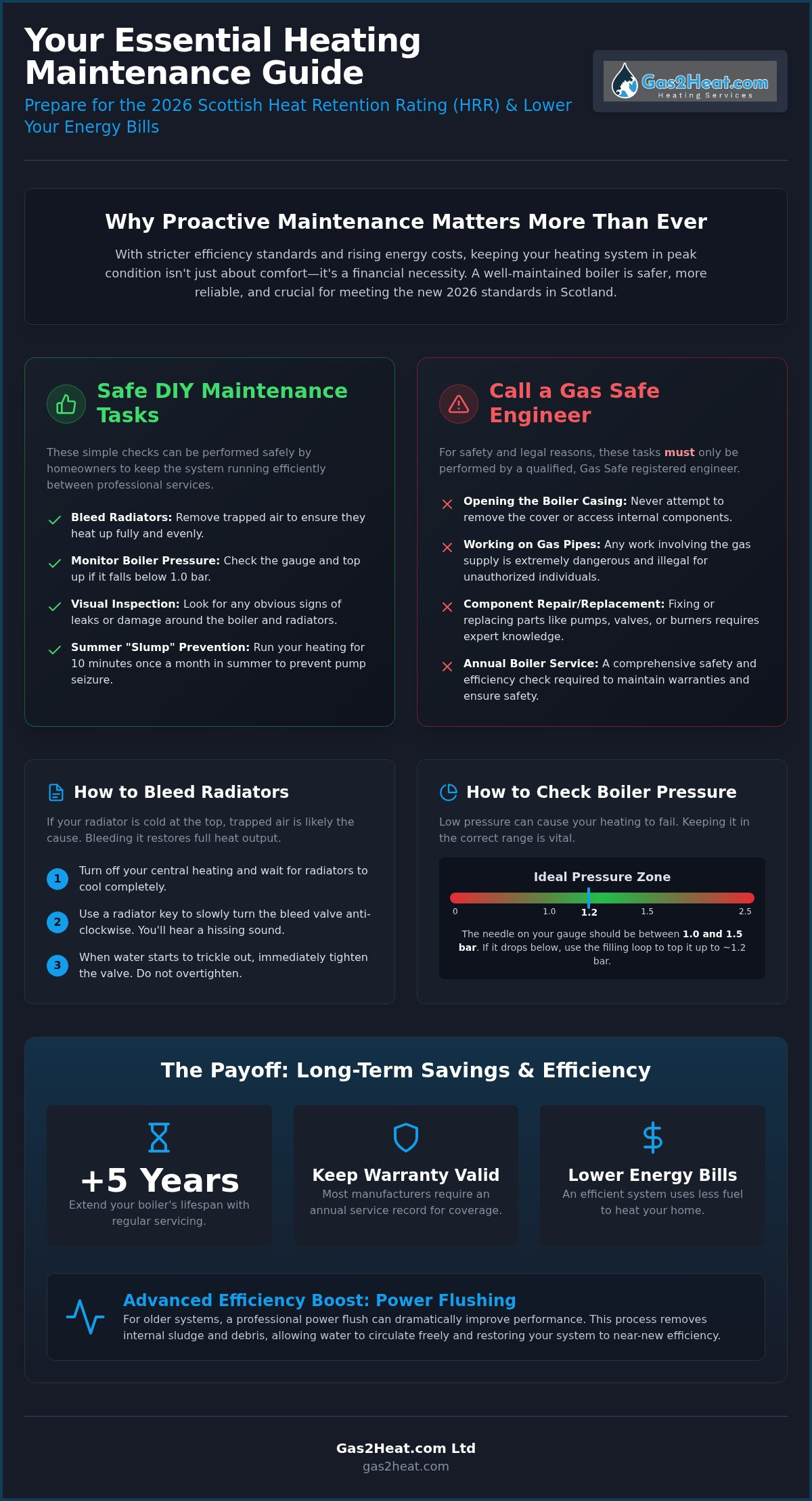
Empower yourself with these simple steps to keep your home warm and your bills manageable. While complex internal repairs require a professional, several heating maintenance tips are perfectly safe for you to handle. Taking ten minutes once a month to check your system can prevent small issues from spiraling into expensive failures. For a broader look at home efficiency beyond just the boiler, the U.S. Department of Energy’s Home Energy Checklist offers excellent guidance on seasonal tasks that keep your property running smoothly.
Bleeding Radiators for Maximum Heat Output
If your radiators feel cold at the top but warm at the bottom, you likely have trapped air pockets. These pockets prevent hot water from filling the entire unit, forcing your boiler to run longer to heat the room. To fix this, turn off your heating and let the radiators cool. Insert a radiator key into the valve at the top and turn it slowly counter-clockwise. You will hear a hissing sound as the air escapes; once water starts to trickle out, close the valve immediately. Removing trapped air allows hot water to circulate fully, ensuring you aren’t paying for heat that never actually reaches your living space.
Monitoring Your Boiler Water Pressure
Modern combi boilers rely on a pressurized system to move water around your home. Check your boiler’s pressure gauge regularly to ensure the needle or digital display sits between 1.0 and 1.5 bar. If the pressure drops too low, your heating may become patchy or cut out entirely. You can usually top this up yourself using the filling loop, which is a silver braided hose with two small valves. Open the valves slowly until the pressure reaches the 1.2 bar mark, then close them tightly. If you find yourself topping up the pressure every few weeks, it could indicate a hidden leak that requires professional boiler repairs to resolve permanently.
Safety should always be your priority when performing home checks. Test your carbon monoxide alarm every month by pressing the “test” button to ensure the battery and sensor are active. Additionally, perform a quick visual inspection of your external flue. Ensure no bird nests, leaves, or garden debris are blocking the outlet, as this can cause dangerous gases to back up into your home. Finally, clear any overgrown foliage or snow from around outdoor heating components to maintain steady airflow. These small, consistent actions create a foundation of reliability for your entire system.
DIY vs. Professional Maintenance: Knowing the Safety Limits
Understanding where your responsibility ends and professional expertise begins is vital for home safety. While many heating maintenance tips focus on simple homeowner tasks, the law is very clear about internal gas components. In the UK, it’s a legal requirement that any person working on gas appliances must be Gas Safe registered. Attempting to bypass this isn’t just illegal; it’s dangerous. Safety must come first. DIY gas work carries severe risks, including carbon monoxide poisoning and potential explosions. These hazards are often invisible until it’s too late, making professional intervention the only responsible choice.
A professional diagnostic tool can identify issues that a visual check will always miss. For example, a Gas Safe engineer uses a flue gas analyzer to measure the ratio of oxygen to carbon monoxide. This ensures your boiler burns fuel safely and efficiently. Without these tools, a “simple fix” is often just a temporary patch on a deeper mechanical problem. For property owners in South West Scotland, securing official landlord gas safety certificates is a non-negotiable legal duty. These documents provide the ultimate proof that your heating system is safe for tenants and compliant with 2026 regulations. It is that simple.
Homeowner-Safe Tasks
You can safely manage the external environment of your heating system. Focus on keeping the area around your boiler clean and dust-free to prevent debris from entering the casing. Programming your smart thermostat is another high-value task you can manage yourself to optimize daily usage. While we previously covered bleeding radiators and checking pressure, you can also insulate accessible pipework in unheated areas like lofts or garages. This prevents pipes from freezing during a harsh Moffat winter and reduces heat loss as water travels to your radiators. These tasks are low-risk and high-reward.
Professional-Only Tasks
Anything that requires opening the boiler casing is strictly for a professional. You must never touch gas valves, internal wiring, or the combustion chamber. An engineer will deep-clean the heat exchanger and burner, removing carbon deposits that restrict heat transfer. They also check the integrity of the flue and seals, which are critical for preventing gas leaks. Professional servicing typically costs around £100. This is a minor investment compared to repairs that can reach £750 if a neglected component fails. Trusting an expert ensures your system remains reliable, efficient, and legally compliant.
Advanced Ways to Boost Your Heating Efficiency
Achieving a truly efficient home in 2026 requires moving beyond basic heating maintenance tips. While bleeding radiators helps, deeper technical improvements can significantly lower your energy consumption. Start by looking at your home’s fabric. Insulating your loft and cavity walls ensures the heat you pay for stays inside your rooms rather than escaping through the roof. Complement this by upgrading to modern, high-efficiency thermostatic radiator valves (TRVs). These valves allow you to set specific temperatures for each individual room. This prevents you from wasting energy on unused spaces like guest bedrooms or hallways, which directly lowers your monthly utility bills.
Power Flushing: Restoring Your System
Your central heating system naturally accumulates a cocktail of rust, debris, and metallic “sludge” over several years. This thick substance settles at the bottom of your radiators, creating cold spots and forcing your boiler to work twice as hard to reach your desired temperature. If you notice noisy pumps, vibrating pipes, or radiators that take an unusually long time to heat up, your system is likely struggling with internal blockages. Our guide on improving heating efficiency in Dumfries and Moffat explains how power flushing clears these contaminants. By circulating specialized cleaning chemicals through your pipes at high velocity, we restore full circulation and protect your boiler’s expensive internal heat exchanger. A clean system in 2026 translates to immediate efficiency gains, reducing fuel usage and preventing the mechanical strain that leads to early boiler failure.
Smart Controls and Precise Heating
Modern energy management relies on digital precision. Integrating a smart thermostat allows for sophisticated control that traditional manual dials simply can’t match. You can create custom schedules that align perfectly with your family’s daily routine. This ensures the heating only runs when and where it’s actually needed. This level of granular control is a major factor in meeting the latest Scottish energy standards and reducing your carbon footprint. These devices also offer the benefit of remote monitoring via your smartphone. If you’re away from your Moffat home during a sudden South West Scotland cold snap, you can trigger the heating remotely to prevent frozen pipes. This technological edge provides both significant financial savings and absolute peace of mind throughout the harshest winter months.
Take control of your home’s energy performance today. You can secure your system by booking a professional power flushing service or smart thermostat installation with our expert Gas Safe registered team.
The Gas2Heat Approach: Expert Boiler Servicing in SW Scotland
Choosing a local expert is the final and most important step in your heating strategy. While we’ve shared several heating maintenance tips you can manage yourself, a professional annual check-up is the only way to guarantee total system safety. At Gas2Heat.com Ltd, we bring technical authority and a transparent approach to every home we visit. We understand that boiler maintenance can feel stressful. Our goal is to remove that uncertainty through clear communication and straightforward pricing. Since 2017, we’ve focused on providing South West Scotland with a reliable alternative to large, impersonal corporations. We value your time and prioritize your home’s comfort.
Comprehensive Boiler Service Checklist
Our expert boiler servicing is thorough and methodical. We don’t just glance at the unit. We perform a full internal cleaning of the burner and heat exchanger to ensure peak efficiency. Our Gas Safe registered engineers test every safety device and conduct a precise flue gas analysis. This ensures your boiler isn’t producing dangerous levels of carbon monoxide. We also inspect the entire system for signs of corrosion or minor gas leaks that could become major hazards. This proactive approach identifies wear and tear before it leads to a breakdown during a Scottish winter freeze. You receive a digital record of the service for your own peace of mind and warranty compliance.
Your Local Heating Partner
We’re a local family-owned business based in Moffat. This means we’re uniquely positioned to serve Dumfries, Annan, Lockerbie, and the surrounding rural areas with speed and efficiency. Our regional expertise allows us to provide advice tailored to the specific damp and cold conditions of the Dumfries and Galloway region. Unlike national firms, Gas2Heat.com Ltd prioritizes our local community. We know the specific challenges of the local climate and how it affects different boiler models. If you face an issue, our proximity allows for a more rapid response than a contractor traveling from a distant city. Reliability is our signature. We keep our promises and ensure your home remains a warm haven regardless of the weather outside.
Booking your 2026 annual maintenance check is simple and fast. We’ve streamlined our scheduling to respect your busy routine. Don’t wait for a cold snap to test your system’s limits. Secure your peace of mind and protect your manufacturer’s warranty by contacting us now. Schedule your boiler service with Gas2Heat.com Ltd today and experience a modern, tech-enabled approach to traditional trade excellence.
Secure Your Home’s Warmth and Efficiency Today
Managing your home’s warmth in 2026 doesn’t have to be a source of stress. By combining simple homeowner checks with advanced efficiency upgrades like power flushing, you can significantly lower your energy bills. These heating maintenance tips empower you to take control of your system’s performance while respecting the vital safety boundaries that protect your family. Remember that while bleeding radiators is a great DIY task, internal boiler components always require a professional touch to ensure legal compliance and mechanical reliability.
At Gas2Heat.com Ltd, we’re here to help you navigate these technical requirements with ease. Our Gas Safe registered engineers provide local Moffat expertise and transparent, benefit-first pricing to ensure your boiler remains reliable all year round. Don’t wait for a breakdown to occur during a winter freeze. Book Your Professional Boiler Service with Gas2Heat.com Ltd now to secure your peace of mind and protect your home. You now have the knowledge to stay warm; let us provide the expert support to keep your system running at its absolute peak.
Frequently Asked Questions
How often should I have my boiler serviced in Scotland?
You should book a professional boiler service once every twelve months to ensure your system operates safely and efficiently. Regular annual checks are particularly important in South West Scotland, where the damp climate puts extra strain on domestic heating components. This yearly routine is often a mandatory requirement to keep your manufacturer’s warranty valid. Consistent servicing helps you avoid the high costs of emergency repairs during a harsh Moffat winter.
Can I perform my own heating maintenance to save money?
You can safely manage several heating maintenance tips such as bleeding radiators, topping up water pressure, and testing carbon monoxide alarms. These tasks help maintain efficiency without touching the gas supply. However, any work involving the boiler’s internal components or gas valves is strictly for Gas Safe registered engineers. Attempting DIY gas repairs is illegal and creates severe safety risks like leaks or explosions in your home.
What are the signs that my heating system needs a power flush?
Cold spots at the bottom of your radiators or a noisy, vibrating pump are the most common indicators of internal sludge buildup. If your house takes significantly longer to warm up than it used to, your system likely needs a professional power flush. This process removes metallic debris and rust, restoring full circulation to your central heating. It protects your boiler’s heat exchanger and ensures you aren’t wasting money on fuel.
Is a smart thermostat worth the investment in 2026?
Investing in a smart thermostat is highly effective in 2026 for reducing energy bills and improving home comfort. These devices allow you to set precise temperatures for different rooms, ensuring you only heat the spaces you actually use. With the introduction of the new Heat Retention Rating in Scotland, having granular control over your heating helps your property meet modern efficiency standards. Remote monitoring also prevents frozen pipes while you are away.
What should I do if my boiler pressure keeps dropping?
You should first check your visible pipework and radiator valves for any signs of water leaks. If no leak is found, you can use the filling loop to top up the pressure to the recommended 1.2 bar mark. If the needle continues to drop regularly after topping it up, this indicates a hidden internal fault. You must contact a Gas Safe engineer to diagnose the issue before it causes a complete system lockout or water damage.
Do landlords in Dumfries need a gas safety certificate every year?
Yes, all landlords in Dumfries and across South West Scotland are legally required to secure a Landlord Gas Safety Certificate every twelve months. This document proves that all gas appliances in a rental property have been checked by a certified professional and are safe for tenants to use. Failing to maintain an up-to-date certificate can result in heavy fines and invalidates your landlord insurance. It is a critical part of your legal duty of care.
How long does a professional boiler service typically take?
A comprehensive professional boiler service usually takes between 45 and 60 minutes to complete. During this time, our engineers perform a full internal clean, check all safety devices, and conduct a flue gas analysis to ensure no carbon monoxide is escaping. We also inspect the system for minor leaks or corrosion. This thorough approach ensures your heating is reliable for the year ahead without causing a major disruption to your daily schedule.
What happens if I skip my annual boiler service?
Skipping your annual service leaves your home vulnerable to sudden breakdowns and significantly higher energy bills. While basic heating maintenance tips like bleeding radiators help, they can’t replace a professional safety check. Without regular cleaning, debris builds up inside the burner, forcing the system to work harder. Most importantly, you risk your family’s safety by leaving potential carbon monoxide leaks undetected. You will also void your manufacturer’s warranty, leading to expensive repair bills.

Leave a Reply
You must be logged in to post a comment.