
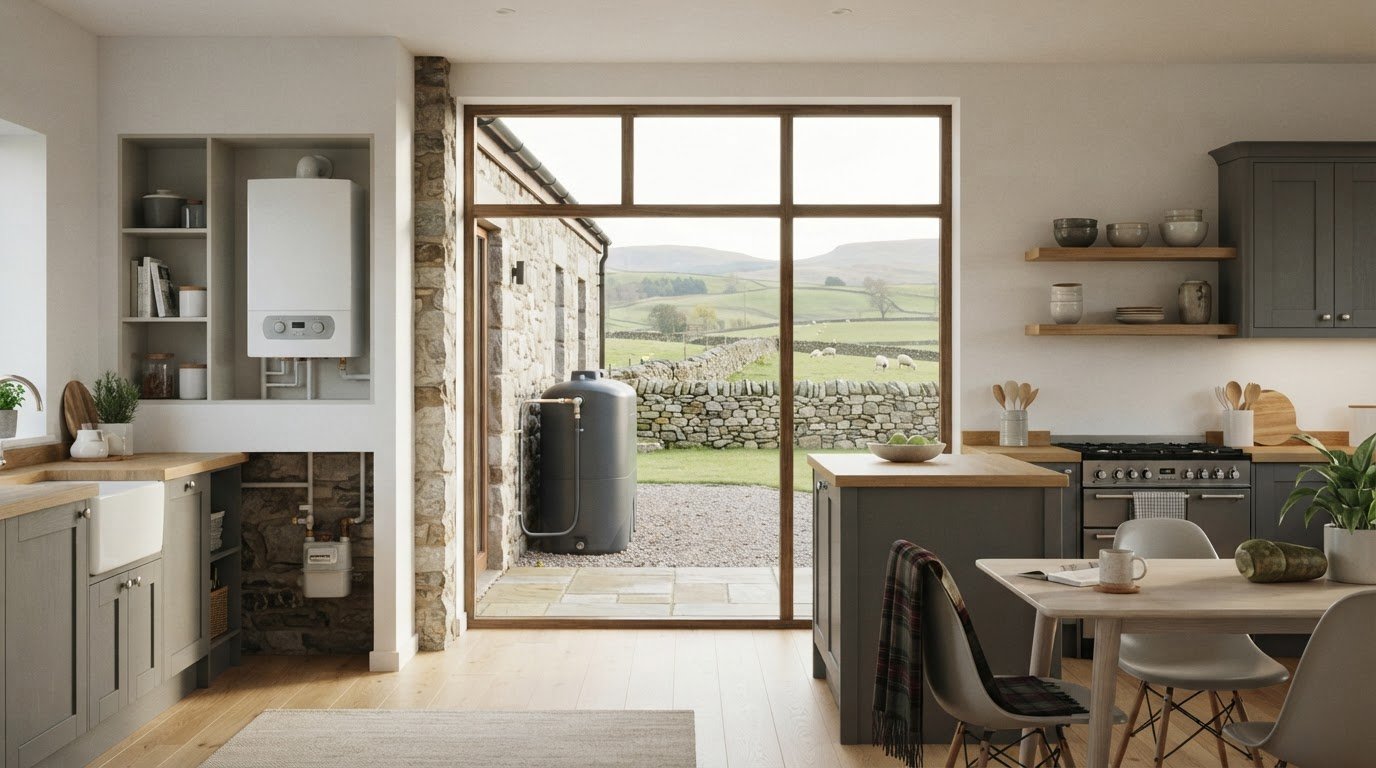
Gas vs Oil Boiler: Which Heating System Suits Your Home in 2026?
The lower-cost boiler on paper may not be a realistic choice for your home. In Dumfries and Galloway, the first question in a gas vs oil boiler decision is whether your property has a usable mains-gas connection.
It’s understandable to focus on fuel prices, especially when heating costs can change. But the right system also depends on fuel access, how you store and manage heating oil, your home’s heating needs and what a changeover would involve. Replacing a boiler isn’t always a straightforward switch from one fuel to another.
This guide compares gas and oil boilers in 2026 so you can assess which options are practical for your property before weighing up running costs. You’ll learn how fuel availability affects the decision, what day-to-day ownership involves and which property details to gather before planning a change. We’ll also explain what current Scottish rules mean for existing homes, helping you make a more informed decision about your next step.
Key Takeaways
- Start by finding out whether your property has a usable mains-gas connection. Fuel access may determine which systems are practical.
- Compare a gas vs oil boiler by considering fuel supply, storage, billing and day-to-day planning, not just the boiler itself.
- Use bills and purchase records for the same period, and note the tariff or oil-price dates to make running-cost comparisons more meaningful.
- Separate replacing an existing boiler from changing your home’s fuel arrangement, as switching systems may involve additional planning.
- Gather details about your fuel access, current heating costs and property before deciding on your next step.
Gas vs Oil Boilers: Why Fuel Access Comes First in Dumfries and Galloway
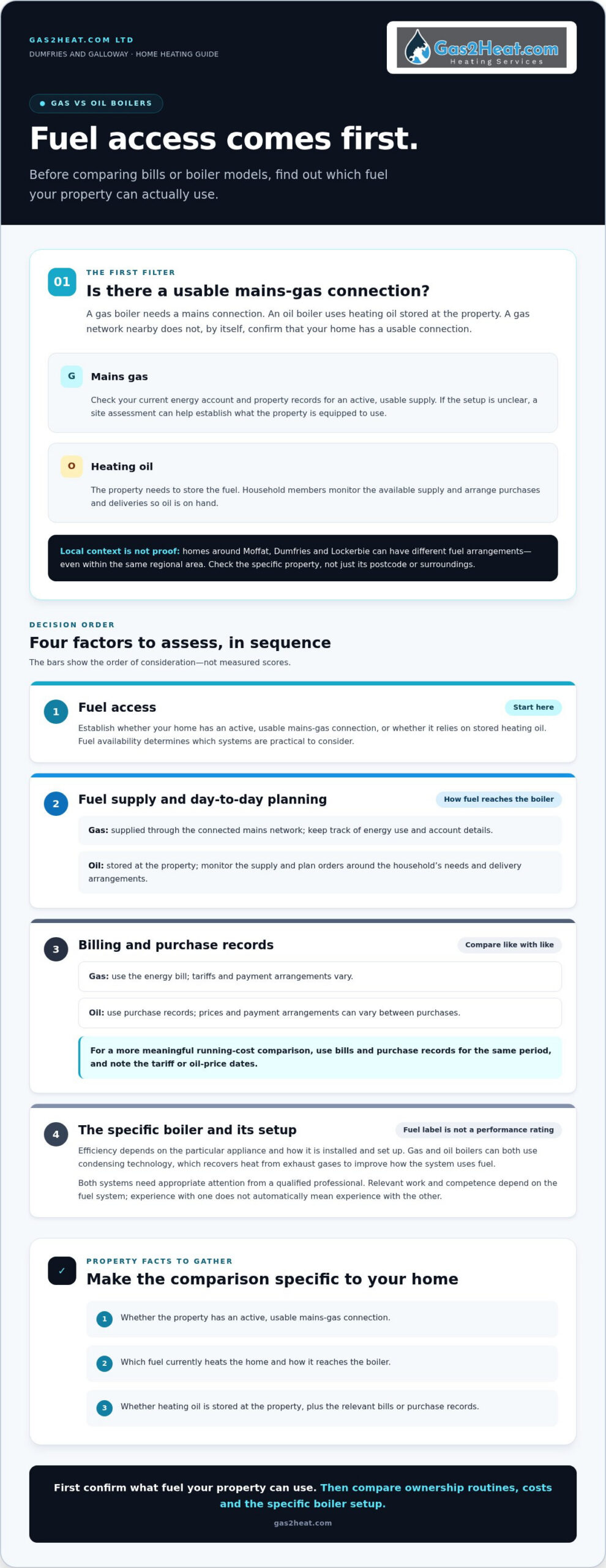
Before comparing efficiency, bills or boiler models, establish which fuel your property can actually use. A gas boiler heats water using gas, usually delivered through a mains connection. An oil boiler burns heating oil stored at the property. Both can provide home heating, but the fuel reaches your home in very different ways.
Fuel availability sets the starting point for a gas vs oil boiler comparison: a system is only a realistic option if your property can access and manage its fuel supply. A home without a usable mains-gas connection can’t make a straightforward switch to a gas boiler just because gas is available nearby. Equally, living in a rural area doesn’t prove that a particular property is off the gas grid.
Does your Dumfries and Galloway home have access to mains gas?
Check the actual connection status before weighing up boiler options. Look at your current energy account and property records for evidence of a mains-gas supply. Distinguish an active, usable connection from a gas network that may simply be in the wider area. If the records don’t make the setup clear, a site assessment can help establish what the property is equipped to use.
Local context is a useful starting point, not a verdict. Homes around Moffat, Dumfries and Lockerbie sit within the same regional picture, but their fuel arrangements can differ from one address to the next. Rural surroundings may make off-grid heating more common in some locations, yet a village, postcode or landscape alone can’t confirm a specific home’s access. Base the comparison on your property, not an assumption about its area.
What an oil boiler means for a household
An oil boiler uses heating oil stored at the property, rather than fuel arriving continuously through a mains connection. That changes the household routine: you need to keep track of the stored supply and plan purchases and deliveries so fuel is available when needed. The timing and arrangements depend on the household and its circumstances, so don’t assume every oil-heated home follows the same schedule.
There’s also a distinction between the boiler and the way its fuel is supplied. Gas and oil boilers can use condensing technology, which recovers heat from exhaust gases to improve how the system uses fuel. The Condensing boiler overview explains this principle. It’s separate from whether your home has a mains connection or stores oil on site.
To make the first decision concrete, gather these details:
- Whether the property has an active, usable mains-gas connection.
- Which fuel currently heats the home and how it reaches the boiler.
- Whether the existing setup stores heating oil at the property.
Once fuel access is clear, you can compare day-to-day ownership and running costs on a like-for-like basis. In Dumfries and Galloway, this order prevents a headline price comparison from distracting from the more basic question: which fuel arrangement fits your home?
How Gas and Oil Boilers Differ in Everyday Home Heating
The boiler burns fuel to heat your home, but the way fuel reaches it affects household routines. A mains-gas supply connects to the property, while heating oil is stored there and replenished through purchases and deliveries. Keep those arrangements separate from the boiler’s design: the fuel label alone doesn’t tell you how efficiently a particular system will heat your home.
| Ownership factor | Gas boiler | Oil boiler |
|---|---|---|
| Fuel supply | Uses a connected mains-gas supply. | Uses heating oil delivered to the property. |
| Storage | Fuel is supplied through the gas network, rather than kept in an oil tank at home. | Heating oil is stored at the property for use by the boiler. |
| Billing and purchasing | Gas use and related charges appear on an energy bill. Tariffs and payment arrangements vary. | Householders buy oil separately. Prices and payment arrangements can vary between purchases. |
| Day-to-day planning | Keep track of energy use and account details. | Monitor the available supply and plan oil orders so fuel is on hand. |
This comparison describes how each home receives and pays for fuel, not a guaranteed difference in comfort or performance. Boiler efficiency depends on the specific appliance and how it’s installed and set up. Two systems using different fuels can’t be fairly ranked from their fuel labels alone. For background on the wider policy discussion, the UK government boiler efficiency standards consultation covers work on boiler standards and efficiency.
Fuel supply, storage and household planning
A connected gas supply delivers fuel through the network, with charges recorded through the household’s energy billing. Oil involves a different routine: households need to monitor the amount stored and arrange purchases as needed. There’s no single ordering pattern that suits every home. Storage space, fuel use and delivery arrangements all shape the practical experience of living with an oil boiler.
Maintenance, reliability and safety considerations
Both types of boiler need appropriate attention from a qualified professional. The work and relevant competence depend on the fuel system, so don’t assume that experience with one automatically means experience with the other. Gas2Heat.com Ltd’s fully qualified engineers are Gas Safe registered and hold up-to-date certifications for domestic gas systems. This distinction matters when planning routine maintenance or considering a replacement.
For a gas vs oil boiler decision, assess the supply arrangements and the individual appliance as separate questions. If a gas system is the right fit for your property, Gas2Heat.com Ltd’s domestic gas boiler services in Dumfries and Galloway include installation, servicing and repairs.
Gas vs Oil Boiler Running Costs: How to Compare Without Stale Prices
Neither fuel is always cheaper for every household. Gas tariffs and heating-oil prices change, and the result depends on how much fuel your home uses, the boiler’s efficiency and the charges involved. A comparison that quotes a unit rate without its date or assumptions can quickly mislead.
Compare total household heating costs, not unit rates alone. Include the fuel used over a matching period, relevant fixed charges and any costs associated with buying or delivering oil. Keep boiler or installation costs separate so you can see exactly what you’re comparing.
Which costs belong in a fair comparison?
Gather bills or purchase records for the same length of time, ideally covering a comparable heating period. Record the tariff or oil price date and the amount of fuel used. If the homes or periods have different levels of use, their totals won’t offer a fair like-for-like comparison.
For context, Ofgem’s price cap for 1 October to 31 December 2026 sets an average gas unit rate of 7.97p per kWh and an average daily gas standing charge of 29.68p. These are cap-period averages for a typical household, not a promise of your personal tariff. Your region, payment method and meter can affect what you pay. Use the rates on your own bill for a household-specific calculation.
Work through the figures using clearly labelled variables rather than borrowing an old online estimate:
- Gas total: gas used during the chosen period × your current unit rate, plus standing charges for that same period.
- Oil total: oil purchased for the matching period × the price per litre, plus any delivery charges that apply.
- Context: note the period, price date and boiler information alongside both totals. Keep equipment and installation costs separate from fuel spending.
Why oil and gas prices do not produce a universal winner
Oil is bought separately from a mains-gas tariff, so a past delivery price may not represent what a household would pay now. Gas tariffs also change. Treat published comparisons as historical context unless their prices, dates and assumptions match your circumstances. The Energy Saving Trust boiler advice can help explain boiler efficiency, another factor to consider alongside fuel prices.
Usage matters too. A home’s heating demand and the efficiency of its specific boiler affect how much fuel it needs. A cheaper theoretical option isn’t useful if the property can’t access that fuel. Confirm the home’s practical setup, then compare current costs on equivalent terms.
Once you’ve established that mains gas is a workable option, Gas2Heat provides domestic gas boiler installation in Dumfries and Galloway. Local gas-boiler expertise can help turn your comparison into a property-specific next step.
How to Decide Between a Gas and Oil Boiler for Your Property
A clear decision starts with your home, not a general claim about which fuel is cheaper. Work through this checklist in order. It helps separate a like-for-like boiler replacement from a larger project that changes how fuel reaches or is stored at your property.
A practical property-first decision checklist
- Establish fuel access. Find out whether your property has a usable mains-gas connection. Don’t assume access based on the nearest town or neighbouring homes.
- Record the existing setup. Note the current boiler type, fuel supply, heating controls and whether the home uses stored oil. Include any details you know about the system and its layout.
- Review household use and bills. Compare bills or fuel purchases for matching periods, and record the dates and amounts. Consider how your household uses heating across the year, not only on the latest bill.
- Define the work involved. Replacing an existing boiler with one using the same fuel is different from changing the home’s fuel arrangement. A switch may involve more than choosing a boiler, so consider the property layout and what would need to change.
- Set out your next step. If the fuel supply and existing setup suit a straightforward replacement, gather the system details for an installation assessment. If the plan involves changing fuel arrangements, identify what needs assessing before choosing equipment.
This process keeps the gas vs oil boiler decision grounded in what your property can support. A larger home, different household routine or unusual system layout can affect heating demand and the scope of work. Write down these details before comparing options, so you’re not relying on an estimate based on a different type of home.
When professional gas-boiler advice can help
A qualified assessment can help clarify whether a gas-boiler replacement fits the existing system and property. It can also identify relevant installation considerations, including how the heating setup and layout affect the work. In Dumfries and Galloway, Gas2Heat’s engineers are fully qualified, Gas Safe registered and hold up-to-date certifications for domestic gas work.
Keep the decision in two parts: first establish the fuel arrangement that’s practical for the home, then assess the boiler and installation needed. That distinction can prevent a routine replacement from being mistaken for a simple fuel switch, or vice versa.
For a closer look at what to prepare and consider, use this boiler installation guide. It’s a useful next step once you’ve noted your current fuel supply, boiler type, household usage and property layout.
Planning a Gas Boiler in Dumfries and Galloway: Your Next Steps
Make the decision in order: confirm your property’s fuel access, compare current heating costs on a like-for-like basis, then assess the boiler and the home. This helps distinguish replacing a gas boiler from changing the property’s fuel arrangement, which may involve wider planning. Once you’ve completed that comparison, gather a few details to make the next discussion more useful.
What to prepare before planning a gas-boiler installation
Note the existing boiler type and heating setup, whether the property has a mains-gas connection and any changes you’re considering. Add your household’s heating priorities and concerns, such as rooms that are difficult to keep comfortable or issues with the current system. These details focus the assessment on your property’s needs rather than a general comparison.
It can also help to have recent heating bills or fuel records available. You don’t need to settle every technical decision first. A clear picture of the current setup and what you want from a replacement gives an assessment a practical starting point.
For background on reducing wasted heat as you plan, the heating efficiency guide can help you consider the home’s wider heating performance alongside the boiler itself.
Local gas-boiler support from Gas2Heat
Gas2Heat is a Moffat-based heating specialist providing domestic gas-boiler installation across Dumfries and Galloway, including Moffat, Dumfries, Lockerbie, Annan, Lochmaben, Thornhill, Gretna and Castle Douglas. Its engineers are fully qualified, Gas Safe registered and hold up-to-date certifications. For jobs of four hours or more, Gas2Heat provides free written estimates with no obligation to proceed.
The initial call-out fee is £85 and includes travel, fuel and up to one hour of on-site labour. Any work beyond that hour must be quoted separately. Additional time is charged at £20 per 15-minute block. Quoted prices are for a single engineer; if a job requires multiple engineers, the price is multiplied by the number of engineers.
Once you’ve confirmed gas access and gathered details about your system, you can explore Gas2Heat’s local gas-boiler installation service. To discuss the work, call 0800 009 6774 or email info@gas2heat.co.uk.
Take the Next Step with Confidence
Your heating decision should support the way you plan to use your home, not just solve an immediate boiler problem. Before committing, consider whether your needs may change and whether the existing setup still suits the property. A clear plan can make the next stage more straightforward.
The gas vs oil boiler choice is personal to your home. If you’re considering a gas boiler, Gas2Heat is a Moffat-based heating specialist serving Dumfries and Galloway. Its fully qualified engineers are Gas Safe registered and hold up-to-date certifications, providing a professional local team for domestic gas-boiler installation.
Explore Gas2Heat’s boiler installation service and call 0800 009 6774 or email info@gas2heat.co.uk to discuss your home’s requirements.
Frequently Asked Questions
Is a gas boiler cheaper to run than an oil boiler?
Not in every home. The result depends on current fuel prices, how much heat your household uses and the efficiency of the specific boiler and installation. A low gas unit rate alone doesn’t settle the comparison, particularly if fixed charges affect your bill. Use your own recent bills and oil purchase records for a useful estimate, and treat online figures as time-specific examples rather than a promise of future savings.
Can I have a gas boiler if my home is not connected to mains gas?
A standard mains-gas boiler needs a suitable gas supply, so it can’t operate as intended in a home without one. If your property has no connection, first establish which fuel systems are practical there rather than selecting a boiler based on price alone. A proposed change can involve more than replacing the appliance, so consider the home’s supply arrangements and heating setup together.
What is the main difference between a gas and an oil boiler?
The key difference is how the fuel reaches the appliance and how the household manages it. With gas, use is recorded through an energy account; with oil, purchases are made separately and the household needs to monitor its supply. The boiler’s operation and installation also depend on the individual model and system. For a comparison, distinguish these ownership differences from how efficiently a particular boiler performs.
Can I switch from an oil boiler to a gas boiler?
Yes, if a suitable mains-gas supply can serve the property and the conversion is practical. It may involve more than changing the boiler, since the fuel connection, heating equipment and layout may need assessment. Gas2Heat provides domestic gas-boiler installation in Moffat, Dumfries, Lockerbie, Annan, Lochmaben, Thornhill, Gretna, Castle Douglas and the wider Dumfries and Galloway area. Start by establishing the property’s gas access and identifying what changes the existing system would need.
Do oil boilers need a tank?
An oil boiler uses heating oil stored at the property, usually in a dedicated oil tank, rather than fuel supplied through mains gas pipes. The household needs to monitor the available oil and arrange purchases so there’s fuel for heating. The tank and delivery arrangements are part of the home’s heating setup, so account for them when considering space and day-to-day ownership.
Is gas or oil better for a rural home in Scotland?
There’s no single answer for every rural property. Some homes can use mains gas, while others rely on fuel stored at the property or another heating arrangement, such as renewable solutions from Love Green Heat Pumps Ltd. A rural address alone doesn’t tell you which setup applies. Check the specific home’s supply, existing system and heating needs first. In Dumfries and Galloway, neighbouring properties can have different fuel options, so assess the address rather than assuming.
Are gas boilers being phased out in Scotland in 2026?
No general phase-out date or ban applies to gas boilers in existing homes in Scotland in 2026. The restriction on fossil-fuel heating applies to new-build homes, not to the continued use of a working boiler in an existing property. Proposals for future changes to existing homes are separate from current rules, so distinguish a consultation or proposal from a requirement already in force.
For help planning a gas boiler in Dumfries and Galloway, contact Gas2Heat on 0800 009 6774 or email info@gas2heat.co.uk to discuss your home and request a free written estimate for jobs of four hours or more, with no obligation to proceed.
