
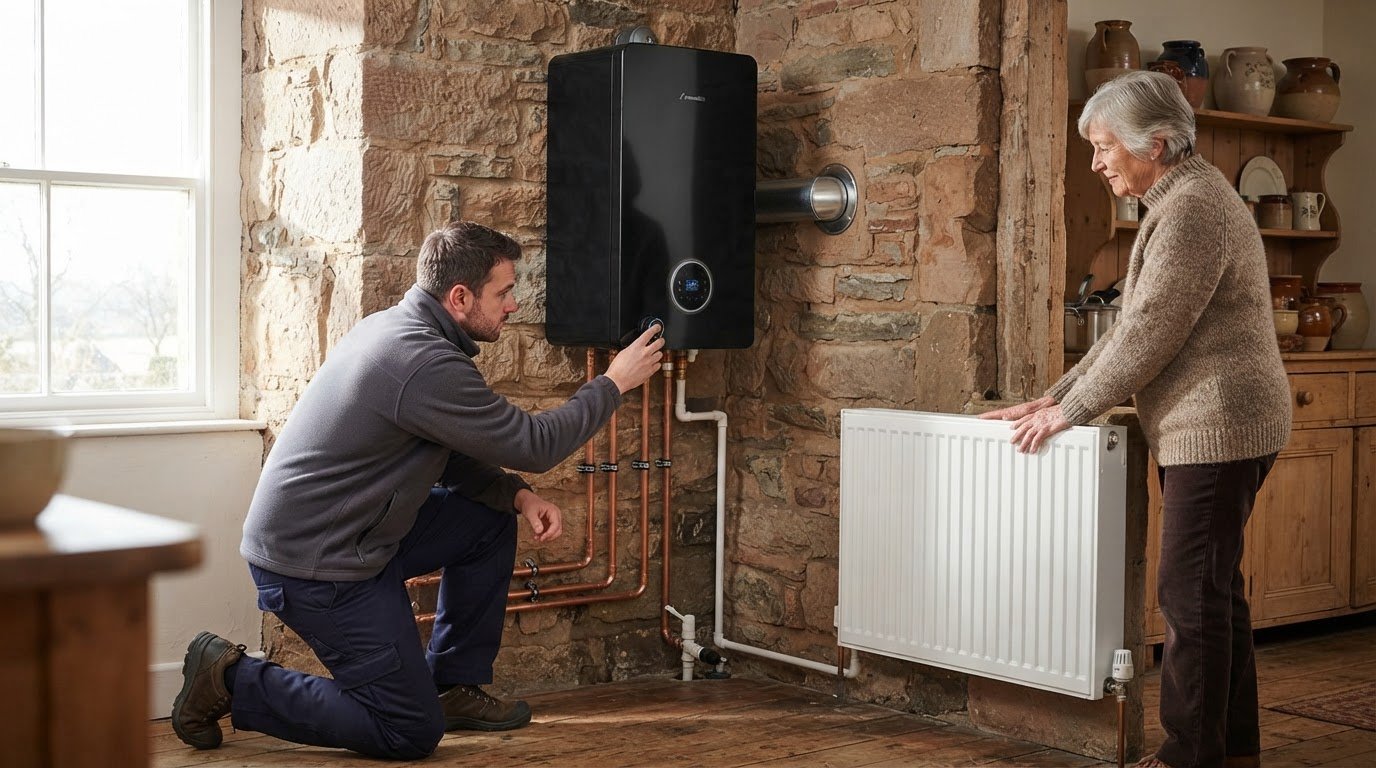
How to save money on a new boiler and lower your bills
A new boiler can lower bills, but replacing it isn’t the only way to save. In a gas-heated detached home in Great Britain, changing an older G-rated boiler for an A-rated condensing model could save up to £840 on bills. To understand how to save money on a new boiler, look at how efficiently it runs and how your home uses heat.
It makes sense to focus on the upfront cost, but the boiler’s settings, insulation and energy tariff also affect what you spend over time. This guide explains how efficiency ratings relate to potential savings, why flow temperature matters and how reducing heat loss can help. You’ll also see why savings vary between homes, so you can weigh up a replacement against practical changes to your existing heating system.
Key Takeaways
- Compare a replacement boiler’s efficiency with your existing system, but consider whether changes to controls or servicing could improve performance first.
- Estimate potential bill savings against the installation cost to understand how long a replacement may take to pay back.
- Flow temperature, insulation and your energy tariff all affect running costs; the right combination depends on your home and heating system.
- Check which government support applies where you live, as schemes differ across the UK and may support alternative heating systems rather than a new boiler.
Are new boilers more efficient?
A modern condensing boiler can usually use fuel more efficiently than an older model. But replacing a boiler may not reduce gas bills if the existing unit is already efficient, the new system is poorly set up or household heating use increases. Cold weather, higher energy prices and longer heating hours can also offset efficiency gains.
For a gas-heated detached home in Great Britain, replacing an older G-rated boiler with an A-rated condensing boiler could save up to £840 on bills. That’s a potential saving, not a guaranteed result for every property. A smaller efficiency difference, or increased heating use after installation, can mean a modest reduction or no visible fall in bills.
Installation costs vary with boiler type, property layout, pipework changes and the work needed to fit the system. There isn’t one reliable cost for every replacement, so compare itemised quotes covering the boiler, labour, removal, alterations, controls and commissioning. Keeping the existing boiler location and suitable pipework may reduce the work involved, while changes can increase the overall scope.
Quotes are easiest to compare when each describes the same boiler type and clearly separates equipment, labour and additional work. Check that the installer is appropriately registered and that commissioning is included. A low headline price can leave out necessary work or rely on a setup that doesn’t suit the property, leading to extra costs or reduced efficiency.
There’s no universally cheapest season. Summer promotions may reduce a quoted price, while quieter periods can affect availability, but compare the full installation scope rather than relying on a sale label. Repairing can cost less upfront if the fault is limited and the boiler remains efficient. Frequent faults or poor efficiency may make replacement worth considering.
For the savings estimate, an older G-rated boiler replaced by an A-rated condensing model could cut bills by up to £840 in the stated detached-home example. Your result depends on the old boiler’s efficiency, heating habits, home and tariff.
Estimating potential savings
Start with annual gas spending, then estimate how lower consumption could reduce that bill. It’s an illustration, not a universal outcome. Working out how to save money on a new boiler starts with using figures that reflect your household.
Treat this as a starting point, then consider your current boiler’s efficiency and your household’s heating use. A smaller efficiency difference between old and new models means less scope for fuel savings.
Compare gas use and costs across the same annual period before and after an upgrade. Separate gas charges from electricity costs, and account for tariff changes. A colder winter, longer heating hours or a higher thermostat setting can increase consumption and narrow the apparent savings.
Payback depends on the estimated annual bill reduction compared with the full installation cost. Divide the installation cost by the expected yearly savings to estimate how many years it could take to recover that outlay. If you’re considering how to save money on a new boiler, keep assumptions consistent, including energy prices and usage patterns.
Compare the estimate with improving your existing boiler’s controls or settings. If projected savings are modest, a smaller heating adjustment may better suit your budget. For an assessment of how an upgrade fits your home with Gas2Heat.com Ltd, explore a boiler installation assessment.
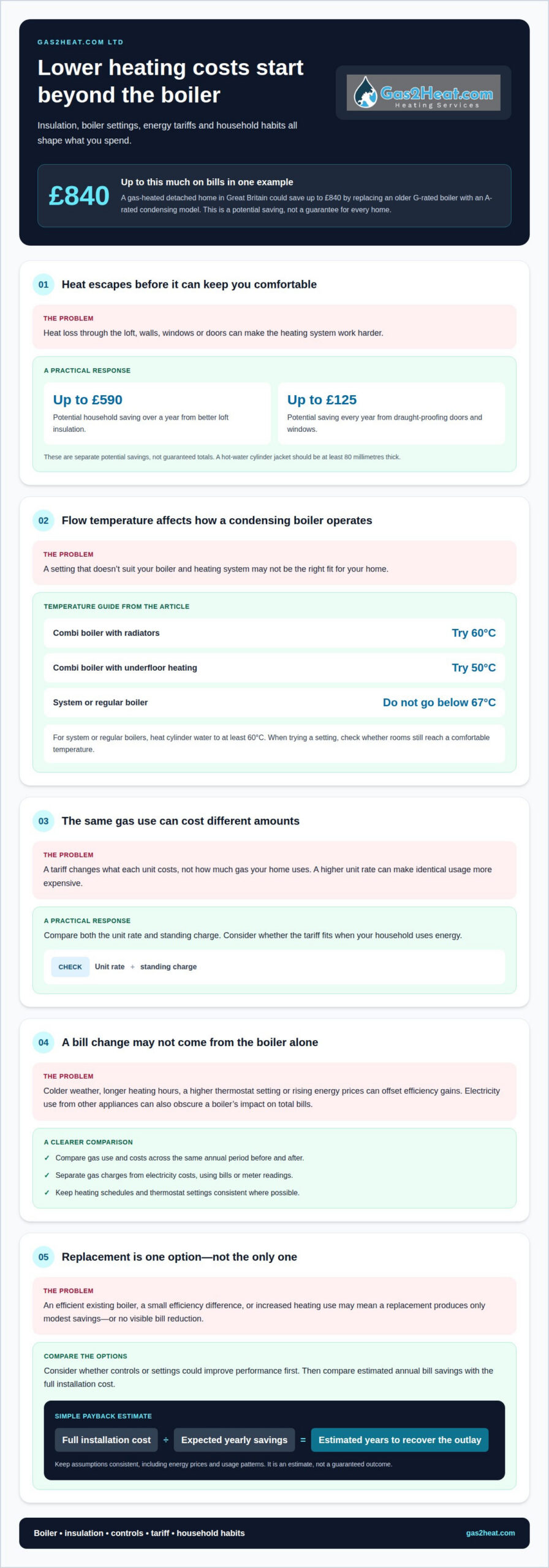
Factors affecting savings, including insulation and energy tariffs
A more efficient boiler can reduce gas use, but insulation affects how much heat escapes. If a home loses warmth through its loft, walls, windows or doors, the heating system must work harder to maintain comfort. Improving the building fabric can complement a boiler upgrade and help keep energy bills down.
Better loft insulation could save households up to £590 over a year, while draught-proofing doors and windows could save up to £125 every year. These are separate potential savings, not guaranteed totals for every home. A hot-water cylinder jacket should be at least 80 millimetres thick, helping reduce heat loss from stored water.
Flow temperature also affects how a condensing boiler operates. For a combi boiler with radiators, try a flow temperature of 60 degrees Celsius, then assess whether rooms still reach a comfortable temperature. A combi paired with underfloor heating can be tried at 50 degrees Celsius. For system or regular boilers, avoid lowering the flow temperature below 67 degrees Celsius, and heat cylinder water to at least 60 degrees Celsius.
Your energy tariff changes the cost of each unit, not the amount of gas your home uses. A lower unit rate may reduce spending for the same consumption, while a higher rate can make identical usage more expensive. Compare the unit rate and standing charge when reviewing tariffs, and consider whether the tariff suits when your household uses energy.
Other appliances contribute to total energy bills, so a boiler’s improvement may not be clear if electricity use rises at the same time. Review gas and electricity consumption separately, using bills or meter readings across comparable periods. Keep heating schedules and thermostat settings consistent where possible. A warmer setting or longer heating hours can increase gas use and offset efficiency gains.
For a balanced view, consider the boiler, insulation, controls, tariff and household habits together. An energy-efficient boiler works best as part of a home that retains heat and uses heating thoughtfully. This wider picture helps explain why two similar homes may see different changes in their bills after an upgrade.
What grants or government schemes help pay for a new boiler in the UK?
Government support depends on where you live and which heating system you plan to install. The Boiler Upgrade Scheme is open to people in England and Wales, according to the Department for Energy Security and Net Zero. It can contribute towards replacing a fossil fuel heating system with a heat pump or biomass boiler, rather than funding a like-for-like gas boiler replacement.
The Boiler Upgrade Scheme can apply to a heating system in a home or a building used for business. Its focus is the change to a different type of heating, so a household planning another gas boiler should not assume the scheme will cover that installation. The scheme is available until April 2028. The proposed system and property need to fit the scheme’s rules.
In Scotland, households might be able to access an interest-free loan or a grant to improve home energy efficiency. Support may relate to broader measures rather than simply replacing a boiler. The type of work and the home’s circumstances affect which help may apply. Consider whether insulation or a different heating system is part of your plan, not just the boiler.
Northern Ireland’s Boiler Replacement Scheme is closed, so it cannot currently be relied on to fund a new boiler there. Across the UK, schemes differ by nation and purpose: a grant for a heat pump is not the same as help towards a replacement gas boiler. Identify your nation first, then distinguish grants from loans and check what type of heating work each scheme supports.
Build any available support into your budget before deciding between a boiler replacement and a different heating system. If you’re planning a gas boiler installation, discuss your boiler installation and the work your home needs.
Gas2Heat.com
Gas2Heat.com can help you consider your boiler’s condition and heating needs when deciding whether to repair, service or replace it. Boiler Repairs and Boiler Servicing can address existing system issues, while Boiler Installation may suit a replacement. Landlords can also arrange Landlord Gas Safety Certificates.
Use your recent energy bills, boiler history and plans for the property to explain what you want to improve. This keeps the discussion focused on your situation, rather than assuming a new boiler will automatically lower your costs. The right next step depends on whether the current boiler is faulty, due for servicing or ready for replacement.
For clear guidance on your boiler options, contact Gas2Heat.com.
Make your next heating decision with confidence
A sensible way to decide how to save money on a new boiler is to treat the purchase as part of a longer-term home heating plan. Look beyond the initial quote: consider how your household uses heat, what needs attention in the property, and whether repair, servicing or replacement best addresses the current problem. This gives you a clearer basis for comparing options without assuming the newest model is automatically the most cost-effective choice.
Before deciding, bring together your recent energy bills, any boiler service history and the changes you want from your heating. These details can help frame a useful conversation about the system’s condition and your priorities. If you’re still weighing up the next step, contact Gas2Heat.com for advice. A clear plan can make the decision feel more manageable, so you can move forward with greater confidence.
Frequently Asked Questions
How else can I save money?
Reduce avoidable energy use beyond heating. Run washing machines with full loads, choose a suitable lower wash temperature and switch off appliances instead of leaving them on standby. Avoid running hot taps unnecessarily, too. These steps target electricity and hot-water demand separately from boiler efficiency, helping you manage other parts of household consumption without changing the heating system.
How much does it cost to upgrade?
An upgrade’s cost depends on whether you mean new controls, pipework changes or a complete boiler replacement. The price depends on the job and is provided after a quote request. Relevant factors include equipment choice, labour, access, flue or pipework alterations and commissioning. Define the work included and compare quotes on the same scope, rather than judging by headline totals alone.
Should I upgrade my boiler now?
Consider upgrading when documented faults, recurring repairs or inadequate heating make continued use a poor fit. If the boiler runs reliably and meets your household’s needs, compare maintaining it with replacing it. Review service records, repair history, changes in household occupancy and planned renovations. These details help you decide whether replacement needs attention now or can be planned around your circumstances.
How much does a new boiler cost in the UK, including installation?
The price depends on the case and is given after a quote request. The total can vary with boiler type, installation complexity, access, relocation, pipework or flue work, controls and removal of the old unit. An itemised scope helps show which tasks are included and which are optional, making it easier to compare the full installation cost consistently.
How can I choose the right boiler size and type to avoid overspending?
Choose a boiler type that suits your home and heating needs, and compare itemised quotes for the same type and installation scope. Keeping the existing boiler location and suitable pipework may reduce the work involved.

Leave a Reply
You must be logged in to post a comment.