
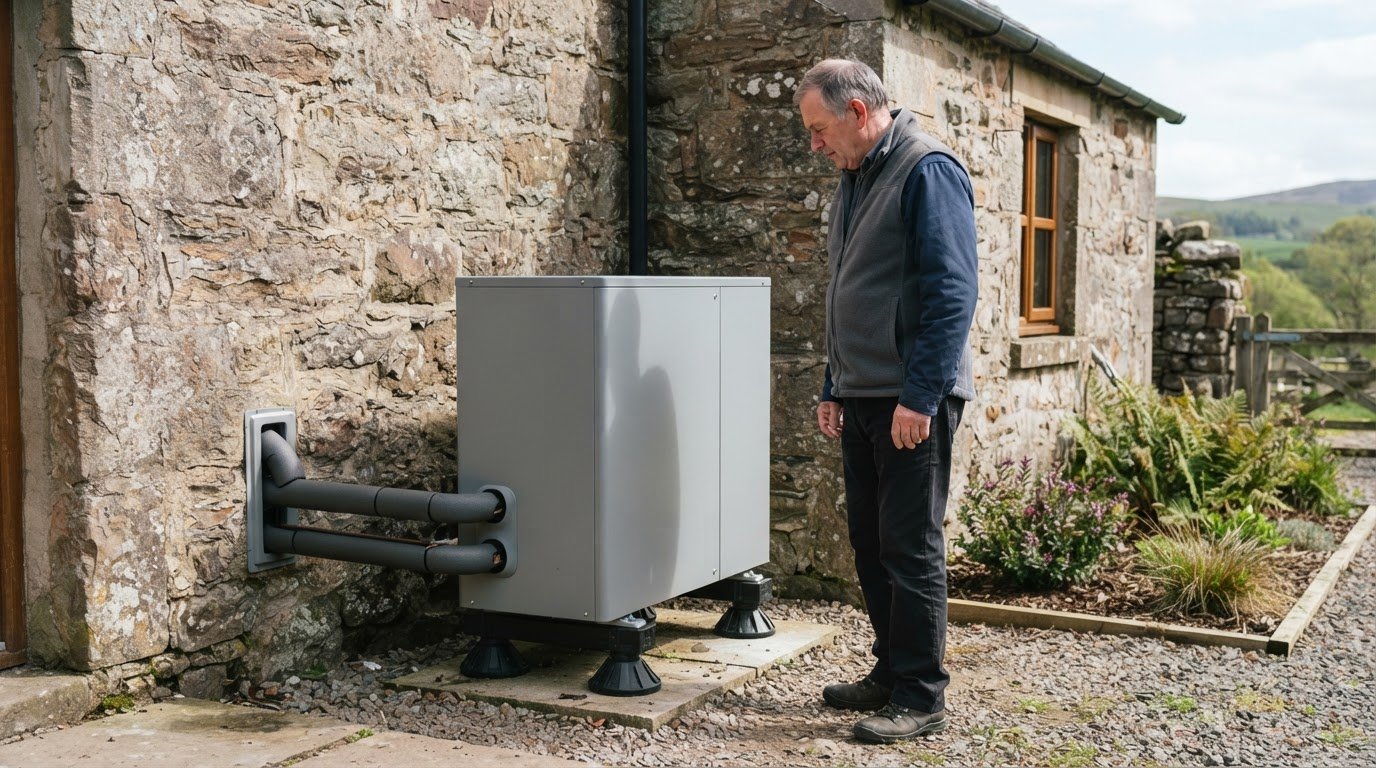
Government grants for heating upgrades in Scotland: funding
Up to £15,000 in grant funding may be available to homeowners in Scotland through the Home Energy Scotland Grant and Loan Scheme. Government grants for heating upgrades in Scotland can support eligible clean heating and energy-efficiency improvements, with additional help potentially available for rural households. Grants don’t have to be repaid.
Working out which support applies can feel complicated, particularly when funding depends on the work and your circumstances. This guide explains the main options, what they may contribute and who may qualify, helping you identify a likely route before planning an upgrade.
You’ll also learn how support for heat pumps differs from funding for insulation and other home improvements, and how area-based schemes may help households facing fuel poverty. Match the upgrade to each scheme’s purpose and eligibility criteria to see what to explore next, and whether a grant, loan or combination could suit your home.
Key Takeaways
- See who can apply for the Home Energy Scotland scheme and how property eligibility affects access to funding.
- Understand how heat pump grants and rural or island uplifts may increase support for eligible homes.
- Compare grants with optional interest-free loans for insulation and other recommended energy-efficiency improvements.
- Learn when area-based support may help households struggling with heating costs, and how underfloor heating installation could fit into wider home upgrades.
What is the Home Energy Scotland Grant and Loan Scheme?
Home Energy Scotland offers grants and optional interest-free loans for eligible Scottish homeowners. If you’re exploring government grants for heating upgrades in Scotland, this scheme can help fund clean heating systems and energy-efficiency work.
Scheme eligibility criteria
The scheme funds qualifying work in existing homes in Scotland, subject to ownership and evidence requirements. Eligibility matters: a recommended measure and valid energy performance certificate can affect whether an application qualifies. Homeowners apply themselves, and funding must be approved before heat pump installation begins.
For low-carbon heating, the system must be recommended in an energy performance certificate or a Home Energy Scotland adviser’s report. Both the installer and product must be MCS-certified. Check these technical and application requirements before progressing with a project.
Homeowner and property eligibility
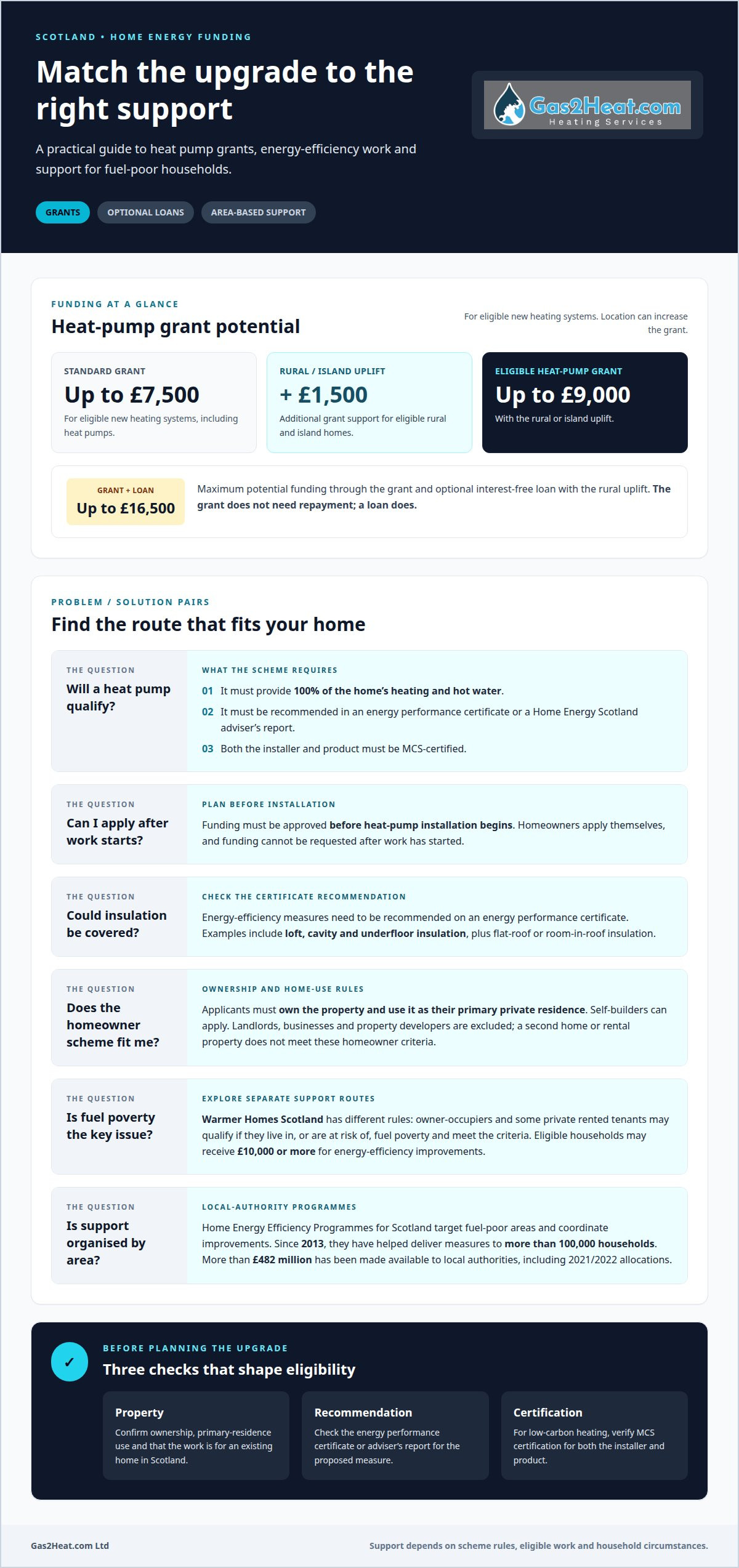
Applicants must own the property and use it as their primary private residence. Landlords, businesses and property developers are excluded, while people undertaking a self-build can apply. A second home or rental property therefore does not meet the stated homeowner criteria.
Warmer Homes Scotland has different eligibility rules. Owner-occupiers and some private rented tenants may qualify if they live in, or are at risk of, fuel poverty and meet the scheme’s criteria. Eligible households may receive £10,000 or more for energy-efficiency improvements.
Eligible home improvements and systems
Home Energy Scotland support can cover clean heating and energy-efficiency work. Eligible heating options include heat pumps and heat network connections; a funded heat pump must provide 100% of the home’s heating and hot water. The grant is for a new installation, although an optional interest-free loan may help with a replacement heat pump.
Energy-efficiency measures must be recommended on an energy performance certificate. Examples include loft, cavity and underfloor insulation, as well as flat-roof or room-in-roof insulation. For anyone comparing government grants for heating upgrades in Scotland, the certificate recommendation helps identify improvements that may qualify.
To reduce scam risk, confirm that both the installer and product are MCS-certified, as required for the Scottish scheme. Ask for the installer’s certification details and check them against MCS records before agreeing to the work.
Funding for low-carbon heating technologies such as heat pumps
Home Energy Scotland supports eligible low-carbon heating, including heat pumps and heat network connections. Its grant and loan options can reduce the amount homeowners need to fund themselves.
Low-carbon heating funding
The scheme offers a grant of up to £7,500 for eligible new heating systems, including heat pumps. This matters because the grant can contribute towards the cost of moving a property away from carbon-intensive heating.
Funding applies to a heat pump only when it provides 100% of the property’s heating and hot water requirements. A heat pump must also be recommended in an energy performance certificate or a Home Energy Scotland adviser’s report. Apply before installation begins, because funding cannot be requested after work has started.
Rural and island funding uplift
Eligible rural and island homes can receive an additional £1,500 uplift on heating and energy-efficiency grants. For a qualifying heat pump, that can raise grant support to as much as £9,000. For homeowners comparing government grants for heating upgrades in Scotland, location can therefore affect the potential grant amount.
Homeowners may also combine grant support with an optional interest-free loan. With the rural uplift, the maximum potential funding through the grant and loan can reach £16,500. The grant portion does not need repayment, while a loan does. This distinction helps households plan the balance between support and borrowing.
Private rented sector funding
Private landlords cannot apply for the Home Energy Scotland Grant and Loan Scheme. This means a landlord cannot use the homeowner grant to install a heat pump in a rental property.
Private landlords may need to look for funding options designed specifically for the private rented sector. The property and proposed heating improvements must meet that programme’s terms. Understanding government grants for heating upgrades in Scotland also means distinguishing landlord support from homeowner funding. Tenants cannot apply for the homeowner grant, but Warmer Homes Scotland has separate eligibility criteria for some private rented tenants.
Underfloor heating installation may be relevant when planning a separate home heating upgrade.
Scottish Government grants and interest-free loans for home energy improvements
Scottish support includes Home Energy Scotland funding and area-based programmes delivered by local authorities. The right route depends on the work, property and location.
Local-authority area-based schemes
Home Energy Efficiency Programmes for Scotland are local-authority schemes that target fuel-poor areas. They aim to improve energy efficiency, reduce fuel poverty and cut emissions. If your household is in an area selected for coordinated improvements, this may be a more relevant route than an individual grant.
Local authorities blend Scottish Government funding with Energy Company Obligation funding, homeowner contributions and registered social landlord funding. Since 2013, these programmes have helped deliver energy-efficiency measures to more than 100,000 households. More than £482 million has been made available to local authorities, including 2021/2022 allocations.
Home Energy Scotland grants and loans
For individual home energy work, the Home Energy Scotland Grant and Loan Scheme can combine grants with optional interest-free loans. Energy-efficiency grants cover up to 75% of the combined cost of eligible measures, with a maximum grant of £7,500. A further interest-free loan of up to £7,500 may help cover eligible costs.
Insulation support includes up to £1,500 per loft, cavity or underfloor insulation improvement. Flat-roof or room-in-roof insulation can receive up to £3,000 per improvement. Measures must be recommended on an Energy Performance Certificate, which links the funding to identified needs in the property.
A successful loan application also carries an administrative fee of 1.5% of the loan value, capped at £150 per application.
Applications are handled first-come, first-served. The scheme runs until its funding is exhausted or the financial year ends, whichever comes first. Factor this timing into plans for insulation and other recommended improvements.
Area-based support for homeowners struggling to heat their homes
Scottish households may qualify for area-based support or individual heating grants, depending on need, property and location. Each scheme has its own purpose and rules.
Scottish and UK heat pump schemes
Scottish homeowners can explore Home Energy Scotland funding, while the Boiler Upgrade Scheme applies elsewhere in Great Britain. The UK Government states that the Boiler Upgrade Scheme is open only to people in England and Wales, not Scotland.
This distinction matters when planning a heat pump application: the Boiler Upgrade Scheme is not available for a Scottish property. Scotland has a separate route, with its own eligibility requirements, including a valid energy performance certificate and an eligible system recommendation.
Heat pump grant amounts
In Scotland, Home Energy Scotland offers up to £7,500 in grant funding for eligible heat pumps and heat network connections. Rural and island homes may receive a further £1,500 uplift, potentially bringing heat pump grant support to £9,000.
The same maximum grant applies to eligible air source and ground source heat pumps. A rural uplift may increase the grant, but the system must meet the scheme’s requirements. For example, the heat pump must provide all the property’s heating and hot water, and the application must be made before installation.
Combining grants and local funding
Scottish grants and local-authority schemes have different funding arrangements, so do not assume they can be combined for one installation. Local programmes may blend Scottish Government money with Energy Company Obligation funding and household contributions to deliver area-based improvements.
Warmer Homes Scotland is another route for eligible households living in, or at risk of, fuel poverty. It supports heating and insulation measures, and renewable options may also be available. Eligibility and the specific work proposed determine the appropriate route.
If you’re considering a boiler upgrade instead, explore boiler installation for your home.
Gas2Heat.com: Underfloor Heating Installation
Gas2Heat.com Ltd provides underfloor heating installation for homeowners planning a heating upgrade. Once you’ve explored grant eligibility and funding routes, the next step is to decide which heating work suits your property and plans.
Underfloor heating may form part of a wider home heating project, alongside a boiler installation or replacement where appropriate. Funding depends on the scheme and proposed work, so do not assume every installation qualifies. Keep the funding decision separate from choosing the heating service.
If your current boiler needs attention rather than an upgrade, boiler servicing or repairs may be more relevant. Gas2Heat.com Ltd also provides boiler installation for homes where a new boiler is the chosen route.
For a practical discussion about underfloor heating installation, contact Gas2Heat.com Ltd.
Make your next heating decision with confidence
Before committing to work, consider how the funding route relates to the heating outcome you want. A grant may support eligible improvements, while your choice of heating system should reflect your home’s needs and plans. Treat these as connected decisions, but do not assume a particular installation will qualify for funding.
Understanding government grants for heating upgrades in Scotland can help you plan what to explore, but choosing and maintaining the right heating system remains important beyond the application. Gas2Heat.com offers boiler installation, servicing and repairs, supporting homeowners with practical boiler needs as their plans develop.
If you’re considering a heating project or need help with an existing boiler, contact Gas2Heat.com to discuss the work you have in mind. A clear next step can make planning your home’s heating feel more manageable.
Frequently Asked Questions
How much funding can you get?
Eligible homeowners may receive up to £15,000 in Home Energy Scotland grant funding, with additional support possible for rural households. The total depends on which eligible heating and energy-efficiency measures are included. For example, a project combining a clean heating system with recommended insulation may use funding across both categories. An optional loan can provide further support, but it must be repaid.
Not in England or Wales?
For a home in Scotland, the Boiler Upgrade Scheme is not the applicable heat pump grant route. The UK Government says it is open only to people in England and Wales. Scottish homeowners can explore Home Energy Scotland’s separate grant and loan support. Check the Scottish scheme’s eligibility and application requirements before arranging installation, as the funding route depends on the property’s location.
What is the Boiler Upgrade Scheme?
The Boiler Upgrade Scheme provides grants for eligible low-carbon heating installations in England and Wales. It can contribute towards replacing an existing fossil-fuel or electric heating system with an eligible heat pump or biomass boiler. Property owners apply through their installer, who submits the application on their behalf. Scottish homes use separate support.
Who is eligible?
For the Home Energy Scotland homeowner scheme, applicants must own an existing Scottish home and use it as their primary private residence. Landlords, businesses and property developers are excluded, while self-build applicants can apply. A valid energy performance certificate is among the stated requirements. Funded low-carbon heating must meet scheme criteria, and both the installer and product must be MCS-certified.
What Scottish government grants are available for heating upgrades in 2026?
Scottish homeowners can apply to the Home Energy Scotland Grant and Loan Scheme for eligible clean heating and energy-efficiency work. Warmer Homes Scotland supports qualifying households, while local-authority area-based programmes target fuel-poor areas. These are distinct routes, not a universal payment. The suitable option depends on the property, proposed improvements and household eligibility, so identify the project type before applying.
Who is eligible for Scotland’s Warmer Homes Scotland scheme?
Warmer Homes Scotland is for owner-occupiers and some private rented sector tenants who live in, or are at risk of, fuel poverty and meet the scheme’s eligibility criteria. Private tenants should note that this route differs from the Home Energy Scotland homeowner grant. The programme can support heating and insulation, with renewable and micro-generation options also available to qualifying households.

Leave a Reply
You must be logged in to post a comment.