

Best Time of Year to Replace a Boiler: A 2026 UK Guide
British Gas research found that 40% of boiler breakdowns happen in autumn, just as households start using their heating again. That makes summer an appealing time to plan ahead, but the best time of year to replace a boiler also depends on its condition. If yours is becoming unreliable, waiting for warmer weather could mean risking a breakdown when you need heating most.
It’s understandable to worry about losing heating during installation or fitting work around family routines. Planning early gives you more time to organise the work, while acting promptly matters if your boiler is showing signs of trouble. This guide explains when replacement may be easier to plan, when not to delay, and what to prepare before arranging installation. Gas2Heat’s fully qualified, Gas Safe registered engineers can help homeowners across Dumfries & Galloway consider the decision and discuss their options.
Key Takeaways
- The best time of year to replace a boiler depends on its condition and your household’s needs, not just the season.
- Compare spring, summer, autumn and winter to find a period that suits your schedule and how much you rely on heating.
- Don’t assume a working boiler can always wait. Distinguish a planned upgrade from a developing fault or a complete loss of heating.
- Prepare for installation by noting your household’s heating needs, preferred timing and access arrangements.
- Gas2Heat installs boilers across Dumfries & Galloway. Its engineers are fully qualified, Gas Safe registered and hold up-to-date certifications. Free written estimates are available for jobs of four hours or more, with no obligation to proceed.
When Is the Best Time of Year to Replace a Boiler?
For a planned boiler replacement, spring or summer can be convenient because your household may rely less on central heating. But there’s no universally best month. Work can be arranged at any time of year if your boiler’s condition or household circumstances call for it. The best time of year to replace a boiler is when you can plan the work without ignoring signs that your current system may not be dependable.
Think of the season as a planning factor, not a rule. If your boiler is working reliably, you may prefer to arrange installation before regular heating use returns. If it has repeated faults or can no longer provide dependable heating, you may have good reason to act sooner, even in cold weather.
The warmer months may be more convenient for planned work, but the right time for your home depends on your boiler’s condition and your household’s needs.
Why warmer months can be convenient for planned replacement
When the weather is mild, a temporary interruption to central heating may be less disruptive than during a cold spell. It may also be easier to arrange access and prepare the area around the boiler without balancing those tasks against an immediate need for warmth.
Planning ahead gives you time to consider what your household needs from its heating and hot water, discuss the existing setup and arrange installation before the next period of regular heating use. That can make the transition more manageable. The installation plan will depend on your home and the work involved, whether you speak to local installers in Scotland or regional specialists such as FM Heating & Plumbing in Essex.
Why season alone should not decide when you replace
A boiler’s age or a change in performance can be reasons to review how it is working, but neither automatically means replacement is the only sensible option. A fault may call for repair rather than a new installation. An engineer can assess the system and its history to help establish the appropriate next step.
Look at the pattern, not just one incident. Has the boiler needed repeated attention? Does it provide reliable heating and hot water? Have you noticed a change in how well the system performs? These details help an engineer understand the situation. One symptom alone isn’t enough to decide whether replacement is necessary.
Equally, don’t let the prospect of waiting for summer override concerns about reliability. If the boiler stops working, develops recurring problems or leaves your household without dependable heating, waiting several months may not suit your needs. A qualified engineer can assess whether repair or replacement is appropriate and explain the options. Gas2Heat’s engineers are fully qualified, Gas Safe registered and hold up-to-date certifications.
The type of system in your home also matters. If you’re weighing up a replacement, understanding the types of boilers and their function can give you useful background. An engineer can then consider how your existing boiler fits your home and heating requirements.
In short, use warmer months to organise a planned upgrade if your boiler is working reliably. If its condition is causing concern, base your decision on the problem and your household’s needs, not a date on the calendar.
How Spring, Summer, Autumn, and Winter Compare for Boiler Replacement
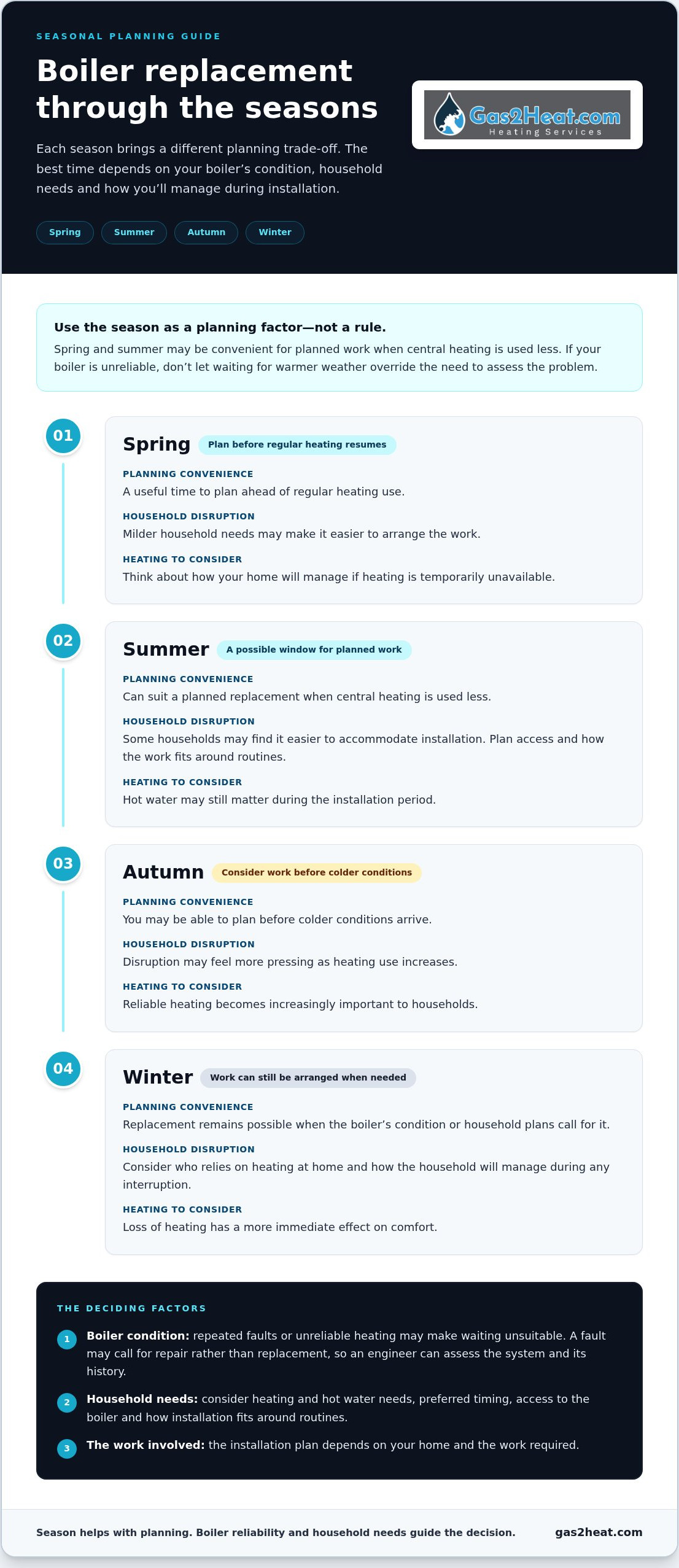
Each season brings a different planning trade-off. Spring and summer may suit a planned installation if you want to organise work while relying less on central heating. Autumn and winter can be less convenient for households that need heating every day, but they’re also valid times to replace a boiler when its condition makes waiting unwise. Your schedule, household needs and the boiler itself matter more than the month.
| Season | Planning convenience | Household disruption | Heating availability |
|---|---|---|---|
| Spring | A useful time to plan before regular heating use resumes. | Milder household needs may make it easier to arrange work. | Consider how your home will manage if heating is temporarily unavailable. |
| Summer | Can suit planned work when central heating is used less. | Some households may find it easier to accommodate an installation. | Hot water may still matter, so plan for the installation period. |
| Autumn | You may be able to plan before colder conditions arrive. | Disruption may feel more pressing as heating use increases. | Reliable heating becomes increasingly important to households. |
| Winter | Work can still be arranged when needed. | Consider how the household will manage during any interruption. | Loss of heating has a more immediate effect on comfort. |
Spring and summer: planning ahead between heating seasons
Some homeowners prefer to arrange a replacement in spring or summer because they expect to use central heating less. This can give you time to think through practical details, such as access to the boiler and how the work fits around household routines, before heating becomes part of your daily routine again.
That preference doesn’t guarantee shorter waits or lower costs. Your availability and the boiler’s reliability still guide the decision. If you’re considering a low-carbon heating alternative, check the UK government Boiler Upgrade Scheme carefully: the scheme described on GOV.UK applies to England and Wales, not Scotland.
Autumn and winter: balance comfort with need
Keep planned replacement separate from urgent help. If the boiler has stopped working or a fault is affecting your heating, the priority is to understand the problem, not to wait for a preferred season. For a planned upgrade, compare the seasons and choose a workable time. Gas2Heat’s qualified, Gas Safe registered engineers can discuss boiler installation in Dumfries & Galloway. Free written estimates are available for jobs of four hours or more, with no obligation to proceed.
Should You Wait for Summer or Replace a Boiler Now?
A boiler that’s working today may still need replacing, but that doesn’t automatically mean you have to act immediately. If it’s operating reliably and you’re considering a planned upgrade, choosing a milder-season work window can be a practical scheduling decision. But “it still works” isn’t, on its own, a reason to postpone every concern until summer.
The key distinction is between a planned replacement, a developing fault and a complete loss of heating. A planned upgrade gives you time to consider household routines and installation arrangements. A boiler that’s becoming unreliable needs professional assessment, while a breakdown or immediate heating concern calls for prompt attention. The best time of year to replace a boiler depends on which situation you’re facing, not simply the season.
When a milder-season replacement may suit you
If your boiler is functioning and you’ve decided to replace it, focus on timing the work around your household. Consider when access to the boiler is easiest, whether anyone at home relies on consistent warmth, and how an interruption to heating or hot water would affect your routine. Spring or summer may be a comfortable planning window, but your circumstances should guide the choice.
Use the planning period to understand the proposed installation and what the work involves. Gas2Heat’s boiler installation guide for Dumfries and Moffat can help you prepare. An engineer can assess your existing setup and discuss the work based on your home, rather than assuming that every replacement is the same.
When a boiler problem means you shouldn’t wait
If heating or hot water has stopped, or the boiler is developing recurring problems, waiting for summer may add avoidable discomfort. Arrange professional help so the problem can be assessed. Don’t try to dismantle or repair a gas boiler yourself. This article can help you think through timing, but it can’t diagnose a fault remotely or establish whether your boiler is safe to use.
Seasonal convenience should never delay attention to an urgent heating problem. Gas2Heat provides 24/7 emergency call-outs, with arrival within the agreed one-hour appointment slot. For an urgent issue, call 0800 009 6774 or email info@gas2heat.co.uk.
Not every fault means a new boiler is needed. A qualified engineer can assess whether repair or replacement is appropriate and explain the next steps. Gas2Heat’s engineers are fully qualified, Gas Safe registered and hold up-to-date certifications. Their assessment helps you make a decision based on the boiler’s condition and your household’s needs, rather than waiting for a preferred month or replacing the system without understanding the issue.
How to Plan a Boiler Replacement Before You Book
A little preparation can make it easier to explain what your home needs and choose a workable time for installation. Use this checklist to organise the key details before arranging a boiler replacement. You don’t need to diagnose the system or decide on technical specifications yourself. Give the engineer a clear picture of your household, current concerns and access to the boiler, then discuss the options together.
- Set out your household’s heating and hot water needs. Consider who lives at home, when rooms are typically used and whether anyone depends on consistent heating during the day. Note any routines that could make an interruption especially difficult. This context helps shape a useful discussion about the replacement, rather than focusing only on the boiler itself.
- Choose a preferred work window. Think about the season and dates that fit around work, school or other commitments. Spring or summer may suit a planned job if you expect to rely less on central heating, but the best time of year to replace a boiler still depends on your system’s condition and household needs. Keep some flexibility in mind, and don’t postpone professional advice if reliability is already a concern.
- Record what you’ve noticed about the current system. Write down recurring faults, changes in performance and any recent repair history you know. Note when the problem occurs and how it affects heating or hot water. These observations are more useful than guessing which component is at fault. They help the engineer understand the background and assess whether replacement is appropriate.
- Plan access to the boiler and surrounding area. Identify where it is located and whether stored items, furniture or household routines could affect access on the day. Mention anything that may help the engineer plan the assessment or installation. You don’t need to estimate how long the work will take; the requirements depend on your home and the job.
- Prepare questions for the installation discussion. Ask what the engineer needs to assess in your existing setup, what the proposed work includes and whether anything in the home could affect the plan. If you’re also reviewing how your heating is used, Gas2Heat’s guide to improving heating efficiency in Dumfries and Moffat offers related points to consider.
Understand the estimate and who will carry out the work
Gas2Heat provides free written estimates for jobs of four hours or more, with no obligation to proceed. Read the estimate so you understand the proposed work before making a decision. Any quoted prices are for a single engineer; multiply them by the number of engineers required. Gas2Heat’s engineers are fully qualified, Gas Safe registered and hold up-to-date certifications.
Ready to discuss a planned replacement in Dumfries & Galloway? Arrange a boiler installation discussion by calling 0800 009 6774 or emailing info@gas2heat.co.uk.
Arrange Boiler Replacement in Dumfries & Galloway with Gas2Heat
Once you’ve considered your boiler’s condition and a suitable time for the work, the next step is a conversation about your home and the installation. Gas2Heat provides boiler installation across Dumfries & Galloway. Its fully qualified engineers are Gas Safe registered and hold up-to-date certifications, so you can discuss the work with a qualified team.
You don’t need to settle every detail before making an enquiry. Be ready to describe your current boiler, any concerns about its performance, your household’s heating and hot water needs, and your preferred timing. This gives the installation discussion a useful starting point and helps establish what needs assessment. The best time of year to replace a boiler is ultimately the time that fits your home and the system’s condition.
What local homeowners can expect when requesting an estimate
For jobs of four hours or more, Gas2Heat provides a free written estimate, with no obligation to proceed. This gives you a clear record of the proposed work to consider before deciding how to move forward. An estimate is based on the job being discussed, so share relevant details about your home and existing setup rather than relying on assumptions about what a replacement involves.
Any quoted prices are for a single engineer. Multiply them by the number of engineers required. The £85 initial call-out fee is not a boiler replacement or installation price. It includes travel, fuel and up to one hour of on-site labour. If the problem cannot be fixed within that hour, any additional work must be quoted separately. Additional time is charged at £20 per 15-minute block.
There’s no need to choose a season simply because it is commonly described as convenient. If your boiler is reliable and you’re planning ahead, discuss your preferred work window. If its condition is worrying you, explain what has changed so the issue can be assessed rather than putting off the conversation until warmer weather.
Choose a next step that matches your boiler’s condition
For a planned replacement, get in touch when you’re ready to discuss the installation. Outline your preferred timing and household requirements, then use the assessment and written estimate, where applicable, to make an informed decision. A seasonal plan is useful only if it works for your home and doesn’t mean overlooking a problem that needs attention.
If you have an urgent fault or have lost heating, treat that differently from a planned installation enquiry. Gas2Heat provides a 24/7 emergency call-out service, with arrival within the agreed one-hour appointment slot. This gives you a route to emergency help while keeping planned replacement separate.
For boiler installation in Dumfries & Galloway, contact Gas2Heat on 0800 009 6774 or email info@gas2heat.co.uk to discuss your next step.
Make Your Next Boiler Decision with Confidence
You don’t have to wait for a particular month to start planning. Turn your concerns into a clear conversation: explain what you’ve noticed, what your household needs and when you’d prefer the work to take place. That gives you a practical basis for deciding whether to plan ahead or address a problem sooner.
The best time of year to replace a boiler is the one that fits your home, provided seasonal convenience doesn’t take priority over a boiler that needs attention. If you’re still weighing up the timing, discuss your situation rather than trying to predict exactly when a fault might occur.
Gas2Heat serves homeowners across Dumfries & Galloway, including Moffat, Dumfries, Lockerbie, Annan, Lochmaben, Thornhill, Gretna and Castle Douglas. To discuss a boiler replacement, call 0800 009 6774 or email info@gas2heat.co.uk, or discuss your boiler replacement with Gas2Heat. A straightforward conversation can help you take the next step with greater confidence.
Frequently Asked Questions
What is the best month to replace a boiler?
There’s no universal best month to replace a boiler. Warmer months can suit planned work because you may rely less on central heating, making it easier to organise the household around the installation. But the boiler’s condition should guide your final decision. If it’s becoming unreliable, don’t choose a month based on convenience alone. Consider the system’s performance and your household’s needs, then discuss the appropriate next step with a qualified engineer.
Is summer the best time to replace a boiler?
Summer can be a convenient time to plan a replacement between periods of regular heating use. You may find it easier to manage a temporary change to your routine when central heating is less important. It isn’t essential, though, and it won’t suit every household. Work commitments, access to the boiler and the system’s reliability all matter. If summer doesn’t fit your plans, replacement can be arranged at another time.
Can you replace a boiler in winter?
Yes, a boiler replacement can be arranged in winter when your circumstances require it. The main practical consideration is how your household will manage if heating is temporarily unavailable during the work. If the boiler has failed or you have an urgent heating concern, don’t delay seeking professional help just to wait for warmer weather. An engineer can assess the problem and explain whether repair or replacement is appropriate.
Should I replace my boiler before it breaks down?
Planning ahead can make sense if you’re already considering replacement, as it gives you time to discuss your household’s needs and organise the work before a breakdown forces a decision. Age alone doesn’t prove a boiler must be replaced, and this FAQ can’t diagnose its condition. Note any recurring issues or changes in performance and share them with a qualified engineer, who can assess the system and explain your options.
How long does it take to replace a boiler?
There’s no single installation duration that applies to every boiler replacement; the work depends on the specific job and your home. An engineer needs to assess what the installation involves before providing a realistic plan. Gas2Heat provides free written estimates for jobs of four hours or more, with no obligation to proceed. The estimate relates to the job and shouldn’t be treated as a fixed duration for every installation.
Can I get a free boiler replacement estimate in Dumfries & Galloway?
Yes. Gas2Heat provides free written estimates for jobs of four hours or more, with no obligation to proceed. The service covers Dumfries & Galloway, including Moffat, Dumfries, Lockerbie, Annan, Lochmaben, Thornhill, Gretna and Castle Douglas. To discuss a boiler replacement, call 0800 009 6774 or email info@gas2heat.co.uk. Gas2Heat’s engineers are fully qualified, Gas Safe registered and hold up-to-date certifications.
What does Gas2Heat’s £85 initial call-out fee include?
The £85 initial call-out fee includes travel, fuel and up to one hour of on-site labour. Additional time is charged at £20 per 15-minute block. If the problem cannot be fixed within the first hour, additional work must be quoted separately. Prices are for one engineer, so multiply them by the number of engineers required. This call-out fee is for an initial visit, not a boiler replacement or installation price.
