
Boiler Warranty: Coverage, Exclusions and Protection
Could a boiler fault be covered by your warranty yet still leave you facing a repair bill? If you’re searching for “boiler warranty what is covered”, the answer depends on the manufacturer’s terms and whether you’ve met its conditions. A warranty usually covers specified faults, often involving boiler components, rather than every breakdown.
This guide explains what a manufacturer’s warranty may cover, what could affect a claim and how a warranty differs from boiler cover. You’ll learn which documents to check, what evidence may be needed and why registration and regular servicing matter. Your warranty paperwork sets out the terms that apply to your boiler.
We’ll also look at common exclusions, including faults linked to installation, missed maintenance or problems elsewhere in the heating system. If you need help maintaining your boiler or diagnosing a fault, Gas2Heat’s local Gas Safe registered engineers provide boiler servicing and repairs across Moffat and South West Scotland. Knowing what your warranty says can help you choose the right next step.
Boiler warranty what is covered: start with the terms
A manufacturer’s warranty may cover certain faults in the boiler itself, subject to its stated conditions. Before arranging work, find your warranty confirmation and check which components, costs and repair arrangements it includes. This is the best starting point for understanding whether a particular fault may qualify.
Key Takeaways
- Check the manufacturer’s terms, model details and registration conditions to understand what your boiler warranty covers.
- Review exclusions carefully. Missed servicing, unauthorised work or installation issues may affect a claim if the warranty terms say so.
- Know the difference between a manufacturer’s warranty, paid boiler cover and statutory consumer rights.
- Prepare for a claim by gathering your warranty certificate and installation records, then noting the fault, when it began and any display codes.
- For servicing or help diagnosing a fault in Moffat and South West Scotland, Gas2Heat’s local Gas Safe registered engineers provide boiler servicing and repairs.
Boiler warranty cover explained: what protection may include
A boiler warranty is protection offered by the manufacturer for specified faults, subject to the written terms. It may cover a fault caused by a defect in a boiler component, but it isn’t a promise to pay for every breakdown. The cover depends on the make and model, warranty period, registration and any conditions attached to the offer.
A boiler heats water for domestic heating and hot water. For a general overview of how these appliances work, see Boiler (heating). For warranty purposes, the manufacturer’s own documents define which faults qualify and what help is included.
Which boiler parts or faults might be covered?
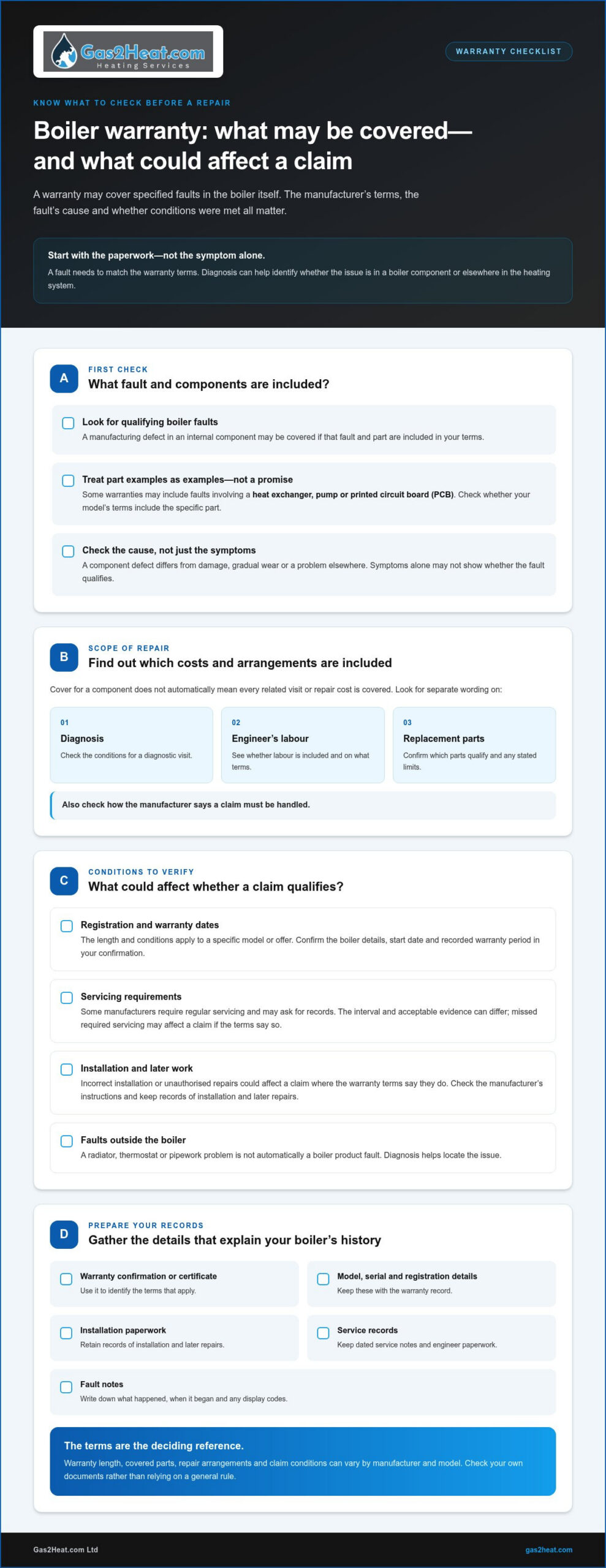
A qualifying failure of an internal component may be covered if the terms include that part and the fault meets the warranty conditions. For example, some warranties may cover a manufacturing fault affecting a heat exchanger, pump or printed circuit board (PCB). These are examples, not a guarantee that every model’s warranty includes them.
The cause matters. A component defect is different from damage, gradual wear or a fault elsewhere in the heating system, such as a radiator or thermostat issue. Symptoms alone may not establish whether a fault qualifies. Diagnosis can help identify what has failed and where.
Check which parts of the repair are included. The warranty may set separate conditions for a diagnostic visit, an engineer’s labour and replacement parts. It may also specify how a claim must be handled. Don’t assume that cover for a component automatically includes every related visit or cost.
What do warranty length and registration mean?
An advertised warranty length applies to a specific model or offer, not every boiler. The period and conditions can vary by manufacturer, installation details and registration. Your warranty confirmation is more useful than a general claim about how long warranties last.
Keep the warranty certificate or confirmation with the boiler’s model and serial details, registration record and installation paperwork. These records help establish which terms apply and make it easier to explain the boiler’s history if a fault develops. If documents are missing, use the manufacturer’s support information to find the relevant warranty details.
A warranty is different from routine servicing. Servicing is planned maintenance to help keep a boiler operating reliably. It isn’t a warranty claim or an insurance-style plan for wider breakdowns. The warranty may set servicing conditions, so check the exact wording rather than assuming a service visit guarantees acceptance of a future claim.
Before relying on cover, look for these details in your documents:
- Covered faults and components: Check what the manufacturer includes and any stated limits.
- Repair arrangements: Look for conditions on diagnosis, labour and replacement parts.
- Registration and dates: Confirm the boiler details, start date and recorded warranty period.
These checks give you a clearer starting point if the boiler develops a fault. Next, consider which conditions or exclusions could affect a claim.
Boiler warranty exclusions: conditions that can affect a claim
A boiler fault doesn’t automatically qualify for a warranty repair. Exclusions depend on the manufacturer’s terms and your warranty documents, so use examples as prompts to check the wording, not as universal rules. Look for clauses explaining how maintenance, installation, damage and faults outside the boiler itself affect cover.
The key question is whether the fault fits the warranty’s definition of a covered product issue and whether you’ve met its conditions. A symptom such as no heating could relate to the boiler, controls or another part of the heating system. The cause needs to be identified before you can know whether the warranty applies.
Can missed servicing affect a boiler warranty?
Some manufacturers require regular servicing and may ask for service records when assessing a claim. The required interval and acceptable evidence can differ, so check your own terms rather than assuming one rule applies to every boiler. If servicing is a condition and you’ve missed a required visit, that may affect a claim.
Regular servicing supports reliable boiler operation, but it doesn’t guarantee that every future fault will be accepted under warranty. Keep dated service records and the engineer’s paperwork with your warranty documents. Gas2Heat provides boiler servicing in Moffat, Dumfries, and South West Scotland to help homeowners maintain a clear service history.
Which installation or system issues should homeowners understand?
Warranty wording may set conditions around installation or work carried out on the boiler. Incorrect installation or unauthorised repairs could affect a claim if the terms say they do. Before arranging work, check the manufacturer’s instructions and warranty process, and keep installation records and details of later repairs.
A fault can also sit outside the boiler. Radiators, thermostats and pipework are wider system components, and a problem with one isn’t automatically a boiler product fault. Accidental damage, ordinary wear or contamination in the heating system may also be treated differently from a qualifying component defect. The warranty wording and fault diagnosis matter.
For a new boiler, keep the installation paperwork with its warranty confirmation and note any conditions the manufacturer sets for the appliance. For help diagnosing a fault or maintaining your boiler locally, explore Gas2Heat’s boiler services.
Boiler warranty vs boiler cover: compare the protection before relying on it
A manufacturer’s warranty, a paid boiler cover plan and your statutory consumer rights are three different forms of protection. They may relate to the same boiler fault, but have different purposes and rules. Before deciding whether a repair is covered, identify which protection you’re relying on and read its terms.
| Protection | Purpose and typical scope | When it applies | Where to check the terms |
|---|---|---|---|
| Manufacturer warranty | May cover specified product or component faults. Inclusions and exclusions depend on the manufacturer and model. | Usually applies for the period and under the conditions set out for that boiler. | Warranty certificate, confirmation and manufacturer’s written terms. |
| Paid boiler cover | A separate paid agreement that may include breakdown support. The plan defines its own scope, limits and exclusions. | Applies according to the plan’s start date, payment conditions and other terms. | Policy documents, schedule and plan terms. |
| Statutory consumer rights | Legal protections connected with buying goods or services. These are distinct from a manufacturer’s voluntary warranty. | Depend on the relevant law and circumstances of the purchase or service. | Current UK consumer-rights guidance and relevant purchase or service records. |
How does a manufacturer warranty differ from boiler cover?
A warranty is tied to the boiler and its manufacturer’s stated conditions. A paid cover plan is a separate agreement, and its benefits depend on the policy’s limits, exclusions and claim process. Neither automatically covers every fault or cost. Compare the documents directly, including what counts as a covered repair and whether service or call-out conditions apply.
Boiler cover isn’t automatically necessary, and buying a plan doesn’t replace the manufacturer’s warranty. A plan may offer a different kind of support, but its wording determines whether it suits your needs. If a fault occurs, check both sets of terms rather than assuming one protection takes priority.
Does a warranty replace your consumer rights?
No. A manufacturer’s warranty and statutory consumer rights are distinct. Warranty terms describe the manufacturer’s offer; legal rights arise separately and may relate to the purchase or service. A warranty shouldn’t be treated as a complete statement of your legal position or assumed to remove rights provided by law.
Consumer law can depend on the circumstances, so a brief summary may not resolve a dispute. Check current UK guidance or seek appropriate advice if you need to understand your position. Keep purchase records, warranty documents and repair history together. They can help clarify which route may be relevant.
To work out what your boiler warranty covers, start with the warranty document, then compare it with any separate plan and consider whether consumer rights may also apply. This helps you identify the relevant terms before arranging or paying for work.
How to check your boiler warranty and prepare a claim
Preparation can make a warranty enquiry clearer and help you follow the manufacturer’s process. Start with the documents for your specific boiler, then record exactly what has happened. The manufacturer’s instructions explain how to report a fault and whether an assessment needs to take place before repair work begins.
Work through these steps before making a claim:
- Find the warranty documents. Locate the certificate or confirmation and note the manufacturer, model, serial number, installation date, registration details and stated warranty period.
- Gather installation and service records. Keep invoices and service paperwork together. Check whether your warranty terms require particular records or evidence.
- Write down the symptoms. Note when the problem began, what the boiler was doing, any display codes and relevant recent changes, such as a loss of heating or work on the system.
- Read the claim instructions. Use the manufacturer’s guidance to find out how to report the fault, what information to provide and how an inspection or repair is arranged.
- Wait for the appropriate assessment. Don’t attempt a repair or arrange unauthorised work based on an assumption that it’s permitted. Your terms may specify who can assess or repair the boiler.
What information should you have ready?
Have the boiler make, model, serial number and installation date to hand, along with warranty registration details. Gather service records and invoices if the terms require them. Describe what you can observe, such as when the fault occurs or what a display shows, but distinguish a suspected cause from a confirmed diagnosis. This gives the manufacturer or engineer useful facts without overstating what you know.
What if a claim is declined or the warranty has ended?
If a claim is declined, request the reason in writing and compare it with the warranty wording and evidence submitted. Ask which condition or exclusion the decision relates to, then check whether your documents and service records address it. Keep copies of correspondence and assessment notes. If the warranty has ended, a separate repair assessment can still help identify the fault and practical next steps.
Cover decisions depend on the written warranty terms, the fault assessed and the evidence available for the claim.
A disagreement about cover doesn’t remove the need to deal with a boiler fault. Avoid opening or repairing the appliance yourself. A local Gas Safe registered engineer can help diagnose a problem and carry out boiler repairs. For boiler support in Moffat and South West Scotland, arrange help with boiler repairs from Gas2Heat.
Boiler warranty help in Moffat and South West Scotland
A boiler fault can leave you unsure whether to start with the manufacturer, arrange an engineer or do both. Gas2Heat provides domestic boiler installation, servicing and repairs across Moffat, Dumfries and surrounding South West Scotland communities. Its local Gas Safe registered engineers can help with routine servicing or assess a boiler problem, offering practical support close to home.
That support is separate from a manufacturer’s warranty decision. The manufacturer sets the warranty terms and claim process, so use the route in your documents to report a potential warranty fault. An engineer’s assessment can help identify what may be happening, but it doesn’t determine whether the manufacturer will accept a claim.
When can local boiler servicing or repair help?
Regular servicing supports routine care and reliable boiler operation. If your warranty requires servicing, keep the service record and check that the work meets the manufacturer’s stated conditions. Servicing helps you maintain a useful maintenance history, but can’t guarantee that a later fault will qualify for warranty cover.
If the boiler develops a fault, a professional assessment can help establish whether the issue appears to involve the boiler or another part of the heating system. Note any display codes and symptoms, and share relevant warranty and service documents with the engineer. Before repair work starts, follow the manufacturer’s instructions for reporting the fault, especially if the warranty requires its own assessment or approval process.
This distinction matters when you’re working out what your boiler warranty covers. Local repair support can address the practical fault; only the manufacturer can decide whether the repair falls within its warranty terms. Keep the two processes clear, and don’t assume that arranging an engineer automatically starts or replaces a warranty claim.
A straightforward next step for local homeowners
Gas2Heat is based in Moffat and serves homeowners across South West Scotland and nearby areas, including Dumfries, Lockerbie, Annan, Lochmaben, Thornhill, Gretna and Castle Douglas. The family-owned team is made up of local Gas Safe registered engineers, with services including boiler installation, servicing and repairs. If you’re uncertain about a fault, an engineer can assess the boiler and explain practical repair options. Routine servicing can also help you keep a record of the boiler’s care.
Before arranging work, have the boiler’s make and model, any fault codes and your warranty paperwork nearby. This can help you explain the situation clearly and keep the manufacturer’s claim process separate from engineering support. You don’t need to assume that every boiler fault is covered to take a sensible next step.
If you need local help with boiler maintenance or a fault, Contact Gas2Heat about boiler servicing or repairs.
Take the next step with confidence
If you’re still asking what your warranty covers for your model, let the written terms guide your next move. Keep your paperwork close, note what the boiler is doing and follow the manufacturer’s process for any claim. If the fault needs attention, arrange local servicing or repair separately without assuming the manufacturer has accepted the claim.
Gas2Heat is a family-owned business with local Gas Safe registered engineers serving Moffat and South West Scotland. The team can service your boiler, assess a fault and explain practical repair options. A clear description of the issue and any display codes can help you prepare for that conversation.
Take one manageable step: organise the warranty details, then arrange the support your boiler needs. Arrange local boiler servicing or repair support with Gas2Heat.
Frequently Asked Questions
Is a boiler warranty the same as boiler cover?
No. A boiler warranty is the manufacturer’s promise to deal with specified faults under its terms, while boiler cover is a separate paid plan with its own benefits, limits and exclusions. For example, a warranty might address a qualifying boiler component fault, while a plan may offer different breakdown support. Compare the documents before deciding what applies to your boiler, rather than assuming either protects you against every repair.
Does a boiler warranty cover labour as well as parts?
It can, but labour, replacement parts and diagnostic visits may have different conditions. Check whether the warranty describes engineer time or call-outs as included, and look for limits, exclusions or requirements about who carries out the work. If the wording is unclear, note the relevant clause and ask the manufacturer how it applies to the fault before arranging a repair that could affect a claim.
Can a boiler warranty be affected if I miss a service?
Yes, if your manufacturer’s terms make servicing a condition of cover. Check whether the documents specify an interval or require proof of completed services. If you’ve missed one, don’t assume every claim is automatically invalid; the decision depends on the wording and circumstances. Arrange any overdue maintenance and keep the record. Gas2Heat provides boiler servicing for homeowners in Moffat, Dumfries, Lockerbie, Annan, Lochmaben, Thornhill, Gretna and Castle Douglas.
Do I need to register my boiler warranty?
Registration may be required to activate the manufacturer’s stated warranty, so check the instructions supplied with your boiler or installation paperwork. Confirm that the make, model, serial number and installation details were recorded correctly, then keep the registration confirmation. If you can’t find it, use the manufacturer’s support route to ask whether the boiler appears on its records and what information is needed to locate it.
Can I transfer a boiler warranty when I move house?
Possibly, but transfer rules vary by manufacturer and warranty. Before moving, check whether the cover stays with the property, can be transferred to a new owner or needs the manufacturer to update its records. Find out what details or steps are required, and keep written confirmation with the boiler documents. Don’t assume the warranty transfers automatically just because the boiler remains in the house.
What should I do if my boiler warranty claim is rejected?
Ask the manufacturer for its decision and the reason for rejection in writing. Compare that explanation with the warranty clause it relies on, then check whether your registration, servicing or installation records address the issue. If you think relevant evidence was missed, send a clear follow-up with copies of the documents. Keep the practical fault separate from the dispute: a rejected claim may still need professional assessment or repair.
Does a boiler warranty cover radiators, pipework, or the whole heating system?
A boiler warranty often focuses on the boiler itself rather than automatically covering every part of the home’s heating system. Radiators, pipework and controls may fall outside the warranty, but the exact boundary depends on the manufacturer’s terms. If heating fails, describe what is affected, such as one radiator or the entire system. That detail can help distinguish a boiler fault from an issue elsewhere.
