
Carlisle Oil to Gas Conversion: 2026 Homeowner Guide
A new gas boiler isn’t the first thing to assess when considering an oil to gas conversion. First, find out whether the property can connect to the gas network and what changes the existing heating system would need.
Before comparing options, build a clear picture of the supply, equipment and work involved. This guide explains how to check gas availability for a specific address, what to consider about the boiler, pipework and oil tank, and which decisions shape the project. It also explains how to compare conversion with keeping or replacing your current system without relying on assumed savings.
Suitability is specific to the property, so treat it as something to establish rather than assume. Begin by checking supply access, then identify the changes the heating system may need and compare the options against your household’s priorities. Gas2Heat.com Ltd provides boiler and central-heating services across Dumfries & Galloway, including Moffat, Dumfries, Lockerbie, Annan, Lochmaben, Thornhill, Gretna and Castle Douglas.
Key Takeaways
- An oil to gas conversion Carlisle homeowners consider involves more than replacing a boiler. Supply access, the existing heating system and the project’s full scope all matter.
- Use a practical preparation sequence: gather boiler and fuel-use records, investigate supply access, assess existing equipment and compare written options.
- Compare conversion with keeping or replacing oil equipment against your household’s priorities, including the work involved and what happens to the tank.
- Gas2Heat provides boiler and central-heating services across Dumfries & Galloway, including Moffat, Dumfries, Lockerbie, Annan, Lochmaben, Thornhill, Gretna and Castle Douglas.
Oil-to-gas conversion in Carlisle: what changes for a homeowner?
An oil-to-gas conversion changes a home’s heating fuel and the equipment and connections needed to use it. It is not simply a boiler swap. For an oil to gas conversion Carlisle homeowners are considering, suitability depends on the property, access to a gas supply and the work needed to adapt the heating system.
Replacing an oil boiler with another oil boiler is a boiler replacement. Converting to gas means planning for a different fuel source and a heating setup that can use it. The exact scope depends on the home, so the boiler alone cannot tell you whether conversion is practical.
What does changing from oil heating to gas involve?
The existing boiler, heating arrangements and connections need to be considered alongside the route to a gas supply. A property-specific assessment should establish what equipment may need replacing or adapting and whether other parts of the system suit the proposed setup. Don’t assume every radiator, control or existing component can be retained without checking its condition and compatibility.
The oil tank is also part of the project scope. Include its future in the plan rather than treating the conversion as complete once a new boiler is installed. The appropriate arrangements depend on the property and the proposed work, so don’t make assumptions about the tank based on a general guide.
Natural gas is supplied through a network, unlike oil stored at the property. For background on its composition and uses, see this Natural Gas Overview. Understanding the fuel difference helps explain why conversion involves more than selecting a replacement boiler.
Why do Carlisle homeowners consider switching?
Homeowners may consider conversion when an ageing oil system needs attention, when reviewing how fuel is supplied to the property or when planning broader heating work. A different approach to fuel management may also be a priority. These are reasons to investigate, not proof that conversion will suit a particular household or reduce its bills.
Location matters when researching the subject. This guide concerns Carlisle in Cumbria, England. Search results can also refer to Carlisle, Pennsylvania, where network arrangements, fuel options and local requirements differ. Check that information you use applies to the UK property you are assessing.
Start by separating the decision into three questions:
- Can the property access a gas supply?
- What changes would the heating system and associated equipment need?
- Does conversion fit the household’s priorities better than keeping or replacing the oil system?
Answering these questions in order gives you a clearer basis for comparing options. A different fuel arrangement may be convenient for some households, but that outcome is not guaranteed by conversion. Establish what is possible at the specific address before deciding what work makes sense.
What determines whether a Carlisle home can convert from oil to gas?
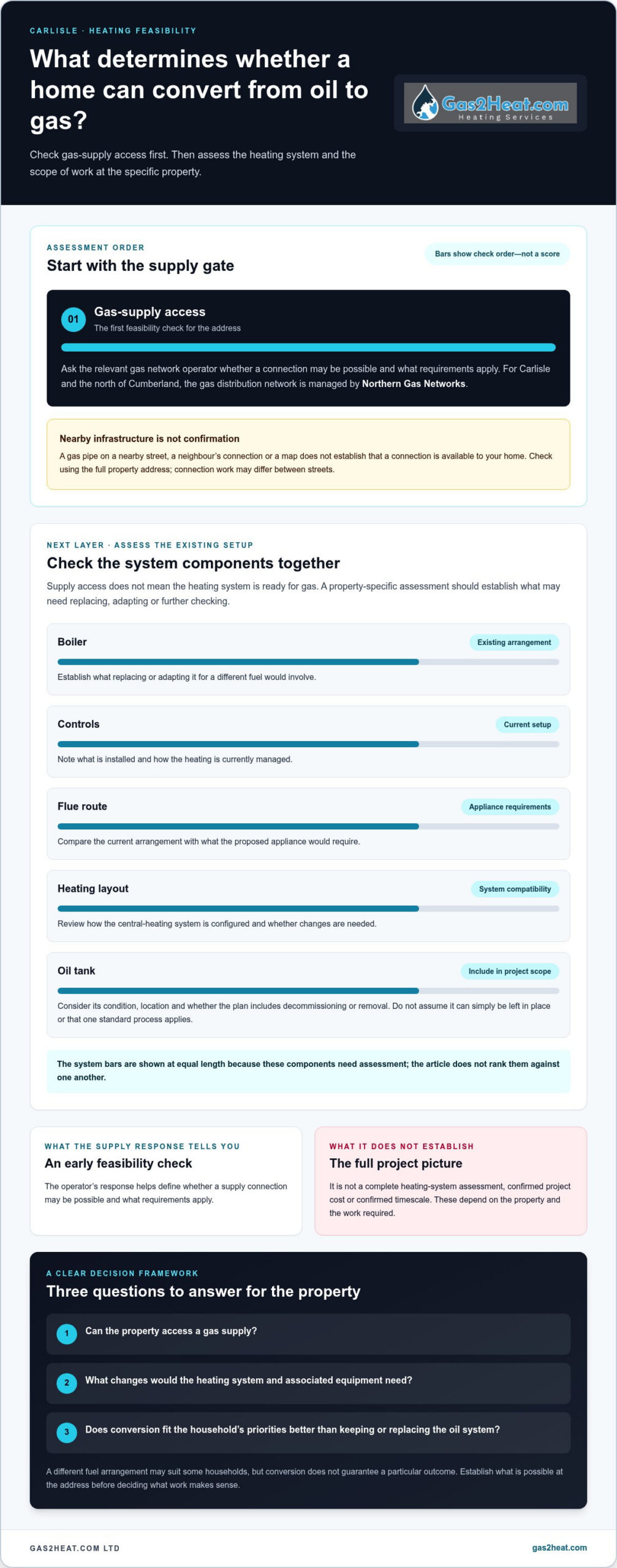
Gas-supply access comes first. Don’t assume that a connection is available just because a gas pipe serves a nearby street. The relevant network operator can advise whether a connection may be possible at your address and what connection requirements apply. For Carlisle and the north of Cumberland, Northern Gas Networks manages the gas distribution network. An address-specific enquiry is needed to establish what applies to your property.
A response about supply helps define the project, but it does not establish that the existing heating arrangements are ready for gas. The boiler, controls, flue route and central-heating layout also need to be considered alongside the proposed connection. Requirements can vary from one property to another.
How can you check whether gas is available at your property?
Start with the full property address and check availability with the relevant gas network operator. Ask about potential supply and connection requirements rather than relying on a map, a neighbour’s connection or nearby infrastructure. Those clues do not confirm that a connection is available to your home, and the work involved may differ between Carlisle streets.
Use the operator’s response as an early feasibility check. It is not a complete heating-system assessment or a confirmed project cost or timescale. Those details depend on the property and the work required, so avoid basing decisions on figures that have not been established for the address.
Which parts of the existing heating system need assessment?
Record the details of the current setup and have the relevant components assessed when defining the proposed work. Key points include:
- Boiler: its existing arrangement and what would be involved in replacing or adapting it for a different fuel.
- Controls: what is installed and how the heating is currently managed.
- Flue route: the current arrangement and what the proposed appliance would require.
- Heating layout: how the central-heating system is configured and whether changes are needed.
- Oil tank: its condition and whether the plan includes decommissioning or removal.
Don’t assume the tank can simply be left in place or that removal follows one standard process. Its condition, location and the proposed work all affect the plan. Technical requirements for the boiler, flue, ventilation and system compatibility also need to be established for the actual home. The U.S. Energy Information Administration outlines residential uses of gas in its Uses of Natural Gas resource. It provides general context, not guidance on UK connections or Carlisle properties.
For homeowners in Dumfries & Galloway reviewing related boiler and central-heating services, Gas2Heat’s engineers are Gas Safe registered and hold up-to-date certifications. The company provides local heating services across Dumfries & Galloway, including Moffat, Dumfries, Lockerbie, Annan, Lochmaben, Thornhill, Gretna and Castle Douglas. For a Carlisle home, use the supply response and a property-specific system assessment to build a clear scope before comparing options.
Oil heating or gas conversion: how should Carlisle homeowners compare the options?
Compare the whole project, not just the boiler price. Conversion may involve confirming gas access and changing parts of the heating setup. Keeping oil avoids a fuel change for now, while replacing oil equipment may address an ageing system without a gas connection. Each option has different practical demands.
Use this comparison to organise the decision. Details depend on the property, so treat it as a starting point rather than a verdict on what will suit your home.
| Factor | Convert to gas | Keep or replace oil equipment |
|---|---|---|
| Supply access | Requires a feasible gas connection at the property. | Does not depend on a new gas connection. |
| Work scope | May involve a new boiler, connections and changes to existing heating arrangements. | Keeping the system may mean less immediate work; replacing equipment still needs a property-specific scope. |
| Disruption | Consider the combined connection and internal work, and how it fits your household routine. | Consider the work involved in maintaining or replacing the oil equipment. |
| Tank | Include a property-specific plan for the existing oil tank. | Consider the tank as part of ongoing use or any replacement project. |
| Household priorities | May suit priorities that include changing fuel arrangements, if supply and scope allow. | May suit a household that prefers to retain its current fuel setup or avoid a broader conversion. |
When might retaining or replacing oil equipment deserve consideration?
If a practical gas connection is unavailable, conversion may not be a workable route for the property. A homeowner might instead consider continuing with the current system or planning an oil-equipment replacement if it needs attention. These are different choices: one retains existing equipment, while the other involves a planned change. Compare each option with the home’s condition, likely work and household priorities, without assuming one is automatically preferable.
How should you assess claims about savings and efficiency?
Separate broad claims from calculations based on your household’s records. Savings, efficiency and payback depend on the assumptions used, so a general claim is not a personal forecast unless the figures reflect your circumstances.
For a more useful comparison, gather:
- Recorded oil use over a representative period and the amount paid.
- Your current electricity and heating-fuel tariff details, including relevant unit rates and standing charges.
- Proposed gas tariff information, if gas is available, alongside the full work scope for each option.
Compare the same period and household needs across the options. If fuel use is estimated or tariff details are missing, note that limitation rather than turning incomplete information into a precise savings claim. Avoid generic cost ranges, percentage savings and payback periods that are not calculated from your home’s circumstances.
The best option depends on supply access and your home’s full project scope. For an oil to gas conversion Carlisle homeowners should weigh the connection, system changes and tank plan alongside the alternatives. Compare written scopes with your own fuel records and priorities before deciding.
Preparing for Oil-to-Gas Conversion in Carlisle
Preparation makes it easier to understand what a proposed project includes and which questions still need answers. For an oil to gas conversion Carlisle homeowners can work through the checks in order, keeping confirmed facts separate from assumptions. There is no single project duration or scope that fits every property.
- Gather your records. Note the existing boiler’s make and model if available, controls, servicing history, recent oil use and known system problems. Collect information about the tank and heating layout too.
- Check supply availability. Use the property address to ask the relevant gas network operator about potential availability and connection requirements. Keep the response with your project documents.
- Prepare for an equipment assessment. Record concerns about the boiler, controls, flue route, radiators or other heating components. Note access constraints, such as areas that may be difficult to reach.
- Describe household needs. Summarise how the home is used for heating and hot water, including periods when demand changes. This gives the assessment useful context without relying on a generic sizing rule.
- Compare written options. Review the proposed scope alongside alternatives. Identify what is confirmed, what depends on a site assessment and which questions remain unresolved.
What information should you gather before an assessment?
Use the information you already have; a missing record should not prevent you from getting organised. Boiler and control details, service records, oil-use information and tank details can help build a clearer picture. Add known faults, changes in heating performance and concerns about existing components. If you have fuel records from different periods, keep the dates with them so comparisons are not based on memory alone.
Note household routines that affect heating and hot-water use, as well as any practical access limits around the boiler, tank or other relevant areas. These observations do not determine the technical design, but they help ensure the property and household context are considered together.
What should a written project scope make clear?
A useful written scope separates confirmed work from items that depend on a site visit or the gas-supply assessment. It should identify the proposed equipment, connection work, changes to existing heating arrangements, tank plan and commissioning steps where applicable. It should also state what is excluded, what information is still needed and which assumptions could change the plan.
Check that the document describes the whole proposed job, not only the boiler. If a detail is subject to assessment, note what must be established and how it affects the next decision. Do not treat an unresolved item as included or assume every existing component can stay.
For homeowners in Dumfries & Galloway, Gas2Heat provides boiler and central-heating services. Its engineers are Gas Safe registered and hold up-to-date certifications. Gas2Heat serves homes across Dumfries & Galloway, including Moffat, Dumfries, Lockerbie, Annan, Lochmaben, Thornhill, Gretna and Castle Douglas.
Next steps for Carlisle homeowners: Gas2Heat’s local heating services
Make the decision in a clear order. For an oil to gas conversion Carlisle homeowners should first verify gas-supply availability for the address, then assess the existing heating system, compare conversion with the alternatives and obtain a written scope. This sequence separates what is possible from what remains uncertain, helping you weigh the whole project rather than deciding on a boiler alone.
Keep your notes together: the network operator’s response, boiler and system details, recent fuel records, known issues and questions about the tank or proposed work. When reviewing written options, look for the work included, exclusions and points that depend on further assessment. Treat assumptions as questions to resolve, not as confirmed parts of the plan.
What heating support does Gas2Heat provide in Dumfries & Galloway?
Gas2Heat provides boiler installation, boiler repairs, annual boiler servicing, central-heating installation and central-heating upgrades across Dumfries & Galloway. Its engineers are Gas Safe registered and hold up-to-date certifications. If you are considering a boiler replacement as part of a wider heating update, the boiler installation guide explains what homeowners can consider when planning that work.
Gas2Heat also provides emergency call-outs, landlord gas safety certificates, power flushing and specialist heating services. Its local area includes Moffat, Dumfries, Lockerbie, Annan, Lochmaben, Thornhill, Gretna and Castle Douglas.
How can eligible local customers take the next step?
For relevant boiler or central-heating work in Dumfries & Galloway, share details of your home and the work you are considering. Gas2Heat provides free written estimates for jobs of four hours or more, with no obligation to use the service. All quoted prices are for a single engineer; where more than one engineer is required, multiply the single-engineer price by the number of engineers.
For reference, the initial call-out fee is £85 and includes travel, fuel and up to one hour of on-site labour. Work beyond that hour must be quoted separately; additional time is charged at £20 per 15-minute block. The boiler service is £100, the Back Boiler & Fire Front Service is £175, and the Gas Fire Service is £125. A Landlord’s Gas Safety Certificate (CP12) costs £95 for the first appliance and £25 for each additional appliance. The surcharge for a Gas Fire Landlord Safety Certificate is £30. Outside normal working hours, call-outs are charged at 1.5 times the normal rate Monday to Friday, and twice the normal rate on Saturday and Sunday.
To discuss boiler installation or central-heating work in Dumfries & Galloway, call 0800 009 6774, email info@gas2heat.co.uk or visit the Gas2Heat website. One-hour appointment slots provide a clear window for appointments.
Make your next heating decision with confidence
Before committing to a change, turn what you have learned into a short list of questions specific to the address. A clear plan helps you judge whether conversion is practical for your home or whether another heating option better fits your needs. For an oil to gas conversion Carlisle, keep the property’s actual requirements at the centre of the decision rather than relying on assumptions about nearby homes.
Gas2Heat provides boiler and central-heating services across Dumfries & Galloway, including Moffat, Dumfries, Lockerbie, Annan, Lochmaben, Thornhill, Gretna and Castle Douglas. For work in its service area, call 0800 009 6774 or email info@gas2heat.co.uk. Free written estimates are available for jobs of four hours or more, with no obligation to use the service.
Take the next step that matches your location and heating needs. A considered decision starts with the right questions.
Frequently Asked Questions
Is gas available to every home in Carlisle?
No. A Carlisle address alone cannot establish gas availability, and a connection on a neighbouring road does not prove your property can connect. Give the relevant gas network operator your full address and ask what supply and connection requirements apply. Use the response as an early feasibility checkpoint for an oil to gas conversion Carlisle, before making equipment decisions. Keep the information with your property records so later project discussions start from the same details.
Can I convert my oil boiler to gas without changing the whole heating system?
Possibly, but it depends on the existing boiler, controls, flue arrangements, pipework and proposed connection. For example, a boiler may be due for replacement while other parts of the system need separate assessment. Don’t assume existing components can be reused just because they currently work with oil. A written scope should distinguish proposed work from elements that still need a site check.
How much does oil-to-gas conversion cost in Carlisle?
There is no single reliable price that applies to every Carlisle home. The scope may depend on gas availability, connection requirements, equipment, existing heating arrangements and the oil tank plan. Do not treat an online estimate or a figure from another region as a property-specific quote. Compare written scopes that identify included work, exclusions and unresolved checks. This makes it easier to understand why two homes considering conversion may receive different project proposals.
What happens to my oil tank after converting to gas?
The tank needs to be included in the project plan, but the appropriate arrangement depends on its condition, location and the proposed work. Do not assume it can remain untouched or that removal is always the right answer. Make sure the written scope explains what is proposed for the tank, what related work is included and which details still need assessment. Keep that information with the rest of the project documents.
Is converting from oil to gas always cheaper to run?
No. Running costs vary with household fuel use, applicable tariffs, equipment and the home’s heating needs, so savings should not be assumed. For a useful comparison, gather actual oil-use records and current supplier information, then compare them with relevant gas tariff details and the proposed project scope. Treat advertised percentages or payback claims as estimates unless their assumptions match your household. Consider ongoing fuel costs alongside the work involved and your priorities.
Do I need permission or approval for an oil-to-gas conversion in Carlisle?
Requirements depend on the property and the specific work, so do not assume the same answer applies to every home. Before work begins, check current requirements with the relevant local authority and consult applicable official guidance. Keep a record of what you checked and any outcome alongside the proposed scope. This helps you establish whether planned work and required approvals have been addressed, rather than relying on a general statement that may not fit your property.
Who can carry out gas work for a home in Carlisle?
Gas work should be carried out by appropriately qualified professionals. Verify that registration and current credentials are in place before work starts. Gas2Heat’s engineers are Gas Safe registered and hold up-to-date certifications, and the company provides heating services across Dumfries & Galloway. For a Carlisle property, confirm the person undertaking the work has suitable, current credentials and ensure the proposed work is assessed and documented for your home.
