
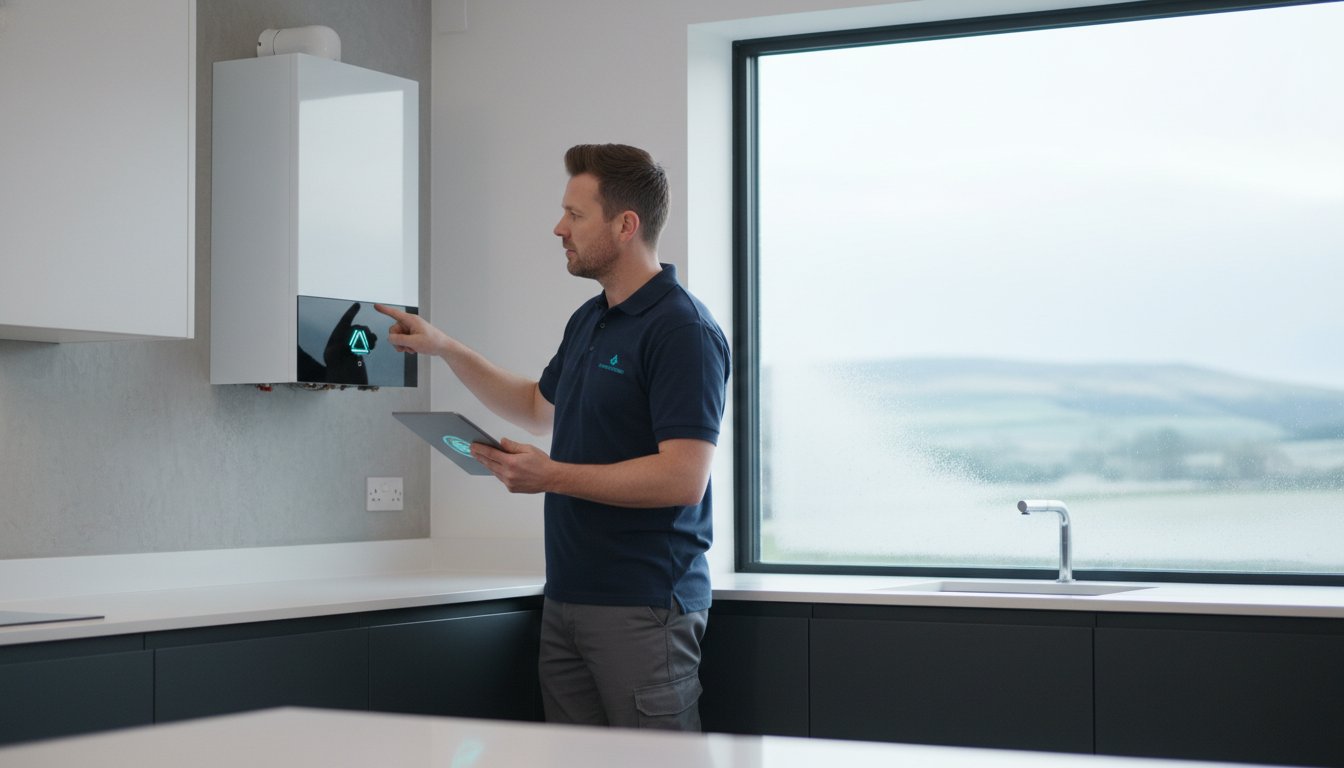
Common Boiler Problems in Moffat & Dumfries: A Homeowner’s 2026 Guide
On a sub-zero morning in January 2026, a family in Moffat discovered their radiators were stone cold despite the thermostat being set to a cosy 21 degrees. It’s a scenario that plays out across Dumfries and Galloway every winter, leaving homeowners feeling vulnerable and frustrated. You want your heating back on immediately, but the fear of hidden costs and complex technical jargon often makes the situation feel worse than it is.
We understand that peace of mind is just as important as a warm house. This guide will help you identify common boiler problems, troubleshoot minor glitches yourself, and recognise when it’s time to call a local Gas Safe registered engineer. Our goal is to remove the uncertainty from your home maintenance and get your hot water flowing again with zero hassle. You’ll gain the technical authority to handle your heating system with confidence.
We’ll provide a clear breakdown of frequent fault codes, explain the difference between minor repairs and major faults, and show you how to find reliable local support in South West Scotland for a fixed price solution.
Key Takeaways
- Recognise the early warning signs unique to the Scottish Borders climate to prevent a total heating failure during a cold snap.
- Identify and troubleshoot common boiler problems such as low pressure, kettling noises, and temperature fluctuations with expert guidance.
- Understand the vital “Safe DIY” checks you can perform and when the law requires a Gas Safe registered engineer for your protection.
- Learn how to winter-proof your system against Dumfries frosts, including practical steps to prevent frozen pipes and internal blockages.
- Access rapid, fixed-price repair solutions from local Moffat specialists who provide transparent pricing and reliable peace of mind.
Identifying Common Boiler Problems in Moffat Homes
Residents in Moffat and across the Scottish Borders rely heavily on their heating to combat the local climate. Sustained low temperatures mean your system works harder for longer periods compared to properties in the south. This increased demand often exposes common boiler problems that might stay hidden during the summer months. Most central heating systems in Dumfries & Galloway face unique pressures due to the age of the housing stock and the volatility of the weather.
Identifying a glitch early saves you from the stress of a cold house. Watch for these early warning signs:
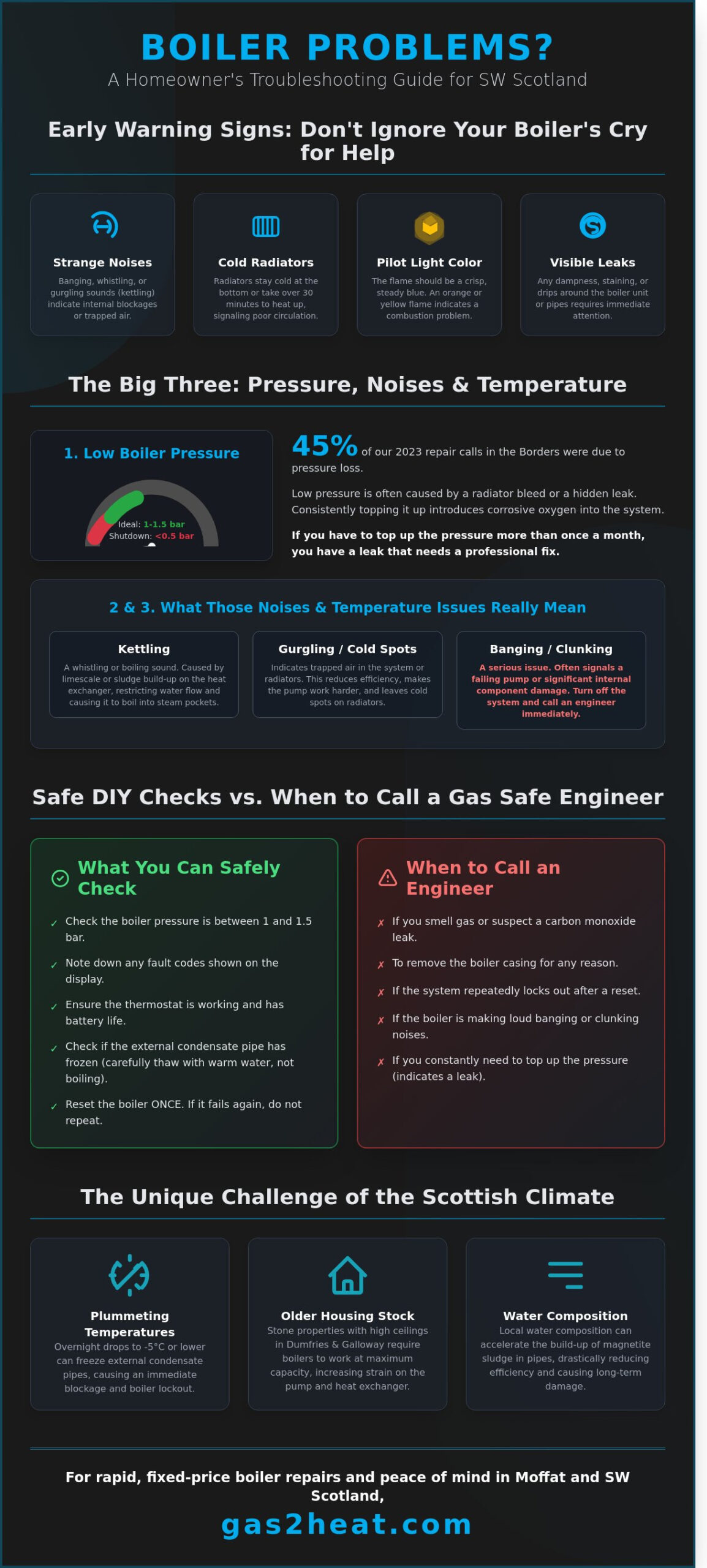
- Strange banging, whistling, or gurgling noises, often called kettling.
- Radiators that stay cold at the bottom or take over 30 minutes to reach temperature.
- A pilot light that appears orange or yellow instead of a crisp blue.
- Visible dampness or staining around the base of the boiler unit.
Is Your Boiler Telling You Something?
Your boiler’s digital display is its primary communication tool. It’s important to distinguish between a “fault” and a “lockout” immediately. A fault might mean the system is struggling but still operational. A lockout is more serious. Many boiler models display specific fault codes which can point to common issues such as flame detection problems, a blocked condensate pipe, low water pressure, or a failed ignition attempt.
Always document the exact code and any specific noises before you call a Gas Safe engineer. This data allows us to provide a more accurate over-the-phone assessment. It also ensures our local engineers arrive with the specific components needed for a rapid, fixed-price repair. Ignoring these codes usually leads to a total system failure within 48 hours.
The Impact of the SW Scotland Climate
Winter temperatures in Moffat can plummet to -5°C or lower overnight. These sudden drops cause water inside external condensate pipes to freeze and expand. This creates a blockage that triggers an immediate shutdown. Older stone properties in Dumfries are particularly susceptible to circulation issues. These buildings often have high ceilings and thick walls that require the boiler to work at maximum capacity to maintain a steady 20°C indoors. This constant high-load operation puts immense strain on the internal pump and heat exchanger.
A boiler lockout is a safety mechanism designed to prevent internal damage during a fault. When this happens, don’t keep trying to reset the system. Repeated resets can cause permanent damage to the printed circuit board (PCB). If your pressure gauge drops below 1.0 bar, it’s a sign of a leak or a failing expansion vessel. Addressing these common boiler problems the moment they appear ensures your home stays warm and your repair costs stay low.
The Big Three: Pressure, Noises, and Temperature Issues
Most homeowners in the Scottish Borders only notice their heating when it stops working. Identifying common boiler problems early saves you from cold nights and expensive emergency call-outs. In areas like Dumfries, the local water composition can accelerate the build-up of magnetite or sludge. This debris settles in your pipes and heat exchanger, which reduces efficiency and causes internal damage over time.
Dealing with Low Boiler Pressure
In 2023, approximately 45% of our repair calls across the Borders involved pressure loss. Check your pressure gauge first. For most modern sealed systems, the needle should rest between 1 and 1.5 bar. If it drops below 0.5 bar, your boiler will likely shut down as a safety precaution. Pressure loss often happens after you bleed your radiators, but it can also signal a leak. In older Moffat cottages, hidden leaks in original copper pipework are a frequent culprit. If you find yourself topping up the system every few weeks, you have a leak that needs professional attention. Don’t simply keep refilling it; doing so introduces fresh, oxygenated water that causes more internal corrosion.
What Those Strange Noises Really Mean
Your boiler shouldn’t sound like a percussion section. Different noises point to specific mechanical failures and are among the most common boiler problems we diagnose. Kettling, which sounds like a whistling tea kettle, occurs when limescale or sludge restricts water flow through the heat exchanger. This causes the water to overheat and turn into steam. Gurgling usually means air is trapped in the system, which forces your pump to work harder and wastes energy. Banging or clunking is more serious; it often indicates a failing pump or a damaged heat exchanger. Understanding boiler efficiency and maintenance helps you spot these signs before the hardware fails completely.
No Heating or Hot Water?
It’s incredibly frustrating to have hot water but stone-cold radiators. This is usually caused by a faulty diverter valve. This component directs hot water to either your taps or your central heating. In Combi boilers, these valves move constantly and are prone to sticking or failing. Before calling an engineer, check your thermostat batteries and your fuse box. If the electrics are fine, it’s likely a mechanical issue. Regular boiler servicing is the most effective way to catch a sticking valve or a blocked heat exchanger before it leaves you without heat. If your system is acting up, you can get a fixed price quote online for a repair or upgrade in minutes.
Boiler Troubleshooting: What You Can Safely Check
Identifying the cause of common boiler problems doesn’t always require a toolkit or a call-out fee. Before you contact an engineer, you can perform several basic checks to see if the issue is external to the boiler itself. These steps are designed to be safe for homeowners and do not involve opening the unit. According to the Gas Safety (Installation and Use) Regulations 1998, only Gas Safe registered engineers can legally remove a boiler casing or work on internal gas components. Staying within these boundaries keeps your manufacturer warranty intact and your household safe.
Start by checking your boiler’s display panel for any fault codes. If the system has locked out, you can often resolve temporary electronic glitches by resetting the unit. Locate the reset button on the front of the casing. Press and hold it for 10 seconds. Wait for two minutes to see if the boiler fires up. If the fault code returns immediately, it indicates a persistent internal issue that requires professional attention.
The Homeowner’s 5-Point Safety Check
- Check 1: Is there power to the unit? Ensure the fused spur switch next to the boiler is turned on. Check your home’s consumer unit to see if a circuit breaker has tripped. If the boiler display is completely blank, it’s often a simple power supply issue.
- Check 2: Is the gas supply active? If you have other gas appliances like a hob or gas fire, check if they are working correctly. If they aren’t, there may be an issue with your gas meter or a local supply interruption.
- Check 3: Is the thermostat calling for heat? Check the batteries in your wall thermostat. If the screen is faint or blank, replace them. Ensure the target temperature is set higher than the current room temperature. For more advice on system efficiency, refer to the Energy Saving Trust’s guide to boiler maintenance to ensure your settings are optimised.
When to Stop and Call a Gas Safe Registered Engineer
Safety must be your primary concern. If you smell gas, see scorch marks on the boiler casing, or notice water leaking from the bottom of the unit, shut off your gas supply at the meter and call us immediately. DIY gas repairs carry extreme risks of carbon monoxide poisoning and explosions. These are not risks worth taking to save a few pounds.
Choosing a local Moffat engineer ensures you receive a rapid response from someone who understands the specific water pressure and climate challenges in the Scottish Borders. We provide a transparent, fixed-price service that removes the stress from common boiler problems. Our team arrives with the right diagnostic tools to fix the fault correctly the first time, giving you total peace of mind and a warm home. If you are based further into the region, our fast boiler repair in Dumfries service offers the same fixed-price guarantee with same-day response from Gas Safe registered engineers.
Preventing Breakdowns: Maintenance for the Scottish Climate
Living in the Scottish Borders means your heating system works harder and longer than in the south of the UK. This intense usage often leads to common boiler problems that are easily preventable with the right care. Taking small steps now protects your home from the stress of a mid-winter breakdown when engineers are at their busiest.
Thawing a Frozen Condensate Pipe
Identify your condensate pipe by looking for the white or grey plastic tube leading from your boiler to the outside wall. During a deep Dumfries frost, the liquid inside this pipe can freeze and cause your boiler to shut down for safety. You don’t need an engineer for this specific issue. Use warm water to gently pour over the frozen section of the pipe. Avoid using boiling water, as the extreme temperature change can crack the plastic material. Once the ice melts, simply restart your boiler to restore heat. You can prevent this from happening next winter by fitting weather-proof foam insulation or upgrading to a larger diameter external pipe.
Power Flushing and System Health
Radiators that feel cold at the bottom are a classic sign of internal sludge buildup. This black iron oxide restricts water flow and forces your pump to work twice as hard to move heat around the house. A professional power flushing session cleanses your entire system and protects the delicate heat exchanger from blockages. A clean system can reduce energy bills by up to 15% by improving heat transfer efficiency.
We also recommend the long-term benefits of a magnetic system filter. These devices act as a permanent shield for your heating circuit, catching metallic debris before it can damage your high-efficiency boiler components. For hard-working Scottish systems, this is a vital upgrade that extends the lifespan of your appliance.
Booking an annual boiler service remains the most cost-effective way to stay ahead of repairs. Our Gas Safe registered engineers identify minor leaks or component wear before they turn into expensive emergencies. It’s about peace of mind and maintaining your manufacturer’s warranty. A well-maintained system is reliable, safe, and significantly cheaper to run throughout the colder months.
Don’t wait for the temperature to drop further. Book your annual maintenance check with our local Borders experts to keep your home warm and efficient.
Expert Boiler Repairs and Support in Moffat and SW Scotland
Gas2Heat.com Ltd delivers rapid, fixed-price repairs across Dumfries and the Borders to ensure your home stays warm throughout the year. We understand that common boiler problems like ignition failure or pump issues require immediate attention. Our local engineers are Gas Safe registered and bring extensive experience with the specific heating systems found in Southwest Scotland housing. When our team arrives at your door, you can expect total transparency and professional expertise. We maintain a strict policy of cleanliness, using protective covers to keep your carpets and surfaces pristine while we work.
Our service focuses on moving your heating system from a state of emergency repair to consistent reliability. We don’t believe in temporary fixes that lead to repeat call-outs. Instead, we offer ongoing maintenance plans designed to prevent future breakdowns. This proactive approach helps extend the lifespan of your appliance and keeps your energy bills manageable by ensuring peak efficiency. Our engineers take the time to explain the fault and provide advice on how to avoid similar issues in the future.
Transparent Pricing with No Hidden Costs
We’ve removed the uncertainty of traditional trade services by focusing on fixed-price quotes rather than open-ended hourly rates. This means the price we quote is the price you pay, regardless of how long the repair takes. Our commitment to quality involves using only high-quality, manufacturer-approved parts for every job. This ensures your boiler remains compliant with its original specifications and operates safely. Our local coverage is comprehensive, providing expert support to residents in Moffat, Dumfries, Annan, and Gretna. We prioritise local engineers who can reach you quickly, often providing same-day or next-day assistance for urgent faults.
Book Your Local Heating Specialist Today
Restoring your heating and hot water is a straightforward process with our digital booking system. You can get an instant quote or book a repair online in less than 60 seconds. This streamlined approach respects your time and eliminates the need for endless phone calls. For added peace of mind, every repair we carry out includes a 12-month guarantee on both parts and labour. If you are experiencing common boiler problems and need a dependable solution, our team is ready to help. Take the first step toward a warm home and a reliable boiler system right now.
Secure Your Home’s Warmth and Efficiency
Maintaining a reliable heating system in Dumfries and Galloway requires proactive care and a basic understanding of how your unit operates. You’ve learned how to identify common boiler problems like fluctuating pressure or unusual kettling noises, which are often the first signs that your system needs professional attention. While simple checks can be performed safely at home, ensuring your boiler survives the damp Scottish climate requires expert maintenance.
Since 2017, our local family-owned business has provided dependable support to homeowners across SW Scotland. We remove the stress of unexpected breakdowns through a transparent approach to every call-out. You’ll benefit from the expertise of Gas Safe Registered Engineers who prioritise your safety and comfort. Our fixed price guarantees mean you won’t face hidden costs or surprise fees when the work is finished.
Don’t let a minor fault turn into a cold night without heating. Book a Fixed-Price Boiler Repair in Moffat & Dumfries
Frequently Asked Questions
Why is my boiler losing pressure every few days?
Pressure loss usually indicates a leak in your pipework or a failing expansion vessel. Even a tiny pinhole leak can drop pressure by 0.5 bar over 48 hours. Check your radiator valves and boiler connections for visible moisture. If you can’t find a leak, the internal pressure relief valve might need replacing by a Gas Safe registered engineer. Constant topping up can introduce fresh oxygen, leading to internal corrosion.
What should I do if I smell gas near my boiler?
Turn off your gas supply at the meter immediately and open all windows to ventilate your home. Don’t operate electrical switches or use naked flames, as these can trigger an ignition. Contact the National Gas Emergency Service on 0800 111999 right away. This is a critical safety issue that requires an immediate inspection from a qualified professional to prevent carbon monoxide exposure or fire risks.
Can I reset my boiler myself if it shows an error code?
You can safely reset your boiler once by pressing the reset button for five seconds to see if it clears a temporary glitch. If the error code returns immediately, it indicates one of the common boiler problems like a faulty pump or ignition failure. Don’t keep resetting the unit to bypass safety locks. Refer to your manufacturer’s manual for the specific code meaning before calling a local engineer to diagnose the underlying fault.
How much does a typical boiler repair cost in Moffat?
Average boiler repair costs in the UK typically range from £150 to £400 depending on the parts required. According to 2023 industry data, a simple fan replacement might cost £250, while a new heat exchanger can exceed £500. We provide a fixed price quote before starting any work so you don’t face unexpected bills. Our local engineers in Moffat ensure you get a transparent service without hidden call-out fees.
Why are my radiators hot at the top but cold at the bottom?
Cold spots at the bottom of your radiators usually signal a buildup of magnetite sludge and debris. This metallic sludge settles at the base, blocking the flow of hot water through the panel. You’ll likely need a professional powerflush or a system cleanse to restore efficiency. Ignoring this can increase your energy bills by 15% because your boiler has to work harder to heat the room.
Is it worth repairing a 10-year-old boiler or should I replace it?
Replacing a 10-year-old boiler is often more cost-effective if the repair bill exceeds £300 or 50% of the unit’s value. Modern ERP rated boilers are up to 20% more efficient than decade-old models, potentially saving you £200 annually on heating bills. We offer next day installation for new systems to provide better long-term peace of mind. Investing in a new unit with a long warranty is often smarter than patching up an aging system.
How can I stop my boiler pipes from freezing in the winter?
Insulate your external condensate pipe with waterproof lagging that’s at least 19mm thick to prevent ice blockages. During extreme Scottish winters, you can also leave your heating on a low constant setting of 12°C to keep water moving through the system. If your pipe does freeze, you can gently pour warm, not boiling, water over the frozen section to thaw it and restart your heating system safely.
How often should I have my boiler serviced in South West Scotland?
You should book a boiler service every 12 months to maintain your manufacturer’s warranty and ensure peak performance. Annual checks catch common boiler problems early, such as blocked injectors or failing seals, before they lead to a total breakdown. A regular service by a Gas Safe registered engineer in South West Scotland keeps your home safe and ensures your high-efficiency system operates at its maximum rated output.
