
How to Check If Your Boiler Can Handle More Radiators
Adding radiators doesn’t automatically mean replacing your boiler. The answer to “Can my boiler handle more radiators?” depends on its central-heating output, your home’s heat demand and whether water can circulate evenly through the system. Combi and conventional boilers work differently, so the checks depend partly on the type you have.
Check the system before adding radiators. A boiler may supply enough heat, yet new or existing radiators can warm slowly if water flow isn’t balanced properly. Lockshield valves help regulate that flow, so their settings matter alongside the boiler’s rating.
This guide explains how to identify your boiler type and heating output, assess whether it can meet the added demand, and understand how lockshield valve adjustments help distribute heat. You’ll also learn what to look for when radiators don’t heat evenly, so you can make a more informed decision about adding them.
Key Takeaways
- Identify whether you have a combi or conventional boiler, as each provides hot water differently and this affects how you assess extra heating demand.
- Estimate the room’s heat requirement from its size and heat-loss features before choosing a radiator, rather than relying on radiator dimensions alone.
- Find the boiler’s central-heating output rating and compare it with the heating demand of the whole system, including the proposed additions.
- After adding radiators, use lockshield valves to balance water flow so nearby radiators don’t take too much heat from those farther away.
Combi and conventional boiler types
Consider upgrading the boiler or heating system if its central-heating output cannot meet your home’s heat demand after radiators are added. To answer “Can my boiler handle more radiators?”, identify the boiler type first, then assess the whole system rather than counting radiators alone.
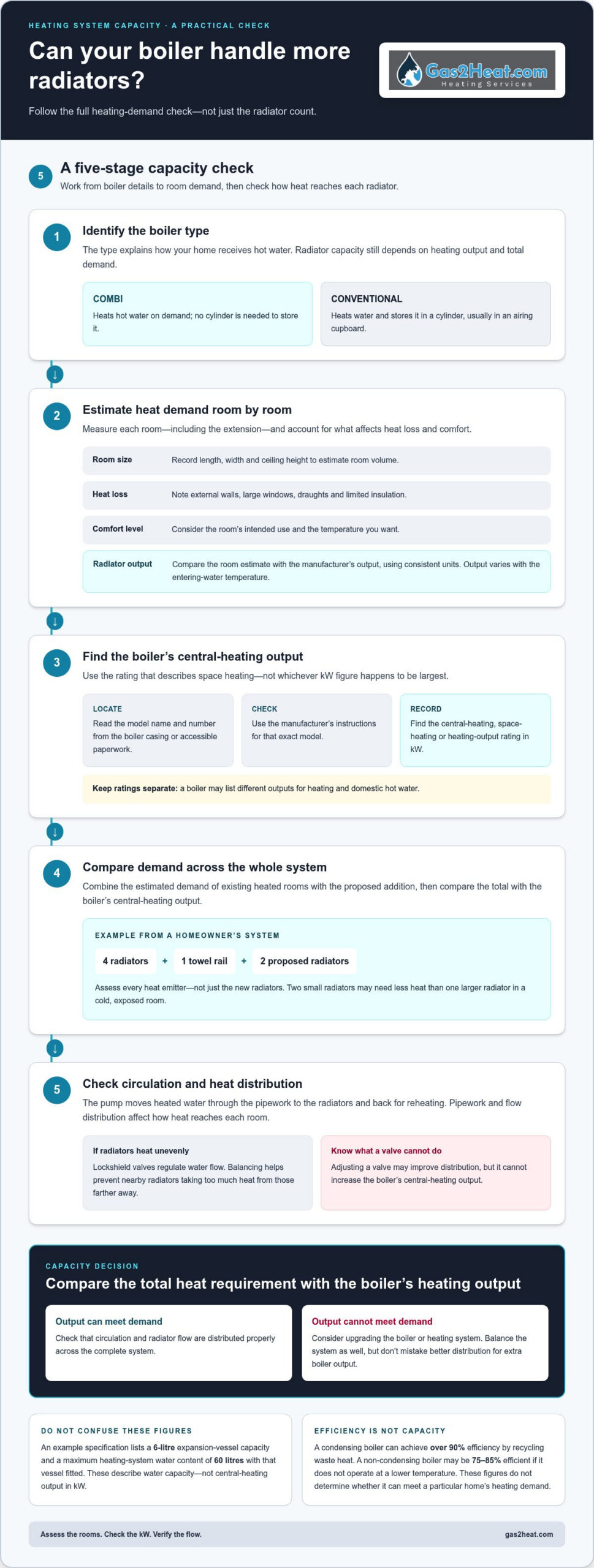
- Identify your boiler type. A combi boiler heats hot water on demand and doesn’t need a cylinder to store it. A conventional boiler heats water and stores it in a cylinder, usually in an airing cupboard. This distinction affects how your home receives hot water, but radiator capacity still depends on the heating output and demand.
- Include every heat emitter in your assessment. For example, one homeowner’s combi system has four radiators and a towel rail, and they’re considering adding two radiators for an extension. Don’t decide based on the new radiators alone. Include existing radiators and towel rails, then consider whether the boiler can supply enough heat across the complete system.
- Check how water circulates. The pump moves heated water from the boiler through the pipework to the radiators, then back for reheating. Extra radiators add to the system’s demand, while pipework and flow distribution affect how heat reaches each room. Adjusting a valve may improve distribution, but it cannot increase the boiler’s central-heating output.
- Consider boiler performance before deciding on replacement. A condensing boiler can achieve efficiencies of over 90% by recycling waste heat before it leaves the boiler. A non-condensing boiler may have an efficiency of 75-85% if it doesn’t operate at a lower temperature. These figures describe efficiency, not whether a boiler can meet a particular extension’s demand. Compare its heating output with the home’s requirements before choosing an upgrade.
How to calculate the heating output required for a room and radiator
- Measure the room. Record its length, width and ceiling height, then use these dimensions to estimate its volume. Measure each room separately, including the extension. A larger room generally needs more heat than a smaller one, but volume alone doesn’t capture heat loss through windows, walls, floors or the roof.
- Note the room’s construction and exposure. Record whether it has external walls, large windows, draughts or limited insulation. A room with several exposed surfaces can lose heat faster than an enclosed room of similar size. Include these details in the heat-demand estimate rather than relying only on floor area.
- Set the room’s intended temperature. Consider how the space will be used. A living room, bedroom and little-used extension may have different comfort needs. The temperature you want, alongside the room’s heat loss, affects the output required. Don’t choose a radiator solely because it fits the available wall space.
- Compare the estimate with radiator output. Check the manufacturer’s stated output for the radiator model and compare it with the room’s estimated heat requirement. Keep the units consistent during comparison. Radiator output varies with the temperature of the water entering it, so a rating at one flow temperature may not reflect performance at another.
- Check the whole system’s added demand. Add the estimated requirement for the new room to the demand from existing heated rooms. This gives a more useful picture than counting radiators: two small radiators may need less heat than one larger radiator in a cold, exposed room. The combined demand is then compared with the boiler’s central-heating output.
For example, an extension with broad glazing and an external wall may need a different radiator output from a compact, well-insulated room. Use the room’s measurements and heat-loss features to estimate its heating requirement, then compare that with the selected radiator’s output. This helps establish whether the radiator suits the room before you assess the boiler’s capacity.
How to check a boiler’s central heating output rating in kW
- Find the boiler’s identification details. Read the model name and number from its casing or accessible paperwork. Use these details to locate the manufacturer’s instructions for that exact boiler. The instructions help distinguish central-heating output from other ratings, which can appear together on a specification page.
- Locate the central-heating output in kW. Look for a rating labelled for central heating, space heating or heating output. Don’t assume the largest kW figure is the relevant one: a boiler may show separate outputs for heating and domestic hot water. Record the heating figure, keeping the unit as printed.
- Compare output with total heat demand. Add the heat output required by the existing rooms and the proposed radiator. The boiler’s kW output needs to heat the system, rather than being judged only by how much water it holds. A system’s water volume alone doesn’t show whether the boiler can supply enough heat to all rooms.
- Use water-capacity figures only as a separate check. For example, a boiler specification may give an expansion-vessel capacity of 6 litres and a maximum heating-system water content of 60 litres with that vessel fitted. Those figures describe system-water capacity, not the boiler’s central-heating output. Don’t treat either one as a substitute for the kW rating.
- Assess the complete installation. Check whether the existing radiators heat adequately and whether the proposed addition increases demand beyond the boiler’s output. Also consider the system’s pipework and pump, because adequate boiler output must reach the radiators through circulating water. A kW comparison is a useful first assessment, not a radiator-count rule.
For a practical comparison, note the boiler’s central-heating rating and estimate the required output for every heated room. If the combined demand exceeds the rating, the system may need a different design or more heating capacity. If the demand appears within the rating but rooms still heat unevenly, investigate circulation and balancing rather than assuming the boiler is undersized.
What boiler flow temperature and radiator balancing are needed after adding radiators
- Set the boiler flow temperature. Around 60°C is a recommended flow temperature for water leaving the boiler. Check the boiler manufacturer’s instructions before adjusting it. Flow temperature affects how much heat each radiator can emit, so assess room comfort alongside the system’s behaviour.
- Check the lockshield valves. These valves control how much water returns from each radiator and continues towards the next. If a nearby radiator takes too much flow, radiators farther away may not get as hot. Open or close lockshields gradually, then observe how heat reaches each room.
- Balance the new radiator with the existing system. Adding or replacing a radiator can change the system’s balance. Start with the radiator furthest from the boiler and open its lockshield by about three-quarters of its available turns. Adjust other valves in small increments to distribute flow rather than allowing nearby radiators to dominate.
- Allow time for changes to take effect. After balancing, wait up to about 20 minutes for radiators to heat before judging the result. Compare how quickly and evenly each radiator warms. A cold radiator may indicate a flow issue, but trapped air causes uneven or absent heating and needs bleeding, not lockshield balancing.
- Assess flow and return temperatures across the system. Correct balancing aims for a return temperature 20°C below the flow temperature. This is a system-level guide, not a required 20°C difference at every radiator. Frequent boiler cycling can indicate that flow and return temperatures are not achieving the intended difference.
New radiators that remain cool, or existing rooms that lose heat after installation, call for a system check. A heating engineer can assess flow temperature, lockshield settings and circulation together. Arrange boiler servicing to have the heating system assessed and its operation checked.
Gas2Heat.com Ltd: Boiler Installation
Gas2Heat.com Ltd can help when your boiler’s central-heating output cannot meet added demand, or when the existing system needs assessment before an extension. Boiler Installation may be appropriate if the current boiler can’t supply enough heat for your home’s requirements. If the boiler appears suitable but radiators heat unevenly, Boiler Servicing or Boiler Repairs may help address system performance.
Share your planned changes and the heating problems you’ve noticed, such as slow-warming rooms or radiators that stay cool. This gives a clear starting point for discussing the boiler and heating system. Contact Gas2Heat.com Ltd to discuss your heating needs.
Plan Your Next Heating Upgrade
If you’re asking, “Can my boiler handle more radiators?”, base your decision on your home’s heating needs, not the radiator count alone. Consider how the new room will be used and whether the current system can heat it comfortably. This gives you a clearer brief before making changes.
Where existing heating performance is poor, Boiler Servicing or Boiler Repairs may be relevant. If the system needs greater capacity for your plans, Gas2Heat.com Ltd offers Boiler Installation. The right option depends on whether the issue is the boiler itself or how the heating system is operating.
Talk through your planned radiator additions and current heating concerns with Gas2Heat.com Ltd. Ask Gas2Heat.com Ltd about your radiators and take the next step towards a heating setup that suits your home.
Frequently Asked Questions
How can I tell if a boiler has enough capacity for additional radiators?
Compare the boiler’s central-heating output with the heat demand of all rooms, including planned additions. A boiler may have enough output on paper, but a new radiator that stays cool while others work normally can indicate a local circulation or valve issue. If several rooms struggle once the extension is heated, consider system demand and heat distribution together rather than assuming the new radiator is the only problem.
How many radiators can a typical UK boiler support?
There’s no useful fixed radiator count for a typical UK boiler. Radiators vary in size and heat output, and rooms lose heat at different rates. For example, one large radiator in a cold, exposed room may add more demand than several smaller radiators in compact rooms. Assess the home’s total heat requirement and compare it with the boiler’s central-heating rating.
Can a combi boiler provide enough hot water while heating more radiators?
It can, provided its heating and hot-water performance suit your home’s demands. A combi boiler heats domestic hot water on demand, while additional radiators increase the central-heating load. Assess these requirements separately: note whether hot-water performance changes during everyday use, then compare the heating load with the boiler’s central-heating output. A heating assessment should consider both functions, not just radiator count.
