
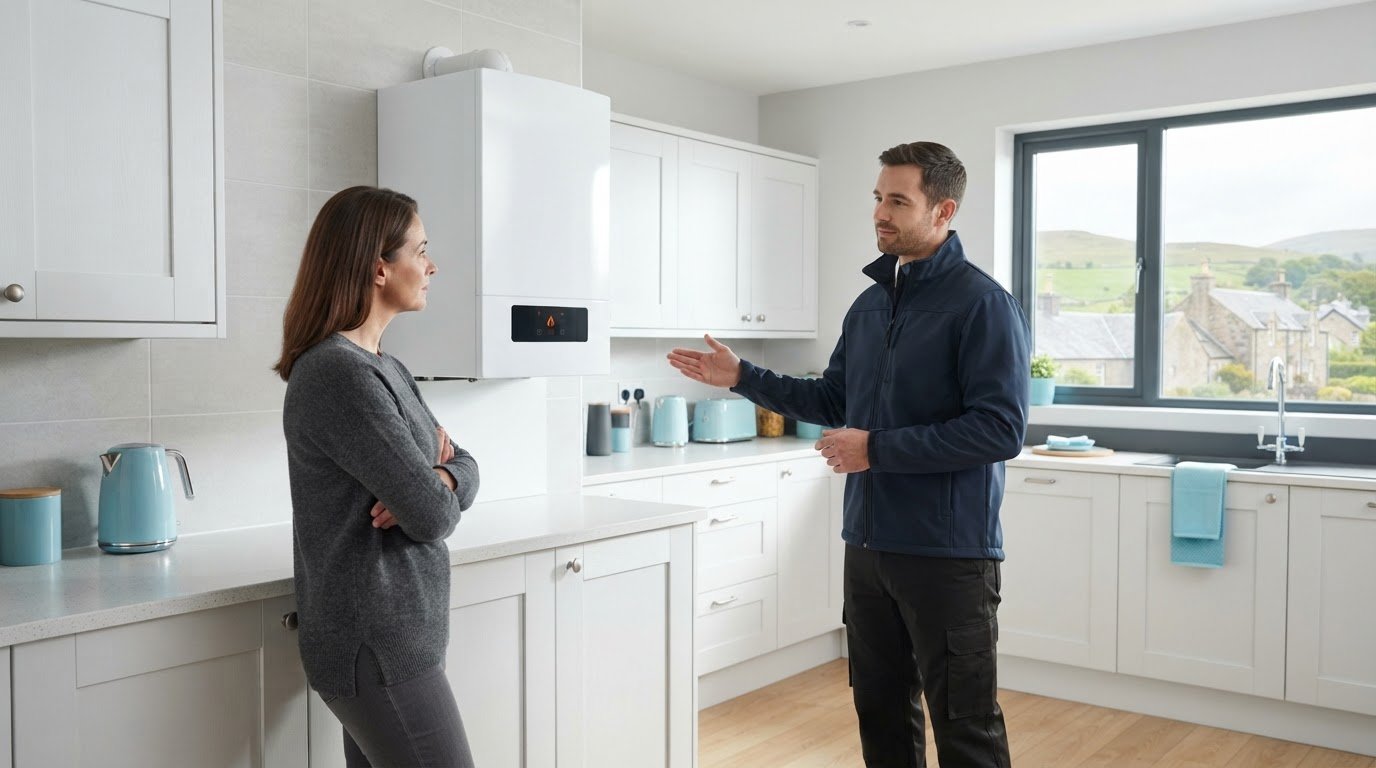
Ideal L2 Fault Code Meaning: Causes, Safe Checks and When to Call an Engineer
Could a single reset clear the fault, or is your boiler warning you about a problem that needs an engineer? If you’re searching for the Ideal L2 fault code meaning, the code commonly points to flame loss: the boiler has not ignited or cannot keep a flame, so it may enter safety lockout. That can be unsettling, especially if you’re unsure whether it is a one-off or a recurring fault.
Check before taking action. The exact meaning and permitted user steps can depend on your Ideal boiler model, so consult its manual. Do not remove the casing or attempt repairs. This guide explains what L2 commonly indicates, which observations may help, and when to stop and contact a Gas Safe registered engineer.
A fault that returns after a reset should not be ignored. Possible causes include an interrupted gas supply or a frozen condensate pipe, but the code alone cannot identify the cause. The guidance below can help you choose a safe next step without guessing.
Key Takeaways
- The Ideal L2 fault code meaning can vary by model, so check your boiler’s manual to confirm what the display indicates.
- A reset may clear the lockout temporarily, but it will not confirm or fix the cause. Note whether the code returns.
- Before seeking help, record your boiler model, when the fault appeared and whether a manual-approved reset changed anything.
- Recurring or unresolved faults are a reason to stop troubleshooting and arrange an assessment from a Gas Safe registered engineer.
- Gas2Heat.com Ltd provides domestic boiler repairs and servicing in Moffat, Dumfries, Lockerbie, Annan and nearby communities.
Ideal L2 fault code meaning: what the display is telling you
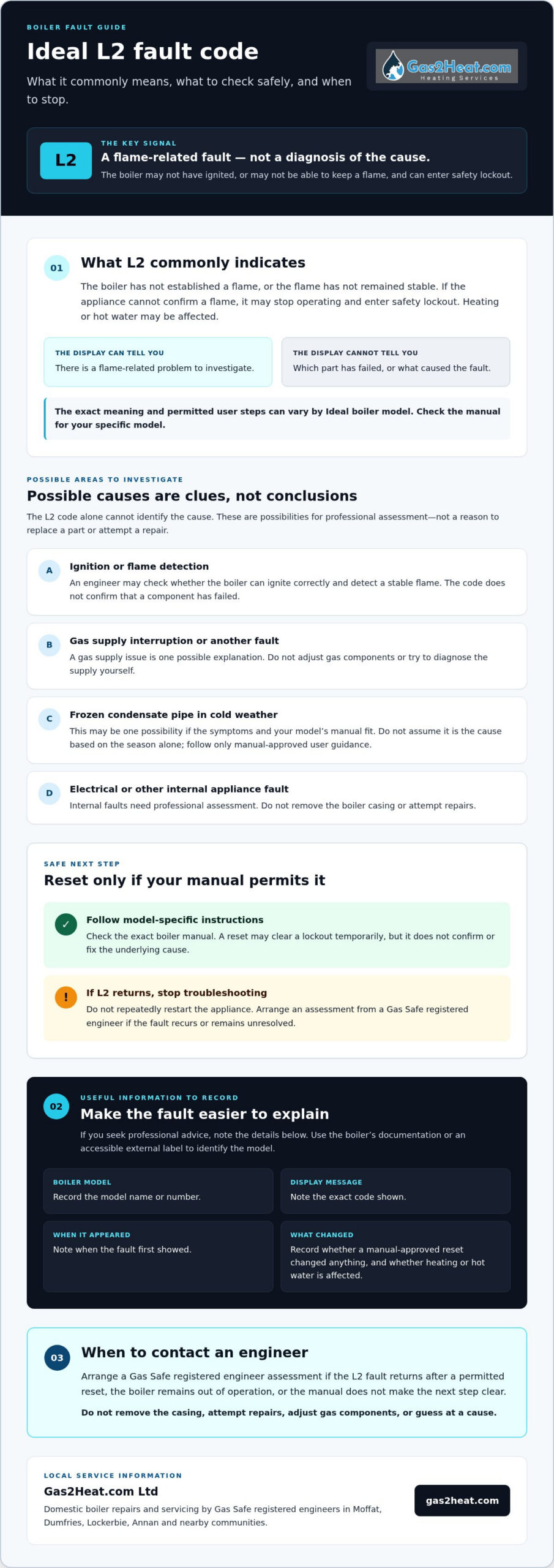
The Ideal L2 fault code meaning commonly relates to flame loss: the boiler has not established a flame or has failed to maintain one. Check the user manual for your exact model, as Ideal’s wording and instructions can differ between boiler ranges. If the appliance cannot confirm that a flame is present, it may stop operating and enter safety lockout. You may then lose heating or hot water until the fault is addressed.
Understanding what a boiler is can help put the display message in context, but the code itself is only a starting point, not a diagnosis.
The L2 code points to a flame-related problem. It does not, by itself, identify the cause or confirm that a particular component has failed.
Does L2 mean the boiler has lost its flame?
Usually, yes. The boiler’s control system has not detected a flame when expected, or the flame has not remained stable. This signals that the appliance has stopped normal operation, but it does not prove a specific fault. Follow only the user steps permitted by your model’s manual. Do not open the casing to investigate.
Why the exact Ideal boiler model matters
Identify your boiler using its user documentation or an accessible external label. Then find the matching Ideal manual and check its L2 description and instructions. Code wording, display layouts and permitted actions can vary between model ranges, so do not assume that guidance for another Ideal boiler applies to yours. If you cannot identify the model or the manual does not make the next step clear, do not guess.
Note the exact display message and whether the boiler has stopped providing heating, hot water or both. This information can help you explain the problem if you seek professional advice. If the code reappears after a permitted reset, arrange further assessment rather than repeatedly restarting the appliance.
What can cause an Ideal boiler to show an L2 fault?
An L2 display points to a flame-related problem, but it does not identify a confirmed cause. Several issues can prevent a boiler from establishing or maintaining a flame. Treat the code as a clue for further investigation, not a reason to replace a part or attempt a repair yourself.
A fault can appear after a temporary interruption, but do not assume it is harmless just because it clears once. If L2 returns or the boiler remains out of operation, record what happened and arrange a professional assessment. Repeated resets will not resolve the underlying issue.
Ignition, flame detection and gas supply: possible areas to investigate
An engineer may check whether the boiler can ignite correctly and detect a stable flame. Ignition or flame-detection components could be involved, but only model-appropriate checks can establish whether a component has failed. The same caution applies to possible gas supply concerns. Do not adjust gas components or try to diagnose the supply yourself.
Possible areas for professional investigation include:
- Whether the boiler can establish and maintain a flame.
- Whether the ignition and flame-detection systems are operating as expected.
- Whether a gas supply issue or another fault is affecting operation.
These are possibilities, not a diagnosis. A qualified professional can assess the appliance safely. For information from the professional body for the UK plumbing and heating industry, visit the CIPHE website.
Could weather, a frozen condensate pipe or another issue be involved?
In cold weather, a frozen condensate pipe may be one possible explanation, particularly if the symptoms and your boiler manual fit. Do not assume this is the cause based on the season alone. Check the manual for your exact model before following any user guidance about an external pipe, and do not remove the boiler casing.
Other faults inside the appliance, including electrical or gas-related problems, need professional assessment. If the code keeps returning or the manual does not make the next step clear, stop troubleshooting and contact a Gas Safe registered engineer. Gas2Heat provides domestic boiler repairs through Gas Safe registered engineers in Moffat, Dumfries, Lockerbie, Annan and nearby communities.
Can you reset an Ideal L2 fault code, or should you stop?
A reset can sometimes clear a lockout, but it does not reveal or repair the reason the boiler stopped. The Ideal L2 fault code meaning is flame-related, and a fault that clears temporarily may still need attention if it returns. Try a reset only if the instructions for your exact boiler model allow it, and follow them precisely.
Use this guide to decide what to do next:
| What happens | Safer next step |
|---|---|
| The manual permits a reset and the boiler operates afterwards | Record the code and what changed. Watch for the fault returning, and do not treat the reset as a diagnosis. |
| The code remains, returns, or the boiler behaves unusually | Stop resetting and contact a Gas Safe registered engineer for professional advice. |
Which checks can a homeowner make safely?
Limit checks to what you can observe and what the user manual specifically permits. Write down the displayed code, when it appeared and any visible symptoms, such as the boiler stopping during operation. Find the model-specific reset instructions before taking action. Keep the casing closed, and do not adjust gas or electrical controls or work on internal components.
If the manual does not clearly permit a reset, do not guess. Seek advice rather than trying a procedure intended for another Ideal model.
When does an L2 reset become a reason to call an engineer?
Contact an engineer if the code stays on after a manual-approved step, returns, or the boiler behaves unusually. Repeated resets are not a substitute for diagnosis, and they are not a reason to keep trying to operate an appliance that continues to show a fault. Share the model, code, timing and what happened after any permitted reset.
If you suspect a gas leak or another immediate danger, do not reset the boiler. Follow official gas emergency guidance. In the UK, call the National Gas Emergency Service on 0800 111 999 from a safe place.
What should you do next if the Ideal L2 code returns?
If L2 comes back, pause troubleshooting and gather clear information for a professional assessment. Note the model and exact display message, then check the matching user manual for its instructions. Record whether you tried a permitted reset and what happened afterwards. This helps an engineer assess the fault without you attempting repairs or guessing which component may be involved.
A recurring L2 fault needs diagnosis, not repeated resets. Resetting the boiler does not establish or fix the underlying cause.
What information should you have ready before calling?
Before contacting an engineer, write down:
- The Ideal boiler model and the exact code displayed.
- When the fault began and whether it happens during start-up or while the boiler is running.
- Whether heating, hot water or both are affected.
- Whether the manual permitted a reset, and whether the code cleared or returned.
Stick to what you can see and remember. Do not open the boiler casing or attempt further repairs to collect more details.
What should a qualified engineer assess?
The engineer’s checks will depend on your model, reported symptoms and their assessment of the appliance. They can use model-appropriate checks to investigate the cause rather than assume that the L2 display confirms a specific failed part. Share your notes and show the manual’s instructions if you are unsure which model you have.
Once the immediate fault has been assessed, routine maintenance may also be relevant. See information about expert boiler servicing in the local area.
Gas2Heat provides domestic boiler repairs and servicing through Gas Safe registered engineers in Moffat, Dumfries, Lockerbie, Annan and nearby communities. If the L2 fault has returned, contact Gas2Heat about boiler repairs to discuss an assessment. You do not need to identify the failed component yourself. The model and symptoms you have recorded are a practical place to start.
Ideal boiler L2 help in Moffat, Dumfries and South West Scotland
If your Ideal boiler’s L2 fault persists or returns after a reset permitted by the user instructions, a local engineer assessment is a sensible next step. Gas2Heat provides domestic boiler repairs and servicing through Gas Safe registered engineers, serving Moffat, Dumfries, Lockerbie, Annan and communities across South West Scotland.
The Ideal L2 fault code meaning can point towards flame loss, but the display alone does not identify the cause. An engineer needs to assess the boiler before confirming what has gone wrong or recommending work. You do not need to guess which component may be at fault or arrange a parts replacement based only on the code.
When a local boiler repair assessment makes sense
Contact an engineer if the fault remains after following the model-specific user guidance, returns after a permitted reset, or the boiler behaves unusually. A professional assessment is more reliable than repeated resets or replacing parts based on a fault-code description. Keep the casing closed and share the details you have recorded, including the boiler model, displayed code and any changes to heating or hot water.
For maintenance information beyond the immediate fault, see local boiler servicing in Moffat, Dumfries and South West Scotland. Servicing is separate from diagnosing a recurring L2 fault, so the engineer will need to assess the appliance to advise what is appropriate.
How to request boiler repair help
When you get in touch, explain the fault clearly. Share the Ideal boiler model, exact L2 display, when it first appeared, whether heating or hot water is affected, and whether a manual-approved reset changed anything. These details help start the conversation, but they do not replace an inspection or confirm the cause.
Gas2Heat’s service coverage includes Moffat, Dumfries, Lockerbie, Annan, Lochmaben, Thornhill, Gretna and Castle Douglas, as well as nearby communities. If the L2 fault has returned, contact Gas2Heat about your boiler fault to discuss the next step.
Take the next step with confidence
The Ideal L2 fault code meaning commonly relates to flame loss, but the display does not confirm why it happened. Check the manual for your exact boiler model and follow only the user instructions it permits. A reset may clear the lockout temporarily, but if the code returns or remains, avoid repeated attempts and arrange a professional assessment.
Note the boiler model, displayed code, when it appeared and whether heating or hot water is affected. These details help an engineer understand what you have observed without you needing to diagnose or repair the boiler yourself.
Gas2Heat provides boiler repairs and servicing through Gas Safe registered engineers across Moffat and South West Scotland. If your L2 code is recurring, contact Gas2Heat to discuss a boiler repair assessment.
With clear information and qualified support, you can take the next step without guessing.
Frequently Asked Questions
What does an L2 fault code mean on an Ideal boiler?
An Ideal boiler’s L2 code commonly indicates flame loss: the boiler has failed to establish or maintain a flame. Check the Ideal L2 fault code meaning against the user manual for your exact model, as wording and instructions can vary. The code identifies a problem area, not a confirmed failed component. If the boiler locks out, note the display and consult the manual before taking any user-level action.
Can I reset an Ideal boiler showing an L2 fault?
Reset it only if the user manual for your exact Ideal model permits this, and follow those steps precisely. A reset can clear a lockout temporarily, but it does not establish or repair the cause. If the code remains, returns or the boiler behaves unusually, stop and contact a Gas Safe registered engineer. Keep the casing closed and do not adjust gas or internal components.
Why does my Ideal boiler keep showing L2 after a reset?
If L2 returns, the reset has not resolved the underlying issue. Possible causes include an interruption to the gas supply, ignition or flame-detection concerns, a frozen condensate pipe in suitable conditions, or another fault. The display alone cannot identify which applies. Note when the code appears and whether heating or hot water is affected, then arrange an engineer assessment. Do not keep resetting the boiler or replace components based on the code alone.
Is it safe to use an Ideal boiler with an L2 fault?
An L2 code may mean the boiler has locked out and stopped operating, so do not assume it is functioning normally simply because a reset clears the display. Follow the instructions in your exact model’s manual. If the code persists or returns, stop trying to reset it and seek advice from a Gas Safe registered engineer. If you suspect a gas leak, move to safety and follow UK gas emergency guidance.
Can low gas supply cause an Ideal L2 fault code?
A problem with the gas supply can be one possible reason a boiler fails to establish or maintain a flame and displays L2. The code does not prove that the supply is the cause. Make only checks the manual describes as safe for you, and do not adjust gas controls or pipework. If the fault persists, arrange for a qualified engineer to assess the boiler and investigate the possible cause.
Could a frozen condensate pipe cause an Ideal L2 fault?
A frozen condensate pipe can be a possible cause, particularly during freezing weather if the boiler’s symptoms fit, but it is not the only explanation for L2. Check your exact Ideal model’s manual before attempting any user guidance about an external pipe. Do not remove the boiler casing or try to clear internal parts. If the code remains or returns, stop and arrange an assessment by a Gas Safe registered engineer.
When should I call a Gas Safe registered engineer for an Ideal L2 fault?
Contact an engineer if L2 remains after a manual-approved reset, returns, or comes with unusual boiler behaviour. Share the model, displayed code, when it began, any effect on heating or hot water, and what happened after a permitted reset. Gas2Heat.com Ltd provides domestic boiler repairs and servicing through Gas Safe registered engineers across Moffat, Dumfries, Lockerbie, Annan, Lochmaben, Thornhill, Gretna and Castle Douglas. The engineer needs to assess the boiler before identifying the fault or recommending work.

Leave a Reply
You must be logged in to post a comment.