
Is It Worth Replacing a 15-Year-Old Boiler in 2026?
Is your 15-year-old boiler a reliable workhorse or a ticking time bomb waiting for the first frost of 2026 to fail? You aren’t alone in worrying about a total breakdown during a cold snap. It’s frustrating to watch your monthly energy bills rise while you cross your fingers every time the heating clicks on. When you start researching the new boiler cost Moffat residents can expect this year, the decision between a quick fix and a full replacement feels heavy. Most homeowners want to avoid the sting of emergency call-out fees but don’t want to spend money prematurely.
We understand that you want a warm home without the constant threat of expensive repairs for obsolete parts. This article provides the clear financial and safety thresholds you need to decide if your current system is a keeper or a liability in the current energy market. You’ll learn the specific tipping point where a replacement becomes more cost-effective than keeping an aging model running. We will also explore how modern efficiency standards and 2026 UK regulations impact your long-term savings and provide the peace of mind you deserve.
Key Takeaways
- Identify the 15-year tipping point where mechanical wear and part obsolescence make your boiler a liability rather than an asset.
- Compare the true ROI of a major repair versus a replacement, including how sludge can drop an old boiler’s efficiency to just 70%.
- Recognise critical failure signs like kettling or pressure drops before they lead to an expensive emergency breakdown in mid-winter.
- Evaluate the new boiler cost Moffat residents should expect against the benefits of modern smart thermostats and power flushing.
- Gain confidence in your decision by working with a local, Gas Safe registered expert who knows the unique needs of Moffat homes.
The 15-Year Tipping Point: Boiler Lifespan vs. Mechanical Reality
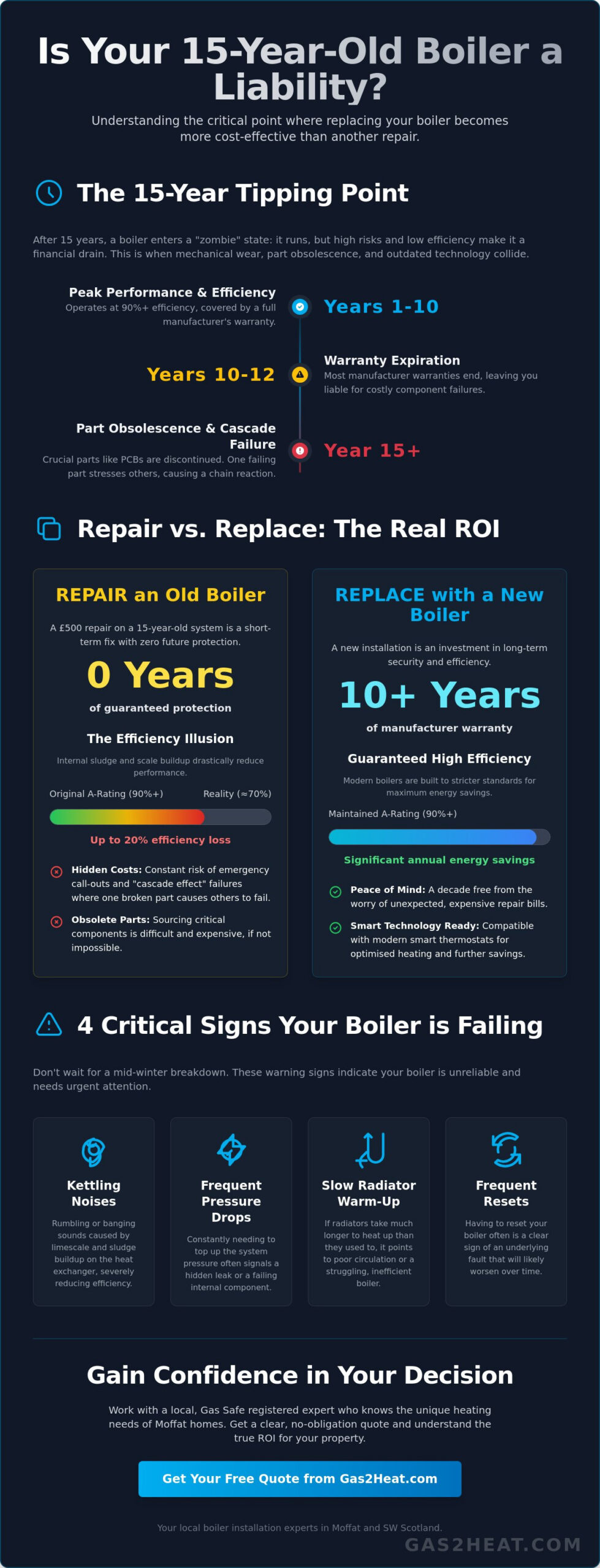
15 years marks the specific point where mechanical wear and parts availability collide. While many boilers can technically limp along for two decades, they often enter a “zombie” state after year 15. A zombie boiler is a unit that still fires up but operates with such low efficiency and high risk that it’s effectively dead from a financial perspective. Boiler obsolescence is the point when manufacturers stop producing critical internal components like PCBs or heat exchangers. Once your system reaches this age, finding a genuine replacement part becomes a scavenger hunt that often costs more than the repair is worth.
Technology has moved rapidly since the Energy Related Products (ErP) Directive was introduced in 2011. While those standards were a major step forward at the time, 2026 technology offers levels of modulation and heat recovery that make older systems look primitive. Understanding the new boiler cost Moffat families are quoted today involves weighing these efficiency gains against the rising price of keeping an old unit on life support. Newer units aren’t just quieter; they are designed to handle the modern demand for instant hot water without the constant cycling that wears out older internal components.
Why 15 Years is the Magic Number for UK Boilers
The mid-2000s saw a mandatory shift across the UK toward condensing technology. These early modern condensing boilers were a massive leap forward in efficiency, but they are now reaching their terminal limit. Most long-term manufacturer warranties expire by year 10 or 12, leaving you fully exposed to the high cost of components. We frequently see a “cascade effect” in older units. A failing fan puts extra strain on the PCB, which then leads to a pump failure. This chain reaction of parts failing in quick succession makes the 15-year mark the point where repairs stop being sensible investments.
Lifespan vs. Reliability: Knowing the Difference
There is a significant gap between a boiler that technically works and one you can actually trust. If you find yourself resetting your system every morning or notice that your radiators take twice as long to heat up as they used to, your boiler is no longer reliable. Local SW Scotland weather patterns, characterized by damp winters and sharp frosts, put intense demand on older heat exchangers. These internal components thin over time, making them prone to terminal cracks during high-demand periods. An annual boiler service is the only way to truly assess internal health and catch these hidden issues. Don’t wait for a mid-winter breakdown to start researching the new boiler cost Moffat installers provide; proactive planning is always cheaper than an emergency call-out in January.
Repair vs. Replace: Calculating the Real ROI in 2026
Deciding between a repair and a replacement often comes down to a single question. Is spending £500 to fix a 15-year-old unit a smart move, or is it throwing good money after bad? In 2026, the financial tipping point is clearer than ever. A major repair on an aging system offers zero future protection. Conversely, a boiler installation provides a 10-year manufacturer warranty. This effectively removes the risk of unexpected repair bills for a decade. When you calculate the new boiler cost Moffat homeowners face, you must factor in this long-term security.
Many homeowners believe their 15-year-old A-rated boiler is still efficient. This is rarely the case. Over 15 years, internal sludge and scale build-up can drop efficiency from 90% down to 70% or 80%. Even if the label says A-rated, the mechanical reality is often closer to a C or D rating. With Ofgem’s energy price cap sitting at £1,758 for typical households in early 2026, even a 5% efficiency gain translates into significant annual savings. Staying informed on government proposals on boiler standards helps you understand how modern systems are built to meet much stricter performance criteria than those from 2011. Understanding the new boiler cost Moffat residents are quoted involves looking at more than just the upfront price; it is about the total cost of ownership over the next decade.
The Ghost Costs of Keeping a 15-Year-Old Boiler
Maintaining an old system involves hidden expenses that don’t appear on a standard quote. Insurance premiums for older heating systems are rising as providers recognise the increased risk of failure. You also face the “emergency premium.” Calling out an engineer during a peak Dumfries & Galloway winter often involves higher fees and long wait times. Internal sludge build-up doesn’t just lower efficiency; it forces the pump to work harder, which increases your electricity usage and shortens the lifespan of other components.
New Boiler Savings: Beyond the Gas Bill
A new system offers more than just lower gas consumption. Modern modulating pumps use significantly less electricity than the fixed-speed versions found in older units. Integration with smart thermostats allows you to eliminate energy waste by heating only the rooms you use. Beyond the numbers, there is a vital non-monetary return on investment. Peace of mind is priceless. Knowing your family will stay warm during a cold snap without the threat of a breakdown removes a massive source of household stress. If you are unsure about your system’s health, booking a professional assessment can help clarify your options.
5 Critical Signs Your 15-Year-Old Boiler is Failing
Recognising the warning signs of a terminal failure can save you from a mid-winter crisis. While you might be focused on the new boiler cost Moffat installers quote, the physical symptoms of your current unit tell the real story. If your boiler makes a loud banging or whistling sound, it’s likely “kettling.” This occurs when sludge build-up restricts water flow, causing localized boiling within the heat exchanger. It’s a sign of deep-seated internal damage that a simple service might not fix.
Frequent pressure drops are another red flag. If you find yourself topping up the pressure every few days, you likely have a failing expansion vessel or a slow internal leak. These issues often remain hidden until they cause a total system lockout. Similarly, if your radiators take significantly longer to reach temperature than they used to, your pump or diverter valves are likely struggling. This mechanical fatigue directly inflates your energy bills, making a modern upgrade a more logical financial choice. A yellow boiler flame requires an immediate Gas Safe engineer visit to check for CO leaks.
The Danger of Carbon Monoxide in Older Units
Safety is the most important factor when assessing an aging system. Seals and gaskets naturally perish after 15 years of constant heat cycling, which increases the risk of internal leaks. Older flue designs can also become compromised or blocked over time, potentially allowing combustion gases to enter your living space. Always ensure you have working Carbon Monoxide alarms installed near your boiler. If you notice soot marks around the casing or persistent headaches when the heating is on, shut the system down immediately. Reliability is one thing, but safety is non-negotiable.
Intermittent Faults: The Reset Trap
Many homeowners fall into the “reset trap,” where they believe a boiler is fine as long as it restarts. Needing to reset your system weekly is often a symptom of a failing Printed Circuit Board (PCB). This component is the brain of the boiler, and once it begins to glitch, a total lockout is inevitable. This usually happens during the coldest week of the year when the system is under maximum load. Intermittent faults lead to higher cumulative repair bills than a single major failure. Instead of chasing these “ghost” faults, researching the new boiler cost Moffat residents typically pay can help you secure a fixed-price installation with a fresh warranty.
Power Flushing and Smart Upgrades: Maximising Your Current System
If you aren’t ready to commit to a full replacement, you can take steps to improve your current system’s performance. A power flushing service acts as a deep clean for your pipes and radiators. It removes the magnetite sludge that builds up over 15 years, allowing water to circulate more freely. This reduces the workload on your boiler pump and can restore some of the efficiency lost to time. It is a practical way to “reset” the system’s internal health without the immediate expense of a full upgrade.
Some homeowners also look at comfort upgrades like an underfloor heating installation. While these systems can be integrated with older boilers, they perform significantly better with modern modulating units. Older boilers often struggle with the lower flow temperatures required for underfloor loops, leading to higher fuel consumption. If you decide to wait another two years before replacing your unit, focus on future-proofing. Installing a magnetic system filter now will protect your current boiler and can be carried over to a new installation later, helping you manage the new boiler cost Moffat residents face in stages.
Is Power Flushing Worth It for a 15-Year-Old Boiler?
Power flushing uses high-velocity water and specialized chemicals to strip away debris. While effective, it carries a small risk for very old systems. The process can occasionally uncover pinhole leaks in radiators that were previously “sealed” by rust and sludge. If your radiators are thin or showing external signs of corrosion, skipping the flush is often the smarter move. In these cases, it is better to save that investment and put it toward the new boiler cost Moffat engineers quote for a fresh, reliable system.
Upgrading Controls: Smart Thermostats
You can usually fit modern smart thermostats like Nest or Hive to a 15-year-old boiler. These devices provide much tighter control over your heating schedules, which reduces the number of unnecessary on/off cycles that wear out internal parts. By preventing the boiler from “short-cycling,” you extend the life of the PCB and gas valve. The best part is that these controls are portable; if your old boiler fails next year, your engineer can simply reconnect the smart hub to your new unit. If you want to see how smart technology can lower your bills today, get in touch with our experts for a professional controls upgrade.
Gas2Heat: Local Boiler Installation Experts in Moffat and SW Scotland
Choosing a local family business over a national corporation ensures you aren’t just another number in a database. At Gas2Heat.com Ltd, we live and work in the same communities as our customers. This proximity allows us to offer a level of accountability that faceless national installers simply can’t match. When you inquire about the new boiler cost Moffat families are currently seeing, you receive a transparent, fixed-price quote based on local reality, not a national average. Every installation we perform is handled by a Gas Safe registered engineer who understands that your home’s warmth is non-negotiable. We’ve built our reputation on a straightforward promise: clear pricing, expert technical authority, and the removal of all complications from your maintenance tasks.
Local Service for Dumfries & Galloway Homeowners
The weather in the Scottish Borders and SW Scotland presents unique challenges for heating systems. From damp, coastal air in Dumfries to the sharp, biting frosts in Moffat, we know exactly how much strain our local climate puts on a 15-year-old heat exchanger. We also understand the specific water quality in the region, which is vital for preventing internal corrosion and sludge build-up. For those managing rentals, Gas2Heat.com Ltd provides comprehensive landlord gas safety certificates to ensure your properties remain compliant and your tenants stay safe. Our rapid fulfillment promise means we prioritise local residents in Dumfries, Lockerbie, and Annan, ensuring you aren’t left waiting when you need us most.
Request Your No-Obligation Boiler Assessment
Don’t wait for a total breakdown to find out the state of your heating. A Gas2Heat.com Ltd health check is a thorough mechanical audit of your system. We inspect the heat exchanger, test the pump, and check for any signs of the “reset trap” mentioned earlier. Our goal is to provide honest, straightforward advice. If a simple repair or a power flush can safely buy you another two years of reliability, we’ll tell you. If your unit is truly at the 15-year tipping point, we’ll explain the new boiler cost Moffat homeowners can expect for a modern, efficient upgrade. Book your boiler health check with Gas2Heat.com Ltd today to secure your home’s comfort before the winter rush begins.
Secure Your Home’s Warmth for the Next Decade
A 15-year-old boiler is often a financial liability. We’ve explored how mechanical wear and parts obsolescence make repairs a risky gamble that rarely pays off in the long run. Upgrading now removes the fear of a mid-winter breakdown and replaces it with the security of a 10-year manufacturer warranty. When you evaluate the new boiler cost Moffat residents are quoted today, it’s clear that the cumulative savings on energy and emergency call-outs make it a sensible investment. You don’t have to navigate these technical decisions alone.
As a family-owned Moffat business since 2017, Gas2Heat.com Ltd focuses on reliability and honesty. Our Gas Safe Registered engineers provide transparent pricing with no hidden extras, ensuring you know exactly what to expect from the start. We’re here to help you move from uncertainty to total peace of mind. Get a Fixed-Price Boiler Installation Quote in Moffat & Dumfries today. Take control of your home’s comfort and enjoy a warmer, more efficient future.
Frequently Asked Questions
How long should a modern gas boiler actually last?
A modern gas boiler typically has a functional lifespan of 10 to 15 years. While some units can technically operate for up to 20 years with meticulous annual servicing, their internal components usually begin to degrade significantly after the first decade. Modern designs prioritise high efficiency, which means internal parts are often lighter and more precise, eventually reaching a point where mechanical fatigue makes replacement the safer option.
Is a 15-year-old boiler considered G-rated for efficiency?
Most boilers manufactured in 2011 were originally A-rated condensing models, but their actual performance after 15 years often drops toward a G-rating. Internal corrosion and the build-up of magnetite sludge significantly hinder heat transfer over time. A unit that started at 90% efficiency can easily operate at 70% or lower today, meaning a large portion of the gas you pay for is wasted through the flue.
What is the average cost of a new boiler installation in SW Scotland in 2026?
Installation costs depend on the boiler type, fuel source, and the complexity of your home’s existing pipework. When researching the new boiler cost Moffat homeowners should expect, it is important to look beyond the initial price and consider long-term reliability. Factors like system power flushing or installing smart controls will affect the total, but these additions also provide greater efficiency and lower running costs over the next decade.
Can I still get parts for a boiler made in 2011?
Sourcing genuine parts for a 2011 model is becoming increasingly difficult as manufacturers phase out support for older components. While common items like fans or sensors might still be available, critical parts such as heat exchangers or specific Printed Circuit Boards are often discontinued after 15 years. This obsolescence is a primary reason why many homeowners choose to replace their system rather than risk a long wait for discontinued parts.
Will a new boiler really lower my energy bills significantly?
Upgrading to a modern A-rated system can save a typical household around £300 annually on energy bills. These savings come from advanced condensing technology that recovers more heat from flue gases than units from 2011. When considering the new boiler cost Moffat families pay, the reduction in monthly gas usage combined with the removal of unexpected repair bills often makes a fresh installation the most financially sound choice.
What happens if my 15-year-old boiler fails its Gas Safety Check?
If a boiler fails a safety check, the engineer is legally required to disconnect it to prevent potential harm. This usually occurs if the unit is classified as “At Risk” or “Immediately Dangerous” due to issues like poor ventilation, gas leaks, or cracked heat exchangers. In these cases, you must decide if the cost of extensive repairs to an aging unit is worth more than investing in a modern, safe replacement.
Is it better to repair a heat exchanger or buy a new boiler?
Replacing a heat exchanger on a 15-year-old unit is rarely a sound investment for homeowners. The part itself is expensive, and the labour required for the repair is extensive and costly. Since other internal components are likely nearing the end of their working life, spending hundreds of pounds on a single part often leads to a cycle of constant, expensive repairs that exceed the value of the unit.
Does a 15-year-old boiler increase the risk of Carbon Monoxide leaks?
The risk of Carbon Monoxide leaks increases as seals and gaskets perish after 15 years of constant heat cycling. These components can become brittle and crack, potentially allowing dangerous combustion gases to escape into your living space. While regular servicing and working CO alarms are vital, a newer unit with modern safety sensors and fresh seals provides a much higher level of protection for your household.
