
Landlord Gas Safety Regulations in Scotland: The 2026 Compliance Guide
Did you know that one in six homes in the UK currently has an unsafe gas appliance? For landlords, this isn’t just a safety concern; it’s a significant legal liability that can lead to heavy fines. Securing a gas safety certificate South West Scotland is the most critical step in protecting your tenants and avoiding the stress of criminal prosecution. Managing a rental property here often feels more complex than in England, especially with the unique requirements of the Scottish Repairing Standard. It’s natural to worry about missing a deadline or failing to meet the latest compliance updates.
This guide helps you master every legal requirement for gas safety so you can protect your investment with confidence. We’ll show you how to maintain full compliance without the usual headaches. You’ll learn about the flexible MOT-style inspection window, the mandatory carbon monoxide detector rules, and exactly how to ensure your property meets every safety benchmark for 2026. By the end of this article, you’ll have a clear roadmap to a valid CP12 and the peace of mind that comes from knowing your legal obligations are fully met.
Key Takeaways
- Understand the dual legal obligations of the Gas Safety (Installation and Use) Regulations 1998 and the Scotland-specific Repairing Standard.
- Discover what to expect during a professional inspection, including gas tightness tests and ventilation checks for all appliances and pipework.
- Secure your gas safety certificate South West Scotland through a streamlined process that combines annual boiler servicing with mandatory safety checks.
- Learn the strict timelines for record-keeping and tenant notification to avoid heavy penalties and ensure full legal compliance.
- Identify the latest requirements for interlinked smoke and carbon monoxide detectors to protect your tenants and your investment.
Understanding Landlord Gas Safety Duties in Scotland
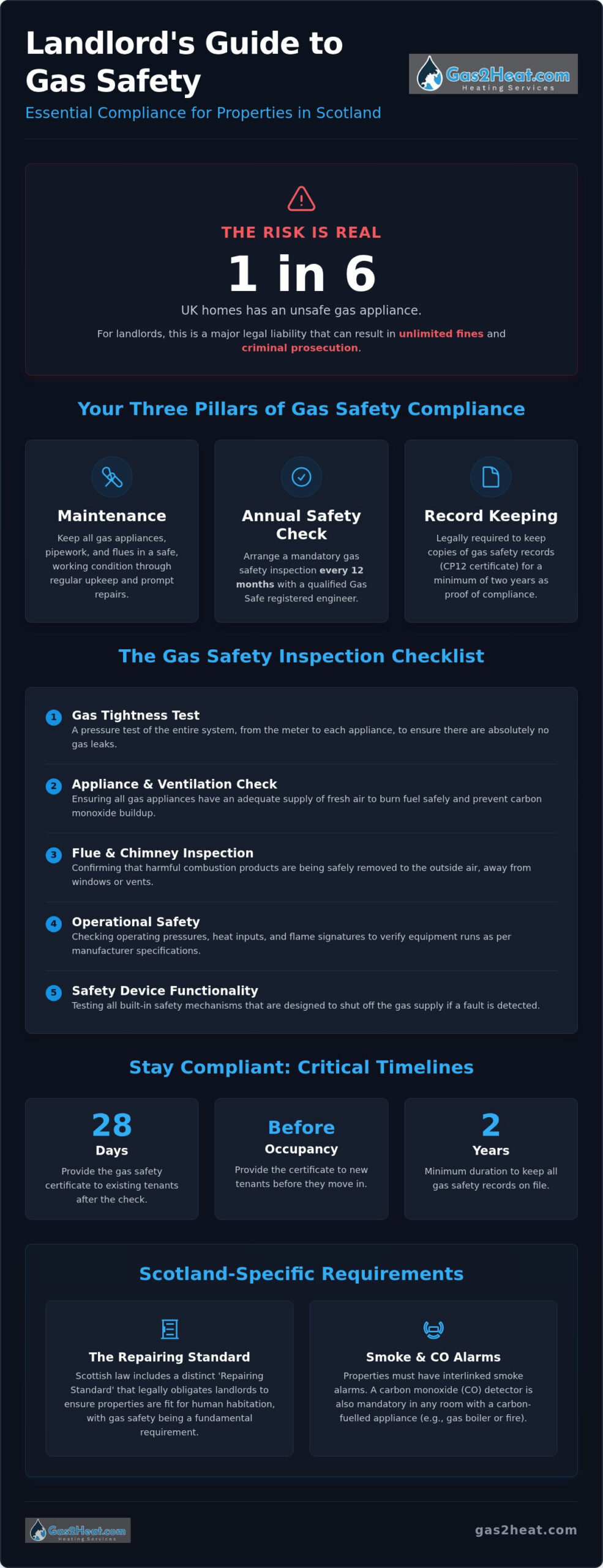
The Gas Safety (Installation and Use) Regulations 1998 form the legal backbone for every rental property in the UK. In Scotland, these rules are enforced with zero margin for error. As a property owner, you have a non-negotiable duty to maintain all gas pipework, appliances, and flues in a safe condition. This responsibility ensures that your tenants are protected from the silent dangers of carbon monoxide and gas leaks. Failing to meet these standards doesn’t just put lives at risk; it exposes you to criminal prosecution and unlimited fines. Every 12 months, a Gas Safe registered engineer must visit your property to verify that everything is functioning correctly. Following this inspection, you must distribute a copy of the Landlord’s Gas Safety Certificate to your existing tenants within 28 days. For those starting a new lease, the record must be provided before they take occupancy.
Who is Classified as a Landlord in Scotland?
Many property owners are surprised to learn how far these regulations reach. Whether you are a private individual with one property, a local authority, or a housing association, the rules remain the same. This includes owners of short-term holiday lets in the Scottish Borders and Dumfries. Even if a professional letting agent manages your property, you remain the person legally accountable for compliance. Agents can facilitate the process, but the legal duty of care rests squarely on your shoulders. You must ensure that every guest or tenant is protected by a valid safety record at all times, regardless of the length of their stay.
The Three Main Gas Safety Pillars
To remain compliant, you must focus on three distinct areas of responsibility. Maintenance is the first pillar. This involves keeping appliances and flues in a safe, working condition through regular upkeep and prompt repairs. Safety Checks represent the second pillar. This is the mandatory 12-month inspection performed by a qualified professional to confirm the system’s integrity. The final pillar is Record Keeping. You are legally required to keep copies of your gas safety records for a minimum of two years. This documentation serves as your proof of compliance and is essential for maintaining the Repairing Standard in your Scottish rental property.
The Gas Safety Inspection Process: What to Expect
A professional gas safety inspection is a systematic review of your property’s entire gas infrastructure. It’s designed to give you absolute peace of mind. When an engineer arrives to provide a gas safety certificate South West Scotland, they follow a strict protocol defined by the Gas Safety (Installation and Use) Regulations 1998. This isn’t just a quick look at the boiler. It’s a comprehensive check of every gas-burning appliance and all visible pipework to ensure the system is “gas tight.” This means there are no leaks whatsoever.
The engineer also examines the ventilation. Gas appliances need a constant supply of fresh air to burn fuel safely. Without it, deadly carbon monoxide can build up. We also check the operating pressures and heat inputs to ensure the equipment is running as the manufacturer intended. Flues and chimneys get special attention too. We must confirm that combustion products are being removed safely to the outside air, away from windows or vents. Finally, we test all safety devices. These are the components that shut off the gas if a fault occurs. If you want to stay ahead of your compliance, you can book your Landlord Gas Safety Certificate through our streamlined online system.
Step-by-Step Breakdown of the Check
The process starts with a visual inspection. We look for signs of distress, corrosion, or improper installation on all gas equipment. Next, we perform a “tightness test” at the gas meter. This involves monitoring the pressure in the entire system to detect even the smallest leak. We then move to individual appliances. We verify the flame signature, looking for a crisp blue flame rather than a lazy orange one, and check burner pressure settings. Once every check is complete and the system is deemed safe, we issue the Landlord Gas Safety Record, commonly known as a CP12.
Appliances Covered vs. Tenant-Owned Equipment
It’s important to understand where your legal responsibility ends. Under Scottish law, you are not responsible for appliances owned by your tenant, such as a gas cooker they brought with them. However, you are 100 percent responsible for the pipework that supplies gas to that appliance. If that pipework is unsafe, you are in breach of the regulations. Our engineers often perform a quick visual check on tenant-owned equipment as a courtesy. This helps identify obvious safety risks before they become a problem. Ensuring your own appliances are in top condition is the best way to maintain your gas safety certificate South West Scotland and keep your tenants safe.
Scotland-Specific Requirements: The Repairing Standard
Scottish landlords face a unique set of challenges that differ significantly from those in England. While UK-wide gas laws apply everywhere, the Housing (Scotland) Act 2006 introduces a higher benchmark known as the Repairing Standard. This legislation ensures that private rentals are safe, functional, and fit for human habitation at all times. It requires your property to be wind and watertight. More importantly, it mandates specific safety installations that go beyond the basic annual check. Meeting these standards is essential for anyone applying for a gas safety certificate South West Scotland. You can’t separate the gas safety record from the broader health of the building; they work together to protect your tenants and your investment.
The Scottish Government’s Repairing Standard provides the statutory framework you must follow. It links gas safety directly to broader property maintenance requirements. For example, you must have interconnected smoke and heat alarms installed in specific locations. This includes one smoke alarm in the most frequently used room, one in every circulation space like halls and landings, and a heat alarm in the kitchen. All these devices must be ceiling-mounted and interlinked. If one goes off, they all go off. This ensures that a fire in the kitchen is immediately signaled to someone sleeping upstairs. Compliance here is just as vital as your gas safety paperwork.
Mandatory Carbon Monoxide Alarms in Scotland
Scotland’s rules for CO alarms are highly prescriptive. Unlike the more flexible regulations in England, Scottish law requires a CO alarm in every room with a fixed combustion appliance. This includes boilers, gas fires, and even wood-burning stoves. These alarms must be either mains-powered or powered by a tamper-proof, long-life lithium battery. You must place them between 1 metre and 3 metres away from the gas appliance. This precision prevents false readings while ensuring the alarm triggers at the first sign of danger. It’s a small detail that makes a massive difference in tenant safety and legal protection.
The 2026 Updates to the Repairing Standard
The compliance landscape is shifting again in 2026. New clarifications focus on the transition to greener energy and the long-term health of Scottish homes. Landlords now need to report on the “hydrogen-ready” status of their boilers during annual checks. There is also a greater emphasis on integrating gas safety with other utilities. This includes checking for lead pipework and ensuring electrical safety standards are met alongside your gas inspections. To help you stay ahead, we’ve updated our Landlord Gas Safety Certificate guide with the latest 2026 requirements. Staying informed now prevents costly surprises and potential legal issues during your next professional inspection in the South West.
Managing Record Keeping and Tenant Access
Compliance doesn’t end when the engineer leaves your property. Maintaining your paperwork is just as vital as the physical inspection itself. Once you receive your gas safety certificate South West Scotland, you must keep it on file for a minimum of two years. This isn’t just a recommendation; it’s a legal requirement that serves as your primary defense in the event of a safety dispute. You must also ensure your tenants stay informed. Existing tenants require a copy of the new record within 28 days of the check. For new tenancies, the law is even stricter. You must provide a valid record before the tenant moves into the property. Digital records are perfectly legal in 2026, provided your tenant can easily access and print them if needed. This level of organization removes the uncertainty that often surrounds trade compliance.
Documentation is your primary shield against legal liability. If an incident occurs, your ability to produce a clear history of safety records is what protects you from prosecution. Beyond the two-year storage rule, it’s wise to keep a digital archive of every certificate issued for the property. When providing copies to tenants, always keep a record of when and how they were sent. If you use email, a simple acknowledgment from the tenant is valuable proof of receipt. This proactive approach ensures you’re always ready for an audit or a property inspection by local authorities.
What to Do if a Tenant Refuses Access
Gaining entry to a property can sometimes be difficult, but you cannot ignore your safety obligations. While you have a legal right to access the property for safety checks, you cannot use force or enter without permission. You must demonstrate that you’ve taken “reasonable steps” to comply. This typically means making at least three written attempts to schedule the visit, including a final notice sent via recorded delivery. This notice should clearly explain the safety risks and your legal duties. Local councils across South West Scotland, including those in Dumfries and the Borders, can provide assistance or legal mediation if a tenant consistently denies access for essential safety work.
The MOT-Style Clock for Gas Safety
The “MOT-style” system is a significant benefit for busy landlords. You can schedule your inspection up to two months before your current certificate expires without losing any time on your next 12-month cycle. This flexibility helps you avoid the stress of a last-minute rush during peak periods like the winter heating season. Carrying out the check between month 10 and month 12 of your current record preserves the original anniversary date for all future inspections. This ensures your property remains compliant year-round without the expiry date creeping forward every year. To simplify your schedule and ensure you never miss a deadline, you can book your Landlord Gas Safety Certificate in advance and let our team handle the logistics.
Professional Compliance with Gas2Heat in SW Scotland
Managing a rental property portfolio shouldn’t be a source of constant stress. Our Gas Safe registered engineers take the weight off your shoulders by providing expert coverage across Moffat, Dumfries, and the Scottish Borders. We’ve built our service around the specific needs of local landlords who value transparency and efficiency. When you book a gas safety certificate South West Scotland with us, you’re securing more than just a legal document. You’re getting a comprehensive health check for your property’s entire gas infrastructure from a team that’s been established since 2017.
Efficiency is at the heart of what we do. We recommend combining your annual boiler servicing with your safety certificate inspection. This “one-visit” approach saves you money and significantly reduces the scheduling burden on your tenants. Our pricing is straightforward. We don’t believe in hidden fees or complicated surcharges. Whether you have a single apartment in Dumfries or a large rural estate, you’ll receive the same high standard of professional care and financial clarity. Our automated reminder system also ensures you stay ahead of the “MOT-style” clock we discussed earlier. We’ll alert you when your renewal window opens so you never risk a compliance gap.
Local Expertise for Dumfries & Galloway Landlords
Rural properties in South West Scotland often present unique challenges, particularly with LPG (Liquid Petroleum Gas) systems. These setups require specialized training and equipment that many general trade services don’t carry. Our engineers are fully qualified to handle LPG installations, ensuring your off-grid properties are just as safe as those on the mains network. We also provide rapid response times for boiler repairs to keep your tenants warm during the harsh Scottish winters. For comprehensive support, explore our Reliable Plumbing and Heating Services designed for local property owners.
Book Your 2026 Gas Safety Check Today
We’ve streamlined the booking process to respect your time. You can secure an appointment through our simple online platform or speak to our support team if you manage multiple properties. Once the inspection is complete, we deliver your comprehensive digital reports immediately. This means you can forward the necessary documentation to your tenants or letting agents within minutes, not days. We handle the technical details so you can focus on managing your investment. Don’t leave your 2026 compliance to the last minute. Take the proactive step now to Secure your Landlord Gas Safety Certificate with Gas2Heat and enjoy the peace of mind that comes with professional, local expertise.
Secure Your Property’s Compliance for 2026
Managing the dual layers of UK gas regulations and the Scottish Repairing Standard is essential for every responsible property owner. By mastering the MOT-style inspection window and ensuring your carbon monoxide alarms meet the latest 2026 requirements, you protect your tenants while avoiding heavy legal penalties. Maintaining a valid gas safety certificate South West Scotland is your most effective tool for long-term property management success. It provides the documented proof of safety that local councils and insurance providers demand. Professional documentation removes the uncertainty often found in traditional trade services.
Gas2Heat makes this complex process simple. Since 2017, our family-owned business has provided expert support to landlords across Moffat, Dumfries, and the surrounding areas. Our Gas Safe Registered Engineers offer transparent, reliable service with automated reminders to keep you on schedule. Don’t leave your legal obligations to chance. Book Your Landlord Gas Safety Check with Gas2Heat today to secure your property. We take care of the technical details so you can enjoy total peace of mind knowing your investment is safe and fully compliant.
Frequently Asked Questions
Is a gas safety certificate different from a boiler service?
Yes, these are two distinct procedures with different goals. A safety check is a legal requirement to ensure appliances don’t pose a risk of fire, explosion, or carbon monoxide poisoning. A boiler service is a maintenance task where components are cleaned and adjusted to prevent breakdowns. Combining these tasks is the most efficient way to secure your gas safety certificate South West Scotland while ensuring your heating system runs reliably all year.
How much does a landlord gas safety certificate cost in Scotland?
The cost depends on several factors, including the number of gas appliances in the property and whether you choose to include a boiler service. The type of fuel, such as Natural Gas or LPG, and the property’s location in the South West also influence the final price. It’s best to request a transparent quote that covers all pipework and flues to ensure there are no hidden fees during the inspection.
Do I need a gas safety check if I only have a gas meter but no appliances?
Yes, you still have a legal obligation to ensure the gas installation is safe. Even without appliances, the meter and the internal pipework can develop leaks or suffer from corrosion over time. A Gas Safe registered engineer will perform a tightness test on the entire system to confirm there are no gas escapes. This ensures you remain compliant with the 1998 Regulations and protects the property from potential hazards.
Can my letting agent be held responsible for gas safety compliance?
The ultimate legal responsibility for gas safety rests with the landlord. While a letting agent can manage the logistics and scheduling, you are the person accountable in a court of law if a failure occurs. You should always verify that your agent employs qualified engineers and request a digital copy of every record. This ensures your gas safety certificate South West Scotland is current and provides you with essential legal protection.
What happens if my gas appliances fail the safety inspection?
If an appliance is deemed “At Risk” or “Immediately Dangerous,” the engineer will issue a warning notice and may disconnect the unit to ensure safety. You must arrange for professional repairs or a replacement before the appliance can be used again. Once the work is complete, the engineer will re-test the system. Prompt action is vital to maintain your compliance and ensure your tenants have access to safe heating and hot water.
Do holiday lets in the Scottish Borders need a gas safety certificate?
Yes, since March 2024, the Repairing Standard has expanded to include all licensed short-term holiday lets in Scotland. Owners of holiday properties in the Borders and Dumfries must conduct an annual gas safety check and provide guests with a copy of the record. This ensures that holidaymakers receive the same level of protection as long-term tenants. Failing to comply can lead to the loss of your short-term let license.
To maintain professional presentation standards in your short-term rental, you can explore Direct E-commerce Product Sales for commercial-grade clothes steamers and pressing equipment to ensure your linens are always guest-ready.
How often should CO alarms be tested in a rental property?
Tenants should test carbon monoxide alarms every month using the built-in test button. However, landlords must ensure all alarms are functional at the start of every new tenancy. Your engineer will also check the placement and operation of these alarms during the annual gas safety visit. In Scotland, these units must be either mains-powered or fitted with long-life lithium batteries to meet the mandatory Repairing Standard requirements.
Is a CP12 certificate the same as a Landlord Gas Safety Record?
Yes, these terms refer to the same legal document. CP12 is an older term from the era when CORGI was the regulatory body, while Landlord Gas Safety Record is the official name used by the Gas Safe Register today. Most landlords and engineers still use the terms interchangeably. The document is only valid if it’s issued by a registered engineer and includes a detailed breakdown of all appliances and pipework tested during the visit.
