
Most Energy Efficient Boilers in Scotland: 2026 Homeowner’s Guide
Did you know that upgrading from an outdated G-rated unit to one of the most energy efficient boilers scotland offers can save a typical three-bedroom household over £300 every year? It’s a significant figure, yet many homeowners still struggle with high bills and cold rooms during our long winters. You might feel skeptical about generic A-rated labels, especially if you’re trying to heat a traditional stone property that seems to leak warmth as fast as you can generate it.
We understand that you need more than just a box on the wall; you need a reliable system that handles the local climate without draining your bank account. This 2026 guide promises to clear the confusion. You’ll discover the highest-performing boiler systems for Scottish homes and learn how expert installation can maximize your efficiency. We’ll preview the upcoming October 2026 EPC reforms, explain how to utilize the 0% VAT rate on energy-saving measures available until March 2027, and show why local expertise in Moffat and the Borders is your best defense against rising costs.
Key Takeaways
- Understand how ErP ratings define the most energy efficient boilers scotland provides and how these standards impact your monthly heating costs.
- Compare high-efficiency combi and system boilers to find the perfect match for your home’s size and hot water demands.
- Uncover the ‘condensing mode’ secret and learn why professional system balancing is critical for achieving the efficiency listed on the box.
- Identify specific heating solutions tailored for traditional stone properties and modern new-builds across Dumfries and Galloway.
- Learn how professional installation and power flushing protect your investment and maintain peak performance in the Scottish climate.
Defining Boiler Efficiency for the Scottish Climate in 2026
Efficiency isn’t just a technical term; it’s a direct measure of how much of your money actually turns into warmth. When we discuss the most energy efficient boilers scotland provides, we are talking about systems that convert gas into usable heat with virtually no waste. Older, non-condensing systems often lose a staggering amount of energy through the flue. Modern units are designed to squeeze every bit of value from your fuel. This is vital for homes in Dumfries and Galloway where the heating season can stretch from September well into May. High efficiency is no longer a luxury, it’s a necessity for managing household budgets in our regional climate.
The ErP Rating System Explained
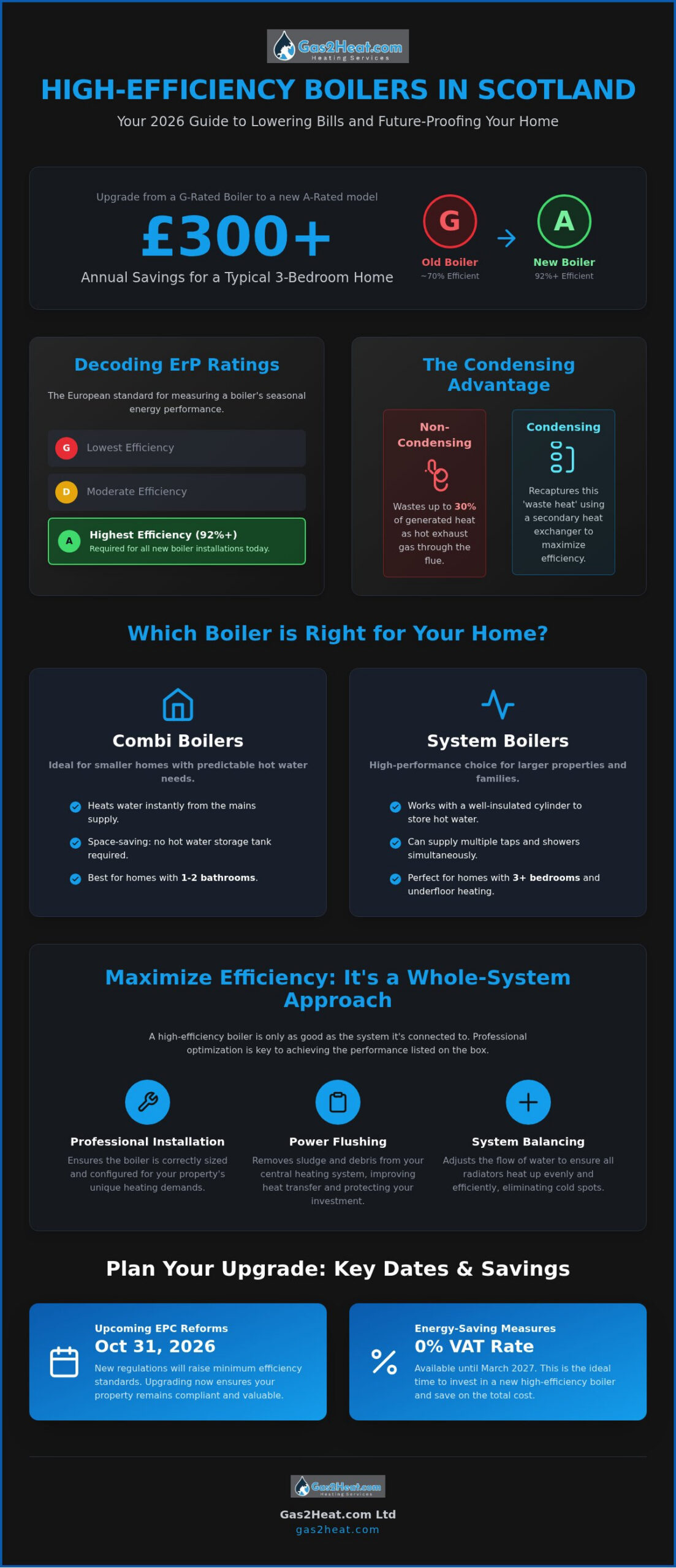
The ErP rating is a simple A to G scale that helps you identify performance at a glance. ErP is the European standard for measuring energy performance in 2026. Every new boiler installed today must meet a minimum seasonal efficiency of 92%, which earns it an ‘A’ rating. While a few percentage points might seem minor, the cumulative impact is significant. Upgrading from an 89% efficient model to a 94% model can save you hundreds of pounds over the system’s lifespan. We prioritize these high-performing units because they offer the most reliable return on investment for local families facing rising energy costs. With new EPC reforms arriving on October 31, 2026, choosing a top-tier system now ensures your property remains compliant and valuable.
Condensing vs. Non-Condensing Boilers
The shift to modern efficiency relies almost entirely on condensing boiler technology. Old non-condensing boilers are notoriously wasteful. They often vent up to 30% of their energy straight outside as hot exhaust gases. Condensing models solve this problem by using a secondary heat exchanger. This component captures latent heat from water vapour in the exhaust that would otherwise be lost. By recycling this “waste heat,” the system works significantly less to reach your desired temperature. Replacing a 15-year-old boiler is the single biggest efficiency win for a Moffat home. It turns a drafty, expensive property into a manageable, warm sanctuary. You can also take advantage of the 0% VAT rate on these energy-saving measures until March 2027, making it the ideal time to upgrade your system.
Choosing a high-efficiency system is about more than just the initial installation. It’s about securing a long-term solution that handles the damp, cold winters of SW Scotland without failing. By focusing on precision-engineered components and smart recycling of heat, these boilers provide the peace of mind you need. You’ll see the results every month when your energy statement arrives.
The Most Energy Efficient Boiler Types for 2026
Selecting the right hardware is the first step toward lower bills. In 2026, the most energy efficient boilers scotland offers fall into four main categories. Each serves a specific purpose depending on your property size and usage patterns. Whether you live in a compact flat in Dumfries or a sprawling farmhouse in the Borders, there’s a high-performance solution available. Matching the boiler type to your specific lifestyle ensures you don’t pay for capacity you don’t need or leave your home feeling cold.
Combi Boilers: Instant Heat, Minimal Space
Combi boilers remain the most popular choice for smaller homes. They heat water directly from the mains when you turn on a tap. This eliminates the standby heat loss associated with storing hot water in a tank. Modern units feature high “modulation ratios.” This means the boiler can turn its power down very low to match your actual heating needs without switching off entirely. This prevents “cycling,” which wears out components and wastes gas. These systems are ideal for 1-2 bathroom homes in Moffat where space is at a premium and hot water demand is predictable.
System Boilers: High Performance for Larger Homes
Larger homes with 3 or more bedrooms often require a system boiler. Unlike combis, these work with a separate cylinder to store hot water. Modern unvented cylinders are incredibly well-insulated. They retain heat for long periods, losing minimal energy over 24 hours. This setup is often the efficiency leader for high-demand properties. It allows you to run multiple showers simultaneously without a drop in pressure. System boilers are also the perfect partner for an underfloor heating installation. This combination provides consistent, low-temperature warmth that is significantly cheaper to run than traditional radiators.
Future-Proofing Your Efficiency
We also look toward future energy security. Most new boilers we install are “Hydrogen-Ready.” This means they can run on a 20% hydrogen blend without modification. As the UK grid evolves, your boiler will be ready to adapt. For homeowners looking to go even further, low-carbon hybrid systems are becoming a viable choice. These combine a gas boiler with an air source heat pump to maximize efficiency in any weather. This approach aligns with the latest Scottish Government energy efficiency standards, which aim to decarbonise our homes by 2045. If you aren’t sure which type fits your home, booking a professional site survey can identify the most cost-effective path forward.
Why ErP Ratings Aren’t the Full Story: System Optimization
An ErP sticker tells you what a boiler can do in a laboratory. It doesn’t tell you how it will perform in a cold stone cottage in the Borders. To find the most energy efficient boilers scotland homeowners can rely on, we must look at how the entire system works together. Even the best hardware fails to deliver savings if it’s poorly configured. Professional installation ensures your boiler actually enters its high-efficiency condensing mode rather than just acting as a glorified kettle. We focus on the fine-tuning that turns a good boiler into a high-performance heating solution.
Proper sizing is a critical factor that many installers overlook. Many older systems used boilers that were far too large for the property’s actual needs. This leads to “cycling,” where the unit constantly fires up and shuts down in short bursts. This process consumes excessive gas and puts unnecessary stress on internal components. We use precision sizing to ensure your boiler runs for longer, steadier periods at lower outputs. This approach keeps your home at a consistent temperature while significantly reducing your fuel consumption.
Local water quality plays a hidden role in your system’s long-term health. While much of Scotland has soft water, the specific mineral content in the Scottish Borders can still lead to internal corrosion over time. This debris settles in your radiators and heat exchanger, acting as an insulator that prevents efficient heat transfer. Your boiler then has to burn more fuel to achieve the same room temperature. Addressing these water quality issues is essential for maintaining the performance you paid for.
Flow Temperature and Weather Compensation
Your boiler’s “flow temperature” is the heat of the water leaving the unit. If this is set too high, the boiler won’t condense properly, and you’ll lose heat through the flue. Setting a “sweet spot,” usually below 55°C for the return water, triggers the condensing process that saves you money. Weather compensation sensors further optimize this by monitoring the Moffat outdoor climate. They automatically lower the flow temperature on milder days. Weather compensation can improve efficiency by up to 3% by preventing overheating.
Power Flushing and Magnetic Filtration
Clean water drives efficiency. Sludge buildup in Scottish radiators forces your boiler to work 15% harder just to push heat through the house. We recommend expert boiler servicing to clear these blockages and restore optimal flow. Magnetic filters are another essential addition to any modern system. They catch metallic particles before they reach the high-efficiency heat exchanger, preventing expensive damage and maintaining peak performance for years.
Choosing the Right Efficient Boiler for Your SW Scotland Property
Every home in Dumfries and Galloway has a different “thermal fingerprint.” A system that works perfectly for a modern flat in Dumfries might struggle to heat a detached stone farmhouse in the Borders. Finding the most energy efficient boilers scotland provides requires matching the technology to your specific building fabric. We don’t believe in a one size fits all approach. Instead, we look at your insulation levels, window types, and even the local exposure to wind and rain to determine the best fit.
Traditional stone cottages present a specific challenge. Their thick walls provide excellent thermal mass but often lack modern cavity insulation. This means they can be slow to heat up and quick to lose warmth through the roof or floors. For these properties, we prioritize high-output systems that can recover heat quickly without sacrificing efficiency. We select units with wide modulation ranges. These can provide a massive burst of heat when needed but then throttle down to a tiny flame to maintain a steady temperature once the house is warm.
Modern new-builds require the opposite strategy. These homes are incredibly airtight and well-insulated. The risk here is installing a boiler that is too powerful, which leads to the inefficient “cycling” we discussed earlier. In these environments, we focus on precision-sized units that run at very low temperatures. This approach maximizes the time the boiler spends in its most efficient condensing mode. It ensures you get the full benefit of the 0% VAT rate on energy-saving measures available until March 2027.
Smart Controls: The Brains of the System
A high-efficiency boiler is only effective if you can control it properly. Smart thermostats are the brains of a modern heating system. They learn your routine and automatically adjust the temperature based on whether you are home or at work. Many systems now use geofencing to detect when your phone is approaching the house, triggering the heat just in time for your arrival. Multi-zone heating takes this further by allowing you to heat the living room while keeping unused bedrooms cool. You can find more tips on improving heating efficiency through advanced controls in our dedicated guide.
Local Climate Considerations
The Moffat climate demands robust installation standards. We pay close attention to the “Big Freeze” by ensuring your condensate pipe is correctly sized and heavily insulated. If this pipe freezes, your boiler will shut down, leaving you without heat during the coldest nights of the year. Our local engineers also understand the specific water pressure requirements across the Borders. We calculate the ROI of every new installation based on 2026 Scottish gas prices to ensure the upgrade makes financial sense for you. You can request a professional site survey to see exactly how much a tailored system could save you each month.
Maximizing Your ROI with Gas2Heat Professional Installation
Buying a high-spec unit is only half the battle. Even the most energy efficient boilers scotland offers won’t deliver their full potential if they aren’t installed with precision. A poor setup can lead to heat loss, increased wear on parts, and higher bills from day one. We view boiler installation as a technical craft where every pipe connection and setting matters. Our goal is to ensure that the efficiency rating on the box matches the performance in your home.
Our approach centers on precision system balancing. This isn’t just about getting the radiators hot; it’s about ensuring every room reaches the right temperature at the same time. We fine-tune the flow rates across your entire Moffat home to prevent the boiler from working harder than necessary. This prevents the “cycling” issues mentioned earlier and keeps your energy consumption at the absolute minimum. When a system is balanced correctly, you’ll notice more consistent heat and a quieter boiler room.
Ongoing maintenance is the secret to sustained ROI. A boiler that is 94% efficient today could drop to 85% in a few years without proper care. Regular servicing ensures that the heat exchanger remains clean and the internal sensors stay accurate. Because we are based in Moffat, we provide rapid support across Dumfries and Galloway. If your efficiency drops or a fault appears, our local team responds faster than national call centers. This local reliability is your best defense against unexpected repair costs and inefficient operation.
The Gas2Heat Installation Standard
We start every project with a full system health check. This identifies existing issues, such as pipework restrictions or radiator sludge, before we fit your new unit. All our engineers are Gas Safe registered, providing you with total peace of mind and technical authority. We believe in financial transparency. You’ll receive a clear, fixed quote with no hidden fees or surprise “efficiency extras.” Our streamlined approach removes the stress from the process while focusing entirely on your long-term savings.
Next Steps for a Warmer, Cheaper Home
Securing a more efficient home starts with a simple, professional assessment. We offer detailed surveys in Dumfries, Lockerbie, and Annan to assess your specific heating needs. During your consultation, we’ll explain which of the most energy efficient boilers scotland has to offer is the right match for your property. We’ll look at your current radiators, insulation, and pipework to provide a clear path to lower bills. Book your efficiency-focused installation today to lock in your savings and ensure a warm home throughout the 2026 winter season.
Secure a Warmer Future for Your Scottish Home
Choosing from the most energy efficient boilers scotland offers is a smart investment that pays dividends through lower monthly bills and improved comfort. You now understand that efficiency depends on more than just an A-rating; it requires a system that is perfectly sized, balanced, and optimized for our unique regional climate. Whether you are upgrading a traditional stone cottage or a modern new-build, the right hardware combined with precision installation is the key to long-term reliability.
As a family-owned business serving Moffat and Dumfries since 2017, we bring specialized knowledge of SW Scotland property types to every project. Our Gas Safe Registered local experts focus on technical authority and transparent service to remove the stress from your heating upgrade. We’re ready to help you navigate the 2026 standards and ensure your home remains a warm sanctuary regardless of the weather outside—and once your living space is comfortable, you can discover Affordable Arts to find beautiful pieces from a fellow independent Scottish business.
Don’t let another winter drain your bank account. Take the first step toward a high-performance heating system and Get a Free Efficiency Quote from Gas2Heat Today. We look forward to helping you achieve a more efficient, cost-effective home.
Frequently Asked Questions
What is the most energy efficient boiler for a large house in Scotland?
Modern system boilers are generally the best choice for larger Scottish properties with high hot water demands. These systems work with a separate unvented cylinder to store hot water, ensuring you can run multiple showers simultaneously without losing pressure. When looking for the most energy efficient boilers scotland offers for 3+ bedroom homes, a precision-sized system boiler provides the most consistent performance and reliability during peak winter months.
How much can I actually save by switching to an A-rated boiler in 2026?
Upgrading from an old G-rated unit to a modern A-rated boiler can save a typical three-bedroom home over £300 per year on heating costs. These savings are driven by the jump from roughly 65% efficiency to over 92%. You can also take advantage of the 0% VAT rate on energy-saving installations until March 2027. This makes the initial upgrade more affordable while securing long-term reductions in your monthly energy outgoings.
Are combi boilers efficient enough for the cold Scottish winters?
Yes, modern combi boilers are highly effective for 1-2 bathroom homes in the Scottish climate. Their efficiency relies on a high modulation ratio, which allows the unit to reduce its output to match your actual needs without wasting gas. To ensure reliability during the “Big Freeze,” we always prioritize correctly insulated condensate pipes. This prevents the system from shutting down when outdoor temperatures drop well below zero in Moffat or Dumfries.
Do I need to change my radiators when I get a more efficient boiler?
You don’t usually need to replace your radiators, but a professional power flush is essential during installation. Sludge buildup in older Scottish heating systems can force your new boiler to work 15% harder than necessary. Clearing this debris ensures that heat transfers efficiently into your rooms. You might only consider larger radiators if you are specifically moving to a low-temperature system to maximize the condensing effect of your new boiler.
What is the Home Energy Scotland grant and does it cover new boilers?
The Home Energy Scotland grant currently focuses on zero-emission heating, offering up to £7,500 for heat pump installations. While standard gas boiler replacements aren’t the primary focus of this specific grant in 2026, qualifying households may still find support through the ECO4 scheme until March 2026. It’s always best to check the latest government criteria, as regional support for energy efficiency often updates to meet new Scottish climate targets.
How often should I service my boiler to maintain its energy efficiency?
You must schedule a professional service every 12 months to keep your system running at peak performance. Annual maintenance ensures the heat exchanger stays clean and internal sensors remain accurate. Without this, a boiler’s efficiency can drop significantly over time as soot or debris builds up. Regular checks by a Gas Safe registered engineer also protect your warranty and help identify small issues before they become expensive repairs.
Is it worth installing a smart thermostat with a new efficient boiler?
Installing a smart thermostat is one of the most effective ways to unlock the full potential of the most energy efficient boilers scotland provides. These controls act as the “brain” of your system, learning your schedule to prevent heating an empty house. Features like geofencing and multi-zone control allow you to manage your warmth with precision. This ensures you only use gas when and where it’s actually needed, further reducing your annual bills.
Why is my new boiler not as efficient as the manufacturer claims?
Real-world efficiency often falls short of manufacturer labels if the flow temperature is set too high. If the water returning to your boiler is above 55°C, the unit cannot enter its high-efficiency condensing mode. This means heat is lost through the flue instead of warming your home. Professional system balancing and the addition of weather compensation sensors are the best ways to correct this and reach the advertised efficiency levels.
