

Signs of an Inefficient Heating System: A 2026 Homeowner’s Diagnostic Guide
What if your heating system is working exactly as it should, yet it is still stealing hundreds of pounds from your bank account every year? It is a common reality for many homeowners in 2026. You likely feel the frustration of rising energy bills even when you have not turned the thermostat up. It is exhausting to deal with a living room that stays chilly while the upstairs is sweltering, or a boiler that makes enough noise to keep you awake at night.
Recognizing the signs of an inefficient heating system is the only way to stop the waste. This diagnostic guide will show you how to spot the subtle red flags of system fatigue before they turn into an expensive emergency. By identifying these issues early, you can secure a warmer home, lower your monthly outgoings, and ensure your system remains safe. We will walk you through the diagnostic steps every homeowner needs, from checking for radiator sludge to understanding how the latest 2026 Scottish EPC regulations affect your property’s value and comfort.
Key Takeaways
- Identify the physical signs of an inefficient heating system, including cold radiator spots and unusual boiler noises like kettling or banging.
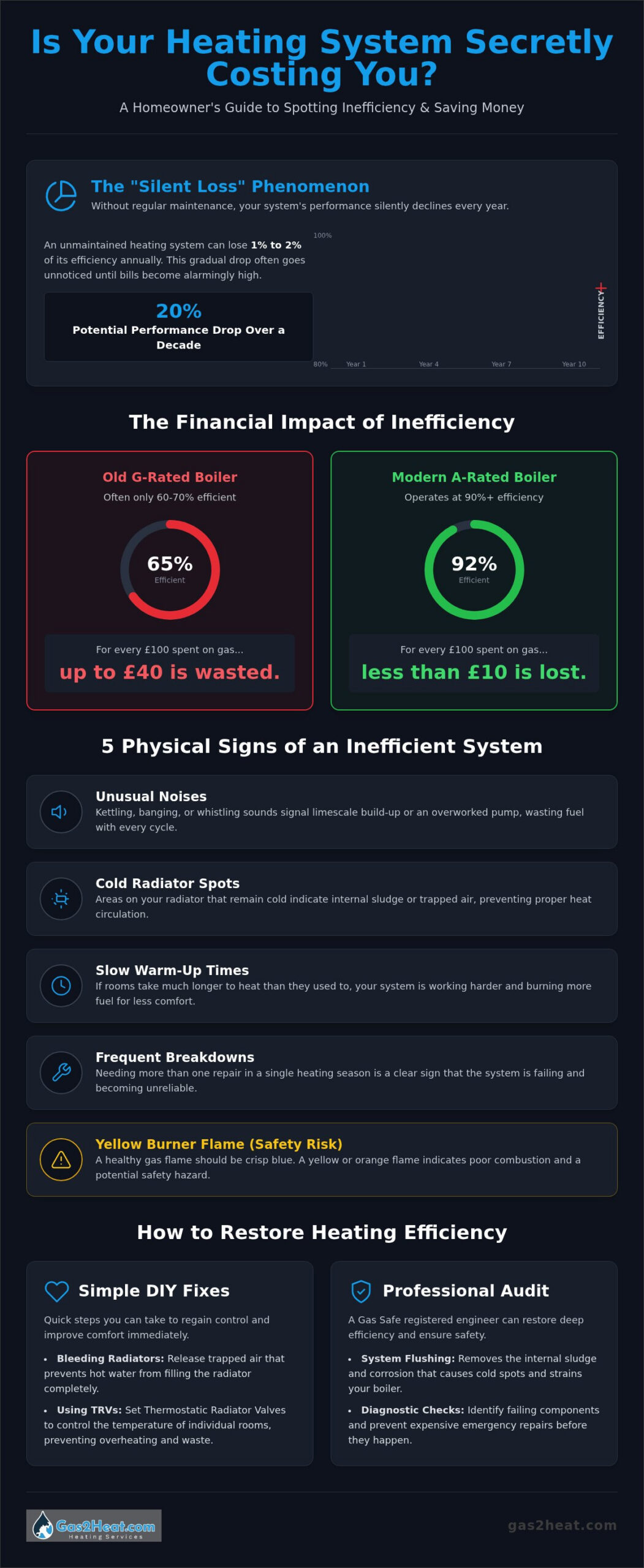
- Understand the “Silent Loss” effect, where internal sludge and corrosion reduce your system’s performance by up to 2% every year without maintenance.
- Learn simple DIY fixes such as bleeding radiators and using Thermostatic Radiator Valves to regain control over your home’s temperature.
- Evaluate your boiler against the “10-Year Rule” to see if outdated technology is the primary cause of your high energy bills.
- Discover how a professional audit by a Gas Safe registered engineer can restore efficiency and prevent expensive emergency repairs.
Understanding Heating Inefficiency: Why Your Bills Are Rising
Heating inefficiency is the gap between the energy you pay for and the actual warmth delivered to your rooms. To understand why this happens, it helps to look at how central heating works. Your boiler burns fuel to heat water, which then travels through a network of pipes to your radiators. If that heat is lost through poor insulation, internal system sludge, or outdated components, you are paying for energy that never reaches your living space. It is a direct drain on your household budget.
Most homeowners don’t notice the “Silent Loss” phenomenon until it is too late. Without regular maintenance, a heating system can lose between 1% and 2% of its efficiency every year. Over a decade, that adds up to a 20% drop in performance. In the damp, chilly climate of South West Scotland, this degradation often accelerates. The extra strain of a Moffat winter means your boiler works harder for longer periods. This constant pressure increases internal wear and significantly shortens the boiler’s total lifespan.
The Financial Impact of a Struggling Boiler
The difference between an old system and modern technology is stark. Older G-rated boilers are often only 60% to 70% efficient. This means for every £100 you spend on gas, up to £40 vanishes through the flue. Modern A-rated units operate at 90% efficiency or higher, ensuring more of your money stays in your pocket. To better understand how these various efficiency benchmarks are calculated, you can explore the technical guides provided by Ray Brown Air and Heat. One of the most expensive signs of an inefficient heating system is frequent “cycling.” Boiler cycling is a key efficiency killer where the unit turns on and off rapidly to meet heat demand, wasting significant fuel every time the burner ignites.
You might find yourself turning the thermostat up to 23°C or 25°C just to feel comfortable. This is usually a sign that heat transfer is failing. If your radiators take an hour to get warm or rooms feel drafty despite the heating being on, the system is consuming maximum fuel for minimal gain. This creates “heating anxiety” during Borders winters, where the stress of high bills competes with the need for a warm home. Eventually, you will reach a tipping point. When the price of constant repairs and high fuel consumption outweighs the cost of an upgrade, it’s time to prioritize efficiency over temporary fixes.
5 Physical Signs of an Inefficient Heating System
Your heating system often communicates its health through sound, touch, and sight. Recognizing the physical signs of an inefficient system allows you to act before a minor quirk becomes a total failure. While some issues are merely annoying, others indicate that your boiler is working far harder than necessary to keep your home warm.
Watch for these five indicators of a struggling system:
- Unusual noises: Sounds like kettling, banging, or high-pitched whistling.
- Cold radiator spots: Sections of the radiator that stay cold while others are hot.
- Slow warm-up times: Rooms take significantly longer to reach temperature than they did a few years ago.
- Frequent breakdowns: If you’ve needed more than one repair visit this heating season, your system is failing.
- Yellow flames: A healthy gas burner should have a crisp blue flame; yellow indicates poor combustion and a safety risk.
Radiator Cold Spots and Internal Blockages
If you touch your radiator and find the bottom is cold while the top is warm, you likely have a “sludge” problem. This black iron oxide build-up settles at the base, preventing hot water from circulating properly. Conversely, air trapped at the top forces your pump to work much harder to move water. These are common signs of an inefficient heating system that waste fuel daily. Identifying radiators needing flushing is often the most effective way to restore whole-home comfort without replacing the entire boiler.
Strange Noises: Kettling and Pipe Vibrations
A noisy boiler is literally “screaming” for a service. “Kettling” sounds like a whistling kettle and usually signals limescale build-up on the heat exchanger. This layer of scale acts like an insulator, meaning the boiler has to burn more gas to heat the water through the crust. If you hear vibrations in your walls, your pump might be overworked or failing due to the resistance from system debris. If these sounds are becoming a daily occurrence, it’s worth having a Gas Safe registered engineer perform a diagnostic check to protect your boiler’s internal components.
Safety is just as important as efficiency. A yellow flame on your burner is a critical warning. It suggests the gas isn’t burning correctly, which produces less heat and potentially dangerous carbon monoxide. Never ignore a change in flame colour or a pilot light that frequently goes out. These physical red flags are your first line of defence against rising costs and safety hazards.
The Root Causes: Age vs. System Health
While physical symptoms are easy to spot, the root causes of performance loss often hide within the pipework. Understanding the difference between a mechanical failure and a gradual decline in health is vital for any homeowner. One of the most common signs of an inefficient heating system is its age, but age isn’t the only factor. Even a relatively new system can struggle if it hasn’t been maintained or set up correctly.
The “10-Year Rule” serves as a helpful benchmark for homeowners. In the last decade, boiler technology has advanced rapidly. A unit installed in 2016 simply cannot match the fuel-to-heat conversion rates of a 2026 model. Central to this performance is the heat exchanger. This component transfers heat from the gas burner to your water. If it’s coated in limescale or debris, your efficiency drops instantly. Interestingly, even a 5-year-old boiler can be inefficient if it was poorly commissioned. If the flow temperatures are set too high or the system wasn’t balanced by a Gas Safe registered engineer, you’ll pay for energy that never translates into comfort. Specialists like J Marin Gas Services advocate for precise system commissioning to prevent this common cause of fuel waste.
The Sludge Factor: How Debris Chokes Your System
Sludge is the primary enemy of heating health. This black iron oxide forms when water reacts with the metal inside your radiators over time. It acts as a thick layer of internal insulation, choking your radiators and preventing heat from escaping into your rooms. Beyond radiators, sludge causes significant damage to sensitive internal components like the diverter valve. This leads to frequent, expensive repairs. Investing in power flushing is the most effective way to clear this debris and restore the flow your system needs to operate at peak performance.
Technological Obsolescence in Older Models
If your boiler is over 15 years old, it likely uses non-condensing technology. These older models lose a huge amount of heat through the flue. Modern condensing boilers capture that “waste” heat and recycle it back into the system, drastically reducing fuel consumption. Additionally, older units often feature permanent pilot lights that burn gas 24/7, even when you don’t need heat. For these aging systems, a professional boiler installation is usually the most financially sound decision. The long-term fuel savings often outweigh the cost of keeping an obsolete unit running.
Actionable Steps to Restore Heating Efficiency
Once you’ve identified the signs of an inefficient heating system, the focus shifts to restoration. You don’t always need a full replacement to see a drop in your energy bills. Many performance issues can be resolved through targeted maintenance and simple upgrades. Start by bleeding your radiators to remove trapped air pockets that prevent hot water from filling the unit. It’s a simple DIY task that ensures your boiler isn’t working overtime to heat a half-empty radiator. Next, evaluate your level of control. Installing Thermostatic Radiator Valves (TRVs) allows you to manage heat room-by-room. There’s no reason to pay for maximum heat in a guest bedroom or a storage space that you rarely use. Combine this with basic insulation checks. Ensure your loft has adequate depth and that any exposed pipework in unheated areas, like garages or crawl spaces, is properly lagged. These small steps keep the heat inside your system until it reaches your living area.
Upgrading Your Controls for Precision
Modern smart thermostats take efficiency a step further by learning your daily schedule. They prevent fuel waste by automatically lowering the temperature when you leave the house and pre-warming it before you return. For residents in rural areas around Moffat or Dumfries, remote control via a smartphone app is a game-changer. It allows you to adjust your heating if you’re delayed coming home, ensuring you never heat an empty house. At Gas2Heat.com Ltd, we specialize in smart thermostat installation to help you gain precise control over your energy consumption.
The Power Flush: A Deep Clean for Your Pipes
If bleeding your radiators doesn’t solve the problem, the signs of an inefficient heating system likely point to internal sludge. A professional power flush is a comprehensive deep clean for your entire circuit. We use a high-velocity, low-pressure pump to circulate specialized chemicals through your pipes and radiators. This process dislodges the black iron oxide and flushes it out of the system entirely. The impact is immediate. You’ll notice radiators getting hot to the touch much faster and a significant reduction in pump strain. Industry data suggests that a professional power flush can improve your heating efficiency by up to 15% by restoring the flow of heat. It’s a proactive way to extend the life of your boiler while cutting your monthly outgoings. If your home feels colder than it should, book a professional power flush with Gas2Heat.com Ltd to restore your system’s health.
Professional Efficiency Audits in SW Scotland
While DIY maintenance helps, a professional diagnostic is the only way to fully address the signs of an inefficient heating system. A Gas Safe registered engineer brings technical tools that the average homeowner cannot access. In the specific climate of Dumfries and Galloway, where damp winters put extra load on boilers, a professional audit acts as a performance tune-up. We don’t just look for faults; we look for opportunities to save you money on every unit of gas you burn.
A critical part of this audit is flue gas analysis. By using a digital analyzer, we measure the ratio of oxygen to fuel in your boiler’s exhaust. This tells us exactly how well your boiler is converting gas into heat. If the combustion is off by even a small percentage, your bills will stay high regardless of how many radiators you bleed. Our local expertise is also vital. We understand the specific water hardness and pressure levels in Moffat and the surrounding areas. These factors directly impact how quickly limescale builds up on your heat exchanger, which is a primary driver of system fatigue.
The Annual Service: More Than Just a Safety Check
Many homeowners view an annual service as a simple safety box-ticking exercise. In reality, an expert boiler service is a deep cleaning for your system’s “lungs.” We clean the primary heat exchanger and burner to ensure maximum heat transfer. Even a thin layer of dust or debris can force the boiler to burn more fuel to reach the same temperature. We also check for minor internal leaks that cause pressure loss. These small drips often go unnoticed until they cause a total lockout. Maintaining a consistent service record also protects your manufacturer warranty, ensuring you aren’t left with a massive bill if a major component fails.
Choosing a Local Moffat Heating Expert
When your heating starts to struggle, you need a team that understands the local landscape. National “big-brand” call centres often treat every home the same, whereas a local, family-run business like Gas2Heat.com Ltd prioritizes long-term reliability. We’ve been serving the community since 2017, focusing on transparent advice rather than high-pressure sales. Our Gas Safe registered engineers are specialists in efficiency-boosting upgrades, from power flushing to smart controls. We believe that a well-tuned boiler is the foundation of a comfortable home and a healthy bank balance. Don’t wait for a total breakdown to address high bills. Book an efficiency-focused boiler service today to secure your home’s comfort for the winter ahead.
Secure Your Home’s Comfort and Efficiency Today
Ignoring the early warning signals of a struggling boiler only leads to higher bills and stressful winter breakdowns. By recognizing the signs of an inefficient heating system, you’ve already taken the first step toward a more comfortable, cost-effective home. Whether it’s clearing internal sludge through power flushing or finally upgrading to smart controls, these adjustments make a significant impact on your monthly outgoings.
Don’t leave your comfort to chance. Our Gas Safe registered engineers have been serving Moffat, Dumfries, and the Borders since 2017. We focus on transparent pricing with no hidden costs, ensuring you get the technical expertise you need without any financial surprises. A well-tuned system doesn’t just save you money; it provides the reliability your family needs during a harsh Scottish winter.
Take control of your energy consumption before the next cold snap arrives. Request an Efficiency Audit from our Moffat Engineers today and see how much you could save. You deserve a home that is warm, safe, and truly efficient.
Frequently Asked Questions
Is my boiler inefficient if it is making a whistling noise?
Whistling, often called kettling, is one of the most common signs of an inefficient heating system. It usually indicates a build-up of limescale or debris on the heat exchanger. This layer acts as insulation, meaning your boiler has to burn more gas to heat the water. If you hear this in your Moffat home, it is a signal that your system is wasting fuel and needs a professional service to restore its performance.
How much can I save on my gas bill by upgrading to an efficient system?
Upgrading from an old G-rated boiler to a modern A-rated model can significantly reduce your gas consumption. Older units often operate at around 60% efficiency, while new condensing boilers reach 90% or higher. This means you stop losing 40p of every pound spent on fuel through the flue. While savings vary based on your property size in Dumfries, the long-term reduction in monthly energy bills makes a modern installation a financially sound decision.
Why are my radiators cold at the bottom but hot at the top?
Radiators that are cold at the bottom but hot at the top are usually choked by “sludge.” This is a build-up of black iron oxide that settles at the base, blocking the flow of hot water. It prevents the radiator from emitting its full heat, forcing you to turn the thermostat up. Our Gas Safe registered engineers in SW Scotland recommend a professional power flush to remove this debris and restore the heat output of your radiators.
Can a smart thermostat actually make an old boiler more efficient?
A smart thermostat can improve the efficiency of an older boiler by providing more precise control. It prevents “boiler cycling,” where the system turns on and off too frequently, which is a major source of fuel waste. By learning your schedule and adjusting the temperature based on your actual needs, these controls ensure you aren’t heating an empty house in Lockerbie or Annan, making your existing setup work much smarter.
How often should I have my heating system power flushed?
Most heating systems benefit from a power flush every five to ten years, though this depends on the age of your radiators and water quality in Dumfries and Galloway. If you notice cold spots or noisy pipes, it is time for a deep clean. This process removes the internal corrosion that chokes your system. Proactively flushing the circuit protects sensitive components like the pump and diverter valve from premature failure and expensive repairs.
Will a new boiler installation pay for itself in energy savings?
A new boiler installation often pays for itself through a combination of lower fuel bills and the absence of repair costs. Modern boilers are significantly more reliable and efficient than units installed over a decade ago. When you factor in the reduced gas consumption and the peace of mind of a manufacturer warranty, the initial investment provides a clear long-term financial benefit for homeowners in Moffat and the surrounding Borders.
What is the most efficient temperature to set my boiler flow to?
For a modern condensing boiler to operate at its most efficient, the flow temperature should ideally be set to around 55°C or 60°C. This allows the boiler to stay in “condensing mode,” where it can recover heat that would otherwise be lost through the flue. Many systems in SW Scotland are set too high by default. Lowering this temperature can reduce your gas usage without compromising the comfort of your home.
Why does my boiler keep losing pressure and turning off?
Constant pressure loss is usually caused by a leak in the system or a fault with the expansion vessel. When the pressure drops too low, the boiler will turn off as a safety precaution. This frequent shutting down is a major sign of inefficiency, as the system consumes extra energy every time it tries to restart. If you are constantly topping up your boiler in Thornhill or Gretna, you need a Gas Safe registered engineer to find the leak.
