
Underfloor Heating Cost 2026: Complete Price Guide for South West Scotland
What if your floor could cut your annual heating bill by 15% while removing those bulky, dust-trapping radiators forever? Most homeowners in South West Scotland expect the underfloor heating cost to be a budget-breaker, especially when dealing with our region’s unique mix of historic stone cottages and modern developments. You’re likely tired of unpredictable energy hikes and the confusion of choosing between complex heating technologies. You deserve a warm home without the financial sting of hidden extras that often crop up during local property renovations.
We’ve built this 2026 price guide to give you total transparency and peace of mind. You’ll discover the exact investment required for wet versus electric systems across Moffat and Dumfries, based on real-world data from our latest Gas Safe registered installations. We’ll outline how to set a realistic budget for your specific property type, explain the long-term savings on your monthly energy statements, and show you how our fixed-price approach removes the guesswork from your project. From Victorian floor joists to modern screeds, we’ll ensure you have the expert local facts needed to make an informed decision for your home.
Key Takeaways
- Compare wet and electric systems to find the most efficient balance between upfront investment and long-term energy savings for your home.
- Identify how regional factors like property age in Moffat and Dumfries dictate your installation strategy, especially when retrofitting older stone cottages.
- Get a transparent breakdown of the total underfloor heating cost for 2026 to help you secure a fixed-price quote with no hidden fees.
- Prepare for a hassle-free installation by understanding local labour rates and the typical 3–5 day project timeline for South West Scotland.
- Maximise your return on investment by learning how high-efficiency systems lower gas consumption and boost your property’s resale value.
Understanding Underfloor Heating Costs in South West Scotland
Modern heating is shifting away from bulky radiators toward high-efficiency underfloor systems. This technology turns your entire floor into a low-temperature heat source, providing consistent warmth from the ground up. For a standard three-bedroom home in 2026, the average underfloor heating cost typically ranges between £3,000 and £13,000. These figures depend heavily on your specific property type and the installation method chosen for your renovation or new build.
Local factors play a major role in these initial estimates. A Victorian sandstone villa in Moffat requires a different approach than a 2015 timber-frame build in Dumfries. Older properties often need additional floor preparation or high-grade insulation to meet current efficiency standards. You generally choose between two primary systems:
- Wet Systems: These use water-filled pipes connected to your boiler or heat pump. They’re ideal for whole-house renovations and long-term savings.
- Dry Systems: These use electric heating mats or cables. They’re perfect for smaller areas like bathrooms or kitchens where floor height is a concern.
Why Underfloor Heating is Trending in Dumfries & Galloway
Energy efficiency is now a top priority across the Scottish Borders. UFH systems operate at lower temperatures than traditional radiators; this can reduce energy consumption by up to 15% when paired with a modern condensing boiler. Beyond the savings, the invisible nature of the system is a huge draw. It frees up roughly 10% of usable wall space in a typical room by removing the need for radiators. This design flexibility is essential for modern open-plan living. Most importantly, UFH provides superior comfort during Dumfriesshire winters, where temperatures dropped to -10°C in January 2024.
Generic UK Estimates vs. Local Scottish Reality
National price guides often fail to account for the logistical realities of rural Scotland. Transporting materials to areas like Thornhill or the Rhins of Galloway adds specific costs that generic UK averages ignore. Local labor availability also fluctuates based on seasonal demand. Gas2Heat solves this by providing transparent, localised quotes that reflect the actual underfloor heating cost for your specific postcode. We use a fixed-price model to remove the guesswork. You get a clear breakdown of costs upfront, ensuring your project stays on budget without hidden surprises or trade markups. Our Gas Safe registered engineers handle the entire process, combining local expertise with a streamlined, modern service.
Wet vs. Electric Underfloor Heating: Comparing Installation and Running Costs
Choosing the right system is the single most important factor in your total underfloor heating cost. You’ll face a choice between water-based (wet) pipes and electric heating mats. For homeowners in South West Scotland, the long-term savings of a wet system usually outweigh the lower initial price of electric alternatives. Wet systems function as a permanent part of your home’s infrastructure; electric systems serve better as a luxury addition to specific, small rooms.
Wet Underfloor Heating: The Boiler-Linked Solution
Our Gas Safe registered engineers connect wet systems directly to your existing high-efficiency gas boiler or heat pump. This setup uses a central manifold to distribute warm water through oxygen-barrier pipes buried in the floor screed. Mixing valves ensure the water stays at a safe, consistent temperature, typically between 35°C and 55°C. For larger properties in Lockerbie and Annan, this is the gold standard for efficiency. It provides a consistent heat profile that traditional radiators can’t match. These systems are built for the long haul; the pipes often carry a 50-year manufacturer guarantee. Many homeowners are surprised to learn that installing underfloor heating with an existing boiler is entirely achievable without a costly full system overhaul.
- Upfront Investment: Higher due to specialist plumbing and manifold installation.
- Efficiency: Uses low-temperature water, reducing boiler workload by 15%.
- Lifespan: Components like the manifold last 25 years, while pipes last 50+ years.
Electric Underfloor Heating: Best for Small Spaces
Electric underfloor heating uses thin wires or mesh mats installed just below the floor finish. It’s much cheaper to install, often costing 40% less upfront than a wet system because it doesn’t require plumbing. However, the energy consumption is a major drawback. Electricity prices in 2026 remain significantly higher than gas. You’ll likely pay 3 times more to run an electric mat compared to a water-based system. We limit our recommendations for electric UFH to small en-suites or single bathrooms where retrofitting pipework is impractical. It isn’t a cost-effective primary heat source for a full lounge or kitchen area.
Maintenance requirements differ between the two technologies. Wet systems need an occasional system flush every 5 to 10 years to keep the manifold clear. Electric systems are technically maintenance-free, but they have a shorter operational lifespan. If a cable fails under your tiles after 15 years, the repair is often invasive and expensive. To get a clear picture of which system fits your property and budget, you can get a fixed price quote online in under 60 seconds. Understanding your projected underfloor heating cost early prevents surprises during your renovation or build.

Key Factors Affecting Your Underfloor Heating Quote in 2026
Estimating your underfloor heating cost requires looking beyond the square footage of your home. Every property in South West Scotland has a unique thermal profile that dictates the hardware required. Your quote will fluctuate based on the complexity of the installation and the existing structure of your building.
- Property Age: New builds are designed for UFH from the blueprint stage, making installation straightforward. Retrofitting a 19th-century stone cottage in Kirkcudbright or Castle Douglas often requires excavating solid floors or using low-profile 15mm overlay systems, which increases labor time.
- Floor Build-up: The choice between a traditional 65mm sand and cement screed or a high-performance liquid screed impacts the price. Liquid screed is more expensive but offers superior thermal conductivity.
- The “Zone” Factor: Controlling rooms independently adds comfort but increases the hardware count. A system with five independent zones requires more manifolds and smart thermostats than a single-zone open-plan layout.
- Floor Finish: While we can install UFH under most surfaces, your choice of finish changes the system design. Tiles and stone are the most cost-effective long-term because they require lower flow temperatures to heat the room.
The Impact of Insulation and Heat Loss
We don’t guess when it comes to your comfort. Our engineers perform a room-by-room heat loss calculation before providing a fixed price. This is vital in Dumfries and Galloway, where average January temperatures frequently drop to 1°C. High-quality PIR insulation boards are a non-negotiable part of our quotes. Adding 50mm of edge and floor insulation can reduce your running costs by 25% by preventing heat from escaping into the ground. It ensures the energy you pay for stays inside your living space.
Floor Finishes and Thermal Conductivity
Your floor finish acts as either a conductor or an insulator. Stone and ceramic tiles provide the best return on investment because they have high thermal conductivity, allowing the system to reach target temperatures 40% faster than other materials. If you prefer carpet, it must have a combined tog rating of less than 2.5 to remain effective. For Luxury Vinyl Tile (LVT) or vinyl, we install floor sensors to cap the temperature at 27°C. This protects your flooring warranty while maintaining a consistent underfloor heating cost throughout the winter months.
The Installation Process and Professional Labour Costs
Expert labour ensures your system runs efficiently for decades. In South West Scotland, qualified heating engineers typically charge between £250 and £450 per day for specialist installation services. For a standard 40 square metre ground floor project, expect the installation to take between 3 and 5 days. This timeframe covers everything from the initial site preparation to the final system balancing. Labour usually represents 40% of the total underfloor heating cost, but cutting corners here often leads to expensive repairs later.
Understanding the full underfloor heating cost involves more than just buying the parts. Homeowners should set aside funds for specific project requirements that aren’t always obvious. Skip hire in Dumfries averages £240 for a standard 6-yard container to handle old flooring waste. Professional floor levelling costs roughly £15 per square metre. If you require furniture removal services, local firms charge approximately £150 for a single room. Attempting a DIY installation for wet systems is a false economy. A single leak under a cured screed can cost over £2,000 to rectify, which far outweighs any initial savings on professional fees.
What to Expect During a Gas2Heat Installation
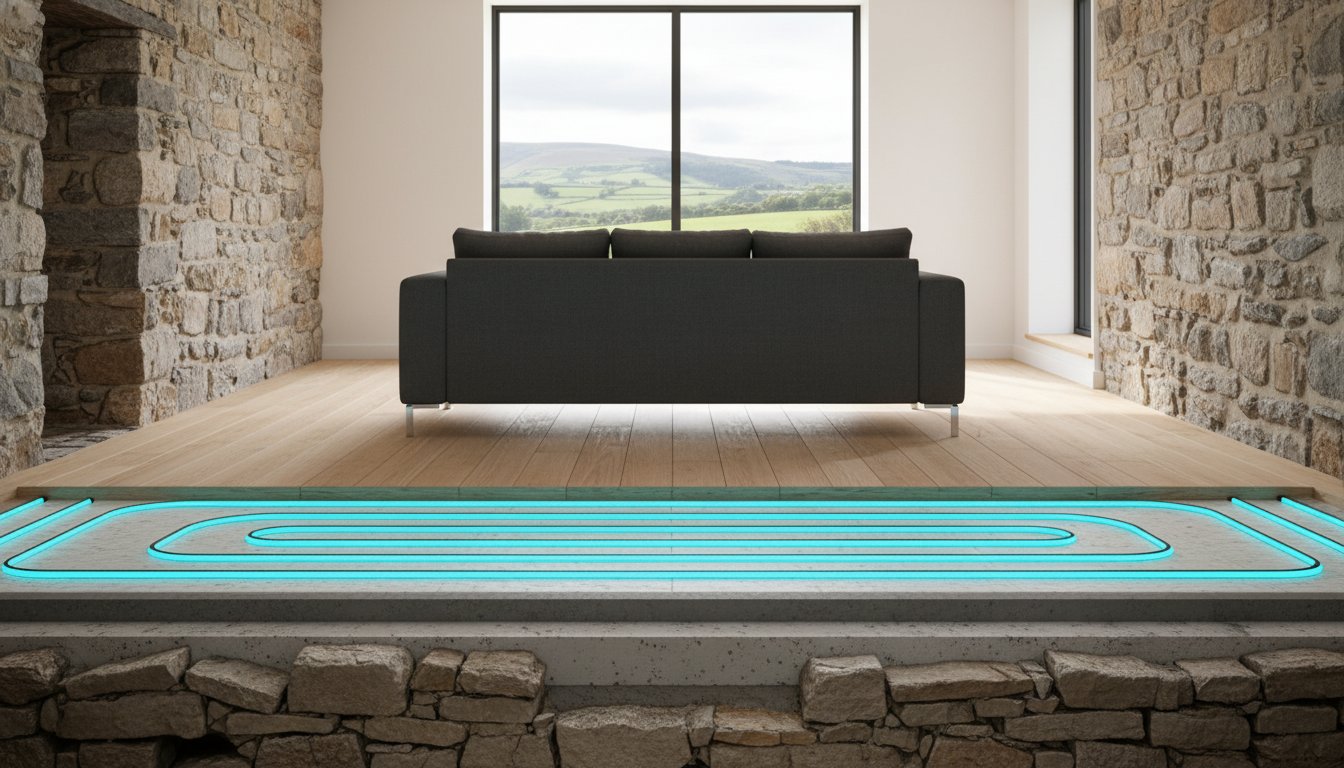
Our process follows three strict phases. First, we prepare the subfloor and install high-grade 50mm PIR insulation boards to prevent heat loss. Second, we lay the oxygen-barrier pipework in a precise serpentine pattern and conduct a 6-bar pressure test. Finally, our engineers connect the system to a high-efficiency manifold and your existing boiler. We ensure every zone is balanced for optimal thermal comfort before we leave the site.
Finding Trusted Installers in Moffat and Dumfries
Choosing a local expert is vital for compliance. All wet underfloor systems must be commissioned by a Gas Safe registered engineer to validate your manufacturer warranty. Local knowledge of Section 6 (Energy) of the Scottish Building Standards is essential for properties in the Scottish Borders and Dumfries and Galloway. Gas2Heat provides a fixed price and hassle-free service that removes the stress of hidden surcharges. You get a reliable, high-performance heating system installed by experts who live and work in your community.
Maximising ROI: Is Underfloor Heating a Smart Investment?
Investing in UFH is a calculated financial move that extends beyond the luxury of warm tiles on a cold Dumfries morning. When you evaluate the total underfloor heating cost, it’s vital to consider the long-term appreciation of your property. In South West Scotland and Cumbria, homes equipped with modern, wet UFH systems often command a 3% to 5% higher resale price than those with standard radiator setups. Buyers recognize the efficiency, comfort, and aesthetic benefits of a hidden heating system, making it a powerful differentiator in the local property market.
The most immediate financial benefit appears on your monthly energy bills. Traditional radiators require water heated to approximately 75°C to be effective. In contrast, a wet UFH system operates efficiently at just 35°C to 45°C. This lower flow temperature allows your condensing boiler to stay in its most efficient mode for longer periods. Most homeowners in our region report a 15% to 25% reduction in gas consumption after the switch. If you’re renovating a large open-plan kitchen or extension, UFH is the superior choice for consistent heat distribution without the cold spots common with radiators.
Smart Controls and Efficiency Gains
Precision is the key to maximizing your ROI. Integrating smart thermostats like Nest or Hive allows you to manage your home’s climate directly from your smartphone. You can implement “zoning” to prevent heating empty rooms, which is particularly effective in larger properties across Gretna or Lockerbie. By only heating the spaces you use, you stop wasting energy. A professionally installed wet system typically offers a payback period of 8 to 10 years through these efficiency gains alone. This makes the initial underfloor heating cost a sustainable long-term investment for your home.
Next Steps for Your Moffat or Dumfries Home
Booking a professional site survey with Gas2Heat is the first step toward a more efficient home. Our local Gas Safe registered engineers visit properties across Moffat, Dumfries, and the surrounding areas to assess floor heights and subfloor insulation. To ensure we provide an accurate, fixed price quote, please have your room measurements or floor plans ready for our team. We prioritize transparency, ensuring you understand every aspect of the installation process before work begins.
Secure Your Energy-Efficient Future Today
Investing in your home’s comfort for 2026 requires clear data and local expertise. You’ve seen that wet systems can reduce annual energy bills by up to 25% compared to traditional radiators. You also know that specific factors in South West Scotland, from floor insulation levels to property size, dictate the final price. Navigating the underfloor heating cost doesn’t have to be a guessing game or a source of stress. Our Moffat-based family business brings years of local experience to every project across Dumfries and Galloway. We use 100% Gas Safe Registered Engineers to ensure your system is installed to the highest safety standards. We believe in total transparency. That’s why we provide fixed pricing with no hidden costs; the quote you see is the price you pay. It’s time to stop worrying about fluctuating estimates and start enjoying a warmer, more efficient home. You can trust our professional team to handle the technical details while you focus on the comfort of your upgraded living space.
Request your fixed-price underfloor heating quote from Gas2Heat
We look forward to helping you create a cozy home that stays warm all year round.
Frequently Asked Questions
How much does it cost to install underfloor heating per square metre in 2026?
Professional installation for a wet system in South West Scotland costs between £130 and £185 per square metre. This price covers high-efficiency piping, manifolds, and Gas Safe engineering labour. Electric mat systems offer a lower entry point at £65 to £95 per square metre, though they result in higher monthly energy bills. Your total underfloor heating cost will vary based on whether you choose a new build installation or a retrofit in an existing property.
Is it cheaper to run underfloor heating or radiators in a Scottish home?
Underfloor heating is 25% more efficient than traditional radiators in a typical Scottish climate. Radiators require water temperatures of 70°C to heat a room, whereas underfloor loops operate effectively at just 35°C. This lower demand reduces the workload on your boiler and cuts annual gas consumption by approximately £210 for a three-bedroom house. You get a consistent heat profile that eliminates the cold spots common in older stone buildings.
Can I install underfloor heating with my existing combi boiler?
Yes, your current combi boiler can power an underfloor system if it has the correct kilowatt capacity for your floor area. A standard 30kW boiler easily manages a 60 square metre ground floor installation alongside its usual hot water duties. Our engineers install a dedicated mixing valve to ensure the water entering your floors stays at a safe 40°C. This setup allows your boiler to run at its most efficient condensing mode more often. For a detailed breakdown of how this integration works in practice, read our complete guide on underfloor heating with an existing boiler for Moffat and Dumfries homeowners.
What is the most expensive part of an underfloor heating installation?
The manifold and its associated smart controls represent the highest hardware expense, usually costing between £450 and £850 for a four-zone system. This component acts as the central hub that regulates flow and temperature for every room. Labour for floor preparation and screeding also accounts for 40% of the total underfloor heating cost. Choosing high-quality components at this stage prevents 90% of future maintenance issues and ensures system longevity.
How long does it take for underfloor heating to pay for itself?
Most homeowners in Dumfries and Galloway see a full return on investment within 9 to 12 years through reduced energy bills. This calculation is based on 2026 energy price forecasts and the 30% efficiency gain seen when replacing old radiators. Beyond direct savings, a professional underfloor heating installation adds roughly 6% to your property’s market value. It’s a long-term investment that improves your EPC rating and makes your home more attractive to future buyers.
Does underfloor heating require annual servicing like a boiler?
Underfloor systems don’t need a standalone annual service, but you should have the manifold checked during your yearly boiler safety inspection. Our local engineers verify that the pump is clear of sediment and the pressure remains steady at 1.5 bar. We recommend a system flush every 5 years to maintain optimal flow rates. This simple check-up takes less than 30 minutes and keeps your 25 year pipe warranty fully protected.
Can underfloor heating be installed upstairs in older Dumfries properties?
You can install low-profile “dry” systems upstairs in older properties without the need for heavy concrete screed. These lightweight panels weigh only 12kg per square metre and add just 18mm to your total floor height. This makes them perfect for timber joists in traditional Victorian or Edwardian homes. You get the luxury of warm floors in your bathroom or bedroom without risking the structural integrity of your ceiling joists.
What happens if a pipe leaks under the floor?
The probability of a leak is less than 0.1% because we use continuous lengths of PEX piping with no joints hidden under the floor. Every system undergoes a 6 bar pressure test for 24 hours before the final floor covering is laid. If a pipe is accidentally damaged by drilling, we use thermal imaging cameras to locate the break within a 5cm margin. This allows us to fix the specific spot by removing only one or two floor tiles.
