
Underfloor Heating Energy Savings: What Really Makes a Difference?
Could underfloor heating energy savings depend more on your home than on the heating system itself? Underfloor heating can use energy efficiently, but it isn’t automatically cheaper than radiators. The outcome depends on factors such as insulation, system design, controls and how you use the heating.
If you’re comparing claims about lower thermostat settings and running costs, look beyond headline promises. A lower setting alone doesn’t guarantee lower energy use. The installation choices and the heat source serving the system also affect how it performs.
This guide explains what influences underfloor heating energy use, how to compare electric and water-based systems, and which design and control considerations matter in practice. It also explains why insulation and the way your heating works as a whole are important when assessing potential savings.
Gas2Heat installs underfloor heating and smart thermostats for homeowners in Dumfries and Galloway. All engineers are fully qualified, Gas Safe registered and hold up-to-date certifications.
Key Takeaways
- Underfloor heating energy savings depend on the whole home, including insulation, system design, controls and how you use the heating.
- Compare electric and water-based systems in the context of the rooms, project and heating routine you have in mind.
- Neither underfloor heating nor radiators guarantees lower energy use in every property. The heat source and existing setup matter too.
- Use a considered routine, zone controls and comfort checks to manage energy use, following the guidance for your system.
- Plan installation around your home’s needs, and treat potential savings as dependent on the finished system and how you use it.
Underfloor Heating Energy Savings: What Can Homeowners Realistically Expect?
Choosing underfloor heating doesn’t automatically reduce energy consumption or bills. Energy savings mean using less energy for a similar level of comfort, or spending less to provide that comfort. These outcomes are related but not identical: energy use depends on the heating system and how you run it, while your bill also depends on your gas or electricity tariff.
No single saving applies to every home; results depend on the property, system design, controls, heat source and household routine. To assess what might change, compare your current energy use and comfort with the setup and heating pattern you’re considering. The comparison is most useful when you look at similar periods and similar levels of warmth.
How underfloor heating delivers warmth
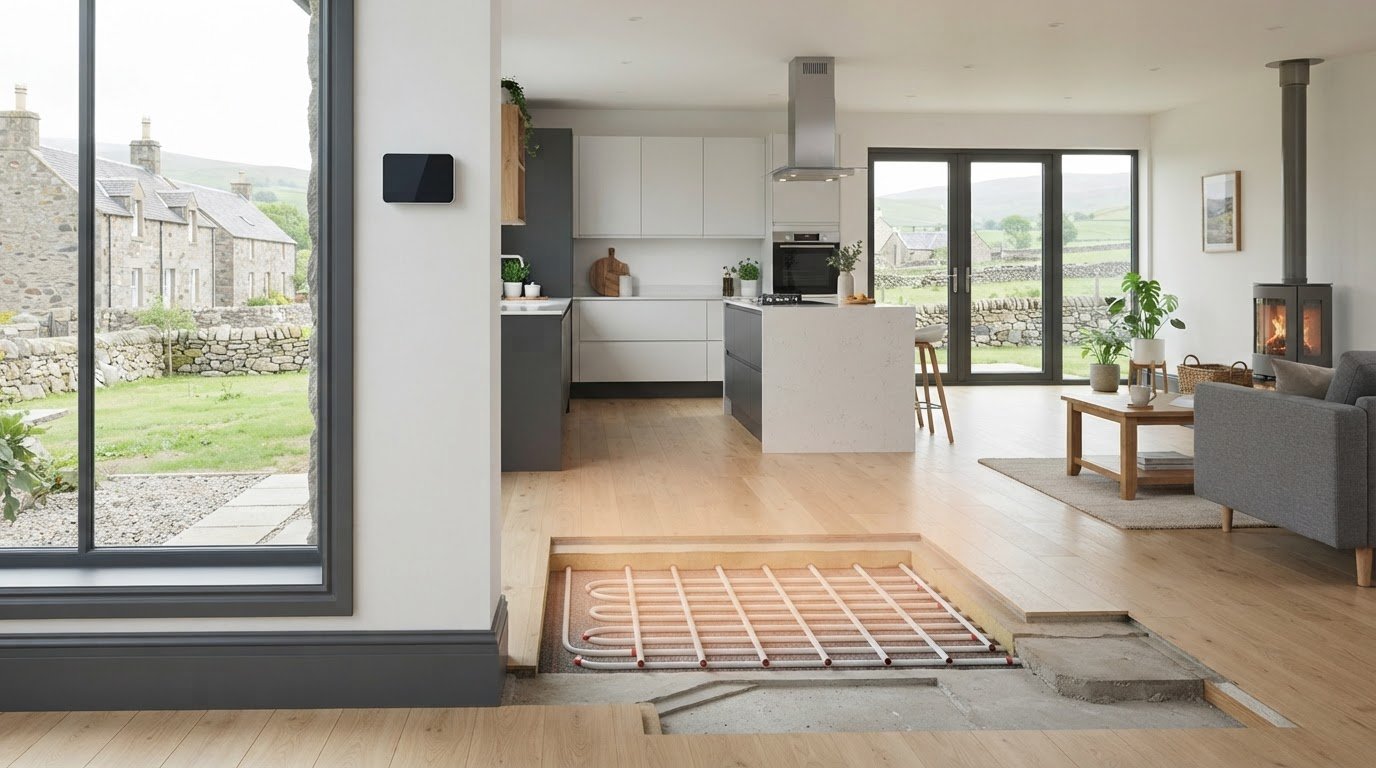
Underfloor heating uses either pipes carrying heated water or electric heating elements beneath the floor. The floor surface warms the room, including the people and objects in it. This is often described as radiant warmth. It can feel comfortable, but comfort alone doesn’t show whether the system uses less energy. For a general overview of underfloor heating, including its forms and how it works, see Wikipedia.
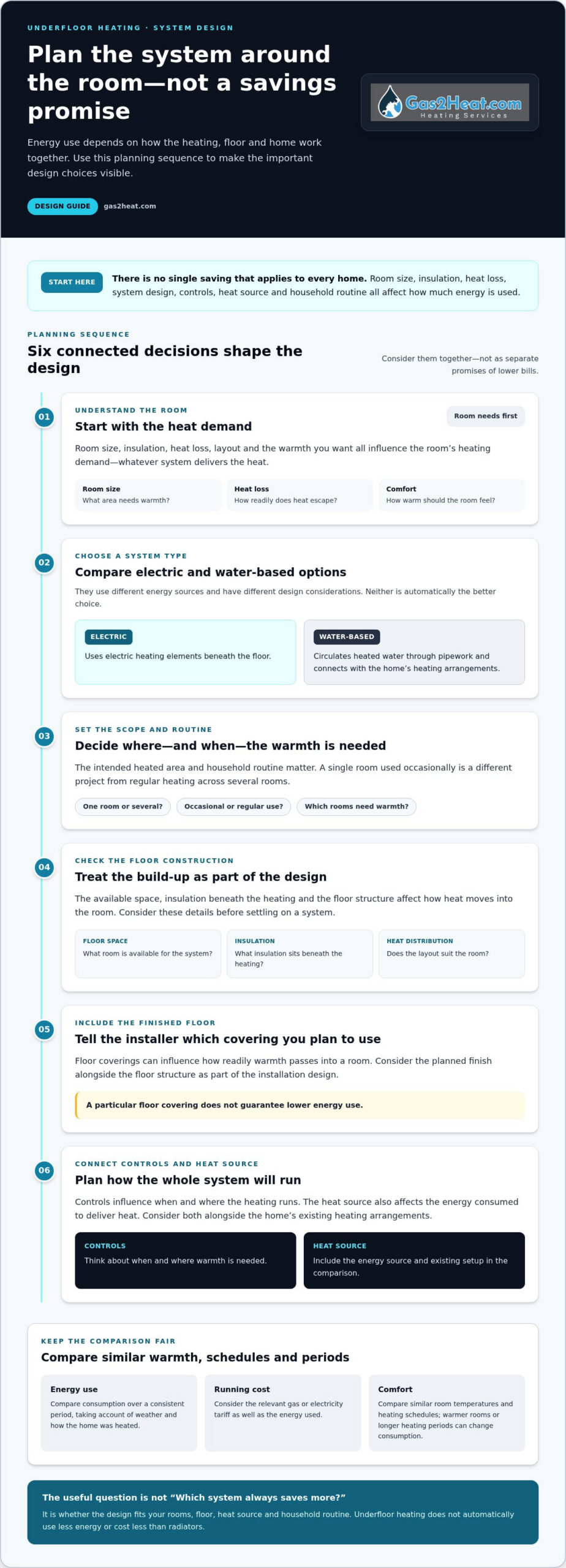
The system still needs to meet the room’s heat demand. Room size, insulation, heat loss, layout and the warmth you want all influence that demand, regardless of where the heat is delivered from.
Why savings differ from home to home
Start with the factors that shape your own heating needs. Insulation affects how readily heat escapes. Room use determines when warmth is needed. System type and design affect how heat is supplied, while controls influence when and where it runs. The heat source also matters because it affects the energy consumed to deliver heat.
Usage patterns are central to a fair comparison. Imagine two similar homes, one heated mainly in the evenings and the other kept warm for longer periods. Even with underfloor heating in both homes, their energy use may differ because the systems serve different routines. Another household’s experience is not a reliable forecast for your own.
- Energy use: Compare consumption over a consistent period, taking account of weather and how the home was heated.
- Running cost: Consider the relevant gas or electricity tariff as well as the energy used.
- Comfort: Compare similar room temperatures and heating schedules. A warmer room or longer heating period can change consumption.
This home-specific view is more useful than assuming underfloor heating will always cost less than radiators. Gas2Heat installs underfloor heating and smart thermostats in Dumfries and Galloway. All engineers are fully qualified, Gas Safe registered and hold up-to-date certifications.
How Underfloor Heating Energy Use Depends on System Design
The heating system beneath the floor is only one part of the design. Energy use also depends on which rooms it serves, how the floor is built, what sits above it and how the system connects with the home’s existing heating arrangements. A design that suits one room may not suit a whole-home project.
System type, heated area, floor build-up, insulation, covering and controls all influence underfloor heating energy use. Consider these factors together rather than relying on a general claim that one type of system is always cheaper or more efficient. The Energy Saving Trust’s guidance on underfloor heating also provides useful context on how system design relates to energy use.
Electric and water systems: different energy considerations
Electric underfloor heating uses heating elements beneath the floor. A water-based system circulates heated water through pipework and connects with the home’s heating arrangements, where experienced professionals such as All Types Plumbing, Heating & Air Conditioning LLC emphasize the importance of proper pipe installation and system integration. These systems use different energy sources and involve different design considerations. Compare them against the needs of your project instead of assuming one is automatically the better choice.
For example, a homeowner planning to heat one room during a renovation has a different project from someone considering underfloor heating across several rooms. The intended routine matters too. Occasional warmth in one space is not the same requirement as regular heating throughout the home. Consider the area to be heated, the heat source and how you expect to use the system. For electric setups requiring dedicated circuit wiring or panel assessments, regional specialists such as essexhomeelectricians.co.uk provide professional domestic electrical support.
Floor build-up, insulation, and heat distribution
Before choosing a system, consider the floor construction. The available space, insulation beneath the heating and the finished floor covering are all part of the design. These details affect how heat moves into the room, so factor them in before settling on a system rather than treating them as finishing details.
Floor coverings can influence how readily warmth passes into a room. Tell the installer what finish you plan to use so it can be considered as part of the design. No particular covering guarantees lower energy use. The floor structure and planned finish need to be considered together in the installation plan.
Good heat distribution supports consistent comfort across a space. If the system layout doesn’t suit the room, some areas may feel different from others. The aim is a system designed around the room’s needs, not a promise of a particular bill reduction.
Gas2Heat installs underfloor heating across Dumfries and Galloway and installs smart thermostats for precise temperature control. For advice on planning a system around your home, contact Gas2Heat about underfloor heating installation on 0800 009 6774 or at info@gas2heat.co.uk. All engineers are fully qualified, Gas Safe registered and hold up-to-date certifications.
Is Underfloor Heating More Energy-Efficient Than Radiators?
Neither underfloor heating nor radiators guarantee lower energy use in every home. The outcome depends on the property, heating design, heat source and how you use each room. Underfloor heating distributes warmth across the floor, while radiators release heat from individual points. This changes how warmth is delivered, but it doesn’t by itself show which setup will use less energy.
Keep three things separate: how comfortable a room feels, how much energy the system consumes, and what that energy costs on your tariff. A lower thermostat setting isn’t proof of savings. If the room is heated for longer, or the system has to work harder to meet its heat demand, consumption may not fall. The U.S. Department of Energy home heating guide offers broader information about heating choices, but a useful comparison still needs to reflect your home and routine.
Heat delivery: Underfloor heating spreads warmth across the floor; radiators release heat from their position in the room. The feel of that warmth can differ, so compare comfort as well as energy use.
Controls: Both arrangements can be controlled, but the settings available and how they’re used depend on the system. Suitable zoning can help avoid heating rooms unnecessarily.
Heat source: The boiler or other heat source is separate from the heat emitter. A difference between radiators and underfloor heating may reflect the source or overall setup, not just the emitter.
Household routine: Heating schedules, room use and comfort expectations affect consumption. A household that heats rooms for longer isn’t directly comparable with one that uses them intermittently.
What makes a fair radiator comparison?
Compare rooms with similar uses and heat demand, and aim for similar comfort expectations and heating schedules. Account for weather too, since a colder period can increase demand. Look at energy consumption over comparable periods, then consider the tariff when assessing bills. Keep the heat source in view: replacing radiators with underfloor heating doesn’t automatically mean the boiler or other equipment has changed.
Anecdotes can mislead. One home may heat a living room throughout the evening, while another warms it only briefly. Even if the rooms seem similar, different schedules make a direct comparison unreliable. For a sensible view of potential underfloor heating energy savings, compare like with like and note any changes in how the rooms are used.
When underfloor heating may suit a home’s needs
Room use and project timing can help shape the decision. Underfloor heating may suit a room that’s being renovated or a wider project, but suitability depends on the individual property and its floor construction. Avoid assumptions based on location alone. The layout, insulation, existing heating arrangements and household routine matter more than a regional generalisation.
Zoning may allow different areas to be controlled separately, helping you avoid heating rooms you don’t need. Its value depends on thoughtful system design and how you use the controls. Gas2Heat installs underfloor heating and smart thermostats across Dumfries and Galloway. All engineers are fully qualified, Gas Safe registered and hold up-to-date certifications.
Practical Ways to Manage Underfloor Heating Energy Use
A steady routine makes it easier to understand how your system is performing. Rather than changing several settings at once, follow a simple sequence: learn the controls, set heating times around room use, manage zones where available, then review comfort and energy use. This gives you a clearer basis for decisions about underfloor heating energy savings without promising a particular result.
- Understand the system. Read the guidance for your installation and learn how its controls work. Systems can respond differently to adjustments, so follow the instructions for your setup.
- Set a routine. Match heating periods to when rooms are normally used. If household patterns change, consider that before adjusting the schedule.
- Control zones thoughtfully. If your system has separate zones, use them in line with how each area is used. Avoid heating a room unnecessarily while keeping comfort needs in mind.
- Review comfort and energy use. Observe how rooms feel and track energy use consistently before changing your routine. This makes it easier to judge whether an adjustment is helping.
Use controls and heating schedules deliberately
A clear schedule can align heating with the times rooms are occupied, rather than relying on frequent manual changes. Set controls according to the system guidance and your household’s comfort needs. There isn’t one temperature or timetable that suits every property. Smart thermostats are another option for precise temperature control. Gas2Heat installs smart thermostats to support considered heating routines, without promising a set level of energy saving.
Where zones are available, consider each room’s purpose and typical use. A rarely used room may not need the same schedule as a living space, but follow the system instructions when adjusting settings. If your routine changes, update the schedule deliberately instead of making repeated, untracked tweaks.
Review comfort and energy use over time
Keep a simple record of which rooms are comfortable, when the heating runs and how energy use changes. Compare periods with broadly similar routines and conditions. A colder spell or more time spent at home can affect demand, so note those changes instead of attributing every difference to a thermostat adjustment.
Changing several settings at once makes the result harder to interpret. Adjust one aspect at a time, then observe how the room feels and what happens to energy use. If the system isn’t providing the expected comfort, avoid repeatedly raising or lowering settings without understanding the cause. Professional advice can help identify whether the controls, system design or wider heating setup needs attention.
Heating performance also depends on factors beyond the floor system. Insulation, the heat source and how rooms are used all shape the outcome. For a broader view of these whole-home considerations, explore our heating efficiency guide.
For advice on underfloor heating or smart thermostat installation in Dumfries and Galloway, contact Gas2Heat on 0800 009 6774 or email info@gas2heat.co.uk. All engineers are fully qualified, Gas Safe registered and hold up-to-date certifications.
Plan Underfloor Heating Energy Savings with a Local Specialist
A useful installation discussion starts with your home, not a promised saving. The goal is to understand what the system needs to do, how it will fit the property and how you expect to use it. This helps you make a considered choice about underfloor heating energy savings, while recognising that actual energy use depends on the final design and household routine.
What a home-specific discussion should cover
Before installation, bring together the details that shape your heating needs. Which rooms need warmth, and when are they usually occupied? What heating arrangements are already in place? These answers help establish the project scope and provide context for discussing the system and its controls.
- Room use and comfort: Identify how each space is used and what level of warmth feels comfortable to your household.
- Existing heating: Consider the current heat source and how underfloor heating would fit with the home’s wider arrangements.
- Property and floor design: Discuss the floor construction, insulation and planned floor covering as parts of the system design.
- Controls and routine: Talk through how heating times and temperature control could reflect the way you use different rooms.
These details provide a more realistic basis for considering energy use than a general estimate or a comparison with another home. A carefully planned system can be matched to the property, but it can’t guarantee a particular reduction in consumption or bills. The result depends on the design, heat source, home’s heat demand and how the system is operated.
If you’re planning a project, our underfloor heating installation guide explains installation considerations in more detail. It can help you understand the practical steps alongside the energy questions covered here.
Underfloor heating installation across Dumfries and Galloway
Gas2Heat provides underfloor heating installation across Dumfries and Galloway. Based in Moffat, the team serves homes in Moffat, Dumfries, Lockerbie, Annan, Lochmaben, Thornhill, Gretna and Castle Douglas. Local installation advice can connect the principles of system design and temperature control to the needs of your property.
All Gas2Heat engineers are fully qualified, Gas Safe registered and hold up-to-date certifications. That professional grounding supports a clear, considered approach to heating work, without suggesting that every system delivers the same result in every home.
For work that takes four hours or more, Gas2Heat provides a free written estimate with no obligation to proceed. The initial call-out fee is £85 and includes travel, fuel and up to one hour of on-site labour. Any work beyond that hour is quoted separately. Additional time is £20 per 15-minute block. Prices quoted are for a single engineer; multiply them by the number of engineers if more are required. Outside normal working hours, call-outs are charged at 1.5 times the normal rate Monday to Friday and 2 times the normal rate on Saturday and Sunday.
Ready to discuss underfloor heating installation for your home in Dumfries and Galloway? Contact Gas2Heat on 0800 009 6774 or email info@gas2heat.co.uk to talk through your property, heating needs and next steps.
Take the Next Step Towards a Better-Fitted Heating System
Make your next step a home-specific conversation, not a decision based on a headline saving. Consider which rooms you want to heat, how you use them and what you want from your heating controls. With those priorities clear, it’s easier to discuss a system that fits your home and routine. Potential underfloor heating energy savings should be assessed in that context, rather than assumed in advance.
Gas2Heat provides underfloor heating and smart thermostat installation across Dumfries and Galloway. All engineers are fully qualified, Gas Safe registered and hold up-to-date certifications. Precise temperature control can support a considered heating routine, while results depend on your property, system design and how you use it.
Ready to discuss your project? Contact Gas2Heat about underfloor heating installation on 0800 009 6774 or email info@gas2heat.co.uk. Free written estimates are available for jobs of four hours or more, with no obligation to use the service.
A clear conversation is a practical place to start. You can move forward with a better understanding of what may suit your home.
Frequently Asked Questions
Does underfloor heating reduce energy bills?
It can support efficient heating in suitable circumstances, but lower bills aren’t guaranteed. Underfloor heating energy savings depend on the home’s heat demand, system design, controls, heat source and household routine. Your tariff also affects what you pay for the energy used. For a practical assessment, compare your current energy use and comfort with the proposed setup, rather than relying on a universal saving claim or someone else’s bill.
Is electric underfloor heating expensive to run?
There’s no single running-cost answer for every electric system. Energy use depends on the system design, how much floor area is heated, how often it runs and how its controls are used. Your electricity tariff affects the bill too. Keep running costs separate from installation considerations: compare options based on the rooms and heating pattern in your project, rather than assuming electric heating is always more expensive than a water-based system.
Can underfloor heating work with an existing boiler?
It may work with an existing boiler, but compatibility depends on the boiler, the rest of the home’s heating arrangements and the proposed system design. Don’t assume every boiler can serve every underfloor heating setup without adjustment. An assessment of the property can establish how the components should work together and whether changes are needed. This is useful if you’re retaining a boiler while renovating or updating only part of the heating system.
Does flooring affect underfloor heating energy use?
Yes. The floor structure, insulation and chosen covering can all influence how heat passes from the system into the room. Consider their suitability together during design, rather than treating the floor finish as a last-minute choice. There isn’t a guaranteed saving associated with a particular covering. Discuss the planned floor build-up and your comfort needs as part of the design, so the installation is appropriate for your property.
Can underfloor heating be controlled room by room?
Room-by-room control depends on the system design and the controls installed. Zoning can help you manage heating to suit how different rooms are used, but it doesn’t guarantee lower bills. Think about which spaces are occupied at different times and whether separate control would suit your routine. Gas2Heat installs smart thermostats for precise temperature control, helping homeowners manage heating settings with their household’s needs in mind.
Is underfloor heating suitable for older homes in Scotland?
An older home isn’t automatically unsuitable, but age alone can’t determine whether underfloor heating is right. The floor construction, insulation, existing heating arrangements, renovation plans and rooms to be heated all matter. Scottish homes vary, so avoid assuming one answer fits every property. A home-specific discussion with Gas2Heat can help assess the options for properties across Dumfries and Galloway. All Gas2Heat engineers are fully qualified, Gas Safe registered and hold up-to-date certifications.
How can I tell whether my underfloor heating is using energy efficiently?
Review energy use alongside room comfort and heating schedules over consistent periods. Note changes in weather or occupancy, since a colder spell or more time at home can affect consumption. Avoid changing several controls at once, as that makes comparisons harder to interpret. There’s no universal benchmark that proves a system is efficient. If comfort remains poor or energy use seems unexpected, have the system and its controls assessed by a qualified professional.
