

Underfloor Heating Running Costs vs Radiators: 2026 UK Comparison Guide
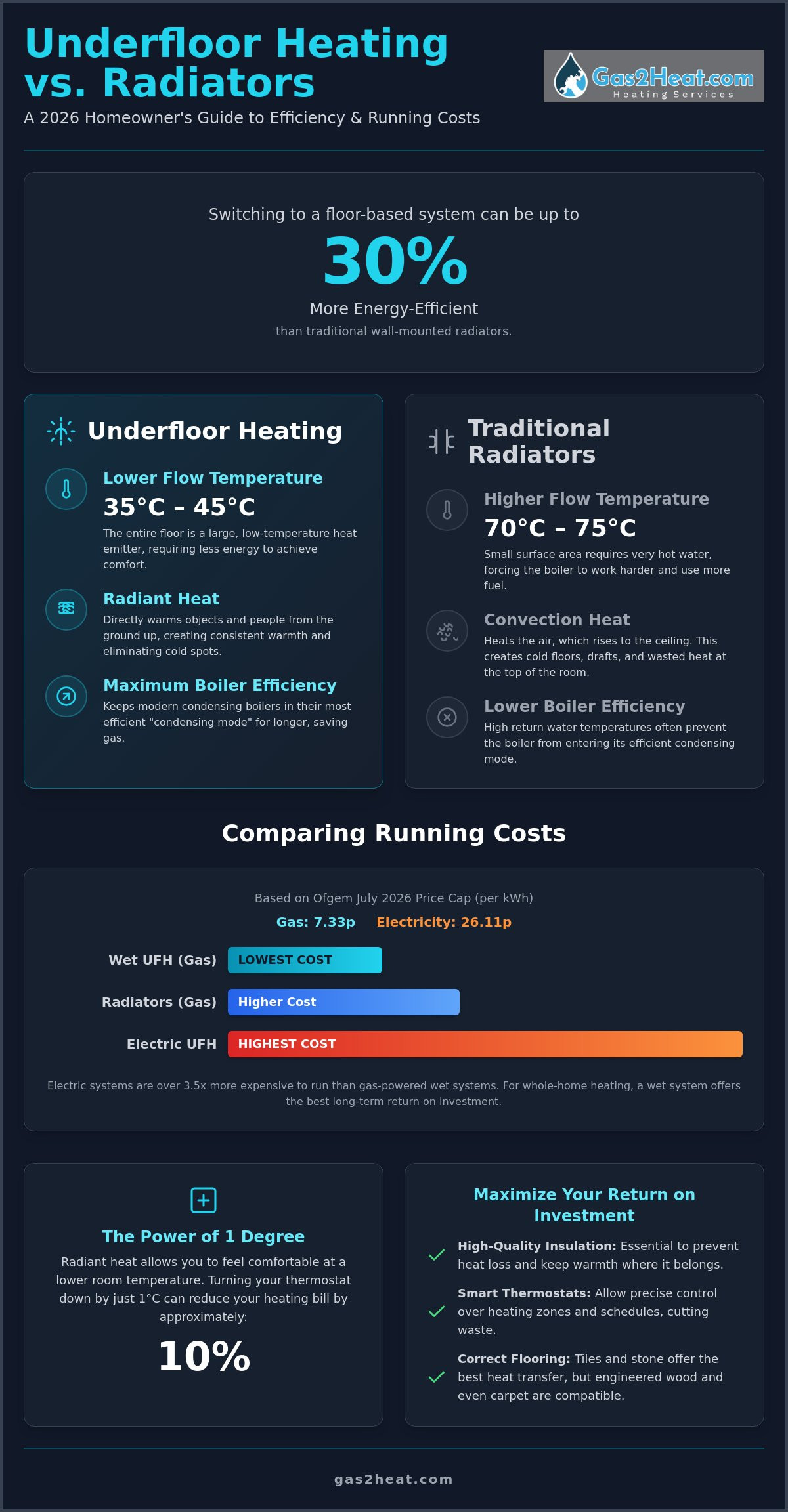
Did you know that switching to a floor-based system can make your home up to 30% more energy-efficient than using traditional wall-mounted units? It’s a common misconception that luxury heating always comes with a luxury price tag. When you look at underfloor heating running costs vs radiators, the reality of modern energy prices might surprise you. With the July 2026 Ofgem price cap setting gas at 7.33p per kWh and electricity at 26.11p per kWh, choosing the right distribution method is more critical than ever for your monthly budget.
We know how frustrating it is to deal with high energy bills during a freezing Scottish winter, especially when large rooms with high ceilings still have uncomfortable cold spots. This guide promises to clear up the confusion by showing you exactly how much you can save through better efficiency and lower flow temperatures. You’ll get a clear comparison of wet versus electric systems and see how these choices impact your long-term financial goals under the new Future Homes Standard. It’s time to stop guessing about your utility costs and start making informed decisions for a warmer, more affordable home.
Key Takeaways
- Discover how operating at lower flow temperatures of 35-45°C allows your boiler to run more efficiently than with traditional radiators.
- Get a direct comparison of underfloor heating running costs vs radiators to see how radiant heat can lower your monthly energy expenditure.
- Learn why high-quality insulation and smart thermostats are essential to prevent heat loss and maximize your return on investment.
- Understand the specific technical requirements for retrofitting systems in older properties throughout Moffat and Dumfries.
- Identify the key differences between radiant and convection heat to eliminate cold spots in large rooms with high ceilings.
Is Underfloor Heating Cheaper to Run Than Radiators?
The short answer is yes. In most cases, a professionally installed wet system is significantly cheaper to operate than traditional wall-mounted units. The primary reason lies in how these systems distribute warmth. Radiators rely on convection, which heats the air and causes it to rise to the ceiling. This often leaves you with cold feet and warm air trapped where you can’t feel it. Underfloor heating uses radiant heat, warming the floor surface and the objects in the room directly. This fundamental shift in underfloor heating technology creates a more consistent temperature profile from floor to ceiling.
Efficiency has become the top priority for UK homeowners in 2026. With gas prices currently capped at 7.33p per kWh, maximizing the output of every unit of energy is essential. Wet systems, also known as hydronic systems, are the gold standard for achieving these savings. They allow your boiler to operate in its most efficient state by using much lower water temperatures. This means you get the same level of comfort while consuming less fuel, which is a major factor when analyzing underfloor heating running costs vs radiators.
To explore how modern air conditioning can provide year-round efficiency alongside your heating system, read more about the solutions available from Engico Air Conditioning.
The Radiant Heat Advantage
Radiant heat is naturally more efficient because it doesn’t waste energy heating the air that simply drifts away. Because the heat is distributed evenly across the entire floor, you’ll find that you feel comfortable at a lower ambient temperature. Most users find they can turn their thermostat down by 1 or 2 degrees without noticing a difference in warmth. According to industry data, reducing your thermostat by just 1°C can lower your heating costs by approximately 10%. You also lose less heat through windows and ceilings because there isn’t a pocket of super-heated air gathered at the top of the room. For those interested in how specialized radiant panels can complement this efficiency, learn more about these advanced heating options.
Wet vs. Electric: The Running Cost Divide
It’s vital to distinguish between wet and electric systems before you commit. Electric underfloor heating is often cheaper to install but significantly more expensive to run. With electricity rates at 26.11p per kWh, using it as a primary heat source can lead to staggering monthly bills. We recommend wet systems for homeowners seeking a long-term return on investment. If you are considering underfloor heating installation in Moffat or Dumfries, a water-based system is the logical partner for your gas boiler. It provides the heavy-duty performance needed for our regional climate while keeping your energy expenditure under control.
The Science of Efficiency: Flow Temperatures and Condensing Boilers
To understand why underfloor heating running costs vs radiators favor the former, we have to look at flow temperature. This is simply the temperature at which water leaves your boiler to heat your home. Traditional radiators are relatively small. To heat a room effectively, they must be very hot, usually between 70°C and 75°C. Underfloor heating covers a massive surface area. Because the entire floor acts as a heat emitter, the water only needs to reach 35°C to 45°C to achieve the same comfort levels. This lower demand changes everything for your boiler’s performance.
This lower temperature is the key to significant gas savings. Modern boilers are designed to be “condensing” units. They reach peak efficiency when the water returning to the boiler is cool enough to allow water vapor to condense. According to the Energy Saving Trust’s analysis, this process recovers latent heat that would otherwise vanish up the flue. Because underfloor systems use lower flow temperatures, your boiler stays in this high-efficiency condensing mode for much longer than it would with radiators. You’re essentially getting more heat out of every unit of gas you pay for.
Why 45°C is the Magic Number
The physics are straightforward. A radiator is a high-intensity heat source in a small corner. The floor is a low-intensity heat source that spans the entire room. Your boiler doesn’t have to work nearly as hard to maintain 45°C as it does to hit 75°C. This reduced workload significantly lowers the stress on internal components. You aren’t just saving on your monthly gas bill. You’re likely extending the overall lifespan of your boiler by avoiding the constant “firing and forcing” required for high-temperature radiator cycles.
The Role of Modern Condensing Technology
You won’t see these efficiency gains with an old, non-condensing boiler. To truly maximize your ROI, your system needs careful calibration. Our Gas Safe registered engineers focus on balancing the flow to ensure your boiler operates at its absolute limit of efficiency. Regular maintenance is vital here. Scheduling expert boiler servicing ensures your settings are optimized for the lower demands of floor-based heating. If your current setup feels sluggish, a professional system check can often unlock hidden savings and ensure your home stays warm throughout the winter.
Monthly Running Costs: Wet Underfloor Heating vs Traditional Radiators
For a typical 3-bedroom semi-detached home in South West Scotland, the monthly bill is the ultimate test of any heating system. Many homeowners worry that because underfloor heating takes longer to warm up, it must be more expensive. This is a common myth. While radiators provide a quick blast of heat, they also lose that heat almost immediately once the boiler turns off. When evaluating underfloor heating running costs vs radiators, you’ve to look at the total energy consumed over a 24-hour cycle, not just the initial warm-up period.
Research confirms that wet underfloor heating can be up to 25-30% more energy-efficient than radiators. In a Scottish winter, your boiler often works in short, aggressive bursts to satisfy the high temperature demand of a radiator system. Underfloor systems operate at a steady, low-intensity pace. This consistency prevents the sharp peaks in energy usage that drive up your gas consumption. Because the system is more efficient, you spend less money to achieve the same level of comfort.
Heat Retention and Thermal Mass
Wet systems are usually embedded in a layer of floor screed. This material acts as a massive thermal store. Once the water has heated the screed, it stays warm for hours. It’s essentially like having a giant storage heater under your feet. Radiators are made of thin metal and cool down within minutes of the pump stopping. In the damp, consistent cold of Moffat or Dumfries, this thermal mass means your home stays at a comfortable baseline temperature with far less intervention from the boiler. You don’t need to keep the system “always on” to feel the benefits.
Zone Control and Efficiency
Precision is another area where floor-based systems outperform traditional setups. A central manifold allows you to set different temperatures for every room in the house. If you aren’t using the guest bedroom or a home office, you don’t have to heat it. Traditional radiators use Thermostatic Radiator Valves (TRVs), but these are often inaccurate and blocked by furniture or curtains. Modern thermostats for floor systems are digital and highly precise. By only heating the spaces you actually use, you significantly reduce waste and keep your monthly expenditure as low as possible.
Maximizing ROI: Flooring, Insulation, and Smart Controls
A high-efficiency boiler is only one part of the equation. To truly win the battle of underfloor heating running costs vs radiators, you must look at how your home retains and transfers that heat. If your property is poorly insulated, your system will struggle to reach the desired temperature, leading to higher gas consumption and unnecessary wear on your components. Achieving a high return on investment requires a holistic approach that starts from the ground up.
Think of your floor as a massive radiator. In a traditional setup, heat escapes through the back of the metal unit into the wall. With floor-based systems, the risk is “downward heat loss.” Without a robust thermal barrier, you end up paying to heat the earth beneath your home rather than the air inside it. Modern standards in 2026 prioritize high-performance materials that ensure every penny spent on gas translates into actual comfort for your family.
The Foundation: High-Grade Insulation
For any professional installation in Dumfries or Moffat, we recommend a minimum of 50mm of PIR (polyisocyanurate) insulation. This material has an incredibly low thermal conductivity, meaning it acts as a nearly impenetrable shield. It forces the radiant energy upward into the screed and floor finish. We also pay close attention to edge insulation. This is a thin strip of foam placed around the perimeter of the room. It prevents “thermal bridging,” which is where heat bleeds out into the cold external walls of the house. These details are fundamental to improving heating efficiency in Dumfries and Moffat, especially in older stone properties where heat loss is a constant challenge.
Choosing the Right Floor Finish
Your choice of flooring directly impacts how quickly a room warms up and how long it stays that way. Thermal resistance, often measured as an R-value, determines how easily heat passes through a material. Tile and stone are the gold standard. They have high thermal conductivity, allowing the heat to pass through almost instantly. They also act as a heat sink, holding onto warmth long after the boiler has cycled off.
- Tile and Stone: Best performance; lowest thermal resistance.
- Engineered Timber: Good performance; must be kept at specific moisture levels to prevent warping.
- Laminate and Luxury Vinyl Tile (LVT): Very effective; usually requires a specialized low-resistance underlay.
- Carpet: Most restrictive; the combined tog rating of the carpet and underlay should never exceed 2.5.
Thick carpets and heavy felt underlays act as insulators. They trap the heat beneath the floor, forcing the system to run for longer periods to achieve the same room temperature. If you are planning a renovation, selecting “UFH-friendly” finishes is the easiest way to keep your monthly bills low. You can further enhance these savings by upgrading your management system. Our team provides professional smart thermostat installation to give you room-by-room control, ensuring you never waste energy heating an empty space.
Underfloor Heating Installation in Moffat & Dumfries: Is it Right for You?
Deciding between these two systems often comes down to the specific architecture of your home. In South West Scotland, we deal with a unique mix of modern developments and traditional stone properties. When comparing underfloor heating running costs vs radiators in our regional climate, the damp cold of a Moffat winter makes the consistent warmth of a floor-based system highly attractive. However, the decision isn’t always binary. Many local homeowners find success with a hybrid approach, using radiant heat for high-traffic ground floors while keeping radiators in upstairs bedrooms where rapid temperature changes are sometimes preferred.
The final verdict depends on your long-term goals. If you’re looking for the lowest possible monthly bill and a clutter-free interior, a wet underfloor system is the superior choice. If you need a quick, low-cost installation for a single room that you only use occasionally, radiators might still have a place. Our role is to help you navigate these choices with technical honesty and clear data, ensuring your investment matches your lifestyle.
Retrofitting vs. New Build in SW Scotland
One of the biggest hurdles for Moffat homeowners is the perceived difficulty of retrofitting. Traditional stone houses often have limited floor depth, which used to make underfloor systems impractical. Modern “low-profile” systems have changed this. These panels are thin enough to sit on top of existing subfloors without requiring you to dig up the foundation or trim every door in the house. This makes it possible to enjoy the benefits of underfloor heating running costs vs radiators even in a historic property.
It’s also important to consider your heat source. A floor-based system increases the total water volume in your heating circuit. To handle this efficiently, you may need a professional boiler installation that is specifically sized for the increased demand. We ensure your boiler and manifold work in perfect harmony, preventing the “short-cycling” that often plagues poorly designed DIY installs.
Next Steps for Your Home
Every property in Dumfries, Lockerbie, and Annan has different insulation levels and heat loss profiles. We don’t believe in “one size fits all” solutions. A local site survey is the only way to get an accurate assessment of which system will provide the best return on investment for your specific floor plan. During a consultation, we’ll measure your rooms, check your current insulation, and provide a transparent breakdown of the expected performance.
If you’re ready to upgrade your comfort and lower your energy bills, our team is here to help. We specialize in bespoke underfloor heating installation designed for the Scottish climate. We’ll take the stress out of the process with clear timelines and straightforward pricing. Contact Gas2Heat for a bespoke heating quote today.
Future-Proof Your Home’s Heating Efficiency
Choosing the right heating system for your property doesn’t have to be a guessing game. The data surrounding underfloor heating running costs vs radiators shows that lower flow temperatures and radiant heat offer a clear path to long-term savings. By allowing your boiler to operate in its most efficient condensing mode, you significantly reduce gas consumption while eliminating the cold spots common with traditional convection systems. Whether you are retrofitting an older stone property or building a new home, the combination of high-grade insulation and smart controls will maximize your return on investment.
Our team is a local Moffat-based family business and specialists in low-temperature heating systems. We use Gas Safe Registered Engineers to ensure every installation is calibrated for peak performance and reliability. Don’t spend another winter worrying about rising energy prices or drafty rooms. It’s time to secure a solution that works for your budget and your comfort. Get a Professional Underfloor Heating Quote in South West Scotland and start enjoying a more comfortable, cost-effective home today.
Frequently Asked Questions
Is underfloor heating more expensive to run than radiators in a gas-heated home?
No, wet underfloor heating is generally cheaper to run than radiators because it operates at significantly lower water temperatures. This allows your boiler to stay in its most efficient condensing mode for longer periods. When comparing underfloor heating running costs vs radiators, the savings come from the radiant heat distribution, which prevents the energy waste typically seen with convection-based radiators.
How much can I actually save on my heating bills with UFH?
Homeowners often see a reduction of up to 25% in their annual gas consumption after switching to a professionally designed wet system. Because radiant heat warms you directly, you’ll feel comfortable at a lower thermostat setting than you would with radiators. This small adjustment in your daily habits is a primary driver of long-term financial efficiency.
Does underfloor heating take longer to warm a room than radiators?
Yes, underfloor systems have a slower response time because they must heat the entire floor mass before the room temperature rises. While a radiator provides a quick blast of heat, it also cools down rapidly. Using smart controls allows you to schedule the warm-up period in advance, ensuring your home is perfectly comfortable by the time you wake up.
Can I use underfloor heating with my existing combi boiler?
Yes, most modern combi boilers are fully compatible with wet underfloor systems. We use a specialized manifold to manage the water flow and ensure the temperature remains at a safe, efficient level for your flooring. It’s a straightforward integration that our engineers handle during the installation process to ensure your entire heating circuit remains balanced.
What is the best flooring for underfloor heating running costs?
Tile and stone are the superior choices for maximizing your return on investment. These materials have high thermal conductivity, which means they transfer heat from the pipes to the room surface almost instantly. This rapid transfer reduces the amount of time your boiler needs to run to maintain your desired comfort level.
Do I need to leave underfloor heating on all day for it to be efficient?
No, you don’t need to keep the system at full power 24/7. Most efficient systems use a “setback” temperature, where the heat is lowered by a few degrees during the night or when the house is empty. This prevents the floor from cooling completely, which avoids the heavy energy surge required to heat a cold slab from scratch.
Is it worth replacing radiators with underfloor heating in an old house?
It’s a valuable upgrade if you prioritize comfort, but you must address floor insulation first. In older stone properties, heat can escape into the ground if a proper thermal barrier isn’t installed. Using modern low-profile systems allows for retrofitting without major structural changes, making it a viable option for traditional Scottish homes.
How often does an underfloor heating system need servicing?
You should have your system inspected annually to ensure the manifold and pumps are functioning correctly. This check involves verifying the water pressure and checking for any signs of wear in the mechanical components. We recommend scheduling this alongside your annual boiler service to keep your entire heating setup running at peak efficiency.
