
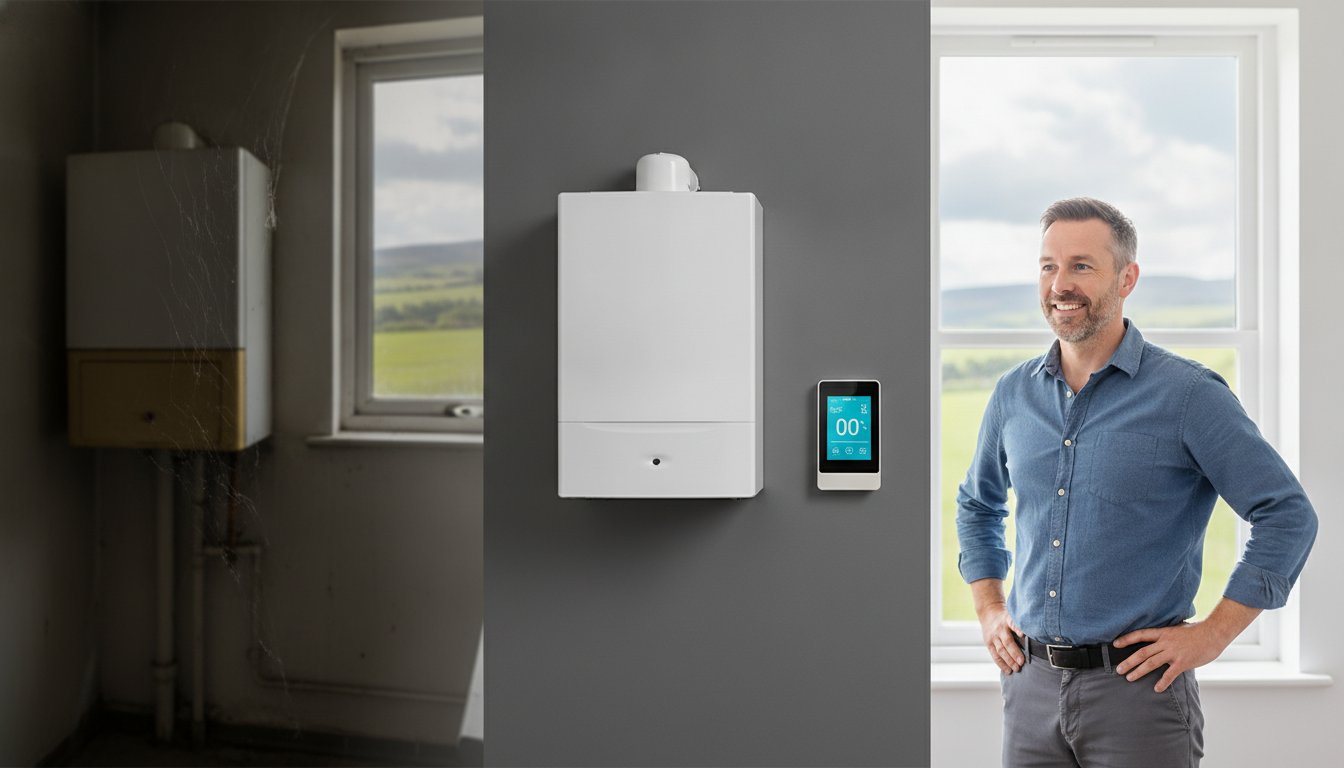
Upgrading an Old G-Rated Boiler: 2026 Guide to Efficiency and ROI
What if that rumbling metal box in your utility cupboard is actually a silent thief, siphoning off 30% of every pound you spend on heating? If you’re still relying on an inefficient unit, upgrading old G-rated boiler systems is no longer just a maintenance task; it’s a financial rescue mission for your household budget. You likely feel the daily frustration of sky-high energy bills and the constant fear of a winter breakdown, especially when replacement parts for obsolete models are becoming nearly impossible to find.
We understand that the uncertainty of home maintenance can be stressful, but reclaiming your comfort doesn’t have to be complicated. This guide reveals how a modern upgrade can slash your energy costs by 30% while providing a safer, more reliable environment for your family. We’ll walk you through the 2026 efficiency standards, explain how to access the £7,500 Boiler Upgrade Scheme grant, and show you how a professional installation increases your property value and provides total peace of mind with a long term warranty.
Key Takeaways
- Identify how obsolete pilot lights and poor efficiency levels in G-rated units waste over 30% of the energy you pay for.
- Discover why upgrading old G-rated boiler systems to modern A-rated condensing technology is the most effective way to lower your monthly bills.
- Evaluate the long-term financial benefits of a new installation by comparing fuel savings against the high cost of emergency winter breakdowns.
- Learn about the critical role of power flushing and heat loss calculations in protecting your investment and ensuring peak performance.
- Access a clear roadmap for a stress-free upgrade with local experts who prioritize transparent pricing and Gas Safe standards in SW Scotland.
What is a G-Rated Boiler and Why is it Costing You Money?
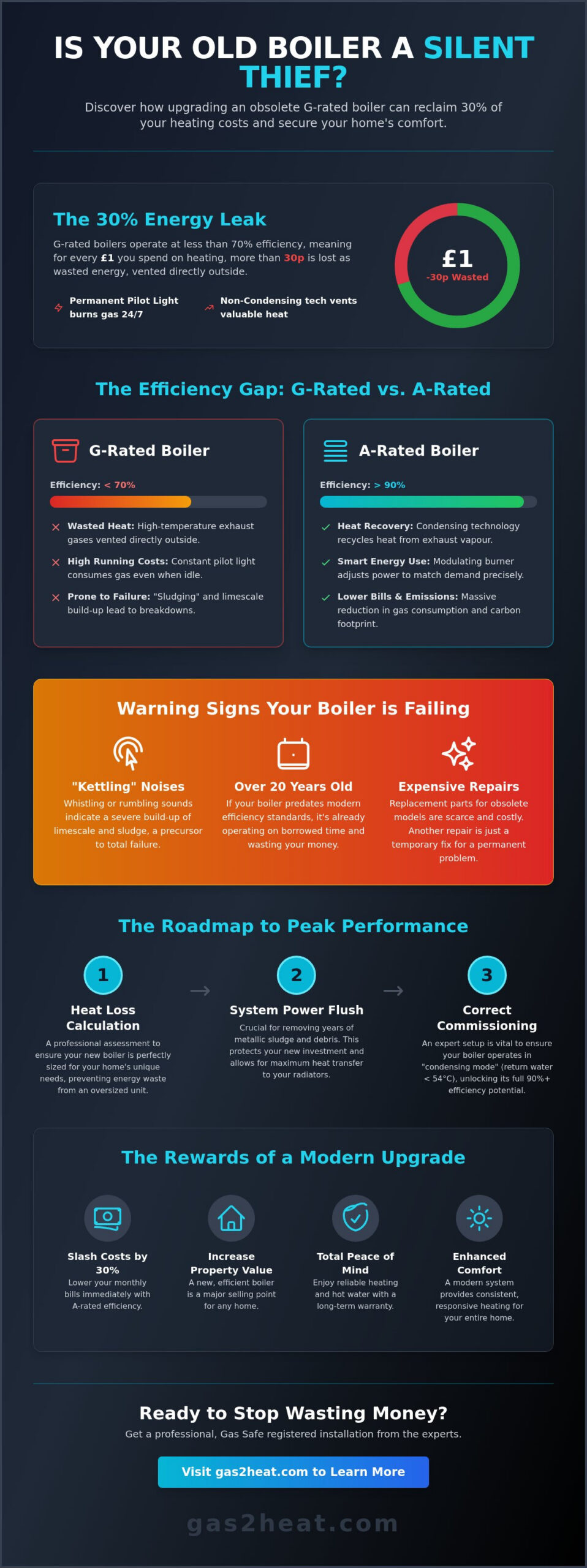
A G-rated boiler is essentially a heating relic from a different era. These units were built when gas was cheap and efficiency was an afterthought. By definition, a G-rating means your appliance operates at an energy efficiency level below 70%. In many cases, older models perform closer to 60%. This means for every unit of energy you pay for, a massive portion never actually reaches your radiators. It stays trapped in the mechanics or escapes through the roof.
The primary culprit behind this waste is the lack of heat recovery technology. Most G-rated units are non-condensing, meaning they vent high-temperature exhaust gases directly outside. They also frequently feature a permanent pilot light. This small, constant flame burns gas 24 hours a day, 365 days a year. It consumes fuel even when your heating is off and you’re fast asleep. Over a year, this adds up to a significant, invisible expense on your monthly bill.
Identifying these units is usually straightforward. If your boiler is over 20 years old, has a floor-standing design, or features a visible pilot light window, it’s likely G-rated. Common models like the Baxi Solo or early Worcester Bosch ranges fall into this category. Beyond the design, the internal components have likely taken a physical toll. Decades of operation lead to “sludging,” where metallic debris settles in the heat exchanger. This creates a thick barrier that forces the burner to run longer and hotter just to achieve basic warmth. Upgrading old G-rated boiler systems is often the only way to stop this cycle of inefficiency.
The 30% Energy Leak: Where Your Money Goes
Think of your heating budget as a bucket with a hole in the bottom. For every £1 you spend, roughly 30p is literally vented out of the flue. A G-rated boiler is a non-condensing unit that loses significant heat through exhaust gases. Unlike modern condensing boilers that recycle waste heat, old units use an “open flue” system. This draws air from the room and sends heated air straight outside. It creates a drafty, inefficient cycle that keeps your home colder for longer.
Signs Your Old Boiler is Approaching Total Failure
Listen to your system. If you hear “kettling” noises, which sound like a whistling tea kettle, your heat exchanger is likely choked with limescale and sludge. This is a frequent precursor to a cracked internal component. You’ll also find that sourcing parts for models like the Baxi Solo is becoming increasingly difficult and expensive. Don’t fall for the sunk-cost fallacy. Investing in “just one more repair” for a machine that is fundamentally broken is a temporary fix for a permanent problem.
The Efficiency Gap: How Modern A-Rated Technology Saves You 30%
The gap between a 60% efficient G-rated unit and a modern A-rated system is vast. While your old boiler vents waste heat directly into the atmosphere, a modern high-efficiency heating system uses condensing technology to squeeze every drop of value from your gas. It does this by capturing latent heat from water vapour within the exhaust gases. By the time the air leaves your flue, it’s significantly cooler because that energy has already been transferred into your home’s water.
A secondary heat exchanger is the component that makes this possible. It provides more surface area for the exhaust gases to cool down, boosting efficiency to 90% or higher. Modern units also feature modulating burners. Think of this like a dimmer switch rather than a standard on/off toggle. Instead of firing at 100% capacity every time you need a little warmth, the boiler “throttles down” to meet the exact demand. This reduces wear and tear while preventing the energy spikes common with older models.
However, simply buying an A-rated unit doesn’t guarantee these results. This is the “A-Rated Myth.” A boiler only reaches its peak efficiency when it’s in “condensing mode.” This requires the water returning from your radiators to be cool enough, typically below 54°C. If your system is set up incorrectly, you’re essentially paying for technology you aren’t using. If you’re considering upgrading old G-rated boiler units, you need an installer like Gas2Heat.com Ltd who understands these technical nuances.
Condensing vs. Non-Condensing: A Technical Comparison
You can often spot a modern unit from the street. That white “plume” of steam coming from the flue is a sign the boiler is working correctly. It’s water vapour that has been cooled enough to condense, releasing its heat into your system. This process creates waste water, which is safely managed by a dedicated condensate pipe. Because these units are so much more efficient, they don’t need the massive cast-iron bodies of the past. They’re significantly smaller, lighter, and run with a quiet hum rather than the clattering of an old G-rated model.
The Importance of Correct Commissioning
Many installers fit a boiler and leave it on factory settings. In 2026, high-performance heating requires more. We use “Weather Compensation” and “Load Compensation” to ensure your unit reacts to the temperature outside. This prevents the boiler from running hotter than necessary. At Gas2Heat.com Ltd, we ensure your new unit actually hits its laboratory-rated efficiency through precise commissioning. We don’t just swap boxes; we optimize the entire system for your specific property.
Calculating the ROI: When Upgrading Your Boiler Pays for Itself
Investing in your home’s infrastructure is a strategic financial decision. When you’re upgrading old G-rated boiler systems, the return on investment starts the moment the new unit fires up. Based on 2026 energy price caps, the efficiency jump from 60% to over 90% translates into immediate, tangible savings. You’re no longer paying for gas that disappears out of a flue; you’re paying for heat that stays in your rooms. For most homeowners, the fuel savings alone can reach up to £500 per year.
Beyond the monthly bills, you must consider the “Emergency Premium.” In rural areas like Dumfries & Galloway, a winter breakdown is more than an inconvenience. It often involves high call-out fees, premium rates for rare parts, and the stress of finding an available engineer during a cold snap. A new installation eliminates this risk. Most modern units come with a 10-year manufacturer guarantee. This essentially fixes your repair costs at zero for a full decade, providing a level of financial predictability that an old G-rated unit simply cannot offer.
Property value is another critical factor for Scottish homeowners. A higher Energy Performance Certificate (EPC) rating is a major selling point in the current market. Modern ENERGY STAR certified boilers are recognized benchmarks for efficiency. Improving your EPC from a D or E to a B or C doesn’t just make your home more attractive to buyers; it protects your equity as domestic energy standards become stricter.
Average Annual Savings in SW Scotland
The regional climate in Moffat and Dumfries makes efficiency even more vital. Our longer, colder winters mean your boiler works harder for more months of the year. For a detached home, the savings are often more pronounced than in smaller semi-detached properties due to the higher heat demand. You can explore a detailed breakdown of potential fuel savings with a new boiler to see how these figures apply to your specific house type.
The Hidden Costs of Keeping a G-Rated Unit
Old boilers suffer from an “Inefficiency Spiral.” As components age and scale builds up, they work harder to produce less heat, which accelerates wear and tear. This leads to higher insurance premiums, as many providers view older, high-risk heating systems as a liability. Additionally, with the ongoing shift toward greener domestic heating and potential carbon-related adjustments in the future, maintaining an obsolete, high-emission unit will only become more expensive. Upgrading now allows you to bypass these rising costs while enjoying a warmer, more reliable home. For readers who also manage business properties, Green Compare provides a specialized comparison service for commercial utility procurement and finance solutions to help further reduce overheads.
If you’re interested in taking your home’s energy independence even further, check out MarGav Solar to explore how renewable solar energy can work alongside your high-efficiency heating system.
The Upgrade Roadmap: Preparing Your Home for a High-Efficiency System
Upgrading old G-rated boiler systems is a technical process that extends far beyond simply swapping one metal box for another. To achieve the 30% efficiency gains discussed earlier, your home must be prepared to handle modern, high-pressure technology. We follow a strict five-step roadmap to ensure your new system performs at its peak from day one. This begins with a professional heat loss calculation. We determine the exact kilowatt requirement for your property, preventing the common mistake of installing an oversized boiler that wastes energy by short-cycling.
Selecting the right boiler type is the next critical decision. While Combi units are excellent for saving space in smaller homes, larger properties in Moffat or Dumfries with multiple bathrooms often benefit from a System boiler. This ensures you have a consistent flow of hot water even when multiple taps are running. Once the hardware is chosen, the focus shifts to the health of your entire heating circuit. Modern boilers have narrow internal waterways that are easily blocked by the metallic debris found in older systems. If you’re ready to secure your home’s comfort, book your professional boiler installation assessment today.
Why Power Flushing is Non-Negotiable
You wouldn’t put a brand-new engine into a car filled with dirty oil. The same logic applies to your heating. Decades of sludge and magnetite from old radiators can ruin a new A-rated heat exchanger in just a few weeks. We perform a comprehensive Gas2Heat.com Ltd guide on power flushing to clear the system of these contaminants. To maintain this clarity, we also install magnetic system filters. These act as a continuous cleaning service, trapping metallic particles before they can enter your boiler.
Smart Controls: The Efficiency Multiplier
Modern technology like Tado, Nest, or Hive acts as the brain of your heating system. These devices can add another 3-5% to your efficiency gains by learning your schedule and reacting to the weather outside. Zoning your home is equally vital; there’s no reason to heat a guest room or a home office all day when they aren’t in use. Implementing a smart thermostat installation is the final piece of the ROI puzzle, giving you total control via your smartphone.
The roadmap concludes with post-installation balancing and a thorough customer handover. We adjust every radiator valve to ensure heat is distributed evenly across your home, eliminating cold spots. Finally, we walk you through your new controls so you feel confident managing your improved, high-efficiency system.
Expert Boiler Installation in Moffat and SW Scotland: The Gas2Heat.com Ltd Approach
Choosing a partner for upgrading old G-rated boiler systems is a decision that affects your home’s comfort for the next decade. You need more than just a plumber; you need a specialist who understands the unique demands of South West Scotland’s climate. Gas2Heat.com Ltd is a family-run business based in Moffat. We serve Dumfries, Annan, and the wider Borders area with a level of personal care that national call centres simply can’t match. We live in the same communities we serve, meaning we’re nearby when you need us most.
Our commitment to “Efficiency First” sets us apart from standard contractors. While many installers focus on “box-swapping,” Gas2Heat.com Ltd prioritizes the technical commissioning required to hit the efficiency targets we’ve discussed. We don’t just hang the boiler on the wall and leave. We balance your system and configure your controls to ensure you actually achieve the fuel savings your new A-rated unit is capable of delivering. Our transparent pricing ensures you know the total cost upfront, with no hidden complications.
Our Process for G-Rated Upgrades
We begin every project with free local surveys in Dumfries, Annan, and Lockerbie. This allows us to assess your current setup and identify any potential issues with your existing radiators or pipework. We don’t believe in “one size fits all” solutions. Instead, we provide a tailored system design based on your household’s specific usage. Once your new boiler is active, we provide comprehensive aftercare. This includes annual boiler servicing to protect your manufacturer warranty and keep your system running at peak performance year after year.
Ready to Stop Wasting Energy?
You don’t have to tolerate high bills or inconsistent room temperatures any longer. Start saving from day one with a professionally installed system that works exactly as intended. Our team is ready to remove the uncertainty of home maintenance with clear guarantees and straightforward service. Book a survey with a local gas safe engineer in Moffat to secure your home’s warmth. Don’t wait for an expensive winter breakdown to force your hand. Request your boiler installation quote today and take control of your home’s energy efficiency.
Secure Your Home’s Warmth and Efficiency Today
Upgrading old G-rated boiler systems is the single most effective way to protect your household from rising energy costs and the stress of winter breakdowns. By moving to A-rated technology, you reclaim the 30% of energy previously lost to the atmosphere. You also gain the security of a modern system designed for the Scottish climate. Our local Moffat-based family business is here to help you navigate this transition with transparency and technical expertise.
Our Gas Safe Registered engineers focus on efficiency first commissioning to ensure your investment delivers maximum returns. We don’t just swap boxes; we optimize your entire system for longevity. With 10-year warranties available, you can enjoy a decade of predictable heating costs and total reliability. Don’t let an obsolete unit drain your budget or leave you in the cold any longer. Secure your home’s future with a system that pays for itself through lower fuel bills and increased property value.
Get a Fixed Price Quote for Your Boiler Upgrade
Take the first step toward a warmer, more cost-effective home today.
Frequently Asked Questions
Is it worth replacing a G-rated boiler if it is still working?
Yes, replacing a functional G-rated unit is a strategic move to prevent an inevitable winter breakdown. While it may still “work,” it operates at roughly 60% efficiency, meaning 40p of every pound spent on gas is wasted. Upgrading now allows you to schedule the work at your convenience rather than paying premium emergency rates during a cold snap when parts for obsolete models are scarce.
How much can I save per year by upgrading to an A-rated boiler in 2026?
You can save up to £500 per year on your energy bills by switching from a G-rated unit to a modern A-rated model. These figures are based on the 2026 energy price caps and the significant jump in efficiency from 60% to over 90%. Over the typical 10 to 15 year lifespan of a boiler, these annual savings often cover the initial cost of the installation entirely.
What is the main difference between a G-rated and an A-rated boiler?
The primary difference lies in the efficiency rating and the use of condensing technology. A G-rated boiler is a non-condensing unit that vents high-temperature exhaust gases directly outside, losing significant heat. In contrast, an A-rated boiler uses a secondary heat exchanger to capture latent heat from water vapour, recycling energy that would otherwise be wasted. This process increases efficiency from below 70% to well over 90%.
How long does it take to replace an old boiler with a modern condensing unit?
Replacing an old unit with a modern condensing boiler typically takes between one and three days. A standard swap is often completed in a single day, but upgrading old G-rated boiler systems frequently requires additional time for new pipework or installing a condensate drain. We provide a clear timeline before work begins to ensure you can plan around the installation with total peace of mind.
Do I need to change my radiators when upgrading my boiler?
You don’t always need to replace your radiators, but they must be compatible with the higher pressure of a modern system. We perform a professional heat loss calculation to ensure your existing radiators provide enough warmth for each room. Crucially, we always recommend a power flush to remove internal sludge, ensuring that debris from old radiators doesn’t damage your new, high-efficiency heat exchanger.
Will a new boiler increase my home’s EPC rating?
Yes, installing a high-efficiency A-rated boiler is one of the fastest ways to improve your Energy Performance Certificate (EPC) rating. Because the EPC calculation heavily weights the efficiency of your primary heating source, moving from a G-rating to an A-rating can often jump your property up by one or even two full bands. This improvement increases your property’s market appeal and overall value for future buyers.
What is the “A-rated myth” regarding boiler efficiency?
The “A-rated myth” is the belief that a new boiler will automatically hit its maximum laboratory efficiency of 94% regardless of how it’s installed. In reality, a boiler only operates at peak efficiency when it is in “condensing mode.” This requires professional commissioning and specific settings, such as low return water temperatures and weather compensation controls, to ensure the unit actually achieves its theoretical energy-saving potential.
Are there any grants available for upgrading an old boiler in Scotland?
Yes, several funding options exist for Scottish residents looking to improve their home’s efficiency. Home Energy Scotland provides grants and interest-free loans for energy-saving measures, while the ECO4 scheme offers support for low-income households. It is important to note that while the £7,500 Boiler Upgrade Scheme is available in England and Wales, Scotland maintains its own distinct programs to help homeowners move away from inefficient G-rated systems.
