
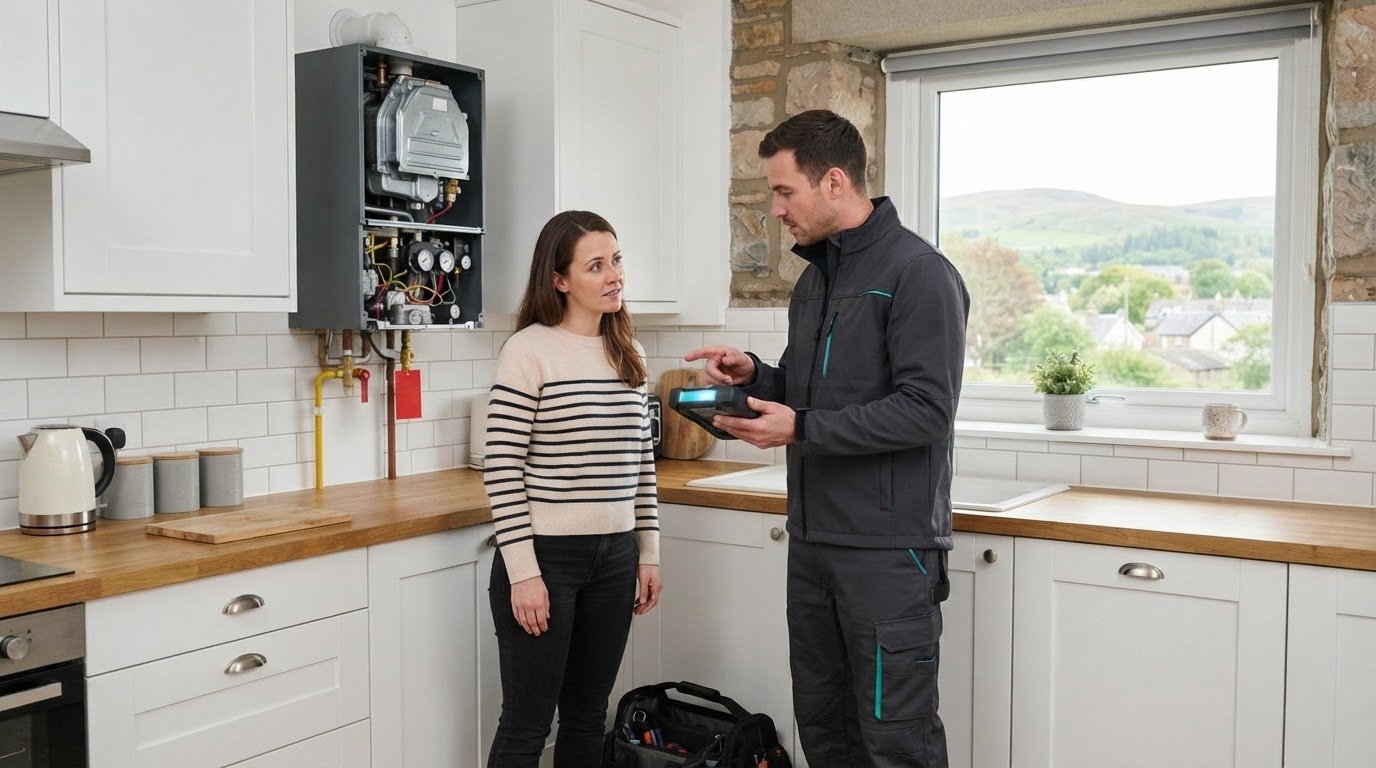
What happens after a failed gas safety inspection
A failed gas safety inspection means the fault needs to be dealt with before the affected appliance is used again. Landlords must give tenants a copy of the latest gas safety record within 28 days of each annual gas safety check. An engineer may disconnect an unsafe appliance, and a new gas safety record follows once the relevant checks are passed.
It’s understandable to worry about tenant safety, access to heating and your legal duties. The key is to act on the engineer’s findings, keep tenants informed and make sure the property has a current gas safety record. According to The National Archives, the Gas Safety (Installation and Use) Regulations 1998 require landlords to arrange gas safety inspections every 12 months.
This guide explains what a failed gas safety inspection means, what to do next, when an appliance or gas supply may be disconnected, and how the rules apply to rental properties. It also explains how an inspection differs from a boiler service, so you can identify what needs attention and take the right next step.
Key Takeaways
- Use the engineer’s findings to identify which appliance or installation needs attention, then arrange the appropriate repair.
- Understand what safety classifications mean and when an appliance may need to be disconnected or left unused.
- Keep tenants informed and provide the gas safety record as part of your rental-property duties.
- In England, landlords must arrange a gas safety check every 12 months, according to The National Archives (legislation.gov.uk).
- Learn how to handle a failed check and maintain the required inspection record for your property.
1. What Happens If a Landlord Does Not Have a Gas Safety Certificate?
A missing gas safety record can leave a landlord unable to show that rental appliances were checked and found safe. In England, landlords must arrange a gas safety check every 12 months, according to The National Archives (legislation.gov.uk). Failure to resolve a failed check can lead to fines of up to £6,000 per offence or per appliance. In the most serious gas safety cases in the United Kingdom, conviction on indictment may result in unlimited fines and up to 2 years’ imprisonment, according to The National Archives (legislation.gov.uk).
Plan the check before the deadline. In England, a landlord may arrange it up to 2 months before it is due without changing the date of the next check, according to The National Archives (legislation.gov.uk). This gives time to arrange access, identify faults and organise repairs before the record expires. The check must be completed by a Gas Safe registered engineer, and the landlord remains responsible for arranging and paying for it.
After a failed check, read the engineer’s findings and identify each appliance or installation needing attention. Arrange the repair or replacement, then have the affected equipment checked again once the fault is resolved. Keep the report, repair paperwork and updated gas safety record together. In England, a landlord must give tenants a copy of the latest gas safety record within 28 days of each annual check, according to The National Archives (legislation.gov.uk).
The landlord is responsible for addressing gas safety problems and paying for the necessary work. Tenants should not be asked to cover inspection or repair costs that fall to the landlord. Explain which appliance is affected, whether it must remain unused, and what is being done to restore safe use. If a boiler fault leaves the home without heating, tell the tenant what will happen next and keep a written record of updates.
If a tenant refuses access, keep records of appointment offers, messages and rearranged visits. The landlord must make reasonable attempts to complete the required check, and the tenant must allow access for it. Contact the tenant in writing, explain the safety reason for the visit and offer a practical appointment. A clear record helps show the steps taken to meet the duty.
A failed check does not automatically mean a tenant must leave. It is not a reason to prevent them from entering their home. The landlord should address the hazard and explain any restriction on using an unsafe appliance. A tenant may report a missing gas safety record to the local authority, which can serve an improvement notice. The Health and Safety Executive can investigate and prosecute gas safety breaches.
For a concern about an engineer’s gas safety work, contact the Health and Safety Executive gas safety advice line on 0800 300 363. Give clear details of the property, inspection and issue. For a landlord’s missing record or failure to meet safety duties, report the concern to the local authority or the HSE. Keep copies of messages and inspection documents to support the report.
2. What to do if you fail a gas safety inspection?
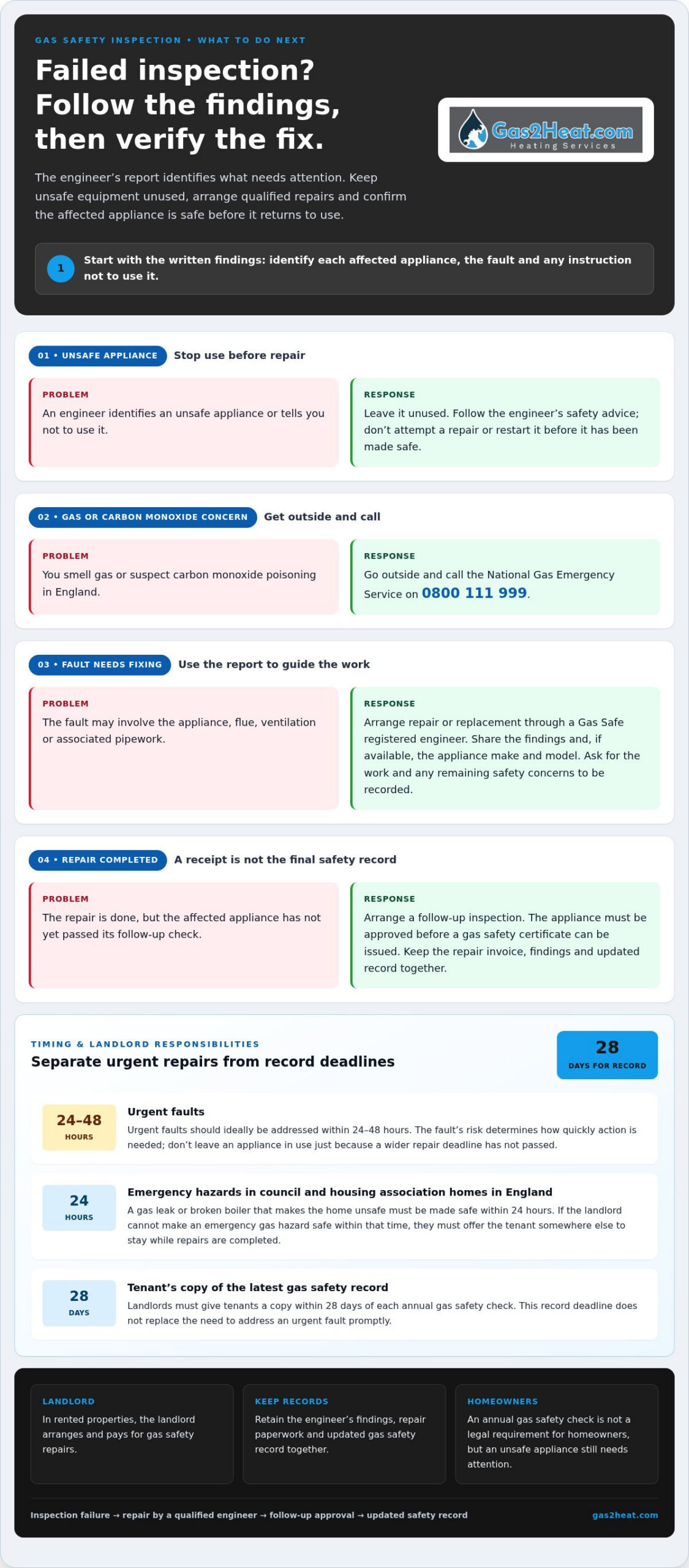
Start with the engineer’s written findings. Identify each affected appliance, the fault recorded and any instruction not to use it. If your gas appliances fail a safety inspection, arrange repairs and keep the inspection record. Homeowners are not legally required to have an annual gas safety check, but an unsafe appliance still needs attention.
If an engineer identifies an unsafe appliance, stop using it and follow the engineer’s safety advice. Don’t attempt a repair yourself or restart the appliance before it has been made safe. If you smell gas or suspect carbon monoxide poisoning in England, go outside and call the National Gas Emergency Service on 0800 111 999.
Arrange repairs or replacement through a Gas Safe registered engineer. Share the inspection findings, including the appliance’s make and model if available, and ask for the work and any remaining safety concerns to be recorded. The fault may involve the appliance, flue, ventilation or associated pipework, so the inspection notes can help direct the repair.
Landlords are responsible for arranging and paying for gas safety repairs in rented properties. Landlords must give tenants a copy of the latest gas safety record within 28 days of each annual gas safety check, while urgent faults should ideally be addressed within 24-48 hours. These are different considerations: the fault’s risk determines how quickly action is needed. Don’t leave an appliance in use just because the wider repair deadline has not passed.
For council and housing association homes in England, emergency hazards such as a gas leak or a broken boiler that makes the home unsafe must be made safe within 24 hours. If the landlord can’t make an emergency gas hazard safe within 24 hours, they must offer the tenant somewhere else to stay while repairs are completed.
After repairs, arrange a follow-up inspection of the affected appliance. It must be approved before a gas safety certificate can be issued. Keep the repair invoice, engineer’s findings and updated record together, then share the relevant safety information with tenants. A repair receipt alone does not replace the required gas safety record.
For a boiler fault identified during the inspection, arrange qualified boiler repairs and follow the engineer’s instructions about safe use. Record when the fault was reported, what work was completed and when the appliance passed its follow-up check. This creates a clear timeline for tenants and helps landlords track unresolved items.
3. Faulty appliances and gas supply disconnection
A failed check may concern one appliance or the property’s wider gas installation. The engineer records the safety classification and explains what it means for use. Read the finding carefully: an appliance marked At Risk requires different action from one classified as Immediately Dangerous. The category, fault and potential danger determine whether the equipment can remain in use or must be disconnected.
An Immediately Dangerous appliance presents an immediate danger to people or property. A gas engineer may disconnect it after obtaining the landlord’s permission. If permission is refused, the engineer may report the appliance to the Gas Emergency Service Provider, which may then disconnect the gas supply to the entire house. Do not switch a dangerous appliance back on while the fault remains unresolved.
An appliance classified as At Risk has a fault that could become dangerous. Do not use it until the fault is fixed, even if it appears to work normally. With the landlord’s permission, a gas engineer may turn off its gas connection or disable the installation. Ask which appliance is affected and what must happen before it can be used again.
Not to Current Standards means an appliance is considered safe to continue using, although it does not meet current industry standards. The engineer should explain how this differs from an unsafe appliance. Do not treat every notice as an instruction to stop using equipment. Follow the classification and any specific directions in the inspection record.
During a gas safety check in a rented home, an engineer can disconnect faulty equipment and arrange for the gas supply to be cut off. The response depends on the danger identified and whether the risk concerns one appliance or the wider supply. A UK gas safety certificate is considered valid only when every gas appliance is rated safe or fit for use. An unresolved unsafe appliance may affect the outcome of the inspection.
Once a fault is identified, arrange repair or replacement through a Gas Safe registered engineer. Share the inspection findings and keep details of the repair with the record. The appliance must be checked and approved before a gas safety certificate can be issued. If the engineer has isolated it, leave it disconnected until the fault is corrected and the safety checks are complete.
Maintenance does not replace a gas safety check. The check covers all gas appliances in a property, while a boiler service focuses on the boiler alone. There is no legally specified timeframe for how often a landlord must service a boiler. Keep the tasks distinct and use the inspection findings to identify which appliance or part of the installation needs attention.
4. Letting a property without a current certificate
A landlord should not treat an expired or failed gas safety record as a paperwork issue alone. The record shows which appliances and flues were checked and their condition. Arrange the required inspection, address any faults, then book a re-inspection once repairs are complete. A gas safety certificate is valid for 12 months from its issue date, so record the next due date and plan access before it expires.
Before a tenant moves in, give them the current gas safety certificate. If a check takes place during the tenancy, provide the tenant with the latest record within the required timeframe. Keep records and repair documents together, and ensure the property and landlord details are accurate. Incorrect landlord details can affect whether a certificate is valid.
A certificate supports safe letting only when every gas appliance is rated safe or fit for use. If an appliance remains unsafe, follow the engineer’s instructions, arrange repairs and obtain an updated inspection record once the fault is resolved. An old certificate does not show that a later repair has been checked. Keep the updated record available for tenants and property files.
Can a landlord keep tenants in a property after a failed gas safety inspection? A failed check alone does not automatically mean tenants must leave. The landlord must address the identified danger, tell tenants which appliance is affected and follow any instruction to stop using it. If an engineer disconnects an appliance or the gas supply, it must not be used until it has been made safe.
Older guidance may refer to gas certificates and Section 21 notices. In England, private landlords cannot give Section 21 notices from 1 May 2026, when Section 21 was abolished. A missing certificate should therefore be treated first as a safety and compliance issue, not as a shortcut to ending a tenancy. Landlords still need to meet gas safety duties and retain inspection records.
Carbon monoxide alarms do not replace a gas safety check or repair. In England, tenants should test smoke and carbon monoxide alarms monthly, and landlords must check that required alarms work on the first day of a tenancy. If an appliance is unsafe, keep tenants informed and arrange the engineer’s follow-up check before it is used again.
The cost of a gas safety certificate depends on the case and is provided after a quote request. Factors include the property, the appliances requiring inspection and access arrangements. The landlord is responsible for arranging and paying for the check, not the tenant. Keep the appointment record, certificate and repair documents together as evidence of the steps taken.
5. Annual inspection requirements for rental properties
Build the gas safety check into your property calendar, rather than waiting for a tenant change or boiler problem. The Gas Safety (Installation and Use) Regulations 1998 require UK landlords to arrange annual gas safety inspections of gas appliances and installations in their properties, according to The National Archives (legislation.gov.uk). In England, landlords must arrange a check every 12 months, also according to The National Archives (legislation.gov.uk).
A gas safety inspection covers the gas appliances and flues in the rented property. A boiler service is different: it focuses on the boiler, while the inspection considers all gas appliances. A recently serviced boiler therefore does not replace the landlord’s duty to arrange the required inspection. Keep a clear list of appliances, including any gas cooker or fire, so the engineer can check the full installation.
Use the previous gas safety record to plan the next appointment. In England, a landlord may arrange a check up to 2 months before it is due without changing the date of the next check, according to The National Archives (legislation.gov.uk). Book access with the tenant, share the appointment details and keep a note of any rearrangement. Early planning leaves time to address a fault before the next check is due.
After the engineer completes the inspection, retain the gas safety record and give the tenant a copy. In England, the landlord must provide the latest record within 28 days of each yearly check, according to The National Archives (legislation.gov.uk). Keep a copy of each record for at least two years. Store it with repair documents, so the property’s inspection and maintenance history is easy to follow.
A failed check changes the next steps, not the need for an inspection record. Follow the engineer’s findings, arrange necessary repairs and have the affected appliance checked again. Keep the initial report and updated record together. If a serious fault remains unresolved, follow instructions to keep the appliance unused or disconnected. A routine boiler service cannot clear an unsafe finding.
For a rental property, make responsibilities clear: the landlord arranges and pays for the gas safety check, while the tenant must allow access. Send the appointment request in writing and keep records of contact if access is refused. This creates a practical timeline and helps prevent an overdue inspection from being overlooked during a tenancy change.
Set a reminder based on the property’s last check date, then arrange the next inspection before it falls due. If you need the required record for a rental property, arrange a landlord gas safety certificate.
Gas2Heat.com: Boiler Installation
Gas2Heat.com Ltd can help with boiler repairs when an inspection identifies a boiler fault, or boiler installation if replacement is needed. For landlords, it also provides Landlord Gas Safety Certificates, helping you address inspection and record requirements for rental properties. Choose the service that matches the issue: arrange a repair for a faulty boiler, consider installation when a replacement is appropriate, and arrange the required certificate check for a rental property. Keep the engineer’s findings and repair details available so the next steps are clear. For help with your boiler or rental gas safety needs, contact Gas2Heat.com Ltd or visit gas2heat.com.
Make your next step a clear one
Knowing what happens if I fail a gas safety inspection is useful, but the important next step is to act on the findings and keep a clear record of completed work. Use the inspection to review the property’s heating needs, note recurring boiler issues and plan suitable maintenance. This gives you a practical basis for future decisions, whether the next step is a repair or replacement.
Gas2Heat.com Ltd offers Boiler Repairs, Boiler Servicing and Boiler Installation. Choose the option that fits the appliance’s condition and the work identified, then keep the paperwork with your property records. Clear next steps can make a stressful fault easier to manage.
Contact Gas2Heat.com Ltd for help with your boiler or gas safety needs. Take the next step with confidence and keep your property’s heating needs moving forward.
Frequently Asked Questions
1. What Happens If a Landlord Does Not Have a Gas Safety Certificate?
A landlord should arrange the missing check, resolve any faults and give tenants the resulting record. A tenant who has not received it can make a written request, keep a copy and note the date. If the landlord still does not provide the record, the tenant can report the issue to the local authority or the Health and Safety Executive. Inspection reports and messages help document what happened.
2. What can a landlord be fined for a missing gas safety check?
Failure to meet gas safety requirements can have serious consequences for a landlord. The amount is not an automatic charge for every overdue check; enforcement and the circumstances matter. Each gas appliance can count as a separate offence. Keep inspection records, repair documents and tenant correspondence together to show the steps taken to meet safety duties.
3. What happens if a gas inspection is overdue?
An overdue inspection leaves the landlord without a current record showing the appliances have been checked. In England, landlords must arrange a gas safety check every 12 months, according to The National Archives (legislation.gov.uk). Arrange the inspection promptly and make access arrangements with the tenant. If the check finds a fault, follow the engineer’s instructions and retain the updated record for the property file.
4. What is the penalty for a landlord who ignores gas safety rules?
Ignoring gas safety duties can lead to prosecution, fines and imprisonment. A landlord convicted summarily of a gas safety offence in the United Kingdom may face up to 6 months’ imprisonment. For the most serious cases, conviction on indictment may result in unlimited fines and up to 2 years’ imprisonment, according to The National Archives (legislation.gov.uk). If a failure contributes to an accident, criminal charges may also follow.
5. What to do if you fail a gas safety inspection?
If you’re asking what happens if I fail a gas safety inspection, start by reading the engineer’s report and identifying each affected appliance or part of the installation. Stop using equipment the engineer has told you not to use, then arrange repair or replacement through a Gas Safe registered engineer. Keep the repair details and arrange the required follow-up check. For a rental property, update the tenant and retain the resulting record.
6. What happens if a landlord fails a gas safety inspection in the UK?
If you’re a landlord wondering what happens if I fail a gas safety inspection, act on the engineer’s findings rather than simply filing the report. Arrange the necessary repair, tell tenants which equipment is affected and follow any instruction to leave it unused. Once the fault is resolved, arrange a check of the appliance and retain the resulting documentation. If access is difficult, keep written records of appointment offers and attempts to arrange entry.
7. What are the legal gas safety duties for UK landlords under the Gas Safety Regulations?
Landlords must arrange gas safety inspections and keep the required records for their rental properties. The Gas Safety (Installation and Use) Regulations 1998 require UK landlords to arrange annual gas safety inspections of gas appliances and installations in their properties, according to The National Archives (legislation.gov.uk). Landlords must also provide tenants with the gas safety record and arrange repairs when checks identify safety problems.
8. What do gas safety warning labels and classifications Immediately Dangerous and At Risk mean?
Immediately Dangerous means the appliance presents an immediate danger, and an engineer may seek permission to disconnect it. At Risk means a fault could create danger, so the appliance should not be used until it is fixed. An appliance marked Not to Current Standards is considered safe to use, although it does not meet current industry standards. Follow the engineer’s instructions for the specific appliance.
