

7 Critical Signs You Need a New Boiler in Moffat and Dumfries (2026 Checklist)
Spending £300 on a single emergency repair could be the most expensive mistake you make this winter. You already know that keeping an aging heating system alive in Moffat or Dumfries is a gamble. When the temperature drops below zero in January, a failing unit doesn’t just cause stress; it drains your bank account. It’s time to stop guessing. This guide identifies the critical signs you need a new boiler so you can stop wasting money on temporary fixes and enjoy a high-efficiency, ERP rated system that actually works.
Lowering your monthly energy bills by up to £540 a year is possible when you move away from an inefficient G-rated model. We’ve compiled a clear 2026 diagnostic checklist to help you decide if it’s time to switch. You’ll learn how to spot the red flags of a failing system and understand when a fixed price replacement is more cost-effective than another temporary patch. From next day installation by Gas Safe registered engineers to 10-year warranties, we’ll show you how to secure a warm, hassle-free home without the fear of hidden costs or cowboy contractors.
Key Takeaways
- Understand how the unique climate in South West Scotland impacts boiler longevity and why the 15-year mark is a critical turning point for your home.
- Detect subtle performance drops, such as rising energy bills and slow-warming radiators, that signal your heating system is no longer operating efficiently.
- Recognise the physical red flags and unusual noises that act as the primary signs you need a new boiler before a total system failure occurs.
- Apply the “£500 Rule” to determine whether a repair is a sound investment or if a high-efficiency upgrade with a 10-year warranty is more cost-effective.
- Learn how to secure a hassle-free, next-day installation in Dumfries and Galloway with transparent, fixed pricing and no hidden costs.
Checkpoint 1: Understanding Boiler Lifespan in Moffat and Dumfries Homes
Most manufacturers suggest a 10 to 15 year lifespan for domestic units. In Moffat and Dumfries, boilers often face harsher conditions than the UK average. SW Scotland winters involve prolonged sub-zero temperatures, which forces heat exchangers to work 20% harder than those in milder southern climates. Constant cycling to combat the damp Borders chill creates internal fatigue. Recognizing the early signs you need a new boiler can save you from a total system failure during a January freeze. Even if your unit still fires up, it might be showing signs you need a new boiler through reduced heat transfer or loud internal vibrations.
Water quality across Dumfries & Galloway also impacts longevity. Mineral deposits in the local supply lead to internal corrosion over time. By the 12 year mark, limescale buildup can reduce heat transfer efficiency by as much as 15%. This means your system burns more gas to achieve the same temperature, driving up your monthly outgoings without improving your comfort. It’s a common issue in rural properties where older pipework introduces more debris into the heat exchanger.
Is your boiler over 12 years old?
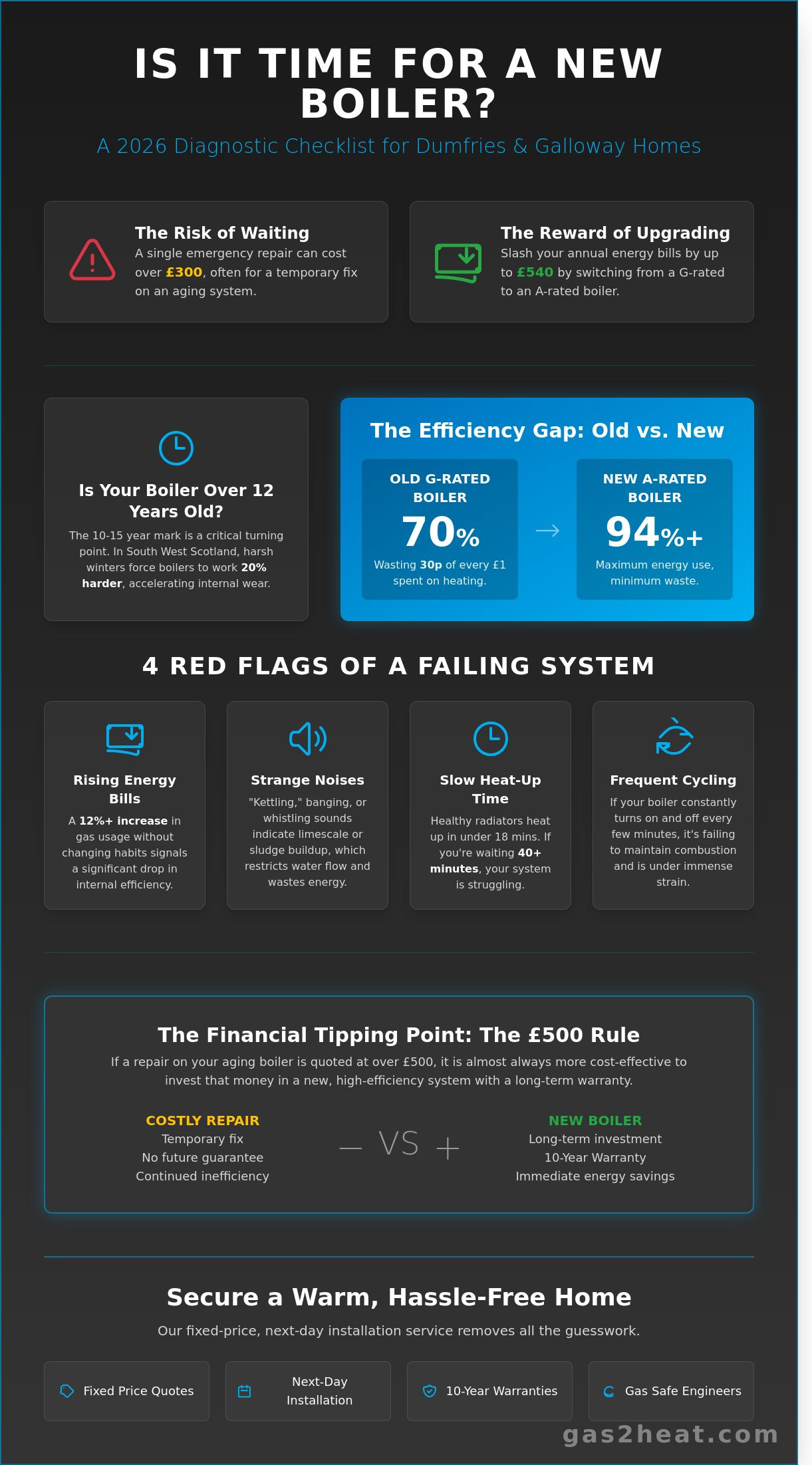
Boiler Lifespan is the period before internal fatigue compromises safety and efficiency. Older G-rated boilers often operate at just 70% efficiency. This means you’re wasting 30p of every £1 spent on gas. Modern A-rated units deliver 94% efficiency or higher. Sourcing parts for discontinued models in rural areas like Lockerbie is also a growing challenge in 2026. If a proprietary PCB or fan fails, you could face a long wait for repairs. Our next day installation service solves this problem before the cold sets in, providing a fixed price solution that removes the guesswork.
The ‘Efficiency Gap’ in older Scottish properties
Moffat is known for its traditional stone-built homes. These properties require consistent, high-output heating to stay dry and warm. An aging boiler struggles to maintain these levels, creating a massive efficiency gap where the unit runs constantly but the rooms stay chilly. You can read our guide on improving heating efficiency to see how modern systems handle these unique challenges. With the 2026 price cap keeping energy costs high, an old unit is a financial liability. Upgrading ensures a fixed price for your installation and immediate relief from rising bills through a high-efficiency, ERP rated system.
Checkpoint 2: Performance Warning Signs and Rising Energy Bills
Your boiler’s performance often declines so slowly that you don’t notice the change until your bank balance takes a hit. We call this the “Creeping Bill” syndrome. If your heating habits remained the same throughout the winter of 2025, yet your 2026 gas usage has increased by 12% or more, your internal components are likely struggling. An aging heat exchanger loses efficiency every year, forcing the unit to burn more fuel to reach the same temperature. This steady decline is one of the most reliable signs you need a new boiler before the system fails completely.
Pay attention to “kettling” sounds. If your boiler mimics the sound of a whistling kettle or makes loud banging noises, it’s usually a sign of lime scale or sludge build-up on the heat exchanger. This debris creates localized boiling, which traps heat and prevents it from reaching your radiators. It’s not just a noise issue; it’s a massive energy drain. Your boiler stays on for longer periods just to fight through the blockage, which significantly increases your daily running costs.
Thermostat struggles also indicate system fatigue. If your boiler frequently “cycles” on and off every few minutes, it’s failing to maintain a steady state of combustion. This constant ignition puts immense strain on the gas valve and fan, leading to a breakdown that usually happens on the coldest day of the year. You can get a fixed price quote online in minutes to see how much a modern, high-efficiency replacement would save you on these monthly spikes.
Identifying the ‘Slow Warm-up’ in Dumfries radiators
Test your system’s health with a simple diagnostic: time how long it takes for the radiator furthest from the boiler to reach full heat. In a standard Moffat semi-detached home, this should take less than 18 minutes. If you’re waiting 40 minutes or more, or if you feel persistent cold spots at the bottom of the panels, sludge build-up is the culprit. While power flushing can provide a temporary fix, it’s often a sign that the internal pipework and the boiler itself are reaching the end of their functional life.
Unexplained spikes in monthly fuel costs
Review your 2026 energy statements against your 2025 data. If your unit consumption has jumped despite a mild winter, your boiler’s combustion process is failing. Look at the flame through the viewing window if your model allows it. A healthy, efficient boiler produces a crisp blue flame. A yellow or orange flame indicates incomplete combustion and the potential presence of Carbon Monoxide. This is one of the most critical signs you need a new boiler for safety reasons rather than just efficiency. If you see a yellow flame, shut the system down and call a Gas Safe registered engineer immediately.
Checkpoint 3: Physical Signs, Strange Noises, and Visual Red Flags
Your boiler should be a silent worker. If it starts communicating through odd sounds or visible marks, it’s telling you something is wrong. These are often the most urgent signs you need a new boiler before a total breakdown occurs. Identifying these physical red flags early can save you from a cold house during a Dumfries winter.
Deciphering strange boiler noises
A healthy system hums quietly. If your unit sounds like a percussion section, it’s under stress. Whistling, often called kettling, usually points to heavy limescale build-up on the heat exchanger. This restricts water flow and forces the unit to overheat. Gurgling is typically less severe, often caused by trapped air or a frozen condensate pipe during a sub-zero Moffat night. However, loud banging or clunking is a major warning. This suggests pump failure or severe internal damage. While a minor noise might cost £150 to fix, persistent metallic clunking in a unit over 12 years old often signals total internal failure.
Leaks and corrosion: The silent killers
Check the base of your boiler casing and the surrounding floor for damp patches. Even a tiny “pinhole” leak is a symptom of internal decay. Corrosion acts as a silent killer for heating systems. Once rust eats through the heat exchanger, the unit is effectively scrap because repair costs often exceed 60% of a new installation. If you spot rust or dark soot marks around the casing, you must act. Book a local Gas Safe registered engineer for an immediate visual assessment to ensure your home remains safe.
Beyond noises and leaks, watch for these two critical safety and performance indicators:
- The Yellow Flame Alert: A healthy boiler flame is crisp and blue. A yellow or orange flame indicates improper combustion and a high risk of Carbon Monoxide poisoning. This is a life-safety emergency.
- Frequent Pressure Drops: You should only need to top up your boiler pressure once every 12 months. If you’re using the filling loop every week to hit that 1.5 bar mark, you have a persistent leak or a failing expansion vessel.
Ignoring these signs you need a new boiler leads to higher bills and safety risks. Gas2Heat provides fixed price quotes and next day installation to resolve these issues quickly. Don’t wait for a leak to become a flood. Modern A-rated units eliminate these “orchestra” noises while cutting your energy waste by up to 30% immediately.
Checkpoint 4: The Tipping Point — Repair vs. Replace Financial Analysis
Deciding whether to patch up an old unit or invest in a new one often comes down to a simple calculation called the £500 Rule. If a single repair quote exceeds £500, or if your total repair bills over the last 24 months have crossed that threshold, a full system upgrade is the more logical financial move. This is one of the most definitive signs you need a new boiler, as it signals that your current unit has reached its mechanical limit.
Reliability is a major factor for homeowners in rural SW Scotland. If your boiler breaks during a cold snap in Moffat, waiting for parts can be a week-long ordeal. Older models often require components that are no longer stocked locally, leading to extended downtime. A new installation eliminates this risk. Most modern systems we install come with a 10-year manufacturer guarantee, effectively removing all repair costs from your household budget for a full decade.
The true cost of frequent ‘Minor’ repairs
Minor fixes rarely stay minor. A £90 call-out fee here and a £150 sensor replacement there quickly add up. Over a two-year period, three small visits can easily total £600 without actually improving the boiler’s lifespan. Beyond the money, you have to consider the “Peace of Mind” factor. You don’t want to be hunting for an emergency engineer in Gretna or Carlisle on a freezing Sunday night. For long-term reliability, choosing the best boiler for your specific property size is a better investment than constant patching.
New boiler efficiency vs. repair costs
The Return on Investment (ROI) of a new unit is driven by the massive leap in efficiency. Older G-rated boilers often operate at just 70% efficiency, meaning 30p of every pound you spend on gas is wasted. Modern A-rated Combi units achieve 94% efficiency or higher. This 24% improvement can save the average Dumfries household over £300 per year on energy bills. Part of making an informed upgrade decision is understanding whether a combi vs system boiler is the right choice for your property’s hot water demands and available space. Understanding the new boiler cost in Moffat and Dumfries helps you make an informed decision about whether the upfront investment delivers long-term savings.
- Fixed Price Promise: Gas2Heat removes the “hidden cost” anxiety by providing a transparent, fixed quote before work begins.
- Smart Tech: Modern thermostats like Nest or Hive can increase ROI by another 12% through precision heating schedules.
- Next Day Installation: We prioritize speed so you aren’t left in the cold while weighing up your options.
If you’re tired of throwing money at an aging system, it’s time to look at the numbers. You can get a fixed price quote online in 60 seconds to see exactly how affordable a high-efficiency upgrade can be.
Checkpoint 5: Next Steps for Homeowners in Dumfries and Galloway
Identifying the signs you need a new boiler is the first step toward a warmer, more efficient home. You don’t have to pay a “national” premium to get high-quality service. Many large UK firms add a 25% to 30% markup to cover their massive marketing budgets and administrative overheads. At Gas2Heat, we keep things local. Our engineers live and work in the region, providing a transparent, fixed-price service without the hidden costs that often plague the trade industry. We focus on speed and reliability so you can get back to your routine without stress.
Requesting a local Moffat boiler survey
A Gas2Heat home visit is technical and thorough. We don’t just swap a box on the wall; we measure heat loss in every room and inspect your existing pipework to ensure it meets 2026 safety and efficiency standards. This precision prevents you from overpaying for a boiler that is too powerful for your needs. We provide full coverage across Dumfries, Lockerbie, Annan, and Thornhill. If your current system has already broken down, our professional boiler installation in Moffat service ensures you aren’t left in the cold. We prioritize emergency replacements to keep local families safe and warm.
Investing in a ‘Hassle-Free’ future
Review your checklist from the previous sections. If you have ticked three or more signs you need a new boiler, continuing to repair an old unit is a poor financial decision. Modern ERP-rated boilers can improve your home’s energy efficiency by up to 15% compared to models installed 10 or 12 years ago. This transition saves significant money on monthly bills and provides the peace of mind that comes with a long-term manufacturer warranty.
Choosing a local specialist means you have a dedicated contact for future annual servicing. We aren’t a faceless corporation; we are a family-run business that values long-term relationships with our neighbors in South West Scotland. Every installer we send to your home is Gas Safe registered and highly trained in the latest high-efficiency technology. We handle the paperwork, the installation, and the cleanup, leaving you with nothing but a warm home.
Ready to secure your home’s comfort? Get your fixed-price boiler quote from Gas2Heat today. We make the entire process simple, fast, and entirely transparent.
Secure Your Home Comfort for 2026 and Beyond
Don’t let an aging heating system leave you in the cold during the next Dumfries winter. If your current unit is over 12 years old, it’s likely operating at less than 80% efficiency, which adds over £300 to your annual energy bills. Recognizing the signs you need a new boiler, such as persistent metallic banging or a 15% spike in your monthly fuel usage, allows you to take control before a total breakdown occurs. Upgrading to a modern A-rated system can reduce your household carbon footprint by 1,220kg annually according to Energy Saving Trust 2024 data.
Our team of Gas Safe Registered local engineers provides the professional expertise you need for a stress-free transition. We offer a fixed price guarantee, ensuring the quote you receive is exactly what you pay. There are no hidden costs or surprise fees to worry about. If you’re facing a heating emergency, our next-day installation service ensures your home stays warm without any delay.
Get Your Fixed-Price Boiler Quote in Dumfries & Moffat
You’re just one step away from a warmer, more efficient home that gives you total peace of mind.
Frequently Asked Questions
How many years should a boiler last in a Scottish home?
A modern boiler typically lasts between 10 and 15 years in a Scottish climate. Beyond the 12 year mark, internal components like the heat exchanger often lose efficiency by 20% or more. Regular annual servicing can extend this lifespan, but most units installed before 2011 are now reaching the end of their reliable service life. We recommend checking your installation date to avoid unexpected winter breakdowns.
Is it worth fixing a 15-year-old boiler?
Investing in repairs for a 15-year-old unit is rarely cost-effective because the chance of secondary component failure increases by 65% within 12 months. If a repair quote exceeds £300, replacing the unit is a smarter financial move. These older models are one of the key signs you need a new boiler as they lack the high-efficiency condensing technology found in current ERP-rated systems.
What are the danger signs of a failing boiler I should watch for?
Immediate danger signs include soot marks around the casing, a yellow pilot light, or a persistent metallic smell. If your carbon monoxide alarm triggers, you must shut off the gas supply immediately and call a Gas Safe registered engineer. Beyond safety, loud banging or kettling noises indicate a 30% increase in fuel consumption due to heavy limescale buildup within the heat exchanger.
Can a new boiler really save me money on my Dumfries energy bills?
Upgrading to an A-rated condensing boiler can reduce your Dumfries energy bills by up to £540 per year according to 2024 Energy Saving Trust data. Older G-rated boilers operate at roughly 60% efficiency, meaning 40p of every pound spent is wasted. Our high-efficiency installations convert 94% of gas into heat, providing immediate relief from rising utility costs during the cold Scottish winters.
How long does it take Gas2Heat to install a new boiler in Moffat?
Most standard boiler swaps in Moffat are completed within 24 hours of your initial inquiry. Our local engineers specialize in next day installation to ensure you aren’t left without hot water. We provide a fixed price quote online in 60 seconds, and the physical installation typically takes between 6 and 8 hours. You’ll receive a full demonstration of your new controls before we leave your property.
What happens if my boiler flame is yellow instead of blue?
A yellow or orange flame is a critical warning that your boiler isn’t burning gas correctly and may be producing carbon monoxide. Healthy boilers produce a crisp blue flame. This visual cue is one of the most serious signs you need a new boiler or an immediate professional inspection. Don’t ignore this change; it often means the burner is blocked or the air-to-fuel ratio has failed.
Do I need a new boiler if my radiators have cold spots at the bottom?
Cold spots at the bottom of your radiators usually signal a buildup of magnetite sludge rather than a total boiler failure. A professional power flush can often remove this debris and restore 15% of your system’s heat output. However, if this sludge has already reached the boiler’s internal pump or heat exchanger, a full replacement is often the only way to prevent recurring leaks and system noise.
Will a new boiler work with my existing underfloor heating in Carlisle?
Every new boiler we install is 100% compatible with existing underfloor heating systems in Carlisle and the surrounding areas. We use specialized mixing valves to ensure the water temperature remains at the required 35 to 45 degrees Celsius for your floor loops. This setup improves your home’s overall thermal efficiency rating by 12% compared to using traditional radiators alone, ensuring consistent comfort throughout the year.
