
Extending My Boiler Warranty: Coverage, Conditions and Costs
New boilers in the UK generally come with a manufacturer warranty lasting 2 to 12 years. To qualify for cover, the boiler needs to be registered with the manufacturer within 30 days of installation. An extension may give you more time under warranty, but the cover and conditions depend on the terms offered.
Before deciding whether extending your boiler warranty is worthwhile, look beyond the headline term. A warranty may cover faults with the boiler itself, while problems elsewhere in the heating system or damage caused by an external issue may be excluded.
This guide explains what boiler warranties typically cover, common exclusions and the conditions for keeping cover valid. It also outlines how extensions work, why annual servicing matters and what to review before your current warranty ends, helping you decide whether extra protection suits your needs.
Key Takeaways
- Understand the difference between faults in the boiler itself and problems elsewhere in the heating system before relying on warranty cover.
- Look closely at exclusions, especially damage linked to external issues, so you know which repairs may incur a charge.
- Keep annual servicing records and follow the manufacturer’s maintenance instructions to help preserve your cover.
- Compare an extension’s terms with your existing warranty, including what it covers and the conditions attached.
What Does an Ideal Boiler Warranty Cover?
A boiler warranty is the manufacturer’s commitment to cover specified faults in the appliance. New boilers in the UK generally come with manufacturer cover lasting 2 to 12 years; Ideal boiler warranties also range from 2 to 12 years. The exact protection depends on the warranty terms, so check what the document includes before relying on it.
Registration records the appliance with its manufacturer and can be necessary to qualify for cover. Register a new boiler within 30 days of installation. Treat the deadline as a practical step, not an administrative extra: keep the confirmation with the boiler’s paperwork and note the installation date. If you’re extending your boiler warranty, registration timing can also affect access to extended cover.
Telephone registration lets you give the manufacturer the details needed to identify your boiler and record its installation. Have the boiler’s identifying details and installation date ready, then ask the manufacturer to confirm registration. Keep the confirmation and date for your records. The installer may also be able to register the boiler through Ideal’s myREWARDS route. Ask for confirmation when registration is complete.
A guarantee is the manufacturer’s commitment to provide cover under stated conditions. Late registration can affect eligibility, but it does not necessarily mean a specific shorter guarantee applies. Ask the manufacturer to explain the cover available and confirm its decision in writing. If it refuses a warranty claim, request the reason and relevant warranty term in writing. Share the registration confirmation, installation records and service documents related to the claim, and ask the manufacturer to review them.
If a boiler fault appears after registration, report it through the manufacturer’s claims process first. Keep the response and any instructions with the warranty paperwork. Clear records link the appliance, installation and claim without relying on memory.
Boiler warranty coverage and exclusions
Warranty protection depends on the fault, appliance and manufacturer’s terms. Before considering an extension, distinguish cover for the boiler from protection for the wider heating system.
Boiler and Heating System Cover
Boiler warranty coverage applies to specified faults in the boiler itself. An Ideal manufacturer’s warranty covers manufacturing issues, not problems with radiators or pipework. For example, a radiator fault may fall outside the warranty even if it affects the heating. When reporting a fault, distinguish an appliance failure from a wider heating-system problem.
Heating-system cover applies to components beyond the boiler, such as radiators and pipework. It is not automatically included in a boiler warranty. If an external issue damages or blocks a component, replacement may incur a charge. The warranty terms define the boundary between a boiler fault and an excluded system problem.
Conditions for Extended Cover
Extended cover is additional warranty protection offered beyond a boiler’s standard guarantee. Its conditions can include installation by an accredited installer and ongoing maintenance under the manufacturer’s instructions. Registration timing can matter too: new boilers generally need to be registered within 30 days of installation to qualify for cover.
You can extend a warranty without an accredited installer only if the extension terms allow it. If accreditation is a stated condition, an installation that does not meet it may be ineligible. Check the written terms for eligibility, covered components, the protection period and servicing conditions. Do not assume an existing guarantee automatically carries over to an extension.
Parts, Labour, Call-Outs and Replacement
Warranty terms may treat parts, labour, call-outs and replacement differently. A boiler warranty does not automatically cover every expense associated with a repair. The manufacturer’s terms specify whether it supplies replacement parts, pays labour costs, covers a call-out or replaces the boiler.
Does a boiler warranty cover parts, labour, call-outs and replacement? Only if those items are included in its terms, so do not assume they are covered. Before arranging a repair, read the claim instructions and check the exclusions. If an external issue damages or blocks a component, replacement may incur a charge, even if the boiler is under warranty.
Keep the warranty terms and service records together, so the covered fault and any conditions are clear when you report a claim. An annual boiler service can also help you maintain the servicing record required by some extended-cover terms.
Conditions for keeping a warranty valid
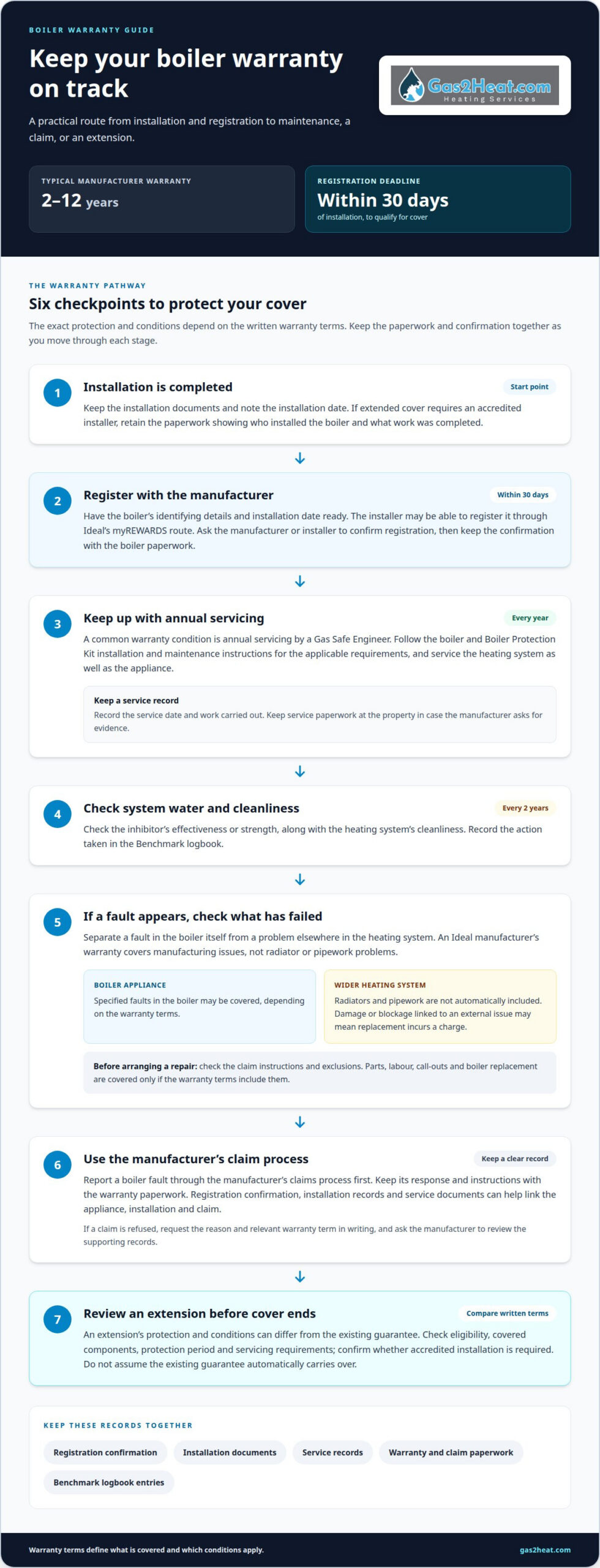
Warranty terms and conditions set out the manufacturer’s requirements for maintaining cover, including installation, servicing intervals and records to keep. Read them alongside the guarantee, as extended cover may have additional conditions. For example, an extended guarantee may require installation by an accredited installer. Keep the installation documents to record the installer and completed work.
An annual service is a maintenance visit to check the boiler and support its upkeep. A common warranty condition is annual servicing by a Gas Safe Engineer. Follow the boiler and Boiler Protection Kit installation and maintenance instructions for the applicable requirements. Keep the service record for each visit, including the date and work carried out.
The heating system also needs maintenance in line with the applicable instructions. The boiler and heating system must be serviced annually in accordance with the boiler and Boiler Protection Kit installation and maintenance instructions. This applies to the system as well as the appliance. Keep the service paperwork at the property in case the manufacturer asks for evidence of maintenance.
Inhibitor checks assess the protection and cleanliness of the system water. Every 2 years, check the inhibitor’s effectiveness or strength and the heating system’s cleanliness. Record the action taken in the Benchmark logbook. If a check identifies that the system needs attention, document the action and date rather than relying on memory.
Organised records help demonstrate that you have followed the warranty conditions. Keep the Benchmark logbook, installation documents and annual service records together at the property. If you make a claim, these documents can show when servicing took place and what checks were completed. Before arranging an extension, review the manufacturer’s requirements, particularly if the boiler’s installation or service history has changed.
Boiler warranty extensions
A warranty extension adds to the manufacturer’s stated protection period. Before deciding, compare the additional term, covered faults and eligibility conditions.
Manufacturers and Extension Lengths
Extension length is the additional period a manufacturer offers beyond standard cover. UK boiler warranties generally range from 2 to 12 years, and some manufacturers offer extensions to 5 years. Ideal’s Vogue Gen2 Combi has a 10-year warranty. These examples show why the model and written terms matter: a headline length doesn’t explain which faults the warranty covers.
Check the exact boiler model, registration status and installation conditions. The boiler may need to meet the manufacturer’s requirements, including any condition about using an accredited installer. Treat eligibility as a requirement to verify, not an automatic benefit. The engineer’s installation records can help establish whether the boiler qualifies.
Comparing Extensions with Replacement or Repair Plans
A repair plan covers specified repair services, while a warranty extension continues manufacturer cover under its terms. Home emergency insurance is a separate policy, so check its written scope rather than assuming it matches a warranty. Membership alone does not mean a boiler fault, call-out or labour is covered.
To compare an extension with a repair plan, list what each covers, exclusions, servicing requirements and the remaining term. Then consider the boiler’s condition and likely repair needs. If a boiler is out of warranty and over 10 years old, replacement may be worth considering alongside repair options. A repair assessment helps clarify the appliance’s condition before you choose.
Typical Extension Costs
An extension’s cost is the amount charged for additional warranty protection. There is no single typical price for UK boilers: the amount depends on the model, added duration, cover and eligibility. Check whether servicing or other support is included, and compare equivalent offers.
Read the terms before joining a plan or accepting an extension. Check the excess, claim limits and whether parts, labour or call-outs are included. A Benchmark logbook can help document servicing, but it does not replace the provider’s written terms.
For a boiler that needs attention before you decide, arrange a boiler repair and use the findings to inform your next step.
Gas2Heat.com
Gas2Heat.com Ltd helps homeowners maintain their heating systems and address boiler problems that may affect warranty decisions. If you’re weighing an extension against a repair or replacement, understanding the boiler’s condition and service history can help you plan your next step.
Gas2Heat.com Ltd provides boiler servicing, repairs and installation. Servicing supports ongoing maintenance, repairs address faults, and installation is an option when replacement is being considered. These services don’t determine the manufacturer’s warranty terms, but they can help you make an informed decision about the boiler itself.
For help with your boiler’s servicing, repair or installation, contact Gas2Heat.com Ltd.
Make your next boiler decision with confidence
Before extending my boiler warranty, consider what you need from your boiler in the coming years, not just how long the cover lasts. A fault, repeated repairs or changing household needs may call for different next steps. Start by understanding the boiler’s condition and how it fits your plans for the home.
Gas2Heat.com Ltd offers boiler servicing, repairs and installation to help with practical heating needs. Servicing supports ongoing maintenance, repairs address faults, and installation is an option when replacement is being considered. These services don’t determine the manufacturer’s warranty terms, but they can help inform a decision about the boiler itself.
Take the next step that suits your situation. If you’d like help with servicing, a repair or installation, contact Gas2Heat.com Ltd. A clear plan for your boiler can make the decision ahead feel more manageable.
Frequently Asked Questions
How do I keep my boiler warranty valid?
Follow the maintenance and servicing requirements in the warranty terms, and keep the paperwork together at the property. Retain service records, installation documents and the Benchmark logbook to show what work was completed. If the manufacturer requests evidence during a claim, organised records make it easier to provide the relevant documents and demonstrate the boiler’s maintenance history.
Can I extend my manufacturers warranty?
Yes, you can extend a manufacturer’s warranty if the manufacturer offers an extension for your boiler and you meet its eligibility conditions. The available term and cover depend on the model and manufacturer’s terms. Before accepting, compare the extension’s start and end dates with your current cover, and check whether it changes which faults or components are covered.
Can I extend my boiler warranty after the original warranty expires in the UK?
An expired warranty does not automatically resume when you request an extension. A manufacturer may offer one only if its terms allow enrolment at that stage and the boiler meets its eligibility conditions. If the original cover has ended, find out whether the offer is an extension or a separate repair plan. Compare exclusions and claim conditions before choosing.
How do I register a boiler warranty or extend it with the manufacturer?
Use the manufacturer’s registration process and provide the boiler details and installation date. Registration for new boilers generally needs to happen within 30 days of installation to qualify for cover. After submission, keep the confirmation with the boiler paperwork. For an extension, review the manufacturer’s enrolment instructions and retain the written terms, so you can identify the added cover period.
What conditions must I meet to keep a boiler warranty valid, including annual servicing?
Meet the servicing, installation and maintenance conditions written into the warranty. A common requirement is an annual service by a Gas Safe Engineer. The boiler and heating system must also follow the applicable installation and maintenance instructions. Keep service records at the property, and record inhibitor effectiveness or strength checks and system-cleanliness actions in the Benchmark logbook every 2 years.
What exclusions or risks commonly apply to extended boiler warranties?
Extended warranties may exclude faults outside the boiler, including problems with radiators or pipework. If an external issue causes damage or a blockage, replacing the affected component may also incur a charge. The main risk is assuming an extension protects the whole heating system or covers every repair cost. Read the exclusions and check whether parts, labour, call-outs and replacement are included.

Leave a Reply
You must be logged in to post a comment.