
How often should a landlord service a boiler in a rental property?
Annual servicing is the practical minimum for a rental boiler, but it isn’t the same as the legally required gas safety check. If you’re deciding how often a landlord should service a boiler, arrange a service each year and keep the gas safety check up to date too. According to the Health and Safety Executive, landlords must have each gas appliance and flue checked at least every 12 months.
It’s easy to treat these as one appointment, but they serve different purposes. A gas safety check assesses whether gas appliances are safe to use; a boiler service involves more detailed maintenance. This guide explains how often a landlord should service a boiler, when to arrange checks around a tenancy, and why planning servicing before problems arise makes boiler care easier to manage.
Key Takeaways
- Plan boiler checks around tenancy changes so maintenance issues can be addressed before a new tenant moves in.
- Consider booking routine servicing in late spring or summer, when the heating system is less likely to be in regular use.
- Keep maintenance and legal safety checks distinct, and account for both when organising a landlord’s boiler care.
- Use a regular service schedule to help spot wear, leaks or other faults before they disrupt heating or hot water.
How often should a boiler be serviced?
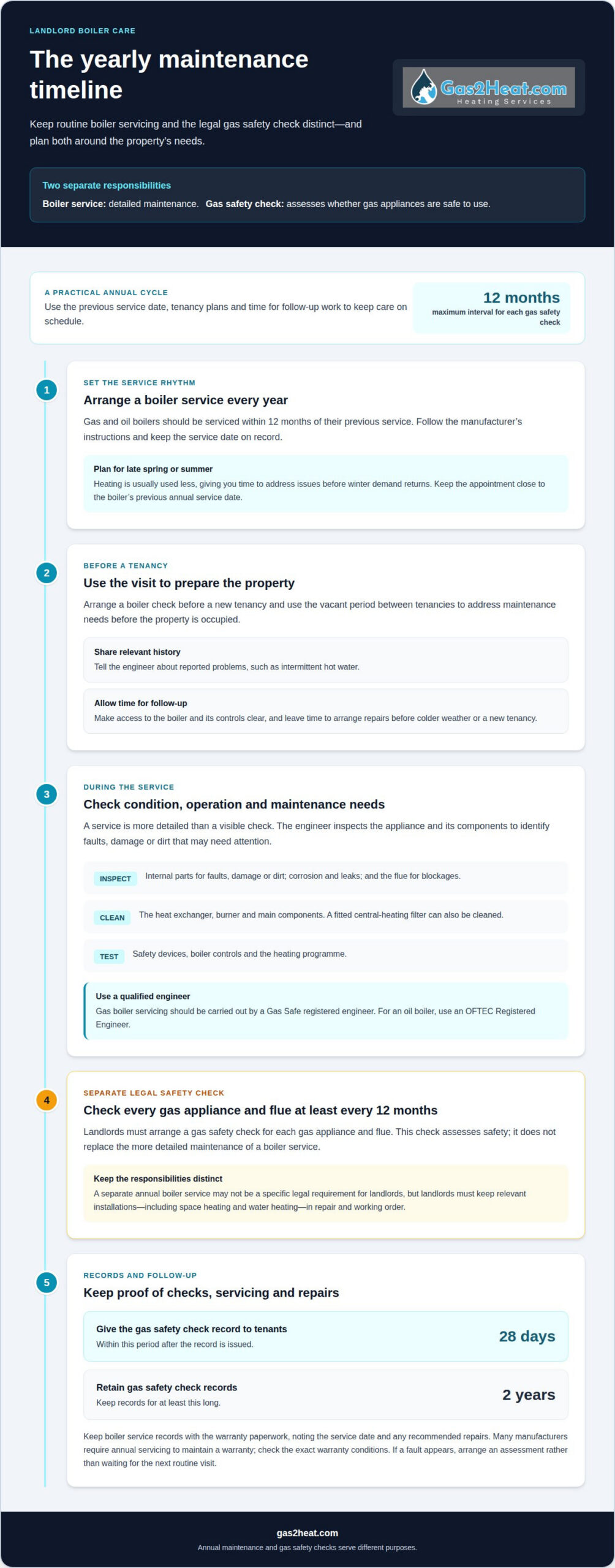
Arrange a boiler service annually as a practical maintenance routine, and follow the manufacturer’s instructions. A boiler service and a landlord gas safety check are separate appointments with different purposes.
Recommended Annual Servicing
Annual servicing means arranging professional inspection and maintenance once each year. Gas and oil boilers should be serviced within twelve months of their previous service, helping landlords identify developing faults before winter brings heavier use.
For an oil boiler, use an OFTEC Registered Engineer. Regular servicing can identify issues that may need repairs and help keep the appliance operating safely. It is separate from checking whether the boiler’s gas safety obligations are up to date.
Legal Requirements and Landlord Inspections
A separate annual boiler service may not be a specific legal requirement for landlords, but regular maintenance can still be important. However, the Landlord and Tenant Act (1985), according to UK legislation, requires landlords to keep water, gas, electricity, sanitation, space heating and water heating installations in repair and working order.
The Gas Safety (Installation & Use) Regulations 1998, according to UK legislation, cover landlords’ gas safety check responsibilities. Landlords must arrange a gas safety check on each appliance and flue at least every 12 months, according to the Health and Safety Executive. This safety check is not a substitute for the more detailed maintenance of a boiler service.
After the check, landlords must give tenants a copy of the gas safety check record within 28 days of issue, according to the Health and Safety Executive. The Health and Safety Executive also says landlords must keep these records for at least two years.
Servicing and Manufacturer Warranties
Many boiler manufacturers require annual servicing to maintain the boiler warranty. The exact conditions depend on the warranty, so keep the service record and follow the manufacturer’s schedule.
This matters if a fault develops: missed servicing may affect whether warranty terms apply. Keep each record with the boiler paperwork, noting the service date and any recommended repairs. A clear maintenance history helps you plan the next annual appointment without confusing it with the gas safety check.
Boiler checks before a tenancy and between tenancies
Arrange a boiler check before a new tenancy begins and between tenancies. This gives an engineer an opportunity to identify maintenance needs before the property is occupied.
Boiler Service Checks and Maintenance
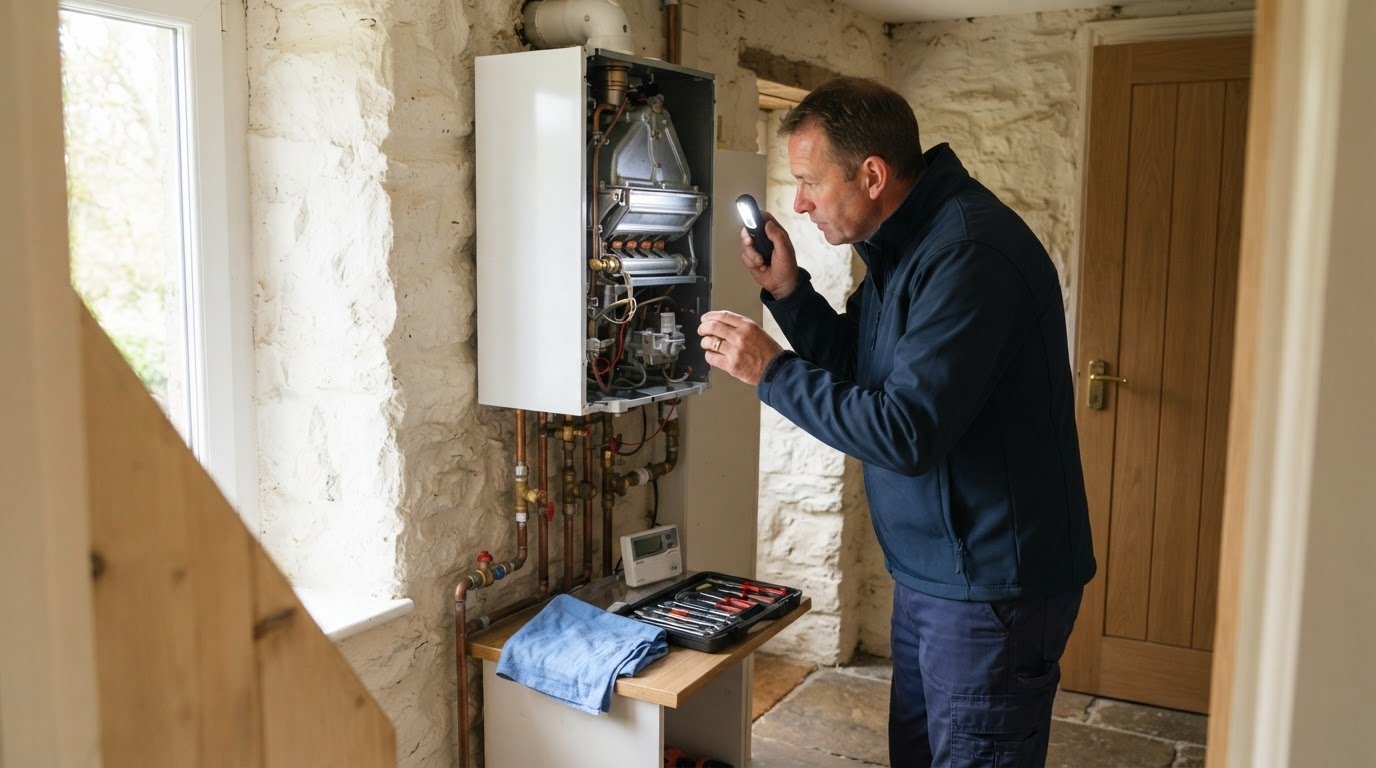
A boiler service combines maintenance with checks of the appliance’s condition and operation. During the visit, an engineer can inspect internal parts for faults, damage or dirt that needs cleaning, then clean the heat exchanger, burner and main components.
The service can also include testing safety devices and checking boiler controls and the heating programme. If a central-heating filter is fitted, the engineer can clean it. These checks can identify issues affecting heating or hot water and give you a clearer picture of the boiler’s condition before a tenant moves in.
Corrosion, Leaks, and Engineer Checks
A service includes checks for corrosion and leaks, along with an inspection of the flue for blockages. The engineer examines the boiler’s internal parts for damage or dirt, which may indicate a maintenance need or developing fault.
Gas boiler servicing should be carried out by a Gas Safe registered engineer. The engineer assesses the gas appliance and its flue as part of the service, rather than treating a visible boiler check as a full assessment. If an inspection identifies a fault, arrange appropriate repairs before relying on the boiler for a tenant’s heating and hot water.
Between tenancies, use the vacant period to address service findings and confirm the boiler operates as expected. For example, if the previous occupant reported intermittent hot water, tell the engineer so the issue can be assessed during the visit. A service does not replace the separate gas safety check, so keep both tasks in your tenancy maintenance plan.
For scheduled maintenance, professional boiler servicing can help assess the appliance and identify repairs that need attention before the next tenancy.
Best time of year to book a service
Late spring or summer is a practical time to arrange an annual boiler service. The heating system is usually used less, so you can plan maintenance before winter demand returns. Booking ahead also gives you time to address any issues identified during the visit, rather than discovering them when the heating is needed.
Choose a date close to the boiler’s annual service interval. For example, if the previous service took place in June, plan the next visit around that time of year. A consistent month makes records easier to follow and helps prevent the appointment slipping into winter.
Use the booking to organise the visit clearly:
- Set a date that leaves time to deal with any repairs before colder weather.
- Arrange access to the boiler and its controls, especially in a tenanted property.
- Confirm the appointment details and payment arrangements in advance.
A qualified, Gas Safe registered engineer can service the boiler and assess its internal components. Keep the service record with the warranty paperwork. If the manufacturer requires annual servicing, a dated record helps show when maintenance took place and creates a clear history of care.
Summer timing is useful, but don’t let the calendar delay attention to a fault. If the boiler develops a problem before its planned appointment, arrange an assessment rather than waiting for the next annual visit. Unusual operation or loss of hot water, for example, may need attention outside the routine schedule. Routine servicing is planned maintenance; repairs address a fault that has already appeared.
Book with the previous service date, tenancy arrangements and time for any follow-up work in mind. This keeps annual servicing manageable while leaving a buffer before winter. A regular seasonal appointment also makes it easier to coordinate access, keep records together and plan payment without rushing as colder weather approaches.
Recommended service frequency for rental properties
For a rental property, plan a boiler service annually and keep the interval consistent. Gas and oil boilers should be serviced within twelve months of their previous service. This gives landlords a clear routine across changing tenancies, rather than relying on a new move-in date to determine when maintenance is due.
Annual servicing is a practical recommendation, not a specific legal requirement for landlords in England. The separate gas safety check has its own legal schedule, so don’t treat a boiler service as a replacement. Keeping both dates in your property records makes it easier to see which maintenance is due and when.
Homeowners in the UK aren’t legally required to arrange an annual boiler service either. However, regular servicing remains a sensible way to maintain the appliance and follow manufacturer requirements. In a rental home, the landlord’s responsibility to keep heating and hot-water installations in repair makes a reliable service routine particularly useful.
Use the previous service date as your reference point. For example, if a boiler was serviced in September, schedule its next service within twelve months, even if the tenancy changes before then. Keep the service record with the property’s maintenance documents. If a fault appears between appointments, arrange an assessment rather than waiting for the next routine visit.
A straightforward record can include:
- The date of the latest service and the planned date for the next one.
- The boiler type, such as gas or oil, and any maintenance findings.
- Any recommended repairs and whether they have been completed.
This approach helps separate routine maintenance from repairs and statutory checks. To arrange a regular visit, book boiler servicing as part of your property maintenance plan.
Gas2Heat.com: Landlord Gas Safety Certificates
Gas2Heat.com Ltd provides Landlord Gas Safety Certificates for landlords arranging required checks on rental property gas appliances. Turn to this service when a gas safety check is due or when you need a record for your tenancy paperwork. A certificate and a boiler service have different purposes, so plan them as separate parts of your property maintenance.
For ongoing boiler care, Gas2Heat.com Ltd also provides boiler servicing and repairs. Servicing supports routine maintenance, while repairs address faults that arise between scheduled visits. If a boiler needs replacing, boiler installation is also available. Choose the relevant service based on whether you need a safety check, planned maintenance, a repair or a new boiler.
Contact Gas2Heat.com Ltd to discuss Landlord Gas Safety Certificates or the boiler work your rental property needs.
Make boiler care part of your property routine
Keep a simple maintenance record for each rental property. Store appointment details, engineer findings and follow-up work together, so future decisions are based on the boiler’s service history rather than memory. A consistent process also makes it easier to plan access and tell tenants when maintenance is due.
If you’re deciding how often a landlord should service a boiler, use the manufacturer’s instructions and the previous service date to guide your schedule. Treat a new fault as a separate issue, not a reason to wait for routine maintenance. Keeping those decisions clear helps you manage property upkeep with less last-minute uncertainty.
Gas2Heat.com Ltd can help with boiler servicing, repairs or installation, depending on what the property needs. Contact Gas2Heat.com Ltd about boiler servicing to discuss the next step for your rental property.
A clear plan makes ongoing boiler care easier to manage. Take the next step when it suits your property.
Frequently Asked Questions
How often should a landlord have a boiler serviced in the UK?
Arrange routine servicing annually, using the last service date to plan the next appointment. For example, if a boiler was serviced in autumn, schedule its next service around the same time the following year. This keeps maintenance records straightforward, even when tenants change. If a fault appears between appointments, arrange an assessment rather than waiting for the routine service.
Is an annual boiler service a legal requirement for UK landlords?
No. An annual boiler service itself isn’t a specific legal requirement for landlords in England. However, landlords remain responsible for keeping heating and hot-water installations in repair and working order. A gas safety check is a separate legal requirement for gas appliances and flues. Keep the service and safety-check records distinct, so each appointment has a clear purpose.
What are landlords’ gas safety inspection and certificate requirements in England, Wales, Scotland and Northern Ireland?
The UK-wide requirement described here is a gas safety check on each relevant appliance and flue at least every 12 months. The Health and Safety Executive says tenants must receive the record within 28 days of issue. Landlord compliance also includes carbon-monoxide detectors in rooms containing a boiler, fire or flue. Scottish rental properties may also be subject to energy-efficiency requirements.
Who is qualified to service a landlord’s gas boiler in the UK?
A gas boiler must be serviced by a Gas Safe registered engineer. Gas Safe registration is the relevant qualification for work on gas appliances, so it’s important to use an engineer registered for gas work. In Moffat, Dumfries, Lockerbie, Annan, Lochmaben, Thornhill, Gretna and Castle Douglas, Gas2Heat.com Ltd states: “All of our Engineers are full qualified with up-to-date certifications.”
What does a landlord boiler service include?
A service generally involves examining the boiler’s internal components, checking for corrosion or leaks, and inspecting the flue for blockages. The engineer may clean key components, test safety devices and assess the controls. If a tenant has reported inconsistent heating, for example, share that information before the visit so it can inform the assessment. Any repairs needed are separate from routine servicing.
How much does a landlord boiler service cost in the UK?
The price depends on the boiler and the work required, and is given after a quote request. Factors include the appliance type, its condition and whether the appointment involves servicing alone or additional repairs. A landlord gas safety check is a separate service, so clarify which work is needed when requesting a quote. That helps distinguish routine maintenance from a safety inspection.

Leave a Reply
You must be logged in to post a comment.