
Thermostatic radiator valves explained: how they control room heat
A thermostatic radiator valve controls room heat, not the radiator’s surface temperature. It senses the air around it and adjusts hot-water flow: setting 3 corresponds to approximately 20°C, while higher settings allow more heat into the radiator. This is the key to having thermostatic radiator valves explained in practical terms.
The numbered dial can look like a direct heat control, but it actually guides the room towards your preferred temperature. The right setting depends on the room and how you use it, so a bedroom may need a different setting from a living room.
Learn how a thermostatic radiator valve responds as a room warms or cools, what its settings mean, and how room-by-room control can help avoid heating spaces more than needed. You’ll also see what to keep clear around the valve so it can sense the room air properly.
Key Takeaways
- Use the dial as a guide to the room temperature you want, rather than as a measure of radiator heat.
- Choose settings to suit each room’s use, then give the temperature time to settle before adjusting again.
- Keep the valve head clear of curtains and other obstructions so it can sense the room air accurately.
- For more control over your heating, learn how smart thermostat installation can fit into your home’s system.
Do valve numbers refer to radiator temperature?
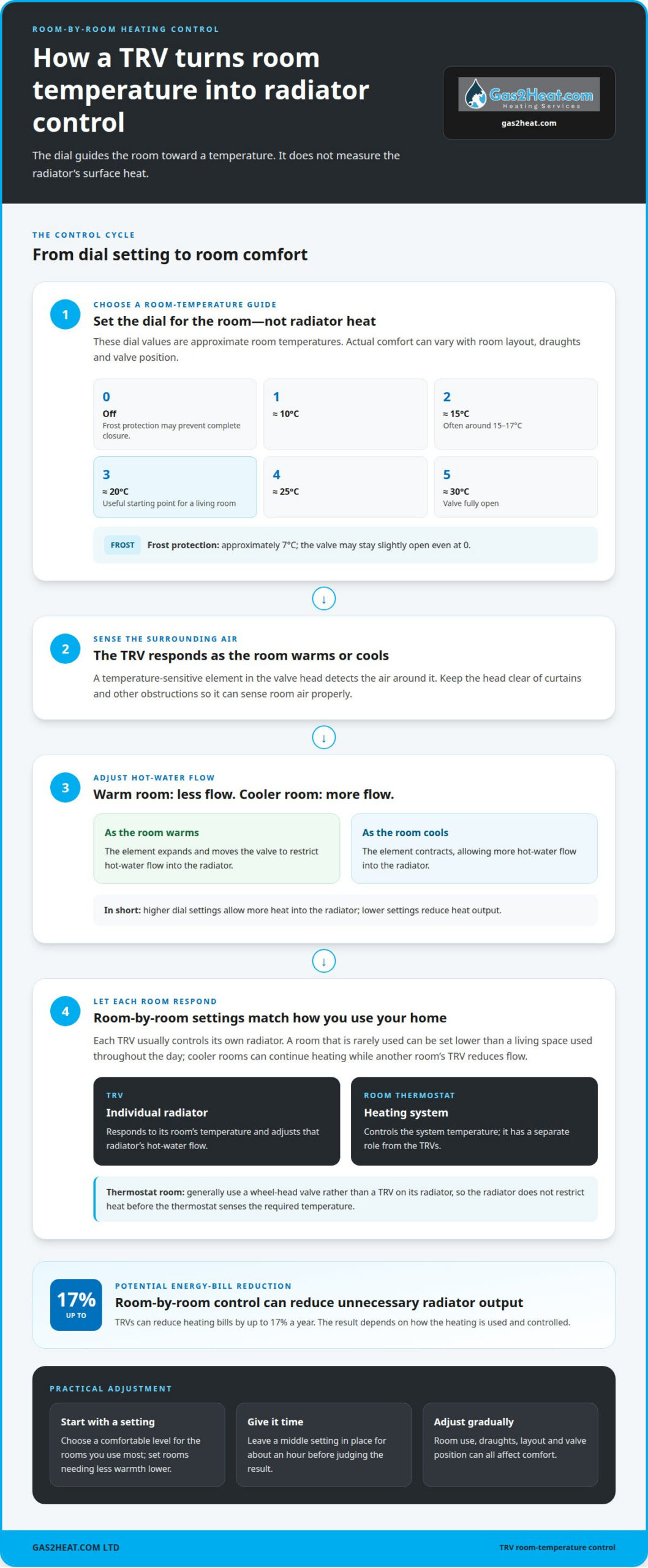
No. A thermostatic radiator valve’s dial refers to approximate room temperature, not the radiator’s surface temperature. Thermostatic radiator valves explained as room-temperature controls are easier to understand: the setting guides the valve’s response as the surrounding air warms or cools. Higher settings allow more hot water into the radiator; lower settings reduce heat output.
Typical dial settings provide a starting point:
- 0: off, although frost protection may prevent complete closure.
- 1: approximately 10°C; 2: approximately 15°C, often around 15-17°C.
- 3: approximately 20°C; 4: approximately 25°C.
- 5: approximately 30°C, with the valve fully open.
- Frost protection: approximately 7°C.
These temperatures are approximate, and room layout, draughts and valve position can affect comfort. Setting 3 is a useful starting point for a living room. Leave a middle setting in place for about an hour before judging the result, then adjust gradually. This approach to thermostatic radiator valves explained in everyday terms helps avoid treating the dial as a direct radiator-heat control.
The fitted cost depends on the valve and the work involved, including any pipework. The cost of a service depends on the specific job and is provided after a quote request.
Fit a TRV on the radiator’s hot-water inlet, where air can circulate around its head. Avoid fitting one in the room containing the main thermostat. In England, the UK Government approved Approved Document L of the Building Regulations in June 2022; it requires TRVs in new homes or when a boiler is replaced, except in the room containing the main thermostat.
If a radiator stays cold or heats unexpectedly, its valve may be sticking. Removing the controller opens the valve fully, while a qualified professional can assess a faulty valve body. Lubricating the valve piston annually may help prevent sticking.
How do thermostatic radiator valves work?
A TRV adjusts hot-water flow to an individual radiator as the room temperature changes. This differs from central heating controls, which determine when the system runs.
A single TRV usually controls its own radiator, not the entire central heating system. If every radiator closes without a suitable bypass and system interlock, such as a room thermostat, water flow can be affected.
TRVs and Manual Radiator Valves
A manual radiator valve opens or closes the flow by hand, while a TRV responds automatically to room temperature. A manual valve stays in its chosen position until someone changes it, so it won’t reduce heat as the room warms. In a TRV head, a temperature-sensitive element expands as the surrounding air warms, moving the valve body to restrict hot water. As the room cools, the element contracts and allows more flow.
TRVs with Thermostats and Programmers
A programmer sets when central heating runs, a room thermostat controls the system temperature, and TRVs adjust individual rooms. Together, they can provide scheduled heating with room-by-room control. The radiator in the room containing the system-controlling thermostat should use wheel-head valves, not a TRV, so the two controls don’t compete. A smart thermostat installation can support central heating control alongside radiator valves.
TRVs are available in mechanical, remote-sensor, tamper-proof and smart forms. A remote sensor measures room air away from the radiator, which can help if the valve head is obstructed. Tamper-proof versions limit casual adjustments. Smart radiator valves let you choose a room temperature and control the heating remotely through a smartphone app.
Each radiator has a control valve and a lockshield valve. The lockshield regulates water leaving the radiator and helps balance the heating system. Before fitting TRVs throughout a property, a qualified heating professional considers system balancing, a suitable bypass and the system interlock.
Turning a TRV to 0 may not shut it completely because frost protection can keep the valve slightly open. If a radiator stops heating, check whether its TRV is set low; a faulty or stuck valve may need attention. A removed TRV controller leaves the valve fully open.
Energy saving through room-by-room control
Room-by-room control lets each radiator respond to the needs of its room. Set each TRV to your preferred temperature, and it will reduce hot-water flow as the room warms.
Benefits of Room-by-Room Heating
Separate radiator settings help avoid heating every room to the same level. For example, you can set a rarely used room lower than a living space used throughout the day. When a room reaches its target temperature, its TRV reduces hot-water flow, while radiators in cooler rooms can continue heating. This makes your heating more responsive to how you use your home.
TRVs, Room Thermostats, and Reference Radiators
A room thermostat controls the heating system, while TRVs adjust the heat from individual radiators. Generally, the radiator in the thermostat’s room should not have a TRV, so its valve doesn’t restrict heat before the thermostat senses the required temperature. This radiator acts as the system’s reference point. An engineer can take the thermostat location and system controls into account when installing or adjusting TRVs.
Room Control and Energy Use
Using lower settings in rooms that need less heat can reduce unnecessary radiator output. TRVs can reduce heating bills by up to 17% a year, although the result depends on how the heating is used and controlled. A smart TRV adds remote room-temperature control through a smartphone app. It can be useful when schedules or room use change, but the room thermostat still has a separate role in controlling the heating system.
Using TRVs to Save Energy
Start with a comfortable setting in the rooms you use most, then choose lower settings for spaces that need less warmth. Let the room settle before adjusting again. Avoid turning down every radiator while relying on a room thermostat in a colder room, as the thermostat may continue calling for heat. With a balanced setup, each TRV regulates its radiator while the central control determines when the heating runs.
How thermostatic radiator valves regulate room temperature
A TRV senses the air near its head and adjusts hot-water flow through the radiator. Its position and surroundings affect how accurately it responds.
Sensing Room Temperature
A TRV head contains a temperature-sensitive element that responds to nearby room air. As the air warms, the element expands and moves a pin inside the valve body, reducing water flow into the radiator. When the room cools, the element contracts, allowing the pin to move back and more hot water to enter.
Position matters. A TRV fitted behind heavy curtains or beside a heat source may sense a different temperature from the rest of the room. Keep the air moving freely around the head so it responds to the room, not trapped warm air. The radiator pipework also determines where the control valve fits: it belongs on the inlet carrying hot water into the radiator.
Controlling Hot-Water Flow
The valve body regulates water entering the radiator, while the TRV head moves its internal pin as the room temperature changes. When the room reaches the selected temperature, the valve restricts flow. If the room cools, it opens to admit more hot water. The radiator’s heat output changes in response instead of staying at a fixed level.
This is an ongoing adjustment, not a one-time switch. For example, sunlight warming a room can cause the TRV to reduce flow, while cooler air later allows flow to increase. The boiler supplies heated water to the central heating system, but each TRV responds locally. A clear valve position and unobstructed head help the control work as intended.
If the room remains cold despite an open TRV, the cause may involve the valve, radiator or wider heating system. A qualified engineer can assess the components and water flow. If central controls also need attention, arrange smart thermostat installation to coordinate room temperature control with your heating setup.
Gas2Heat.com Ltd: Smart Thermostat Installation
Gas2Heat.com Ltd provides Smart Thermostat Installation for households looking to coordinate central heating controls with room-by-room radiator settings. It can be a useful next step when you want a more joined-up approach to managing heating.
If your boiler or heating system also needs attention, Gas2Heat.com Ltd offers Boiler Installation, Boiler Servicing and Boiler Repairs. The right service depends on whether you’re planning an upgrade, arranging maintenance or addressing a boiler fault. Contact Gas2Heat.com Ltd to discuss the heating support you need.
Make your heating controls work for your routine
Understanding thermostatic radiator valves in plain terms is a useful starting point. Next, notice how your home responds during everyday use: which rooms feel comfortable, where temperatures fluctuate, and whether your heating controls work together as intended. These observations can help you decide whether to adjust the controls or seek professional support.
If the issue goes beyond room settings, the wider heating system may need attention. Gas2Heat.com Ltd offers Boiler Installation, Boiler Servicing and Boiler Repairs, alongside Smart Thermostat Installation. The right service depends on whether you’re planning an upgrade, arranging routine maintenance or dealing with a boiler fault.
Choose a next step that suits the problem, rather than changing several controls at once. For advice about your heating system, contact Gas2Heat.com Ltd for heating advice. A clear plan can make your next heating decision feel more manageable.
Frequently Asked Questions
Do I legally need TRVs on my radiators?
In England, Approved Document L requires TRVs in new homes or when a boiler is replaced, except in the room containing the main thermostat. The UK Government approved Approved Document L in June 2022. This requirement does not mean every radiator needs a TRV: the main thermostat room is the stated exception. The rule described here applies to England.
What are smart TRVs?
Smart TRVs are electronically controlled radiator valves that let you set a room’s temperature through a smartphone app. For example, you can adjust a bedroom’s heating remotely instead of turning its radiator dial by hand. They control individual radiators, unlike a central heating programmer, which schedules when the system runs.
What is a smart TRV, and is it worth fitting one?
A smart TRV is a radiator valve with app-based room temperature controls. It may suit a household where room use changes often, such as when a home office is used only on some days. Whether it’s worthwhile depends on how useful remote adjustment and individual room settings would be in your routine. It does not replace suitable central heating controls.
Can I fit radiator valves myself, or do I need a plumber?
Replacing a valve head is different from replacing the valve body. Changing the head does not require draining the heating system, while replacing the body involves draining it and working on connected pipework. If the job involves the valve body, a leak or uncertainty about the system, use a qualified heating professional. The work required depends on the valve type and connection.
Can you replace a TRV without draining the system?
Yes, replacing the TRV head does not require draining the heating system. Replacing the valve body does, because it connects to the radiator’s water pipework. For example, if the dial head is damaged but the body is sound, the repair may only involve changing the head. The exact replacement depends on which part has failed.
Can you replace a TRV yourself?
You may be able to replace a compatible TRV head without draining the system, but changing the valve body is more involved. It requires draining the heating system and reconnecting pipework, so a leak or poor connection can affect the radiator. If you can’t identify the faulty part or match the replacement correctly, arrange professional help.

Leave a Reply
You must be logged in to post a comment.